
How Mike Hartline’s UK football playing career will help him as a Wildcats assistant coach
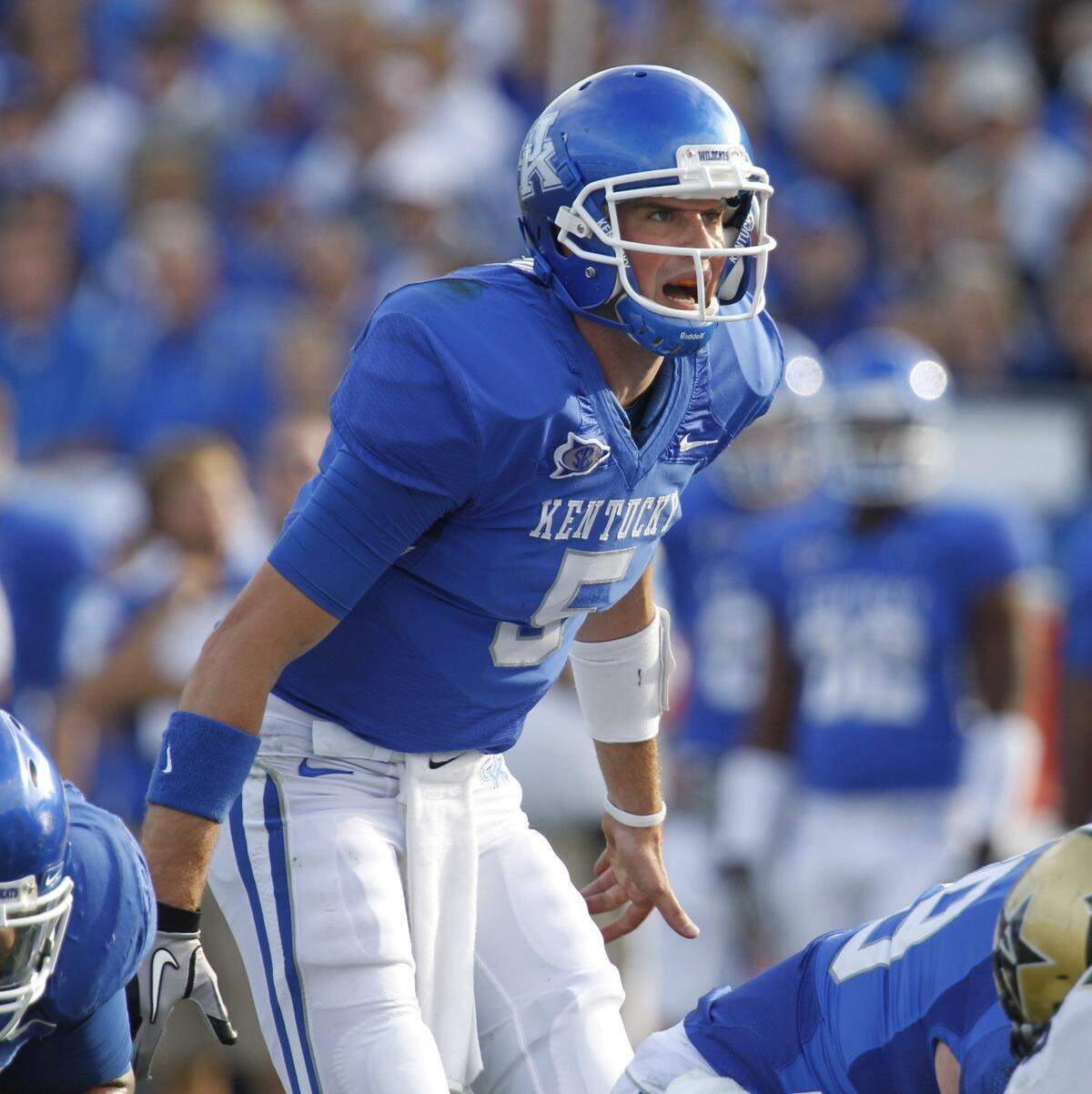
Not much about Kentucky’s football program looks the same as it did when Mike Hartline played his final game as a Wildcats quarterback in November 2010.
The stadium has been renamed after a $126 million renovation. Players and coaches work from a $45 million training facility that opened in 2016. Mark Stoops has improved the success of the program to a point that missing a bowl game last year was viewed as a significant disappointment rather than the general expectation.
“It’s just really awesome to see how much this place has grown and what Coach Stoops and his staff and teams have done to just keep elevating the program and what it does for the city of Lexington and the fan base,” Hartline told the Herald-Leader in an interview Tuesday, less than a week after he was announced as a new quality control coach on Stoops’ UK staff. “It’s just really heartwarming to come back and to see how much they’ve improved everything. It’s a good feeling. It’s kind of hard to put into words sometimes, but it’s just fun, elated to come back and to try to be a part of it again.”
After coaching stops at Ohio State, Cincinnati, Ohio Dominican, Auburn, Charlotte and Coastal Carolina, Hartline has returned to his alma mater. He is expected to work with UK’s quarterbacks, though his specific job responsibilities remain in flux. Hartline also has experience coaching wide receivers.
Hartline spoke with the Herald-Leader about his new role at UK, how his playing career is remembered and more. Here is a segment of that conversation.
On how this opportunity came about after a coaching career that has taken him to a bunch of different places already: “...That’s what coaching just does. Sometimes it just takes you wherever you need to go. And sometimes it’s a risk going here or doing that, but you roll with the tide. Always something when I first started was, everybody always asked, ‘Did you ever go back to your alma mater?’ And of course, it’s absolutely. It’s just you want to be in the right capacity, and you want to earn it. You want to feel like you’ve done enough to feel worthy to come back, not just being an alumni and being a player. It’s different now. … I have the ability to come back and be put in a good position to help these young men with the game and the program that helped build me and be a part of that.
“So, that’s always been in the back of my mind. But obviously, timing is important as well. So getting in touch with Coach Stoops a few years ago, just put feelers out there to them, telling them that I would definitely look into it. Obviously, it’s got to be the right fit for me. It’s not just, it’s my alma mater, and that’s it. Like, there’s got to be a good position that can utilize what I can do to help everybody, to help the staff, and that was the main focal point. Luckily, this year, there was an opportunity, and it was a good move for me and my family. And it was really a no-brainer. It just had to come down to the ins and outs of the details of it, but yeah, it’s awesome to be back.”
On how different quality control jobs look after the NCAA removed limits on on-field coaches last year: “Completely different. Schools can be a little bit limited sometimes with bringing guys in with grad assistant positions, analysts and all that stuff. So, this just kind of alleviates some of those parameters, I think, and it helps you come back and be a part of it in a good way. Now, I think it’s still a challenge to structurally figure out how everybody’s going to have a piece of it to ultimately be aligned with our vision of how the offense is going to go and how the defense is going to go. So, you got to be smart in that way. And I think we have good people here to align that and be structured with it. Because, as you know, if there’s too many hands in the kitchen, it’s hard to get things done. And so I think that’s a big piece of it, but it’s helped a ton. I mean, I think it’s helping a lot of people. It can go the other way and say, ‘Well, it’s not allowing for some guys that are young to come in and be grad assistants,’ but they’re still there if you want them. So, I think those opportunities have kind of opened the door to a lot of different things.”
On how familiar he is with Bush Hamdan’s offense: “I’m actually more familiar with it because I’ve worked with his quarterback coach that he had in Boise State, which was coach Brian Harsin. I worked with him before at Auburn, and the offense that he was running at Auburn, terminology, verbiage, how he coaches the guys, it’s not the same, but it’s similar. So the turnover there with being able to pick up the offense and learn how we’re being coached, it wasn’t 10 fold. It was pretty quick, and I can see the similarities there. It wasn’t coming in and learning a new system. I’ve already very quickly understood how he wants to do things. It’s just more or less being immaculate with it like every day. So, there’s connection there.”
On early impressions of UK’s rebuilt offensive roster: “From being an outsider from last year to the struggles to now, from what I hear in the building and what I’ve seen, I think it’s a better group. And when I say that, just a lot more connectivity. I think a lot more people that fit the program style, but it’s still unknown to me. We’ll still see. I think there’s a lot of guys that are capable. Maybe some of them that haven’t proved it maybe as much as some other newcomers, transfers and whatnot to the program. There’s some guys that have 600-700 snaps that are coming in and have played good college football. There’s some that are really good players. It’s just maybe they haven’t had the opportunity yet, being a second or third string, that we think the world of. It’s just, now it’s their time. So I think we feel better about that as a whole. But again, it’s more of putting it all together, that synergy through spring ball, through fall camp, and ultimately putting a product on the field that wins football games.”
On how he looks back on his UK career and the idea he was underrated: “Definitely will say it’s ups and downs. I mean, between not doing very well as an initial starter, between an injury, between having a pretty good year my last year, there’s definitely ups and downs. But I think that helped me ultimately become a better teammate, become a better player, and I think people need that. The hard part nowadays is people feel like they don’t have a lot of time, or they can make a quick change, and it’s a quick fix, and both of that is true. So the time spent, I think, was a huge piece of why I had success down the road. But also the adversity that hits randomly and sporadically, like it challenges you. There’s a lot of different challenges nowadays that players have to sort through, coaches have to sort through.
“I really just look back at the experience and say, I wouldn’t trade it for the world. I appreciate the struggles, and the successes were great. I wish we had some more. But I really wouldn’t change anything when it comes down to that rocky road, because I think it’s what just builds character and builds you. Embracing that a little bit more than most, I think it’s just the time that was to the time that is now.”
On if coming back feels like a chance to rewrite his UK ending after being suspended for the bowl game his senior season: “To be honest with you, I haven’t considered it in that way. Obviously, the rough end is just — it is what it is. I mean, people make mistakes, and you try to learn from it quickly, and you try to be better from it. And that happens to everybody.
“To me, this is a completely new path. And it’s a path of growth, and it’s a path to try to hopefully make an impact on guys that you sat right in their shoes and you sat right in the chairs of where they were. To me, it’s a chance to do it in a way that it’s different. It just is. I’ve had my time. I’ve had my experiences. I’ve had everything that I would want out of my experience, and now it’s trying to help these guys have the same experience and move the needle more toward their successes and our successes, as opposed to what did happen. I wouldn’t take anything back on my decision to come here, the road that it took me. In the end, I think it’s just something that you decide every day, however you want to look at it, what type of role model you want to be now. The helping piece of it is why I got in this profession. To be able to do it at your alma mater, I don’t think there’s a better way to do it. I think it’s an extra motivation to just be in a place that you love. And I think it’s a different motivation in that fact, as opposed to trying to write a different story.”
On how his experiences as a player influence his coaching style: “It’s just relatability. It’s just being able to be able to sit there and honestly tell guys that have been in your shoes like I understand why this particular thing is difficult, and here’s what helped me. Whether it helps them or not, whether it will help them or not, I think it’s something that can just bridge the gap quicker. I don’t by any means expect people to do what I did or don’t do what I did. You got to write your own journey, but I think the relatability part of being able to handle the pressure, being able to get all the glory when you do well and being able to handle all the criticism when you don’t, it’s just a part of the responsibility of the position. Trying to make things clearer in a very high responsibility, highly chaotic job description, I think is the way to put it. So, I think there’s nothing better than that.”
On if he can play a part now in making sure he’s not the last UK quarterback to throw for 3,000 yards in a season: “I’ll be 100% honest and nice really about that: I really don’t care. I care more about winning football games. I care more about these guys being leaders. When you talk about statistics, to me, it’s what’s your completion percentage as a quarterback and what’s your touchdown interception ratio? Are you throwing more touchdowns than you’re throwing it to the defense? Are you completing the balls to the guys that you need to to sustain drives? Those two things are the most important. I think, as far as just statistically, yards will take care of themselves. I mean, anybody can tell you, if we throw for 100 yards, rush for 300, probably gonna win the game. And I think in the end, winning is the most important thing, and it’s doing it in a collective, universal, unselfish way. If we can get to that point, then I think everything else will take care of itself.”