New KHSAA transfer rules allow greater freedom to varsity athletes who play less
AI-generated summary reviewed by our newsroom.
- KHSAA approved a transfer rule change for low-participation varsity athletes.
- New rule lets athletes with under 20% game time transfer without penalty.
- KHSAA closed a Bylaw 7 loophole affecting international student-athlete transfers.
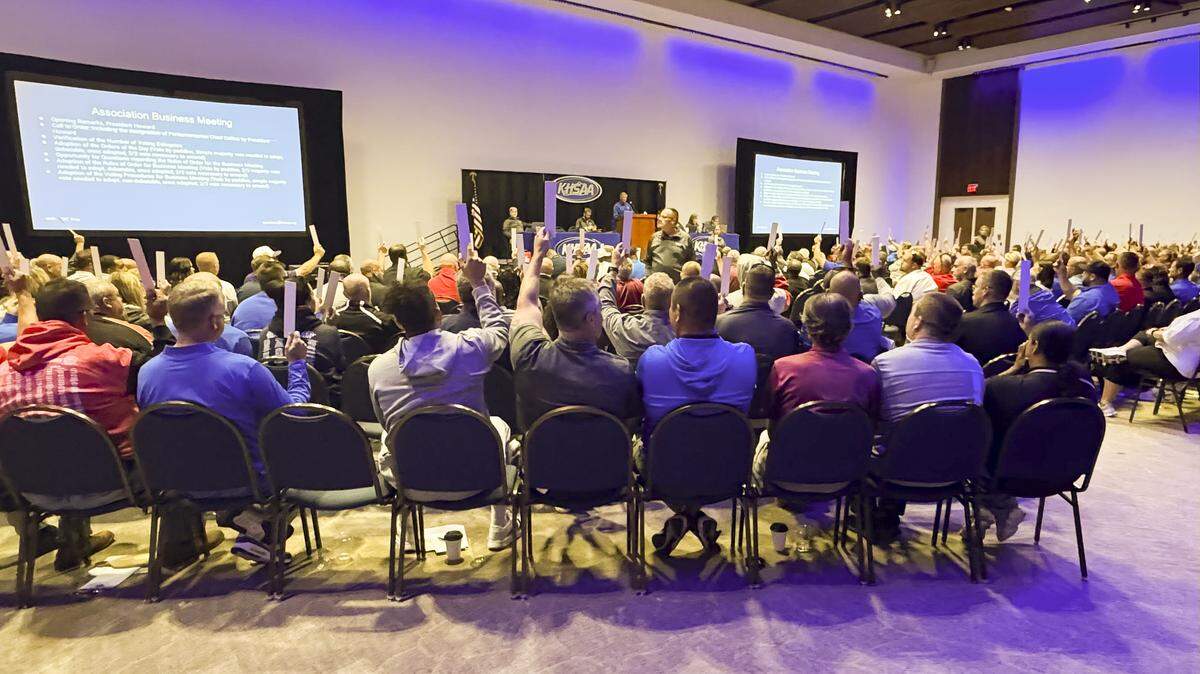
High school student athletes who don’t get much varsity playing time will see a greater freedom to transfer to a new school without losing eligibility under a new rule approved at the Kentucky High School Athletic Association’s annual full membership meeting Thursday at the Central Bank Center.
By a more than two-thirds vote of members present (168-59), the KHSAA’s school representatives approved a new exception to KHSAA Bylaw 6, regarding the transfer of varsity athletes from one school to another.
Under the provision that should go into effect for the 2026-27 school year, varsity athletes who play in less than 20% of their team’s regular season games in any prior school year as a freshman, sophomore or junior will be able to transfer to a new school and play without having to sit out a year.
That means a football player could play in two games in his prior season and be immediately eligible at a new school. For a basketball team playing the maximum of 36 regular season games as another example, the maximum number of games a varsity player could play before Bylaw 6’s eligibility rules apply would be seven.
Bylaw 6 holds that student athletes must sit out a year in their sport upon transferring to a new school, unless they meet certain exceptions, such as a genuine change of address.
The new allowance does not change existing exceptions to Bylaw 6. It also does not apply to seventh- or eighth-grade varsity players, because Bylaw 6 doesn’t govern them, and thus they have complete freedom of movement before starting their freshman years.
The change to Bylaw 6 and another change to Bylaw 7, regarding international transfer students, came as part of an ongoing review of the high school athlete transfer process that the KHSAA Board of Control continues to work on at the behest of the Kentucky General Assembly.
During the last legislative session, a proposed bill aimed to allow complete freedom of movement of varsity athletes without any loss of eligibility, a situation Bylaw 6 is specifically targeted to prevent because of fears that completely free transfers could create unfair competitive advantages for some schools.
“When the board looked at it in September, they really tried to make sure the purpose was clear. It’s not trying to open the floodgates,” KHSAA commissioner Julian Tackett said after the membership vote. “It’s trying to maybe get kids who probably shouldn’t be subject to (Bylaw 6) out of the filter and focus on the athletic advantage aspect.”
The number of transfers the KHSAA and its member schools have to process has risen dramatically in recent years, especially with the advent of school choice and the near-complete removal of transfer limitations at the collegiate level. Across the nation, 10 states now allow at least one free transfer by their high school student athletes, including neighboring Indiana.
“So many of our members are so opposed to a free transfer, they’ll try something that maybe chips away at the problem, which is the wrong kids being ineligible,” Tackett said. “I think we’ve still got issues. In-season transfers are a big issue. And people still get mad at a coach (and) try to transfer. So we’ve got to try to make sure we keep the door closed where it needs to be closed and open where it needs to be open.”
Before the vote, Tacket told school representatives that this was a step in the process of looking at ways to improve the transfer process and not a final measure.
Rep. Nick Wilson, R-Whitley County, offered the transfer rule bill in the Kentucky House, but later withdrew it in favor of a resolution seeking a detailed report from the KHSAA on its transfer process. That report remains underway and is expected to be presented within the year.
Wilson praised the KHSAA after its membership vote Thursday.
“I appreciate the KHSAA for taking steps to address the concerns I share with so many parents and students about this issue,” Wilson said. “As we move forward, I will continue to work with them and monitor how this policy is implemented and how it impacts student athletes.”
Tackett acknowledged there could be abuse of the new rule by coaches who play athletes who at the minimum level just to dissuade transfers. Such circumstances have existed for years with players only having to pinch run in baseball or play a single football snap to trigger Bylaw 6. Athletes who suspect such abuse of the rule can file appeals, Tackett said.
The Bylaw 6 change that was approved made another proposal that would have applied only to varsity student athletes who had not yet started 10th grade moot. That provision also had a 20% varsity participation factor.
In another vote, the KHSAA closed a loophole in Bylaw 7 regarding international students on F-1 visas who are allowed to stay for their entire high school careers at some private schools. Such students, if they are part of an approved academic program, had retained their athletic eligibility regardless of whether they transferred from one private school to another.
After a 204-13 vote, the new rule will require those international student-athletes to sit out a year in their sport if they transfer schools, thus applying the same rules to them as domestic students.
This story was originally published September 18, 2025 at 6:52 PM.