Growing up, ex-UK player ‘didn’t like the police at all.’ Now, he’s a police chief.
As a child growing up outside Atlanta, Eric Scott dreaded family interactions with the police.
“I didn’t like the police at all — but I never knew why,” Scott says.
What Scott did know is that, anytime his parents were pulled over for a traffic stop, the atmosphere in the family car turned hyper-tense.
“My mom and dad would act different. I remember that tension,” Scott says. “My dad, I always saw him as this very strong person. But (speaking with police), I would see him, like, change his voice. He talked different. I remember thinking to myself, ‘Why is he doing this?’”
In due time, Walter Scott II explained to his son why his demeanor changed when dealing with law enforcement officers. His message was, when you are Black, not being ultra-polite when stopped by police could carry grave risks.
“Growing up, when I thought of the police, I just had this sense of fear,” Eric Scott says.
Back then, the idea that Scott would one day earn his living by wearing a badge — would become a chief of police while in his mid-30s — would have been unfathomable.
From pigskin to policing
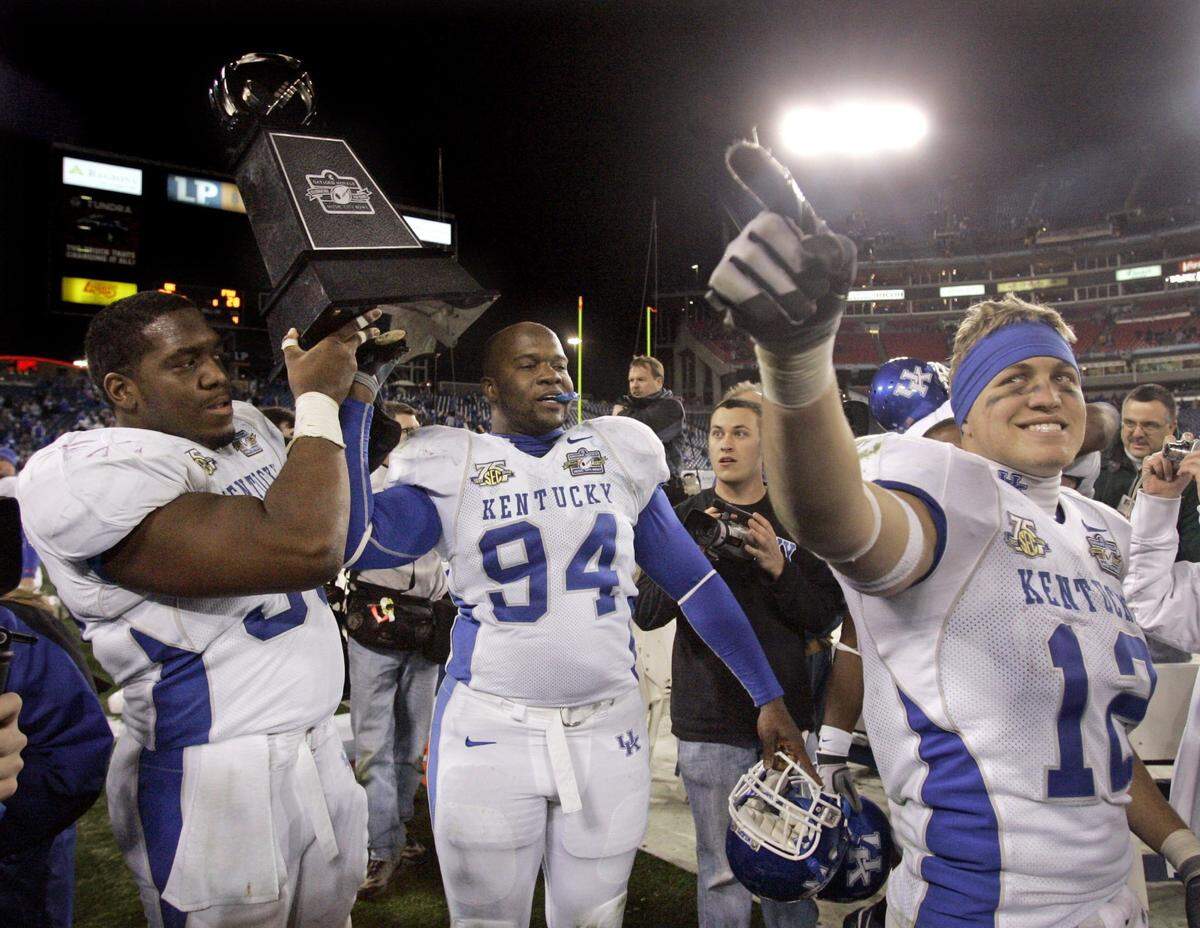
Football brought Eric Scott from Marietta, Ga., to Kentucky in 2003. The fullback/tight end signed with UK as part of Rich Brooks’ first recruiting class as the Wildcats’ coach.
In Lexington, Scott went to work in the weight room, packed on some 60 pounds and transformed into an offensive lineman.
As a senior in 2007, Scott was the starting center in front of quarterback Andre Woodson as UK upset No. 1 LSU and No. 9 Louisville and defeated Florida State in the Music City Bowl.
When a subsequent shot with the NFL’s Tennessee Titans did not yield the enduring pro football career to which Scott aspired, he returned to UK contemplating graduate school.
Instead, at a campus job fair, he encountered a familiar face who changed his life.
As a University of Kentucky policeman, Kevin Franklin had traveled on road trips with the UK football team when Scott was a player. The two formed a bond.
At the job fair, Franklin encouraged Scott to seek a job on the UK police force.
The guy who “didn’t like the police at all” growing up spent the ensuing weekend watching the TV show “Cops” to get a feel for a policeman’s life.
Scott decided to apply, launching a 10-year stint with the UK police that saw him reach the rank of lieutenant.
“But I realized if I ever wanted to make systemic change in law enforcement and implement policies and procedures and hiring practices that would really change the culture of policing, I had to get to the top level,” Scott says. “And that is the chief of police.”
Berea police chief
In pursuit of becoming a top cop, Scott applied the same vigor to educational self-improvement he’d shown in the football weight room.
To buttress his UK undergraduate degree in communications, Scott added a master’s degree in organizational leadership from Western Kentucky; an associate’s degree in criminal justice/safety studies from the University of Virginia; and completed a course at the FBI National Academy.
When Scott applied for the vacant Berea police chief position last year, one might have surmised his UK football pedigree would have given him an advantage.
Berea Mayor Bruce Fraley had been a Kentucky football season-ticket holder throughout the Brooks coaching era (2003-2009).
Alas, Fraley did not recognize the name “Eric Scott” as job applications came in.
It was Scott’s ability to connect with city leaders over two rounds of interviewing and sell an enthusiastic vision of what the Berea Police Department could be that won him the job, Fraley says.
“Eric had plans for the future as far as the way he would like to see a police department evolve and be community-oriented as well as different ways of handling problems and preventing crime,” Fraley says. “He also was clearly committed to education and self improvement. Eric was just extremely impressive.”
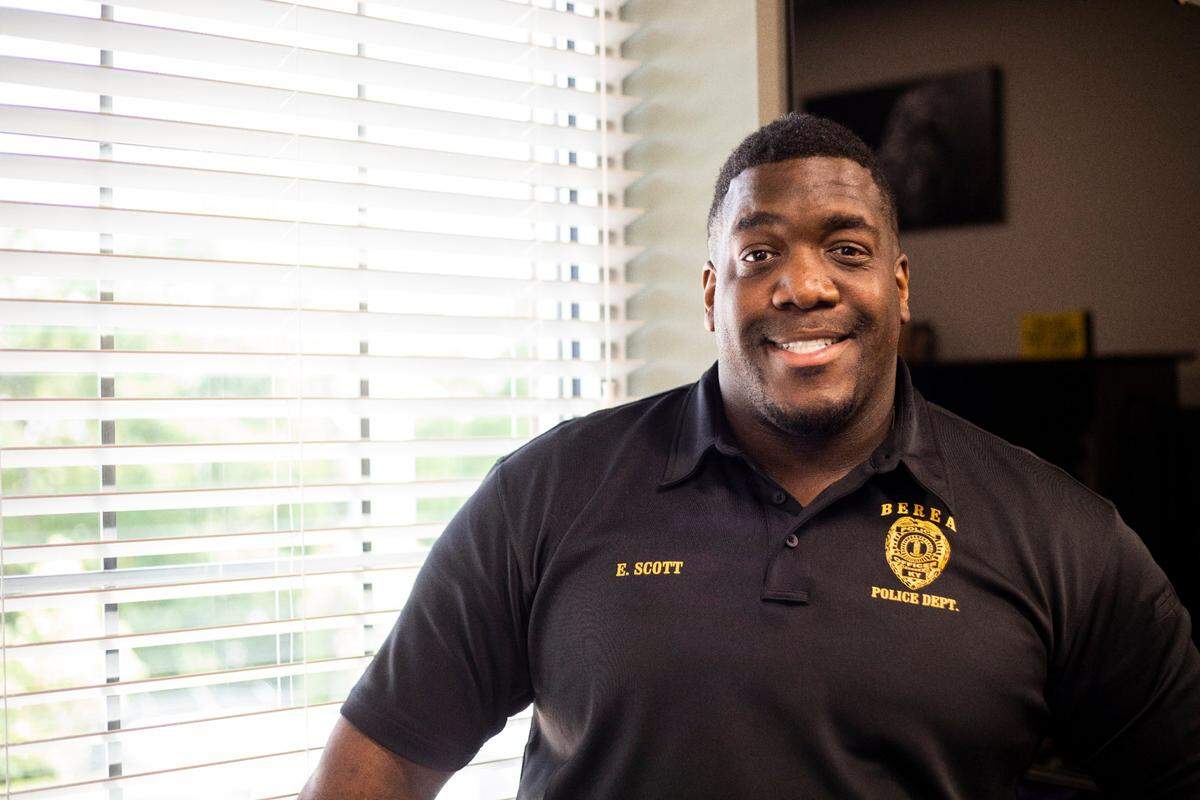
In October of last year Scott started as police chief in Berea, which has a population of some 16,000. When Berea College is in session, the town adds roughly 1,600 students.
Scott, 36, oversees a department with 37 employees, not all of whom are sworn officers.
Even in a small town, there are vexing policing challenges. Scott’s goals in Berea start with assisting those victimized by domestic violence and finding an effective approach to combat drug addiction.
To help those in dangerous home situations, Scott plans to launch a self-defense course designed primarily for women.
“It is going to be about empowerment, not just how to defend yourself but how to empower you and give you the tools to know you are not alone, you do not have to deal with a domestic situation (alone),” Scott says. “It will be a step program and once they are done, they will graduate and we will keep in touch with them.”
A partnership with the local health department is central to Scott’s plan for slowing the scourge of opioid addiction.
“We’re going to start doing block parties in communities, going into communities that are troubled, that are getting riddled with drugs,” Scott says. “We are going to let people know, ‘This neighborhood is off limits now.’ But I want the health professionals there to help us with the addiction component.”
Race and policing
After the unrest that has swept American cities following the death in May of George Floyd, a 46-year-old Black man, during an attempted arrest by four white Minneapolis policemen, Scott believes the only way forward is for police departments to open new lines of communication with Black communities.
“The police have to go into communities and get to know the people and break down barriers,” Scott says. “In my own past, it took me having one (policeman) who was assigned to my football team (at UK) and one who was assigned to my high school (as a resource officer) for me to say, ‘These people aren’t bad.’ And that was because (those two policemen) got to know me and I got to know them.”
Married to his middle school sweetheart, Veronica, Scott has three daughters — Victoria, 18, Madison, 10, and Olivia, 8. In an idealized future, Scott says he would like to end up living somewhere where the weather is warm all year.
Over the near term, “I have a bunch of goals in getting the (Berea Police) Department to where I think we can be — the best agency in the state, especially for a small-town police department,” he says.
Not counting college students, Berea’s Black community makes up only 3.7 percent (2019 U.S. Census Bureau estimate) of the town’s population.
If Scott wants the challenge of testing his ideas for enhanced police/Black community relations in a bigger city with a more diverse citizenry, his current career arc seems likely to provide him that chance.
“Eric has a bright future,” says Fraley, the Berea mayor. “Hopefully, we can keep him here. But I think he is the type of person who can do anything he wants to.”
This story was originally published July 26, 2020 at 8:34 AM.