One team has shown how you ground Mike Leach’s Air Raid. Can UK copy that plan?
When Kentucky’s Mark Stoops looks across the playing field Saturday night at his head coaching rival, he will see a familiar face on the Mississippi State sideline.
The arc of Mike Leach’s coaching career was turbocharged when Bob Stoops, Mark’s older brother, hired the now-MSU head man off of Hal Mumme’s UK coaching staff in 1998 to bring the Air Raid offense to Oklahoma.
That high-profile gig as OU’s offensive playcaller eventually launched Leach into the head coaching ranks at Texas Tech, Washington State and, now, Mississippi State.
“I’ve known Mike for a long time,” Mark Stoops said Monday on his weekly Zoom news conference. “You know what Mike can do offensively. He’s as good as it gets, very creative, puts a lot of pressure on you.”
You might think that Leach and his high-octane aerial attack — MSU is leading the nation in passing yards a game (468) — is the last thing a struggling UK secondary needs to face right now.
That might prove true.
But there is a coaching blueprint for how to defend Leach and his version of the Air Raid that served to consistently foil the coach’s offenses during his tenure (2012-19) at Washington State.
Call it “the Washington plan.”
In the last seven years that Leach’s Washington State teams faced the Washington Huskies in the battle for The Apple Cup, the Cougars’ offense never scored 20 points in a game.
What resulted was a steady diet of WSU losses to its archrival by scores such as 27-17, 31-13, 45-10, 45-17, 41-14, 28-15 and 31-13 last season.
It got so lopsided, then-Washington defensive coordinator — and now the Huskies’ head coach — Jimmy Lake took to publicly taunting Leach.
“They do the same thing year in, year out,” Lake said after the 2018 Washington win over Washington State. “… It makes it really easy to game plan. Hopefully (Leach) remains here a long time. That would be awesome.”
If you are wondering how Washington so throttled Leach’s Air Raid, in layman’s terms, it was by using only three defenders to rush the quarterback and dropping the other eight into zone pass coverage.
As those of us know who are old enough to remember when Mumme and Leach brought the Air Raid to Kentucky, the offense is predicated on hitting playmakers in stride with short passes and letting them turn “the dinks and dunks” into explosive plays.
By dropping eight into coverage, what Washington did against Washington State was keep all those short passes in front of the defense.
The theory is that, if you prevent big plays and force Leach’s quarterback to make a high volume of short throws, it increases the likelihood of something bad — like interceptions — eventually happening for the offense.
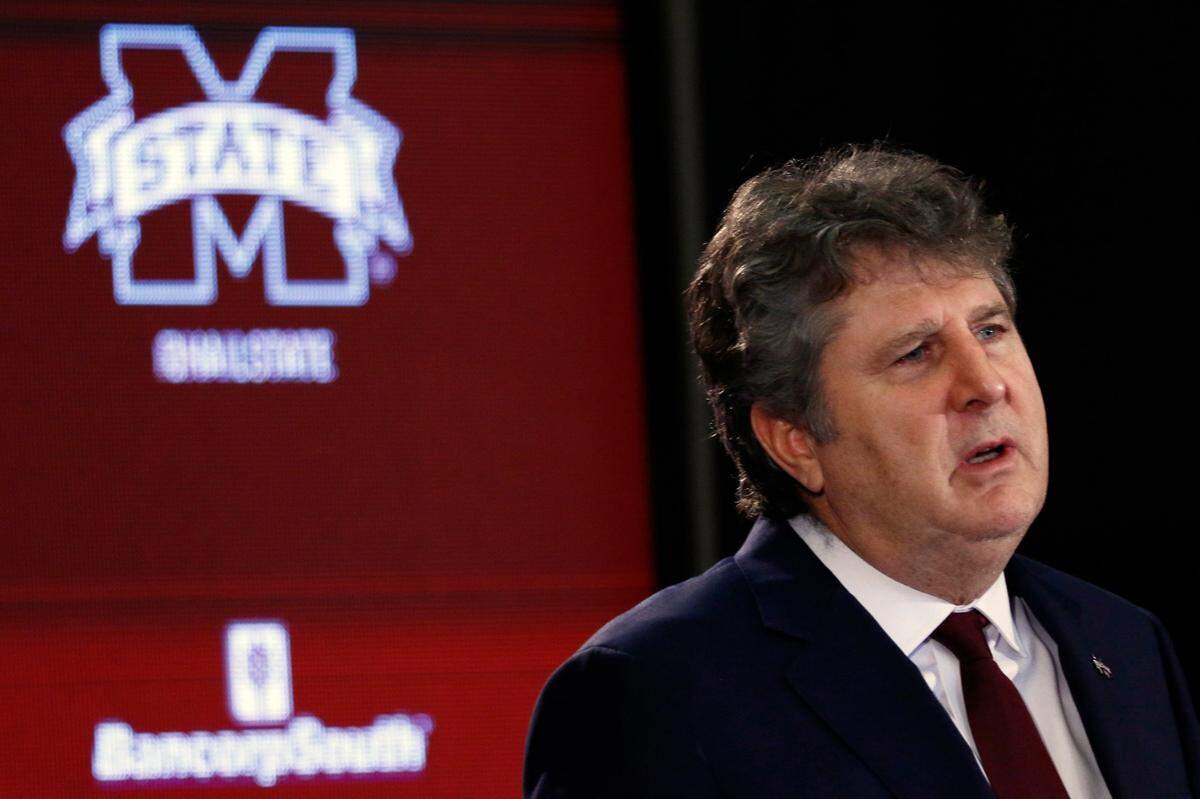
When it was announced that MSU had hired Leach, the debate immediately commenced over whether his Air Raid could work in the 2020s version of the SEC.
Obviously, two games is too small a sample size to render any meaningful answer. What evidence we have is in conflict.
When Leach and MSU torched defending national champion LSU for 623 passing yards and five touchdowns in a 44-34 season-opening upset, the Tigers employed a lot of man-to-man coverage — and Mississippi State made them pay.
However, when Arkansas snapped a 20-game SEC losing streak by stunning MSU 21-14 in Starkville last weekend, new Razorbacks defensive coordinator Barry Odom seemed to draw from the Washington defensive playbook — dropping eight and playing a lot of zone.
Though Mississippi State threw the ball a whopping 59 times, the Bulldogs accumulated “only” 313 yards of passing vs. Arkansas.
While Mississippi State completed 43 passes, the Bulldogs’ leading receiver, freshman running back Jo’quavious Marks, caught 10 passes that went for only 50 yards vs. the Razorbacks.
Odom’s defense set the tone for the game when Greg Brooks intercepted a K.J. Costello pass and returned it 69 yards for a touchdown that gave Arkansas a 7-0 lead.
Appearing afterward on the SEC Network as an analyst, a certain Head Ball Coach predicted that Leach is going to get a steady diet of “the Washington plan” from SEC defensive coordinators until he shows he has a strategic counter.
“They got a different defense (compared to LSU),” Steve Spurrier said of what Mississippi State faced vs. Arkansas. “… Barry Odom, the defensive coordinator at Arkansas, he put in coverage that basically (Washington) played against Washington State all the time.
“That’s the defense, I think, that Mississippi State is going to see the rest of the year. I don’t think you can win on a whole bunch of 5-yard passes.”
So when UK and MSU kick off Saturday at 7:30, it will be fascinating to see if a scuffling Cats defense — having so far not forced one turnover this season — can do to Mike Leach’s Air Raid what Washington used to do to it with regularity.