In switching conferences, a restless EKU takes on a big risk
Eastern Kentucky University prematurely posted the news of its departure from the Ohio Valley Conference to join the ASUN on its athletics website days before Friday’s official announcement.
Even if it hadn’t, the word that EKU is leaving the Ohio Valley Conference would not have been a shock.
Eastern pulling away from the OVC has felt like an ongoing process.
In the prior decade, the previous Eastern administration aggressively pursued a bid to join the Sun Belt Conference — an invitation that was ultimately extended to Coastal Carolina in 2015 — as part of its aspirations to move the Colonels’ football program from the FCS to the FBS.
During the current school year, EKU’s relatively new administration went its own way when the OVC’s response to the coronavirus pandemic was to move its football season to the spring semester.
The Colonels, instead, set up their own schedule for the fall and played 2020 as a football independent.
If you grew up following college sports in the commonwealth, it is hard not to be a bit wistful over Eastern’s plans to depart the OVC. The Ohio Valley Conference was born in 1948 as a Kentucky-centric league, its founding members Eastern Kentucky, Evansville, Louisville, Morehead State, Murray State and Western Kentucky.
Once EKU officially departs for the ASUN on July 1, the OVC’s Bluegrass State contingent will be down to Morehead and Murray.
Is this a good move for Eastern?
I’d say there are short-term risks with the potential for long-term gains.
The downsides are obvious.
In leaving the OVC, EKU is untethering itself from its sports tradition.
Roy Kidd’s 17 playoff and two national championship football teams; the Erdmann family coaching dynasty that has produced 78 league championship track and cross country teams; Eastern’s stirring men’s basketball runs through the 2005, 2007 and 2014 league tournaments to earn NCAA tourney journeys.
All that EKU lore is tied to the OVC.
In the 1970s, the annual battles between Eastern Kentucky and Western Kentucky formed the most intense college sports rivalry in the commonwealth.
However, after WKU left the OVC in 1982, Western-Eastern has never been the same. So you wonder what will happen with Eastern’s long-standing intrastate rivalries with Morehead and Murray.
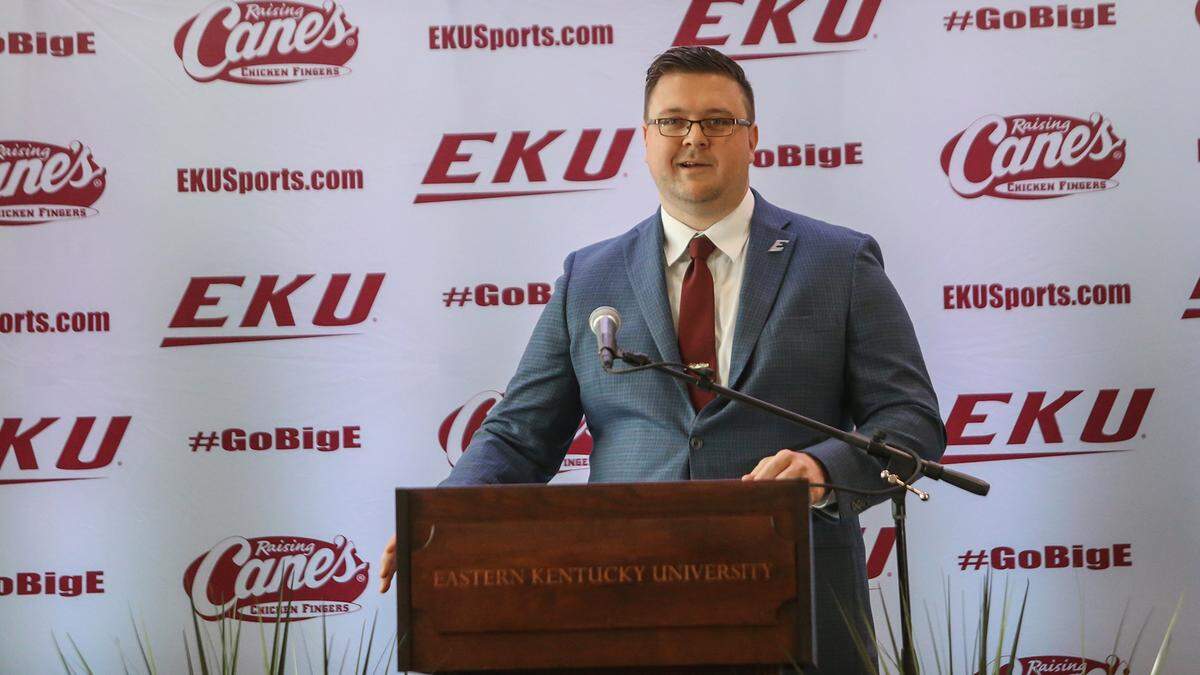
“I don’t think there is anything exclusive about us maintaining those rivalries and us joining the ASUN,” EKU Athletics Director Matt Roan said Friday on a Zoom call. “I think those things can be integrated. We can continue to have historical rivals come here and go on the road and play at their places.”
In a time when the pandemic has pushed college athletics budgets to the brink, EKU is leaving a league where all 11 of the other schools are within 367 miles of Richmond.
In the ASUN, Eastern will be competing in a league in which five schools are more than 590 miles from EKU — Florida Gulf Coast (944 miles), Stetson (775), North Florida (699), Jacksonville (695) and Central Arkansas (595).
On the plus side, Eastern sees a marketing potential that reaches beyond sports in joining the ASUN. Once the expansion is complete, the ASUN’s 12 schools will be spread among Alabama, Arkansas, Florida, Georgia, Kentucky, Tennessee and Virginia.
“It’s an opportunity to expand our reach and make an impact in areas (where) we have not traditionally shared EKU’s story,” Eastern President David T. McFaddin said Friday.
Though many have assumed that a conference switch by Eastern would be primarily motivated by seeking a pathway to FBS football, that does not appear to be the case here.
The ASUN is adding football, with league newcomers EKU, Jacksonville State and Central Arkansas joining existing members Kennesaw State and North Alabama as the core of what is planned to be an FCS league.
“We have an opportunity to be a founding member in what we intend to build into the … number one FCS football conference in the country,” Roan said.
While it will not boast the history of EKU-Morehead State, Eastern will have an intrastate rival in the ASUN.
Bellarmine is currently in its first season in the league. The Louisville private university is transitioning from NCAA Divison II to Division I.
Given how effectively men’s basketball coach Scott Davenport promotes the Knights’ program, it seems likely EKU will reap a bonanza of media exposure in the Louisville market from playing Bellarmine regularly.

Bottom line: For an institution, as with a person, sometimes making a change and accepting a different challenge proves energizing.
The bond between Eastern Kentucky and the OVC has long seemed to be tearing asunder. In the ASUN, EKU officials say they have found a league whose vision of the future matches their own.
The conference switch “is about growth and opportunity,” Roan said. “At EKU, we pride ourselves on being a regional, comprehensive institution. We pride ourselves on being a mid-major athletics department.
“I think our vision, both institutionally and athletically, is to become premier in each one of those categories. Our alignment in the ASUN provides that (chance).”
This story was originally published February 1, 2021 at 5:28 PM.