How Kentucky’s athletics super power turned into a weakness
In the aftermath of Tuesday morning’s Champions Blue board meeting, University of Kentucky publicist Jay Blanton noted that, until now, UK had not conducted a search for a new athletics director in almost a quarter of a century.
The search that yielded outgoing Kentucky athletics director Mitch Barnhart commenced in 2002. With Barnhart set to step down June 30, UK president Eli Capilouto said Tuesday he is winding down a “listening tour” in which he has spoken to more than 70 people to gather ideas on the qualities needed in the next Kentucky AD.
Since it has been so long since UK has hired an athletics director, I asked Blanton what the process for actually making the hire will be.
“It is the president’s choice,” Blanton said. “... It is ultimately his decision that the (AD) reports directly to him, traditionally is part of our cabinet. So that is his decision. But he will consult with lots of people.”
That it has been so long since the University of Kentucky conducted a search for a new athletics director underscores the unusual level of stability in its most high-visibility positions that has defined UK athletics in the past decade-plus.
Barnhart has served as UK AD since 2002. John Calipari served as Kentucky men’s basketball coach from 2009 through 2024. Mark Stoops was the Wildcats’ football coach from 2013 through 2025.
In the entire time Barnhart has been Kentucky athletics director, he has worked for only two university presidents, Lee T. Todd (2001 through 2011) and Capilouto (since 2011).
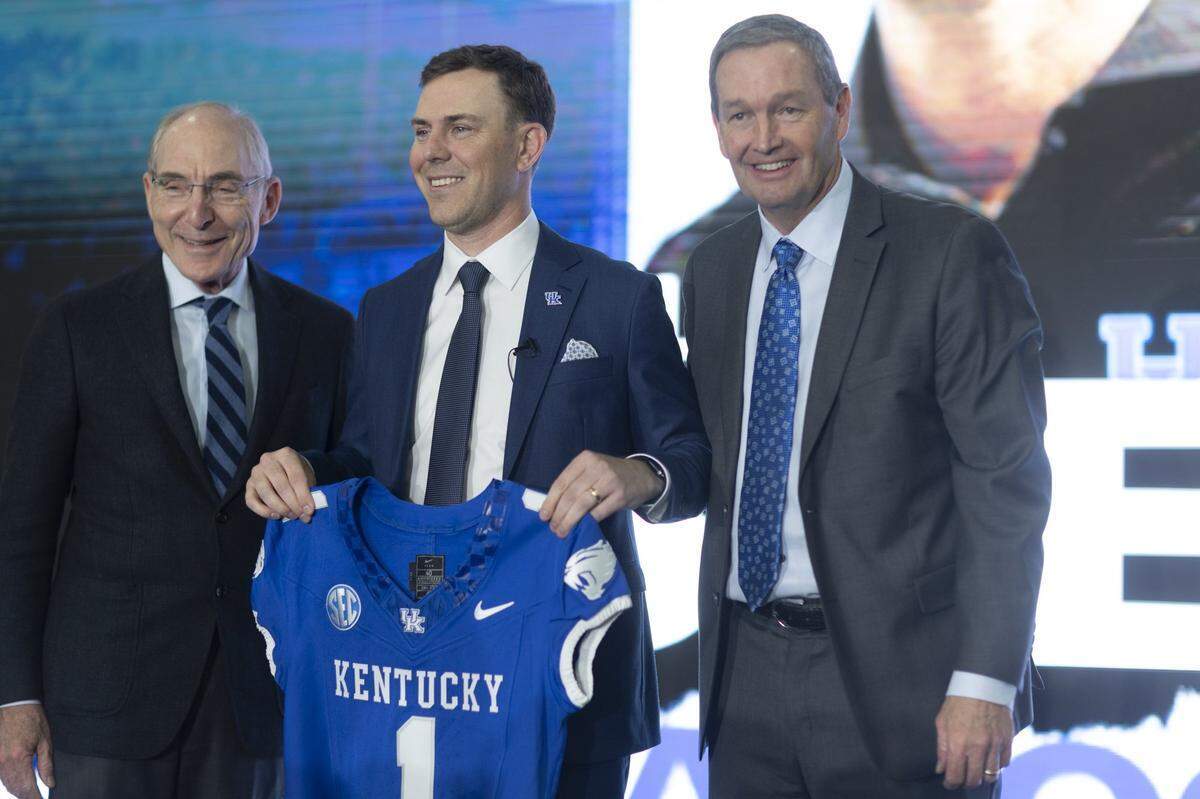
In the current era of college sports, such continuity at the top is almost unheard of. One need only look at two of UK’s biggest sports rivals to see how unusual Kentucky has been.
Since Barnhart was hired at UK in 2002, the University of Tennessee has employed:
• Six different university chancellors (counting two on an interim basis);
• Seven different athletics directors (counting one on an interim basis);
• Eight different head football coaches (counting two on an interim basis);
• Five different head men’s basketball coaches.
Meanwhile, an example of the destabilizing impact that scandals and controversies can have on a university can be found 81.4 miles west of Lexington on the campus of the University of Louisville.
Since 2017, U of L has employed:
• Six different university presidents (counting three on an interim basis);
• Three different athletics directors;
• Five different head football coaches (counting two on an interim basis);
• Six different head men’s basketball coaches (counting two on an interim basis).
For much of the past decade-and-a-half, stability seemed to be the super-power of Kentucky athletics.
From his hiring in 2009 until the coronavirus pandemic in 2020, Calipari led UK men’s basketball to five SEC regular-season titles, six SEC tournament crowns, seven NCAA Tournament Elite Eights, four Final Fours and the 2012 NCAA championship.
After UK stuck with Stoops through three losing seasons to start his tenure, he led Kentucky football to a school-record eight straight bowl games, seven winning seasons and a pair of 10-victory campaigns (the second of which was subsequently vacated by the NCAA for rules violations in the UK program).
Meanwhile, Barnhart slowly built the University of Kentucky’s athletics prowess to unprecedented heights. Starting in 2016-17, UK finished in the top 20 in the Learfield Directors’ Cup — a measurement of a university’s overall athletics success — for six straight years. Included were two top-10 Directors’ Cup finishes for UK, 10th in 2016-17 and ninth in 2021-22.
Alas, the stability upon which so much Kentucky athletics success was built eventually seemed to morph into something akin to stagnation.
After the coronavirus pandemic, Calipari never won an SEC regular season title, went 1-4 in the SEC Tournament, 1-3 in the NCAA tourney and, finally, sent himself into exile at Arkansas after the 2024 season.
Over his final four seasons, Stoops went 23-27, 9-23 in SEC games, and was fired after his 2025 team lost its final two games at Vanderbilt and at Louisville by a combined score of 86-17.
Meanwhile, the UK all-around sports prowess that has been the signature achievement of the Barnhart era has slipped, with Kentucky finishing 32nd (2023-24) and 30th (2024-25) in the past two Directors’ Cup standings.
The lesson to be learned is not that stability is not important in college athletics. Those agitating to have Mark Pope’s third season as UK men’s hoops coach defined as make-or-break after he produced a good first year and a so-so second season should be careful.
One sure way to sports irrelevancy is to enter a constant cycle of changing coaches.
Still, what can be gleaned from the decline in Kentucky’s sports fortunes at the end of long runs by the Wildcats’ most-visible leaders is that, except in rare cases, there seems to be a shelf life on one’s effectiveness in such jobs.
The unusual continuity in its most high-profile positions served University of Kentucky athletics exceedingly well — right up until it stopped doing so.