U.S. Senate bill to ‘fix’ college sports is no boon for UK, other SEC schools
Count me as a “no” on the “Protecting College Sports Act of 2026.”
While there are some provisions in the bipartisan U.S. Senate bill, co-sponsored by U.S. Sens. Ted Cruz, R-Texas, and Maria Cantwell, D-Washington, that merit support, the clear dealbreaker for me is that the bill proposes to cap salaries for college athletes without their consent.
Philosophically, I am opposed to salary caps, period. I don’t want my ability to earn arbitrarily capped, and I don’t think athletes should have their rights to make money impinged, either.
But if you are going to impose a salary cap as the NFL and NBA have done, you need to collectively bargain it with the players so that you have the agreement of those being capped.
The “Protecting College Sports Act” does not prohibit collective bargaining in college sports but does not mandate it, either.
Of the proposed bill, U.S. Sen. Christopher Murphy, D-Connecticut, wrote on X “... Its primary effect seems to be to limit the compensation of athletes while protecting the huge salaries of all the adults — coaches, ADs, sports industry executives — who are getting rich off the performance of the players.
“And it gives the NCAA an antitrust exemption that no other industry gets just so they can keep underpaying the athletes. Sure, there are some good things for players in this bill, but this seems like a great deal for the NCAA and the rich guys who run college sports, and a bad deal for athletes.”
For the 16 schools in the SEC such as the University of Kentucky, as well as the 18 Big Ten schools, the Senate proposal should be considered problematic. The bill contains multiple provisions aimed at limiting the ability of the universities within the two most prosperous conferences to act in their perceived self interests.
Presently, each individual conference negotiates its own media rights deals.
The Protecting College Sports Act proposes letting those media rights be “pooled” nationally if 75% of the schools in the Football Bowl Sub-Division agree to that.
Also proposed is a ban on conference expansion for leagues with $1 billion in revenues.
That ban would apply to only two leagues — the SEC and the Big Ten.
You ask: Why is that ban in the bill?
There are currently 138 schools in the FBS.
If the 34 combined schools in the SEC and Big Ten voted no on pooling but every other FBS university in the country was a yes, you would have 75.3% in favor of pooling media rights.
The ban on expansion seems to have been designed to prevent the SEC and Big Ten from adding teams to flip the percentages on pooling in their favor.
Proponents of pooling TV rights nationally claim it would generate more revenue and lead to a more even distributions of those funds throughout the FBS.
The Big Ten, which is in the midst of a seven-year, $8 billion media rights deal with FOX, NBC and CBS, has every reason to oppose pooling its rights.
Meanwhile, the SEC likely has even more incentive to resist pooling proposals.
In the middle of a 10-year, $3 billion media rights deal with Disney/ESPN, the Southeastern Conference is a wildly undervalued asset.
Keep in mind, it is college football that drives television/streaming revenue.
Now, factor in these numbers from the 100 most-viewed college football games of the 2025 season:
• Fifty-five of the 100 involved at least one SEC team;
• Forty-three of those 100 contests featured two Southeastern Conference teams;
• At least one SEC team was featured in 18 of the 25 most-watched games of last season.
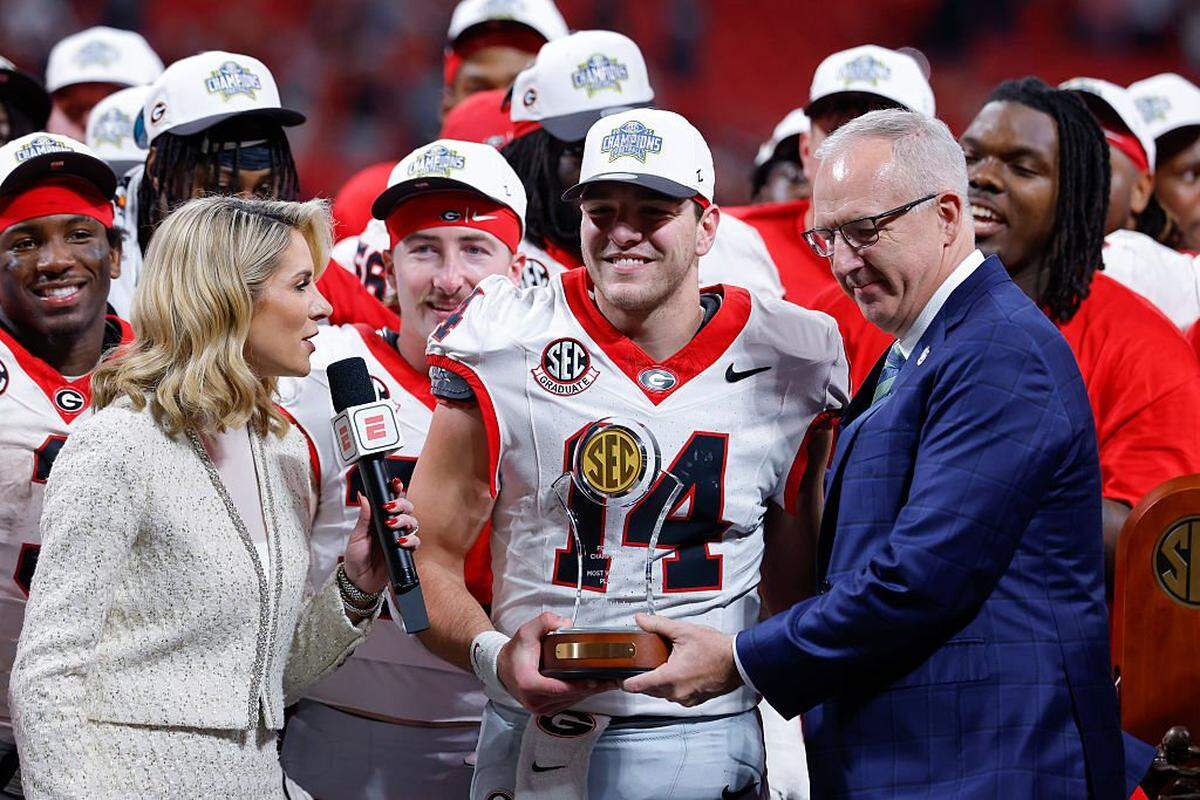
(If you are curious, Kentucky football was a part of two games among the 100 most-watched of last season: UK-Ole Miss was No. 69 with 4.78 million viewers; Kentucky-Georgia was No. 100 with 3.68 million watching).
In light of those numbers, it seems clear that ESPN got an incredible bargain when it signed the SEC to its current deal in 2020.
It also seems obvious that the Southeastern Conference is sitting on a financial bonanza when its media rights next come to market in 2033-34.
So you will understand why an act of congress forcing the SEC to share its impending bounty with New Mexico State, Louisiana Monroe and others doesn’t exactly fill Southeastern Conference presidents with glee.
“The SEC has been intentional, through years of thoughtful planning and decision-making, in strategically positioning itself for future media negotiations,” read a statement issued last week in the name of all SEC presidents. “The Conference must retain the ability to act in the best interests of its membership.
“As such, the SEC does not support assigning the media rights to a third party and remains firmly committed to independently conducting its own media negotiations.”
Whatever the motives, I think it is safe to say I will not be the only person in a Southeastern Conference state arguing against the Protecting College Sports Act of 2026.