Will Stein has decisively won the offseason. Will that help him win the season?
My first-hand recollection of Kentucky Wildcats sports goes back to the early 1970s. In all that time, I don’t recall any new UK head coach handling the public relations aspects of their job any better than Will Stein has done.
In interview after interview, the new Kentucky football coach has come across as enthusiastic and likable while mostly steering clear of the mind-dulling “coach speak” that is the default vernacular of so many members of his profession.
Stein, 36, has performed so well that a UK administrator during the most recent meeting of the Champions Blue, LLC, board listed the coach’s ability as a communicator as an asset the university should draw upon to get its message out
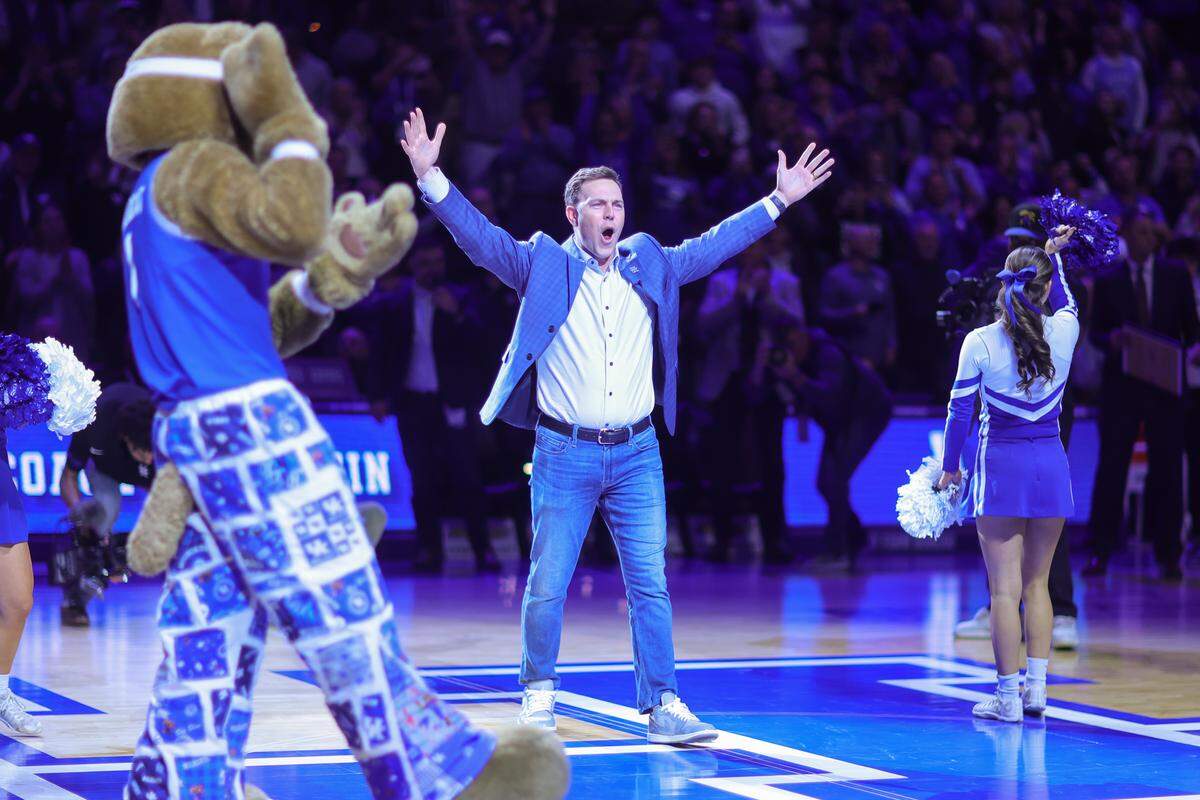
However, the question on the floor today is whether Stein’s decisive “win” of the offseason will have any impact on how things will go for Kentucky on the field in Year 1.
One way to evaluate that is from studying the examples of previous UK head football coaches.
The level of fan enthusiasm that greeted the hiring of Mark Stoops as UK coach prior to the 2013 season was similar to ebullient support presently for Stein. That was demonstrated when an estimated crowd of 50,831 filled then-Commonwealth Stadium to see the first Blue-White spring game of the Stoops coaching era.
Ultimately, Stoops went on to become the winningest coach in Kentucky football history in a 13-year stint. However, the early ardor generated by his hiring did not translate into immediate on-the-field success.
Stoops went 2-10 in his debut campaign in 2013. He followed that up with back-to-back 5-7 seasons in 2014 and 2015 in which UK started 5-1 and 4-1, respectively, then collapsed down the stretch in both seasons.
It was not until his fourth year that Stoops produced a winning season (7-6 in 2016) and earned a bowl berth. So other than the recruiting success that arose from the early Stoops-era momentum, it is hard to correlate the coach’s eventual success to the initial excitement that greeted his hiring.
Along with Stein and Stoops, the other UK football hire that generated the most positive initial reaction was when Kentucky hired Alabama’s sitting head coach, Bill Curry, away from the Crimson Tide in 1990.
UK backers were giddy over luring Bama’s head man.
Alas, in seven seasons as top Cat (1990-1996), Curry never had a winning record and produced only one bowl team (1993’s 6-6 Wildcats, who lost to Clemson in the Peach Bowl).
Not only was there no immediate success that followed the good feelings engendered by Curry’s hiring, there was all but no success, period.
The Kentucky football coaches for whom the vibes that accompanied their hires mostly directly correlated to their early on-the-field performances were both head men whose hirings were panned.
When Rich Brooks was hired by UK after Guy Morriss departed for Baylor in 2002, it was not a popular hire. Though Brooks had built Oregon from a Pac-10 cellar dweller to a Rose Bowl participant, he had an overall losing mark (91-109-4) to show for his 18-year run leading the Ducks.
He had also produced a losing record, 13-19, in two seasons (1995 and 1996) leading the Atlanta Falcons. The veteran head coach had no obvious ties to the commonwealth of Kentucky nor to SEC football.
Inheriting a UK program entering into the teeth of NCAA sanctions resulting from infractions committed during the Hal Mumme coaching era, Brooks got off to a brutal start.
UK went 12-29 in Brooks’ first 41 games.
Yet from that point, Kentucky experienced a turnaround. Brooks went 27-18 with four bowl trips over this final 45 games as top Cat.
Rather than corresponding with the early vibes that accompanied his hiring, Brooks’ ultimate success as Kentucky coach defied them.
The one UK coach whose full tenure seemed to have tracked with the atmosphere that accompanied his hiring was Joker Phillips.
A head coach in waiting while serving as the offensive coordinator under Brooks, Phillips’ head coaching tenure was accompanied by widespread fan displeasure left over from his playcalling late in what became an agonizing Kentucky loss to Tennessee in the 2009 regular-season finale.
With UK trailing border rival Tennessee 24-21 in the final minute, the Cats had the ball, second-and-7, at the UT 10. On successive plays, UK failed to get the ball to its best player, wide receiver/wildcat quarterback Randall Cobb.
When Kentucky had to settle for a tying field goal and then lost to Tennessee 30-24 in overtime, the Big Blue Nation was left seething over Phillips’ late-game strategy.
In a head coaching run that began the following season, Phillips never seemed to overcome those headwinds. He ended up being fired while compiling a 13-23 mark in three seasons.
On balance, there are ample reasons to think Will Stein can succeed as Kentucky football coach.
Based on UK coaching history, there is not much cause to think Stein’s early off-the-field triumphs will be the reason if he thrives.