Trump trade war has cost bourbon millions, could cause KY job cuts, distillers say
AI-generated summary reviewed by our newsroom.
- Tariffs and retaliatory measures since 2018 (including 2025) cut bourbon exports.
- Continued export decline could put 778 jobs and $65.6M in labor income at risk.
- Tariff uncertainty is prompting postponed investments and some production pauses.
A little more than a year ago, Kentucky’s bourbon industry became cannon fodder in President Trump’s on-again, off-again trade war.
And although many of the spirits industry’s most important overseas trading markets are not imposing tariffs at the moment, exports have been impacted by a year of ill will.
Perhaps no one felt it more acutely than Louisville-based Brown-Forman: Their Jack Daniel’s may be the world’s best-selling American whiskey, but many countries are drinking a lot less of it these days.
Trump had campaigned on raising tariffs to boost American manufacturing. But for Kentucky’s bourbon industry, that policy has had the opposite effect — similar to Trump’s first administration.
When he took office, Trump immediately began putting wide-ranging tariffs on several key trade partners. Since then, he has frequently imposed and then suspended tariffs on spirits, sometimes threatening new ones. The legality has been challenged, and the Supreme Court is expected to rule some time this year. The overall climate continues to be uncertain.
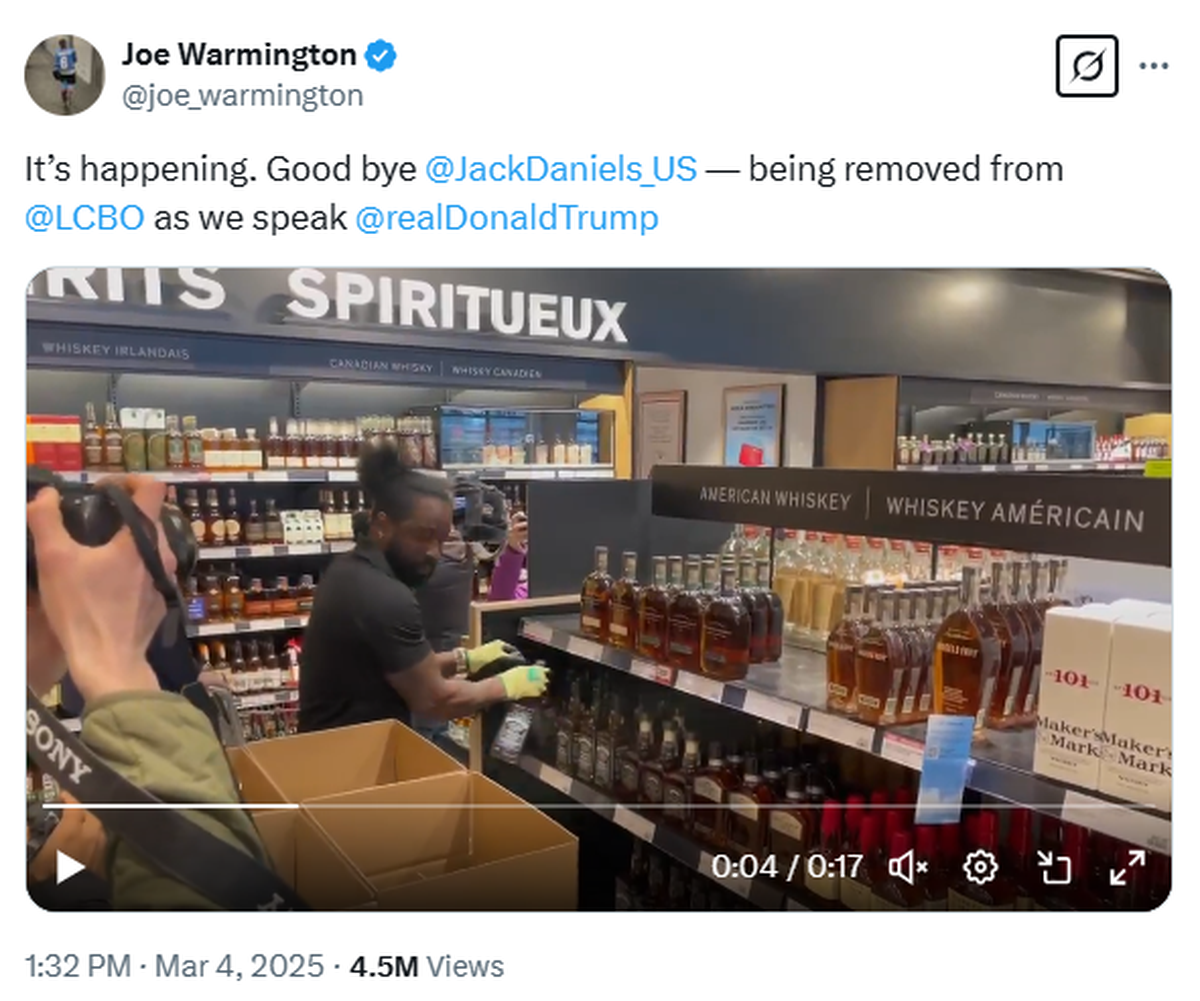
Canada was among the hardest hit, and provincial governors wasted no time striking back, ordering stores to stop selling American spirits.
When Canada began boycotting American whiskey in March 2025, Brown-Forman CEO Lawson Whiting said seeing spirits pulled off the shelves was worse than any tariff. And he’s been proven right: In December, the company’s mid-year profits were down 14%, or nearly $60 million, from the same time period in 2024, before Trump took office.
Brown-Forman declined to comment for this story, but Whiting said last year that major bourbon makers had “throttled back” amid the boycott, which created significant “headwinds” for brands large and small.
Sales of American spirits to Canada from March to October fell by 73%, according to the Distilled Spirits Council of the U.S. Globally, spirits exports were down 9% over the same six months.
The spirits council will release full year numbers in March, and they are expected to show that continuing uncertainty remains a major depressor of sales of American whiskey and other spirits around the world.
Brown-Forman, which will report its own third-quarter numbers March 4, said in December that international sales were down 4%, “driven by the absence of American-made beverage alcohol from retail shelves in most of the Canadian provinces and lower volumes of Jack Daniel’s Tennessee Whiskey in Germany and the United Kingdom.”
Why whiskey exports are key right now
Trump’s trade war has come at an unfortunate time for bourbon. After a decadelong boom, the U.S. market is down. Consumer confidence is at an all-time low, and people are drinking less.
Why? Factors include economic uncertainty, tightened discretionary spending, the influence of GLP-1 medications and legal THC that promises a hangover-free, low-calorie buzz.
Kentucky bourbon companies are sitting on a glut of whiskey, and they’d love to sell it into overseas market they have spent decades cultivating.
An economic impact study of the industry released recently by the Kentucky Distillers’ Association found that the state’s now-$10.6 billion industry is facing “mounting headwinds. Foreign demand, a major driver of past expansion and success, has been curtailed by retaliatory tariffs and other trade policy countermeasures imposed in 2018 and 2025.”
Those policy “countermeasures” came during Trump’s two administrations. But like others in the spirits industry, the KDA seems reluctant to call the president out directly, relying instead on statements of support for Trump’s overall agenda of boosting American manufacturing while pointing out how that agenda is having the opposite impact of their own products.
And there is no doubt that it is: “The industry must maintain existing markets and develop new international markets to grow. Given the heightened level of volatility associated with recent trade policy, making investments in foreign markets has become increasingly uncertain. This could have a cooling effect on potential investments and slow future growth in one of Kentucky’s signature industries,” the economists wrote.
“Looking forward, these challenges could cause distilleries to reduce employment and postpone planned investments over the coming year. It could also result in some distilleries leaving the market.”
How many Kentucky jobs could be impacted
How bad could things get?
Employment, the Kentucky economists said, already has plateaued. Job losses at Brown-Forman and Independent Stave have been offset by gains elsewhere. But that could change.
According to economists, if the decline in exports continues at the current rate, it will translate to a 30% decrease for the year — a $225 million drop in annual sales.
“This level of output supports a total of 778 jobs and $65.6 million in labor income” in distilling industry and related fields including cooperages, transportation and corn growers, the economists said.
“These are jobs that could potentially be at risk if the mid-year decline in exports were to persist,” according to the report.
Rising prices on goods such as imported glass bottles from China are resulting in higher costs to American consumers as well.
U.S. Rep. Morgan McGarvey, D-Louisville, said this week that while Kentucky may be looking at tariffs through the lens of bourbon, everyone is feeling the effects.
Everyone in Kentucky knows someone connected to bourbon, from farmers to truck drivers to those who work at the distilleries, he said. And if the tariffs continue, they will cost Kentuckians jobs.
“You can use words like tariff and trade policy but what we’re really talking about is whether people can go to work and put food on the table for their families,” he said.
He pointed to reports by Goldman Sachs and others that showed American consumers are footing the brunt of the higher costs, amounting to the largest U.S. tax increase as a percentage of GDP since 1993, rising to about $1,300 in 2026.
But the impact on the bourbon industry “is acute,” McGarvey said. President Trump is using tariffs “in such a chaotic and non-strategic way, it’s harming people and businesses in Kentucky.”
And these impacts are likely to be around a while. Kentucky whiskey exports peaked in 2019 at $48.8.6 million. They fell sharply after retaliatory tariffs imposed during Trump’s first administration that resulted in a 35% decrease in exports Kentucky distilled spirits exports in 2020.
While most of the tariffs were either removed or paused, the industry still has not fully recovered, according to the Kentucky Distillers’ Association impact study: As of 2024, whiskey exports are still 26% lower than the 2019 peak.
The European Union has suspended 30% retaliatory tariffs on spirits for another six months while trade negotiations continue, but some manufacturers have said that isn’t actually helpful.
“If the EU were to come out and say there is a retaliatory tariff, deal with it, we could plan for it and make a strategy. By delaying an additional six months, it creates more uncertainty.,” said Robert Cullins, CEO of Disaronno, which also owns Sagamore rye whiskey distillery in Baltimore. “So our international export plans for Sagamore to the EU are still on hold. ... We just need clarity from the administration on what’s going forward. So the one thing I would like to say and plea, if we all come together, is we need a permanent return to tariff-free.”
They aren’t the only ones on pause: Jim Beam, another major American whiskey brand, has stopped bourbon production at its home-place distillery in Clermont for a year, although production will continue at a larger distillery down the road, and Diageo has paused production in Tennessee at George Dickell until the summer. And production halted at Diageo’s Bulleit distillery for months last year as well.
“Ultimately, the effect will depend on any tariffs imposed on distilled spirits by other countries and how responsive foreign consumers are to higher prices that result from these tariffs,” according to the Kentucky impact report.
The Kentucky Distillers’ Association has noted it takes years to build brand awareness and loyalty in new markets,” the economists noted. “Distillers have invested millions in marketing and international branding efforts in the last 25 years to persuade those consumers to switch to Kentucky Bourbon from what they were drinking — mostly Scotch whisky.”
In the meantime, there is some hope that other markets, including in Mexico, Brazil, Turkey and India will take up some slack. American whiskey makers have long been hoping to gain a foothold in India, one of the biggest whiskey-drinking markets in the world.
“Last year’s tariff reduction on U.S. spirits imports to India was an important first step that opened new opportunities for bourbon producers in the world’s largest whiskey market,” Chris Swonger, president and CEO of the Distilled Spirits Council of the U.S. said Feb. 6. “With India now reaching agreements with the EU and the UK to significantly reduce tariffs on their spirits, we are hopeful that this new U.S.-India agreement will secure comparable tariff reductions across all categories of U.S. distilled spirits, ensuring fair and competitive access to the Indian marketplace.”