Local restaurants are struggling again but it isn’t for lack of customers or capacity
When Gov. Andy Beshear recently announced that Kentucky restaurants and bars might soon be going back to full capacity, owners and chefs knew they had their work cut out for them. That’s because they can’t reopen to full strength right now even if they want to.
Many say their current staffing can barely keep up with the business now.
Gwyn Everly, co-owner of J. Render’s Southern Table & Bar, recently announced that her restaurant will be closed on Sundays just to give staff a break.
“Our kitchen manager was working seven days a week, working double shifts, and other staff were working six days a week,” she said. The choice was either to cut back or lose people to burnout.
“I’ve had to cancel about 12 food truck dates — about one to three a day — just because we don’t have staff to do it,” she said.
And restaurants have looked. Hard.
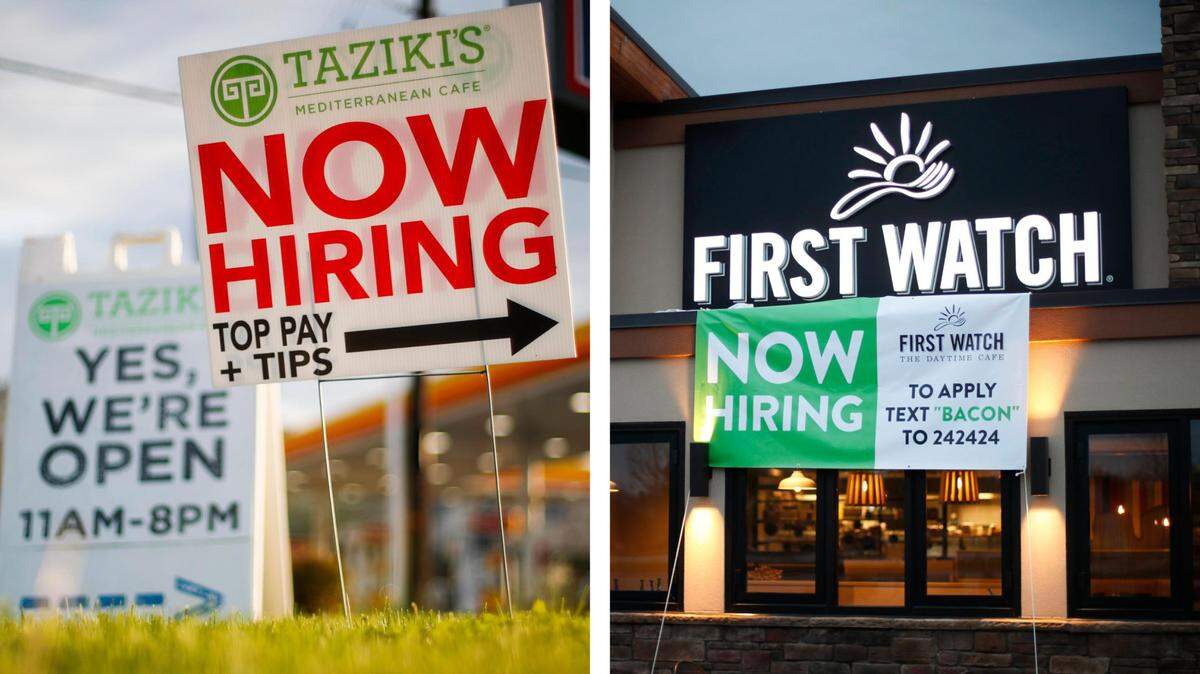
They’ve tried hiring bonuses and retention bonuses. Finder’s fees for employees who bring in someone. And local restaurants from chef-driven fine-dining all the way to fast-food chains are holding job fairs to attract servers and bartenders as well as kitchen staff.
“There’s nobody for us to hire,” Everly said. “COVID’s the gift that keeps on giving. Who knew that we’d be able to open up but not be able to hire?”
It’s an issue plaguing restaurants across Kentucky and nationally. The coronavirus pandemic is easing and vaccinated people want to go back to eating out. But operating short staffed is taking a toll.
Recently, Mark Richardson, executive chef at Dudley’s on Short, posted an internet meme from the television show “The Walking Dead” on a private Facebook group for Lexington food professionals. It showed a lone rider on horseback on an empty interstate under the words, “The Search for Line Cooks” with a message asking applicants to come to the fine-dining restaurant’s back entrance.
Ouita Michel, one of Kentucky’s most celebrated restaurateurs commented: “Can I come to the back door for any extra cooks?”
Chefs and owners of Azur, Corto Lima and other Lexington restaurants also chimed in. They are all in the same boat, searching for employees.
“Simply put, we just can’t get enough people to take care of the customers we need,” said Rob Ramsey, who owns the four Ramsey’s Diners in Lexington. “We need servers, we need carryout people, we need cooks and we simply can’t find the people do it.”
He said before the pandemic he had about 250 people on staff and could have used a half dozen more. Now he only has about 175.
“Our biggest challenge is staffing. Everybody’s desperate. ... The competition for employees is greater than the competition for customers,” he said. “We couldn’t go back to full capacity if we wanted to.”
So they are asking customers to cut them some slack, for now.
“I’m begging for forgiveness,” said Michel, whose flagship restaurant is Holly Hill Inn in Midway. She said she’s been able to hire some new employees but they’re young. “And that does mean a lot of training,” she said.
Why can’t restaurants find help?
At a Lexington roundtable with restaurants owners and food purveyors, Agriculture Commissioner Ryan Quarles said that a severe labor shortage is one of the issues he’s hearing about across the state.
“We’re hearing a lot of different reasons for this. Number one is competitive pay,” Quarles said. Some workers found jobs in other industries that pay better, he said.
And he thinks in some cases, he said, people don’t want to return to the restaurant work because of unemployment and pandemic benefits, including stimulus checks.
“We all know food service industry work is tough work. You’ve got to show up, you can’t Zoom in to work,” Quarles said. “But yes, we are hearing that the level of government support maybe be preventing some folks from choosing to work.”
However, researchers say that can’t explain all of the problem, in part because the money isn’t that great compared to what many could make on the job. Restaurants in Lexington routinely pay well over minimum wage — $12 an hour is common — and still can’t attract applicants.
What restaurant workers say is the problem
Jesus Gonzalez, who owns IP&J Cuban Food pop up and catering company but also has worked in other restaurants, said that the business model didn’t work before the pandemic.
“In my opinion, this is a business that gives employers a way to pay well under minimum wage for some because they make tips,” Gonzalez said. “The only people making above (minimum wage of $7.25 an hour) are managers, are the cooks, and the dishwashers, who are usually making a little above. ... Twelve dollars an hour is not enough to pay kitchen staff.”
Most front-of-house workers like servers, bartenders and busboys rely on tips to augment low wages, he said.
“People are saying ‘am I going to risk (getting sick) to make $12 an hour or ... take care of myself?’” he said.
While many people are getting vaccinated, many others are not and children are still vulnerable. Gonzalez said he has a child with healthcare issues, which makes it difficult for him to work a steady schedule.
“So if I can get help, get unemployment, hell yeah, that’s what I’m going to do,” he said. “We need to change the system, it’s a ‘big picture’ problem.”
Danielle Conner graduated from Sullivan University but is working as a server at East End Tap & Table. She also works at Amazon, which starts at $15 an hour. Conner said that many restaurants give employees part-time status so they don’t qualify for benefits like health insurance. But then ask them to work 40 hours or more, which makes it difficult to seek other employment.
“Most qualified individuals, we’re not jumping at $12 to $14 an hour without knowing it’s going to be an equitable situation with benefits,” she said.
She said the enhanced unemployment benefits are not keeping workers away.
“That’s not the case. Anyone who calls themselves a chef, we want to be creative … we want to be learning new things,” she said. “People absolutely want to work.”
Help wanted: Women, students
Cole Arimes, who owns Coles 735 Main as well as Epping’s on Eastside, said that the hospitality labor problem isn’t new and that there are always seasonal fluctuations in the supply and demand for workers.
“Pre-pandemic, a lot of people had lost the TV glory feeling of what working in a restaurant is. We weren’t overflowing with applicants before,” Arimes said. “Then the restaurants all shut down for three months, so maybe people found other career paths.”
Many may not feel comfortable returning to restaurant work until they feel secure that the jobs won’t go away again in future pandemic shutdowns, restaurants owners say.
Some workers also have been impacted by child-care issues. “With schools out, lot of parents had to stay home. It was a juggle,” Arimes said.
Stacy Roof, president and CEO of the Kentucky Restaurant Association, agreed. “Lot of kids are still at home doing school so, depending on age, they’ve got to have a parent there, somebody who would have been in the workforce,” she said.
Women have been disproportionately impacted by pandemic job losses. With daycare still in short supply, many women haven’t been able or may not feel comfortable returning.
“We need them back and we need them back in force,” Roof said.
Ramsey said he also thinks young people have been turned off working in restaurants in general. Students who used to work their way through college in his diners just aren’t applying, he said.
Michel, who owns seven restaurants in Central Kentucky, said many issues are coming to a head at once.
“It’s the most challenging labor market I’ve have ever experienced, and I’ve owned Holly Hill Inn for 20 years,” Michel said.
Rebuilding an industry that was nearly wiped out will take time, she said.
“To me, it’s the deep uncertainty. And emotional and psychological damage of dealing the past year with a global pandemic,” Michel said. “Overnight it devastated the careers of millions of people. And we have to reassure people that it’s ok to come back to those jobs.
“And that it’s fun, it’s not just about constant sanitation and packing to-go boxes, and being the mask police. .... We have lost a generation of people in the hospitality industry and we need to work like crazy to get them back.”
This story was originally published April 15, 2021 at 10:35 AM.