
Lexington’s poorest neighborhoods experience hotter temperatures. It comes down to trees
If you’ve ever wondered which areas in Lexington experience the most heat for longer periods, take a look at the trees around you and you’ll have a pretty good idea.
Research tells us urban tree canopies reduce temperatures and help mitigate the heat island effect. The cooling effect urban tree canopies provide is so significant, expanding it can cut premature deaths to heat by as much as 40%, a 2023 study that appeared in The Lancet found.
In Lexington, the neighborhoods with the fewest trees tend to also be among the lowest-income and the most racially diverse.
Heather Wilson, the city’s urban forestry program manager and a certified arborist, attributes much of that to how Lexington has developed over the decades and its history of redlining. Redlining is the practice of refusing financial services, such as home loans, to certain neighborhoods or groups based on race or ethnicity, rather than financial criteria. It was widespread for decades until the passage of the Fair Housing Act in 1968.
But the effects still linger.
In 2021, a study of 11 Texas cities found neighborhoods with higher amounts of historical redlining had significantly higher heat-related outpatient visit rates. In Durham, N.C., on one particularly scorching day in July 2021, researchers fanned out across the city collecting data. They discovered temperatures in historically Black neighborhoods were 7 to 10 degrees Fahrenheit hotter than more affluent areas where white people lived, as reported by Nature.
“The northside of Lexington was one of those redlined areas,” Wilson told the Herald-Leader in a recent interview. “So, historically, less trees were planted to start with, and more concrete was placed as buildings were built.”
Conversely, in more affluent neighborhoods on the south side of Lexington, such as Chevy Chase and Ashland, tree cover is as much as 40% or higher.
Wilson said Lexington is working to build up and hold onto the city’s urban tree canopy, especially in areas where it’s most needed. Priority areas are council districts 1, 2, 4 and 7.
More broadly, the city wants to reach 30% canopy coverage citywide. It’s a big job. To achieve that goal, the city will need to plant more than 26,000 trees in 20 years, according to a 2022 study the city commissioned.
Here’s a look at what the city is doing to address Lexington’s heat disparities, the communities with the greatest need and what a healthier tree canopy can offer.
Which Lexington neighborhoods have the greatest heat disparities?
Lexington’s urban tree canopy is the most sparse on its north and east sides, along with a few pockets in other areas of the city.
A look at Lexington’s Tree Plotter, which highlights 2022 data, reveals tree canopy cover is below 20% in many places on Lexington’s north and east sides and is as low as 7% in some cases.
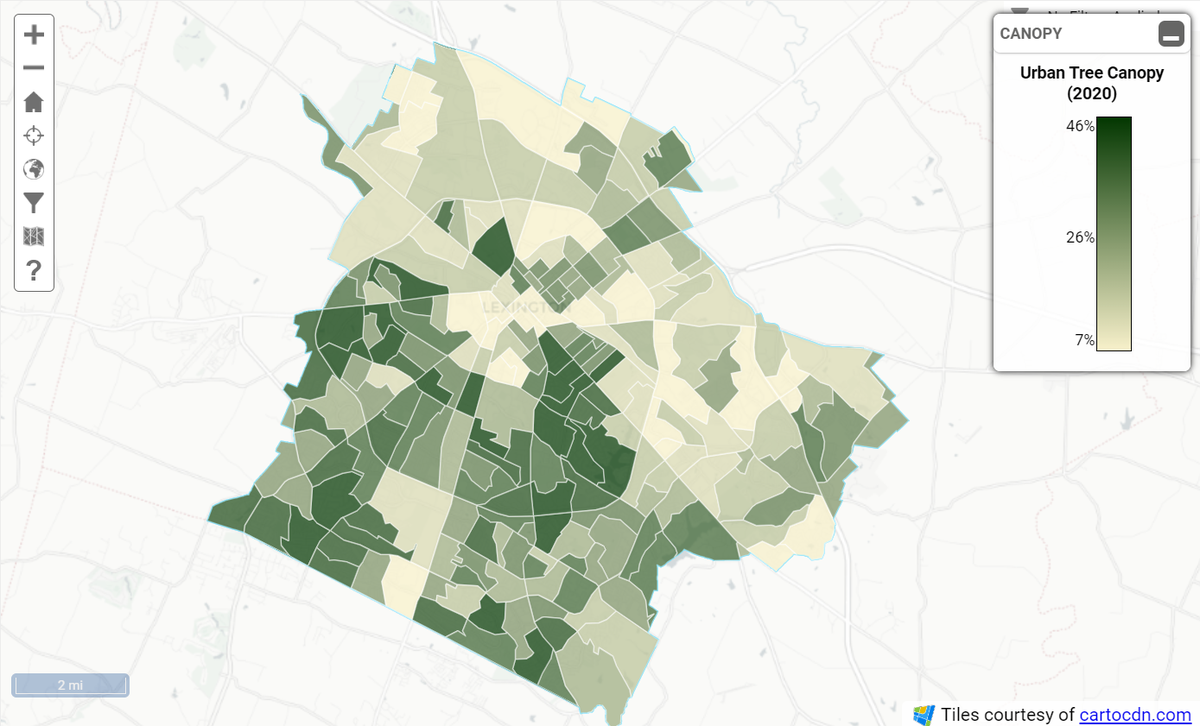
Research published in The Lancet in 2023 found increasing tree cover in European cities to 30% could have reduced premature deaths from urban heat that year by up to 40%.
Neighborhoods on the north and east sides of Lexington also experience the most pronounced heat disparities, according to Tree Equity Score data from 2022.
Surface temperature is a good estimate of where excess heat gathers in a city, and impervious surfaces, such as those made of concrete, asphalt, brick and stone, absorb more of it during the day. Once the sun goes down, these surfaces gradually release their stored heat, making the evenings warmer than otherwise. Daytime temperatures in these heat islands are about 1 to 7 degrees higher than outlying rural areas, and nighttime temperatures are 2 to 5 degrees higher, according to the U.S. Environmental Protection Agency.
The cooling benefits tree canopies provide mainly come from the shade they offer during the day, which reduces the amount of solar radiation that reaches the ground and means those surfaces absorb less heat. But trees also more actively cool the air through evapotranspiration, when they release water vapor through photosynthesis. The effect works similarly to how the human body cools itself by sweating.
Heat disparity, as defined by Tree Equity Score, compares the average heat extremity in a Census block group (a neighborhood) with the overall urban area average. The measure offers a picture of variance in heat severity across an urban area.
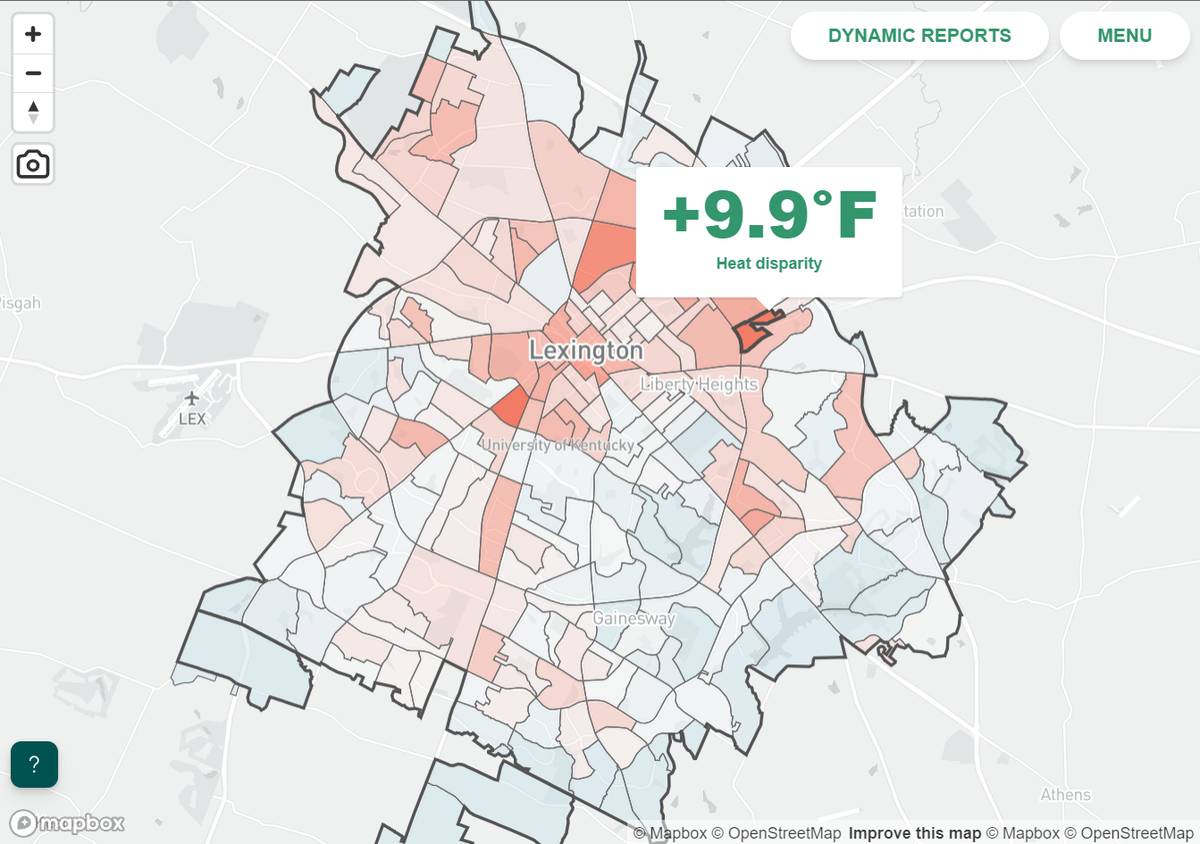
Some Lexington neighborhoods with the most pronounced heat disparities include:
South Broadway Park: +10.5 degrees Fahrenheit
Yates Elementary School area: +9.9 degrees
Northland area between Newtown Pike, North Limestone and West Fourth Street: +8.9 degrees
Here’s an overview of the tree cover and heat disparity in some of Lexington’s lowest-income neighborhoods. For context, the median household income for Fayette County overall is $62,908, based on U.S. Census Bureau data.
Cardinal Valley
Cardinal Valley, bordered by Versailles Road, Alexandria Drive and McConnell Springs Park, is considered one of Lexington’s most diverse neighborhoods.
The median household income there is $45,217, according to U.S. Census Data.
Tree cover varies widely from 40% in the neighborhood’s eastern half to 18% in the residential area surrounding the Lexington Public Library’s Marksbury Family Branch, according to Lexington’s Tree Plotter. Residents in the area experience a heat disparity of up to +5.6 degrees in the central part of the neighborhood, Tree Equity Score data shows.
East End
Home to the Lyric Theatre and Cultural Center, Lexington’s East End is a historic Black neighborhood. It’s also one of Lexington’s lowest-income neighborhoods, with the median household income there estimated at $24,704.
In the East End, tree cover is just 13%. As much of 74% of the area is covered in impervious surfaces that absorb heat in the day and release it at night. As a result, the heat disparity there is +6.4 degrees, Tree Equity Score data indicates.
Yates Elementary School
The area in Lexington with the highest heat disparity at +9.9 degrees, according to Tree Equity Score data, is also home to Yates Elementary School. Data from Lexington’s Tree Plotter indicates tree coverage in the area adjacent to the elementary school is low at 19%. As much as 54% of the area is covered in impervious surfaces.
The median household income in the Census block is $54,684.
What is Lexington doing to close tree canopy gaps?
According to Wilson, Lexington has several initiatives to encourage tree planting and canopy conservation, including:
Reforest the Bluegrass: The annual tree planting event takes place every spring on public property, and over the course of 25 years, more than 215,000 tree seedlings have been planted. A similar program spurred by the coronavirus pandemic, called Reforest at Home, encouraged planting on private property by distributing trees to 400 households.
Lex Grow Trees: The program awards grants for tree planting projects. In 2024, it awarded nearly $500,000 in funds to local organizations such as Trees Lexington and others.
Water quality incentive grants: The grant program awards funding for water improvement projects. As part of the program’s scoring matrix for funding awards, projects received higher scores for improving Lexington’s tree canopy.
Despite its efforts, however, there are challenges. According to Wilson, direct planting efforts are largely limited to public property. There’s also a widespread attitude that trees are dangerous, often fall over and take too much work to maintain, Wilson said.
“I think that one of the big messages has to be that trees are not inherently dangerous, that we want to help and that we are available,” Wilson said. “There are entities available to help increase our tree canopy.”
What it will take to solve the issue for good, however, is changing how people view trees, Wilson said. The phenomenon of plant blindness, or the human tendency to ignore plants, keeps us from seeing all that trees have to offer.
“Trees are a vital piece of green infrastructure, and they haven’t really been looked at like that,” Wilson said.
Do you have a question about the environment in Kentucky for our service journalism team? Send us an email at ask@herald-leader.com or submit your comment or question via the Know Your Kentucky form below.