Overdoses are skyrocketing. This Lexington team is now fighting them door to door.
READ MORE
Fighting overdoses door-to-door
How one Lexington program helps stem skyrocketing overdose deaths Lexington program helps address growing overdose deaths.
Expand All
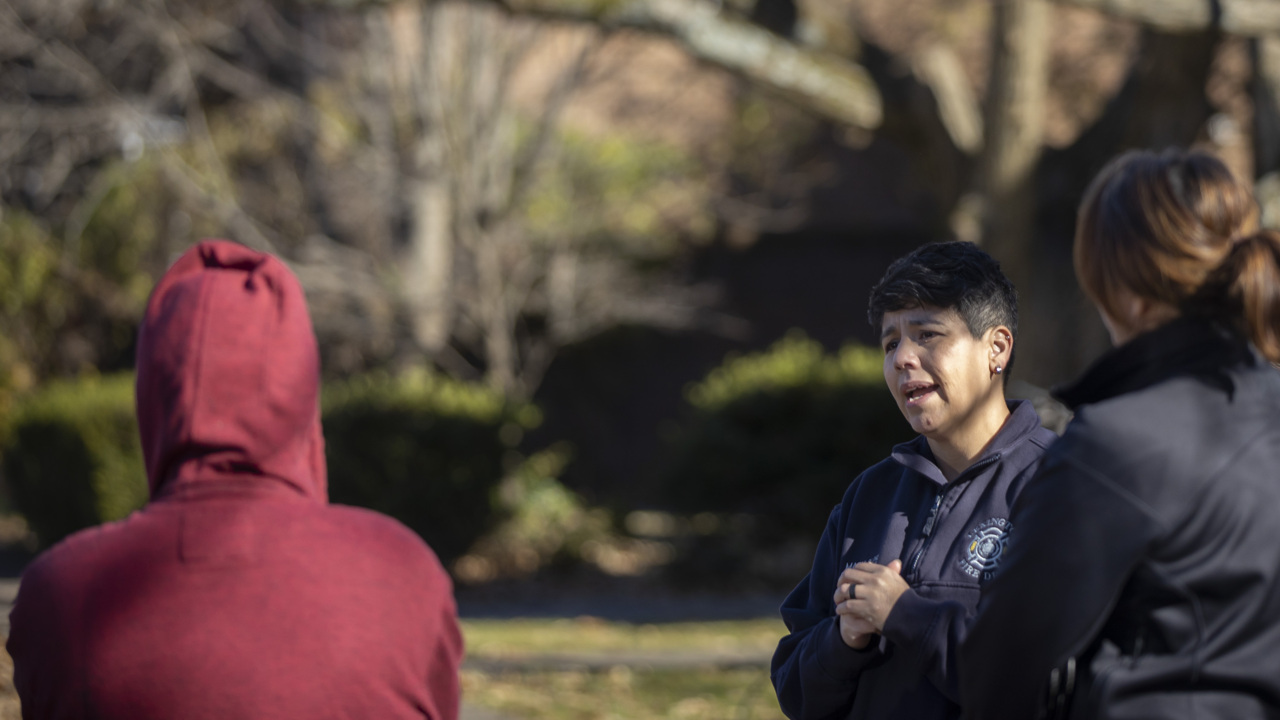
Maria Slone stood on the sidewalk in front of a house in the Woodland Park area and laughed and chatted with several men who were outside the home that day in late November.
It was the third house call Slone, a social worker, Lexington Firefighter Patrick Branam and Lexington Police Detective Kristie Smith made on Nov. 29.
The person they were there to visit— a woman who had overdosed 48 hours before near the property — did not live there and was not there. According to police and fire department records, the woman had overdosed more than 10 times over the past several years. She was successfully revived via naloxone, sometimes referred to as its brand name Narcan, which can reverse opioid overdoses.
Still, Slone, Branam and Smith gave each of the three men boxes of Narcan and showed them how to use it.
They also gave them a 20-page packet of information that included information on local treatment centers, AA and other meetings, transportation options and needle exchange programs. Stapled to the back was Slone’s business card.
Jake Egbert was happy to see them. Egbert said they did not know the woman who overdosed. She ended up on their lawn. Someone at the house found her and called 9-1-1. As the coronavirus pandemic has upended people’s lives, more and more people are now using drugs and dying, Egbert said. Egbert said he recently talked a friend into going into inpatient treatment.
“The fact that they followed up and came here to check on that woman is really something,” Egbert said. “A lot of addicts don’t have family or they don’t have family close to them anymore.”
Slone, Branam and Smith are members of the Lexington Fire Department’s community paramedicine team. Over the past two years, the team’s goal is to make contact with every overdose victim who has been revived.
It’s been a busy 18 months for the team.
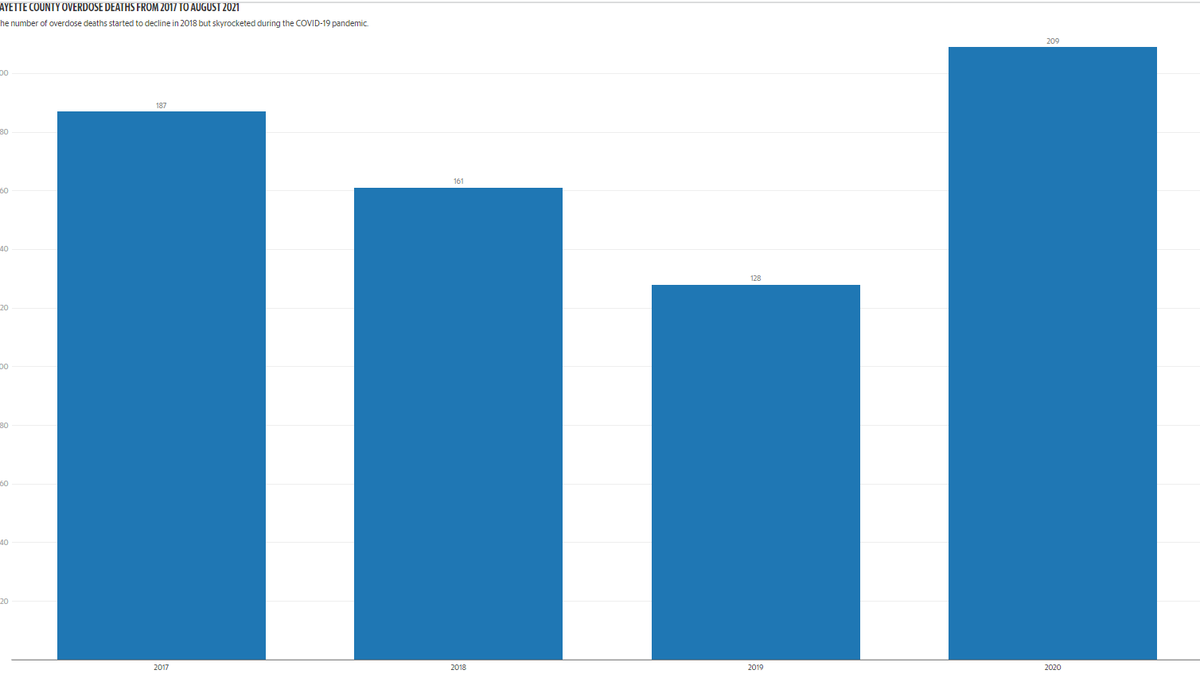
As the city and the country grappled with the coronavirus pandemic, the number of overdoses in Fayette County skyrocketed -- 209 in 2020, a new record. From January to August 2021, there had been 133 overdose deaths.
“It tripled,” said Slone, of the number of people overdosing after March 2020, when the first coronavirus case was recorded in Kentucky and Fayette County.
In 2020, there were 1,228 total overdoses in Fayette County, according to fire department data. From January to October of 2021, there had already been 1,039.
That’s a dramatic increase from 2019 when there were 577 overdoses.
‘We’ve been to every neighborhood’
Captain Seth Lockard thought he knew what an addict looked like.
“I had a stereotype of a 40-year-old living in Mom and Dad’s basement,” Lockard said. “A lot of these individuals are going to work Monday through Friday and we’ll get a phone call back at 6:30 p.m. at night because they found our business card under their door.”
Lockard, the captain of the community paramedicine team, has had to check a lot of his preconceived notions of who an addict is and where they live since the community paramedicine program rapid overdose response team started nearly two years ago.
Substance abuse disorder affects everyone.
“We have been to every neighborhood,” Lockard said. “We have mapped it out.”
Smith agreed.
“We have knocked on doors of some very beautiful homes,” Smith said. “And we’ve knocked on doors and wondered if anybody lived there.”
The community paramedicine program started with just Lockard and Branam in 2018. The program dispatches emergency medical technicians and paramedics but not ambulances to treat people who frequently call 911 but don’t need emergency medical care. The program has successfully slashed the number of ambulance runs.
In 2019, thanks to a federal grant, the department was able to hire Slone, a social worker who was also a former intern with the community paramedicine program, to help it start its quick response teams to visit and encourage addicts who have overdosed to get treatment. Lexington Police have also had a person on the team for several years.
Many of the people they deal with are victims of crimes or are vulnerable adults, Smith said.
“We see a lot of people who are elderly or people who disabilities,” Smith said. “My job is to advocate for them with the county attorney’s office. Or maybe advocate for them to be treated through mental health court.”
Slone has taught firefighters —who are also emergency medical technicians or paramedics — a lot about how to approach people in crisis, Lockard said.
“I know how to interview someone for acute sickness,” Lockard said. “I don’t know how to interview you for what’s going on in your home. What’s going on long term? She really educated us, and still does.”
Sadly, due to the uptick in overdoses, the team needed more help. Thanks to two different grants, it hired Mackenzie Gross, a second social worker, in 2021 and added another firefighter, Ken Powell, to its overdose rapid response team.
“We all have different personalities and different training,” Branam said. “Sometimes people don’t want to talk to me. Sometimes they’ll say, ‘I want to talk to that woman cop. Or they want to talk to Mackenzie.’”
It doesn’t matter whom they talk to, as long as they are willing to talk, Branam said.
Behind the uptick in overdoses and deaths
In December 2019, the number of overdoses in Fayette County had dramatically declined.
“I was worried that I was working myself out of a job, which would have been a good thing,” Slone said.
In December 2019, there were 68 overdoses. By May 2020, the third month of the pandemic, the number of overdoses skyrocketed to 168, fire department data showed.
Many treatment centers and weekly meetings were shut down or went online during the early months of the coronavirus pandemic.
For those in recovery, the lack of in-person treatment options, combined with the unknowns of the first pandemic in more than 100 years, meant people returned to using drugs, Slone and others said.
Slone said she heard from people who had been sober for years who started using again.
Another contributing factor to the dramatic increase in the number of overdose deaths is fentanyl, a synthetic opioid that is 80 to 100 times more potent than morphine.
Fentanyl is now being added to other drugs without users’ knowledge.
This summer a pressed pill that looked like oxycodone made it to Lexington. It was laced with fentanyl. Many users had no idea the drug was fentanyl and died, Branam said.
But fentayl is also showing up in places the team has never seen before.
“We’ve even seen kids who took a hit from a vape that had fentanyl in it,” said Howell. “They had never done drugs in their life.”
A text message and a trip to inpatient treatment
Slone, dressed in a nondescript blue parka, stood on the porch and knocked on the door of a white one story home in North Lexington. It was one of four homes she, Branam and Smith visited on Nov. 29.
The woman who they were trying to track down didn’t live at the home, the woman behind the door said.
Slone, Smith and Branam left the 20-page packet of information about treatment options just in case. Of the four homes they visited that day, no one who had overdosed came to the door.
“There are days where we go to five houses and don’t make contact with any one,” Lockard said. “Then the next day, we make contact with five people.”
Slone, who spent 20 years in mental health prior to working for the fire department, said it’s rare for someone with substance use disorder to seek treatment at first contact.
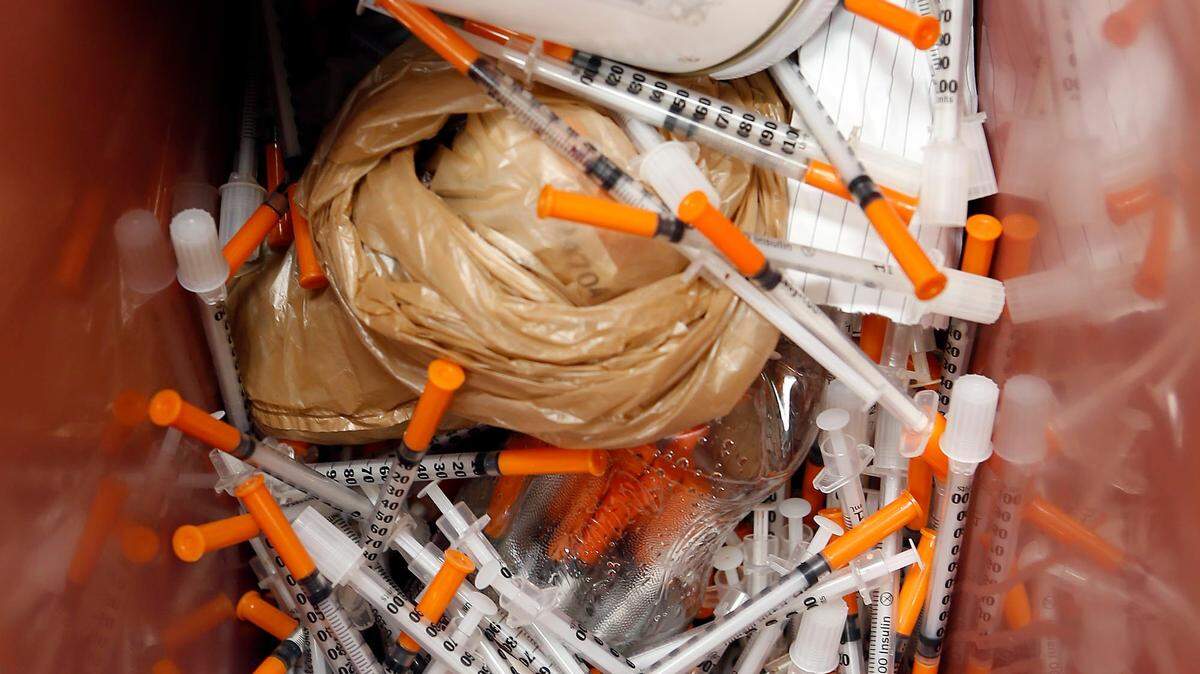
Thanks to a grant from the University of Kentucky, the program now gives out Narcan. They also talk to addicts about harm reduction. They can direct people to the Lexington-Fayette County Health Department’s needle exchange program and talk about the uptick in fentanyl laced drugs on Lexington streets.
Slone said research shows every contact increases the likelihood of someone with substance use disorder opting to get treatment.
There are a lot of barriers for people who need treatment.
“Transportation is probably the number one barrier,” Slone said.
The team has built partnerships with various treatment programs. They know which programs have grants that can provide transportation, Gross said.
“A lot of people don’t know that some of these programs will come pick you up,” Gross said. “Or a lot of people are just scared of taking that first step. We can help knock down all of those barriers and we know what types of treatments may be the best fit for the person based on their needs.”
Brow-beating people into treatment does not work, Slone said.
“We just want you to know that we’re there,” Slone said. “If you want us to come back, we’ll come back. We’ll come back every day.”
They’ve had a lot of successes.
Slone was able to work with a family and the Fayette County attorney’s office to involuntarily commit someone to treatment after he had repeatedly overdosed.
It takes seven days to involuntarily commit a person to treatment. It also takes two separate doctors to evaluate the person. It’s a complicated process.
“It was an all team effort,” Slone said of the involuntarily commitment. “This person didn’t want to go. We were able to navigate that process. It was tedious process. But it was a relief for this family.”
The man is still in treatment and has even extended his time in treatment, Lockard said. He had been using for more than a decade, he said.
Earlier this year, Slone was successful in getting a woman to go to treatment. It started with a text message.
The woman, who Slone had had prior contact with, had texted Slone at 8 p.m. on a weekend night to see how Slone was doing. Slone responded and the two started texting back and forth. Slone then called her.
“The next day at 1 p.m. she went into treatment,” Slone said. “From time to time she will text me and tell me she’s still doing well and to say thank you so much.”
Lockard said the woman just wanted to know that someone was out there who cared about her.
There’s also been times when families have invited them into their homes because the team happened to knock on the door during an intervention, Slone said.
Sadly, there have also been times when the team couldn’t get to someone fast enough as the number of overdoses skyrocketed over the past 18 months.
One man overdosed on a Saturday and was revived. He overdosed again on Sunday and died.
Slone and Branam knocked on his door on Monday to check on him.
“A family friend came to the door and said the family was at the funeral home making arrangements,” Lockard said.
But the team still helped that family.
“Mom reached out because this was not something that you deal with every day,” Lockard said. “We were able to connect her with counseling.”
Smith said the team has learned that it doesn’t matter how the person gets help, it’s that they get help. Substance abuse disorder affects the entire family and the family also needs the community paramedicine team’s help, she said.
“It takes everyone a different amount of time,” Smith said. “There’s so much stigma with substance use. Families are used to thinking this is a private problem . For some of these families, we are the last people that they can ugly cry in front of.”
This story was originally published February 6, 2022 at 5:00 AM.