Skyscrapers, busy roads, iconic Lexington spots. See how city has changed in 40 years
John Wyatt, left, Ryan C. Hermens, right
Herald-Leader staff photos
By Brian Simms
See downtown landmarks before they made it big, main roads (without traffic!) and the beginning phases of what is today one of the city’s busiest roads.
READ MORE
More photos from the Herald-Leader archive
See photos from our archives of Rupp Arena, Fayette Mall, Keeneland and more.
Expand All
Lexington, the Horse Capitol of the World, was founded in 1775. That’s 17 years before Kentucky was even a state.
Of course a lot has changed since settlers made their home at McConnell Springs, but you don’t have to go back that far to see how much the Bluegrass has changed over time.
Just going back 40 years will give you an idea of how much the city has evolved.
That’s what we’re doing here, with then-and-now pictures of the same locations showing what’s changed, and in some cases, what hasn’t.
Forty years ago, Herald-Leader photographer John C. Wyatt was given an assignment to take aerial photographs of construction of new interchange ramps off New Circle Road to Mount Tabor Road (today called Alumni Drive). While hovering around the skies of Lexington, Wyatt took aerial photos — three rolls of black and white film, to be exact — of other locations. He went downtown, on the outskirts of the University of Kentucky campus, main Lexington roads and captured the beginning phases of a section of what is today one of Lexington’s busiest roads, Man o’ War Boulevard.
So what’s changed between then and now?
Drone pictures and video show how Lexington has grown, whether it’s trees maturing, new roads, 31-story skyscrapers going up or buildings coming down. So, compare the before and after images, see what triggers your memory or makes you say, “That used to look like that?”
Downtown Lexington
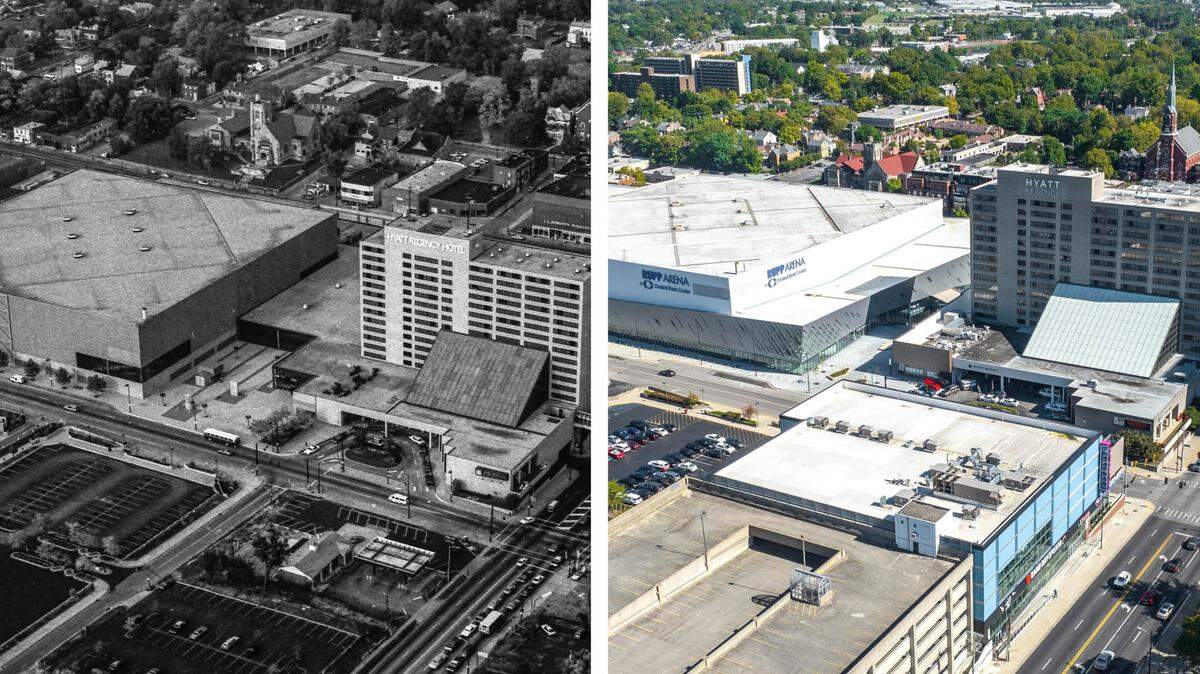
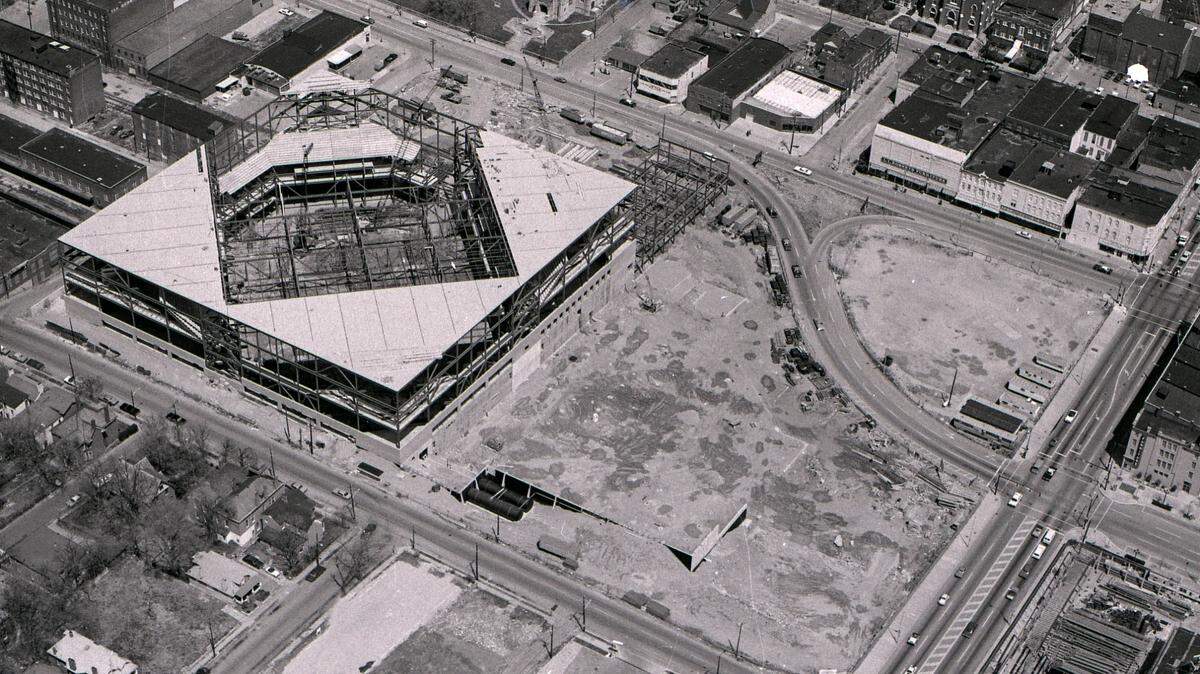
An aerial view of Rupp Arena and downtown Lexington, Oct. 4, 1982. At the center is the 17-story Hyatt Regency Hotel, which opened in 1977. To its left is the Lexington Center and iconic Rupp Arena. The grand opening of Rupp was Oct. 7 to 10, 1976 and the first concert there featured Lawrence Welk and his orchestra. When it opened, Lexington Center was a five-fold operation: the convention-exposition hall, Rupp Arena, a shopping mall, the 366-room Hyatt, and the Lexington Opera House. Behind the Hyatt is Triangle Park, which officially opened just three months earlier before an estimated 4,000 people who oohed and aahed as the lights and fountains came on. Across Main Street are businesses and buildings, including the longtime H.H. Leet Furniture Co., that would become Victorian Square in 1985. Across West High Street from the Hyatt is a Speedway gas station. John Wyatt Herald-Leader file photo
Forty years has certainly seen growth around Rupp Arena. At the corner of South Broadway and West High Street is LexLive movie theater and entertainment complex that opened last March. The Cox Street parking lot and warehouses in the 1982 picture have been wiped out over time, most recently by the 2022 Central Bank expansion that increased the convention area around Rupp Arena. Ryan C. Hermens rhermens@herald-leader.com
In the middle of this image of downtown Lexington from Oct. 4, 1982, you can see the Lexington rainbow mural on the Phillip Gall & Son sporting goods building at 230 West Main St. It was torn down one year later for a retail and office complex called the Lexington Galleria, to be developed by the Webb Companies. This and the adjacent World Coal Center never happened. Instead the Lexington Financial Center (commonly known as the Big Blue Building) was developed. The rainbow mural shown here is now the location of its parking garage. To the right, near the edge of the image is early construction of the Lexington Public Library’s Central Library branch, Phoenix Park and the 21-story Park Plaza apartments. John Wyatt Herald-Leader file photo
Forty years has brought a lot of change in downtown Lexington, but two things stand out: the 31-story Big Blue Building and City Center, a full city block complex of residential, commercial and retail development with a 12-story office tower and two Marriott hotel properties. After buildings were razed in 2008, the project formerly known as CentrePointe, opened in 2020 after many delays. Ryan C. Hermens rhermens@herald-leader.com
Construction of what would become a five-story, 55,593 square-foot office building Oct. 4, 1982. Behind it in the lower right corner is the headquarters of Kentucky Utilities, who moved into this location three years earlier. To the right of the construction site is the Bank of Commerce and Trust Company. The road running diagonal from right to left is East Main Street and in the upper left corner is the Ades-Lexington Dry Goods Co. building. In 1977, the Ades family discontinued the dry goods business, and the building became a warehouse. John Wyatt Herald-Leader file photo
Today the Ades-Lexington Dry Goods Co. building is offices, but most people might remember it as the former location of Portofino restaurant on the first floor. Gray Construction offices are to the left of the KU headquarters. Ryan C. Hermens rhermens@herald-leader.com
Man o’ War Boulevard
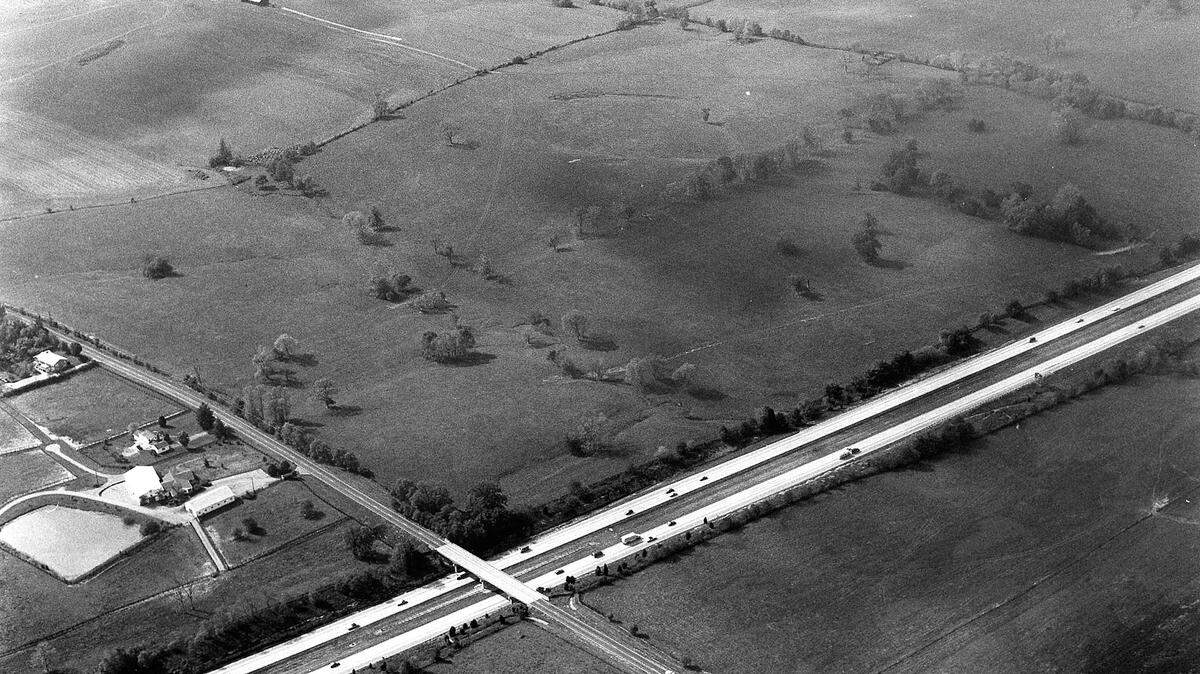
Construction of Man o’ War Boulevard, running from top to bottom of the picture, intersecting with Richmond Road in Lexington on Oct. 4, 1982. Man o’ War was completed and widened in segments over 15 years. The segment shown here extended Man o’ War 1.1 miles from Richmond Road to Mount Tabor Road, now known as Alumni Drive. John Wyatt Herald-Leader file photo
The intersection of Man o’ War Boulevard and Richmond Road 40 years later has a CarMax dealership on one side of Man o’ War and United Motorsports across the street in the Mist Lake Plaza shopping center. For years that site was Lexington’s first WalMart, opening in 1993. Ryan C. Hermens rhermens@herald-leader.com
New Circle Road
The Oaks Condominiums is shown on Oct. 4, 1982 as East New Circle Road runs across the bottom of the photo. The Oaks was Lexington’s first condominium complex, opening a couple of years earlier. Kirklevington Park is seen at the top of the image, with Redding Road separating the park from the condominium complex. To the left of the park’s baseball fields is the Lexington Tennis Club. John Wyatt Herald-Leader file photo
Trees, trees, trees: That’s the biggest noticeable change in 40 years between these images. The Lexington Tennis Club has grown, adding some indoor playing buildings in the upper left corner of the image. In the Oaks Condominiums forty years ago, a two bedroom, two bath condo was listed for $72,500. That same condo would cost $222,000 today, adjusted for inflation. Today listings for the same units range from $175,000-$262,000. Ryan C. Hermens rhermens@herald-leader.com
The intersection of Lexington’s Broadway, running from left to right across the photo, and New Circle Road, moving straight up the middle of the image, Oct. 4, 1982. At the bottom right corner is the Catalina Motel and restaurant, which opened in 1964. Above that at the intersection of the two roads is a Hardee’s fast-food restaurant and across Broadway is Jerry’s restaurant. The restaurant, which opened in September 1954, was one of the first landmarks people saw when visiting Lexington. It closed in October 1992 and was converted into a Denny’s. Above the Jerry’s just above the railroad tracks is the parking lot for and Lexington’s first, and the 87th in the nation, Kmart. In the bottom left of the image is Shopper’s Village Liquors. John Wyatt Herald-Leader file photo
In 40 years, parts of the intersection of Broadway and New Circle Road have seen some change. The Hardee’s and liquor store across the street are still there, as is the Catalina Motel. But the adjoining restaurant has been a Castle Jewelry and Pawn location since May 1988. The Jerry’s restaurant is now a gas station and Kmart is now occupied by Windstream Communications. Ryan C. Hermens rhermens@herald-leader.com
Freedom Dodge auto and truck dealership on Oct. 4, 1982, which opened just over a year earlier at this location on Lexington’s New Circle Road. The auto dealer had been known as Lexington Dodge but closed in Feb. 1981 for financial reasons. Directly behind the car dealer is Idle Hour Park, which then played host to Lexington Parks and Recreation youth football, t-ball, softball and baseball teams. In the upper left corner is the backside of Lexington Mall, anchored by McAlpin’s department store, which had another store in Turfland Mall. Some of the other stores in the mall at this time included Dawahares, Morrison’s Cafeteria, Lexington Mall Twin Cinemas, Wenneker’s, Fashion Shop, Schwab’s Pipes and Stuff, Gateway Books, Phillip Gall & Son and LeRoy’s Jewelers. John Wyatt Herald-Leader file photo
Forty years later, the Dodge dealer is still there, now called Glenn’s Freedom Chrysler Dodge Jeep Ram and the football field in Idle Hour Park became the Lexington Senior Center in 2016. In 2010 Southland Christian Church bought the Lexington Mall property, demolishing part of the building a year later. They opened their new church in 2013. Ryan C. Hermens rhermens@herald-leader.com
Off-ramp construction of New Circle Road leading to Richmond Road on Oct. 4, 1982. At the bottom left is Bob Evans restaurant and just above that is McDonald’s. Up in the far left corner is Sir Pizza and with the triangled striped roof, Kentucky Fried Chicken. In the right corner of the image is one of Lexington’s most elaborate fitness spas, the Sin The Sports Center. Sin The, a 10th-degree black belt and the world’s grand master of the Shao Lin school of karate, opened the gym in 1978 and at one time had more than 5,000 members. The complex featured Nautilus, karate, trimnastics aerobic dance, body shaping, olympic weight lifting, indoor pool and the popular salt-water wave pool, the large white area in the upper right corner of the image. The pool opened in 1981 and by next year The brought in sand by the pool and even had a couple tons of seashells so that people could go “shelling” on the beach. In November 1986 the spa was closed after reorganization under Chapter 11 and auctioned. John Wyatt Herald-Leader file photo
Forty years later, the area where Sin The Sports Center was is now a Space Center Storage facility. Other changes of note: Bob Evans is still open, the McDonald’s was torn down and is now a Zips Car Wash and where the Sir Pizza was is now Dave’s Hot Chicken. Ryan C. Hermens rhermens@herald-leader.com
In October 1982, Lexington’s Carey Construction Co. was busy prepping ground for new interchange ramps off New Circle Road to what was then called Mount Tabor Road. The $2.2 million project was expected to be finished by November 1983. John Wyatt Herald-Leader file photo
Later renamed Alumni Drive, the current interchange has the UK Healthcare Administration Offices, the tallest white building at right, and several other buildings in an office park while some residential structures were built and are shown in the lower part of the photo. Ryan C. Hermens rhermens@herald-leader.com
University of Kentucky campus
Cooper Drive, running from left to right across the bottom of this picture, intersects with University Drive on Oct. 4, 1982. The parking lot for what was then Commonwealth Stadium, the home field of the University of Kentucky football team is shown in the middle. One of the ramps to get to the upper decks of the stadium is visible at the top of the photo. The curved building at left is Lexington Technical Institute, today known as Bluegrass Community & Technical College. Note the cars parked right off Cooper Drive, facing the intramural fields. John Wyatt Herald-Leader file photo
The same view 40 years later shows the growth of trees and a 2015 Kroger Field renovation that included all new exteriors. Ryan C. Hermens rhermens@herald-leader.com
Former Herald-Leader photographers Ron Garrison and Charles Bertram contributed to this report.
This story was originally published October 6, 2022 at 6:00 AM.
Get one year of unlimited digital access for $159.99