KY Supreme Court: Paralyzed former officer shot by fellow cop can sue KY city, supervisor
The Kentucky Supreme Court largely upheld the dismissal of a lawsuit by a former Scott County deputy shot by a fellow a cop in 2018, but it allowed the deputy to sue his former supervisor and the city of Georgetown.
In a decision released Thursday, the court ruled Jaime Morales could sue former Lt. James Wagoner, who oversaw a special response team on the night Morales was shot.
But the court upheld a Scott County Circuit Court and Court of Appeals decision dismissing claims against others involved in the Sept. 11, 2018, arrest of a suspect based on qualified immunity, which shields state and local governments from lawsuits.
Tom Miller, one of Morales’ attorneys, said Thursday’s decision will allow Morales to sue Wagoner and the city of Georgetown for failing to supervise Wagoner.
“Not only is it a win for Jaime,” Miller said. “It’s a win for people of the Commonwealth of Kentucky.
“The opinion makes clear that police officers engaging in operations have a duty to perform the appropriate planning. In this case, to follow the clear direction of the city of Georgetown, which had rules for the SRT (special response team) team. Those rules the lieutenant didn’t follow.”
The case will go back to Scott Circuit Court.
Morales is in a wheelchair and can no longer work.
“It’s been heartbreaking,” he said in June after the Supreme Court oral arguments.
Questions on how Morales was shot
The legal drama surrounding Morales’ career-ending injury has lasted more than five years.
During an attempt to arrest Edward Reynolds, a fugitive from Florida, Morales was shot in the back. Reynolds was killed in the confrontation at a Georgetown rest area on Interstate 75 but did not fire his weapon.
Morales sued the city of Georgetown and its police department in September 2019, alleging the department did not properly train members of its special response team and had no plan when it arrived at the rest stop that night.
The special response team was a combination of Scott County and Georgetown police officers.
The lawsuit alleges that Georgetown officer Joseph Enricco shot Morales, and Enricco had only completed basic response team training one month before the incident. Enricco had not been on any serious response team calls and had no vehicle assault training, the lawsuit said.
Which officer shot Morales during the failed attempt to arrest Reynolds is still disputed. The bullet that paralyzed Morales is still in his body. Ballistics tests have not been conducted.
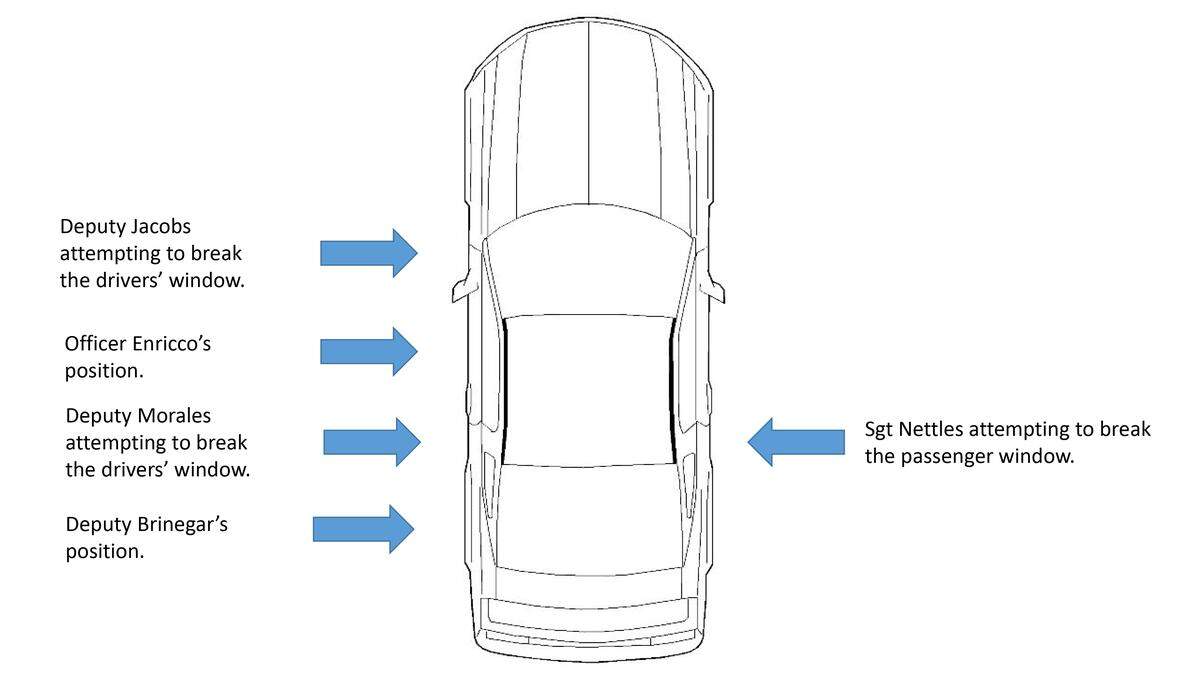
Enricco was the only officer standing in a position that could have fired the bullet that injured Morales, Morales’ lawyers have argued.
Also sued was Wagoner, who commanded the the special response team the night Morales was shot, the city of Georgetown and the Georgetown Police Department. Wagoner has since retired from the department. Enricco also has since left the department.
In December 2021, Circuit Court Judge Brian Privett ruled law enforcement officers involved in the shooting of Morales could not be sued because of qualified immunity.
The state Court of Appeals reversed on whether Wagoner could be sued for failure to supervise the operation. The state Supreme Court upheld the Court of Appeals opinion on Wagoner’s failure to develop a plan for the botched arrest of Reynolds.
‘Ministerial’ and ‘discretionary acts’
Lawyers for the city and Wagoner argued in court documents and in oral arguments before the state Supreme Court in June Wagoner and others could not be sued because their actions were discretionary.
Prior court decisions have ruled police officers and public officials can be sued if they fail to follow “ministerial acts,” such as not following rules or orders. Discretionary actions, when an official uses judgment, are immune from lawsuits.
The majority of lawsuits against police are dismissed —particularly in cases involving excessive force —because police officers’ actions are deemed discretionary.
Morales’ lawyers have long argued Wagoner did not fulfill his ministerial duties.
“We believed and continue to believe that a commander of a police unit has a ministerial duty to appropriately plan for exigent circumstances and in this circumstance to apprehend a dangerous suspect,” Miller said.