Brooks Houck’s sister testifies in Crystal Rogers murder trial: ‘I was paranoid’
READ MORE
Crystal Rogers trial
A decade after the disappearance and presumed death of Bardstown mother Crystal Rogers, a jury will hear evidence against two men charged with killing her.
Expand All
For the first six days of Brooks Houck’s trial in the death of Bardstown woman Crystal Rogers, he remained stoic and attentive.
Houck rarely moved in a button-up dress shirt, his hair a buzz cut, sitting silently as his team worked to defend his innocence.
That changed Wednesday when his younger sister, Rhonda McIlvoy, took the stand.
Houck, 43, was Rogers’ boyfriend when she disappeared in July 2015. Her body has never been found, but she is presumed dead. Houck was the last person to see her alive, and he and an employee of his construction company, Joseph Lawson, are facing a joint trial.
Houck is charged with complicity to commit murder and evidence tampering. Lawson is charged with conspiracy to commit murder and evidence tampering.
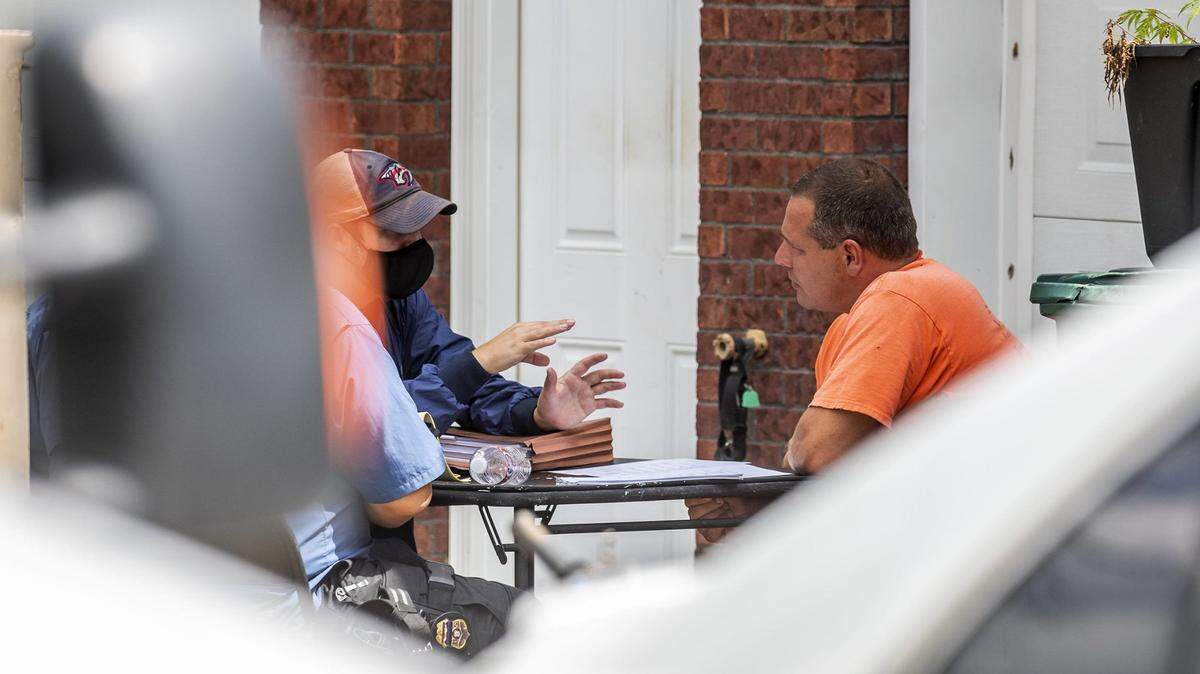
Houck held back tears Wednesday morning as his sister told a jury of the toll the case had taken on Houck’s family.
Accusations haven’t been limited to Houck in the 10 years since Rogers went missing. Though no other family members have been charged, prosecutors have said McIlvoy, Houck’s brother, mother and grandmother were all involved in Rogers’ disappearance in some way.
“I was paranoid,” McIlvoy said. “My family was paranoid due to the threats and accusations.”
Houck and Lawson’s trial began June 24. Prosecutors rested their case Tuesday.
‘Paranoia’ caused Houck family to record grand jury
On Wednesday, the first day of defense testimony, McIlvoy said her family was subject to threats and accusations “immediately.”
McIlvoy moved her children to different schools twice before eventually moving out of state, to North Carolina, in November 2015.
That same year, lead investigator Detective Jon Snow told McIlvoy investigators had a photo of her babysitting Eli, Rogers and Houck’s son, the night of July 3, when Rogers went missing.
McIlvoy testified she didn’t ever see the photo, and had already turned over photos to police that placed McIlvoy and her children at the Louisville Science Center the night of July 3.
“I was upset because I was being accused of something I knew was impossible,” she testified.
This was part of the reason McIlvoy decided to begin recording interactions with law enforcement, she explained to jurors.
McIlvoy and other members of the Houck family illegally recorded grand jury proceedings, which happen in private, with only jurors, the witness and prosecutors present.
“With the environment we lived through, I had a gut feeling,” she explained. “I wanted proof of what I did and didn’t say.”
She said there were no prior meetings for discussions with her family members to conspire to record the hearings. McIlvoy said she only learned others recorded the proceedings from the news.
But when confronted with recordings from the devices police recovered, which contained audio of McIlvoy speaking with Houck before going into the grand jury room, she said she didn’t remember that conversation.
“I don’t remember, but I am not denying it,” she testified.
A juror submitted a question to the judge asking if the grand jury was the first time she had recorded.
McIlvoy responded, “I know I used a cell phone recorder,” she said. “It was more than the grand jury.”
She could not recall whether that was before or after the grand jury testimony.
McIlvoy testified neither she nor her brother, Brooks Houck, was ever part of a conspiracy to kill or harm Rogers.
K9 expert discredits prosecution witness for human remains
Also on Wednesday, Heath Farthing, an expert K9 handler, questioned the reliability of testimony one day earlier from a man who claimed his dog detected human remains near the trunk of a white Buick belonging to Houck’s grandmother.
A major issue with the report from the handler, Terry Benjamin, was that the dog, Ranger, was“cross-trained,” so the dog was taught to recognize both scents of live humans and human remains.
Multiple agencies, including the Federal Emergency Management Agency, do not recognize cross-training, and haven’t since Sept. 11, 2001. Farthing was at Ground Zero on Sept. 12 and said the problem was that the dogs were detecting dead bodies before they would lead rescue teams to people who were alive.
Additionally, Benjamin admitted the certification and training records for Ranger were lost during a move in 2017, so prosecutors had no proof the dog was equipped to detect human remains.
Special prosecutor Shane Young admitted, “Things could have been done better,” with the K9 search.
Houck paid a flat rate of $10,000 for Farthing’s services, according to testimony.
This story was originally published July 2, 2025 at 1:37 PM.
.jpeg)