‘It’s a passion.’ Stumbo wants to be KY attorney general again to fight Big Pharma.
Editor’s Note: This is the second of two profiles of candidate for Kentucky attorney general.
It looked like Greg Stumbo closed his long career in Kentucky politics in 2016 — or had it closed for him.
Floyd County voters dumped him from the Kentucky House seat he held for 36 years, not counting his detour from 2004 to 2008 to serve as attorney general and run unsuccessfully for lieutenant governor under Louisville businessman Bruce Lunsford. Stumbo spent his final eight years as House speaker, ending up the highest-ranking Democrat in a state Capitol swinging to Republican control.
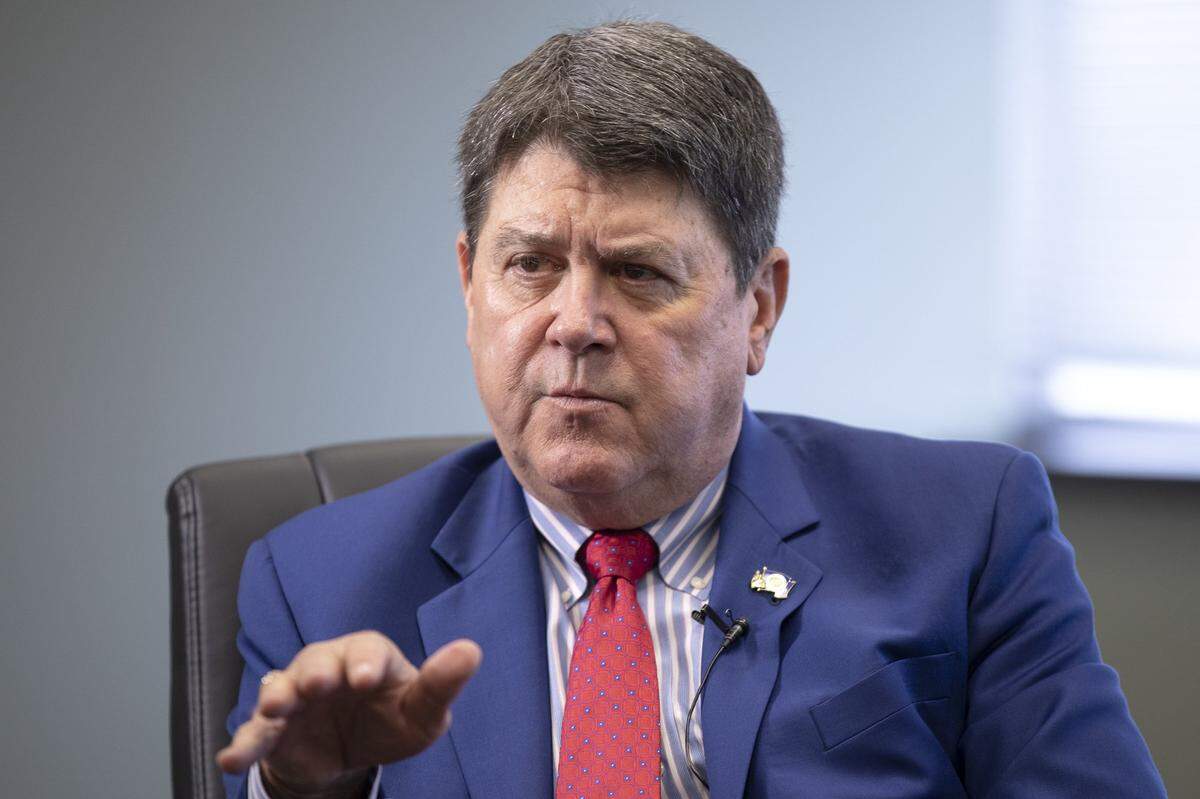
Three years later, the 68-year-old Stumbo is planning a comeback Nov. 5 by campaigning again for attorney general. He shrugs off his 2016 defeat. That was a calamitous election for Democrats everywhere, he said in a recent interview.
“We got caught up in the Donald Trump tsunami,” Stumbo said. “I lost, I think, 16 House members that night. It’s just a part of politics.”
Stumbo said he wants another shot at the attorney general’s office so he can create a massive pool of cash that Kentucky could use to provide desperately needed addiction treatment. The money would come from suing the companies that are responsible for the opioid addiction crisis, he said. The General Assembly would never provide enough funding from tax revenue, he added.
“It’s estimated that we’ve got over 400,000 addicts in Kentucky,” he said. “And we’ve got about, what, 4,000 (treatment) beds, 5,000 beds? So you can see the disconnect.”
Outgoing Attorney General Andy Beshear, a Democrat running for governor, is pursuing nine addiction-related lawsuits seeking damages from lucrative pharmaceutical manufacturers and distributors. Those cases are in the discovery phase, where potentially incriminating evidence about the companies’ behavior is being turned over to the attorney general in preparation for trial.
“They’re good cases,” Stumbo said. “We’ve fought through all their motions to dismiss. And we’re litigating against some of the biggest corporations in America, so it’s not something that’s an easy task to do.”
As a lawyer at the Florida-based firm of Morgan & Morgan, Stumbo was helping the attorney general’s office with the opioid cases until Republican Gov. Matt Bevin’s administration got the firm’s contract canceled in August in a spat with Beshear, his challenger this election year.
Stumbo said he doesn’t want to let go of the suits until the pharmaceutical industry is appropriately punished for creating a generation of addicts. (Even as Stumbo campaigns on this theme, four of the nine drug companies that Kentucky is suing are trying to negotiate a massive settlement with state and local governments that could provide nearly $50 billion in cash, overdose antidotes and treatment drugs.)
“It’s a passion with me,” Stumbo said. ”I’ve seen what it’s done to my community. I’ve seen what it’s done to my family. I’ve seen what it’s done to other families. And I think the people who caused it ought to be held accountable in a court of law.”
In one of his campaign ads, “The Walk,” Stumbo kneels in his family cemetery in Floyd County. Before him is the grave of a cousin who died in 2014 at the age of 34 from drug use.
Can he reopen Purdue Pharma settlement?
“I was the first attorney general in the nation to sue Purdue Pharma,” he said in his interview. “It took us two and a half years, three years almost, to come up with a legal theory that wouldn’t get kicked out of court. No one said we could do it. Everyone said, ‘Well, once the DEA approves a drug for its use, you can’t sue the manufacturer. They’ll kick you out of court quicker than you can imagine.’”
The lawsuit to which Stumbo referred accused Purdue Pharma of fraudulently marketing its prescription painkiller OxyContin as “nonaddictive.” The state of Kentucky alleged that OxyContin abuse caused an explosion in opioid addiction and increased medical costs throughout the state, particularly in Eastern Kentucky, from which the company profited enormously.
The case was settled in 2015 by Stumbo’s successor, Democrat Jack Conway, for $24 million — “a record settlement at that time,” Stumbo said.
Bevin and Republican lawmakers in Frankfort often criticize that settlement for several reasons, not the least of which is the relatively small sum Conway won. Months before the settlement, Stumbo boasted about the suit: “I always thought if we ever got it to a court of law a billion dollars wouldn’t touch it.” Recent addiction-related settlements and trial verdicts have been much larger, with Purdue Pharma filing for bankruptcy this year in an attempt to establish a litigation settlement fund worth billions of dollars.
Stumbo declined to criticize Conway’s resolution of the suit. But he said he’s interested in possibly pursuing criminal charges against the Sackler family, which owned Purdue Pharma, and revisiting the $24 million settlement now that more information about the company’s business practices has poured out through subsequent litigation with other plaintiffs.
“One of the things I want to do is look at that case because I have a feeling that Purdue Pharma did not give Jack Conway the correct information. In discovery you’re entitled to ask for things. If they withheld information which we now know is in the public sphere — if they falsified information, that’s technically grounds to set that (settlement) aside,” Stumbo said. “I don’t know that they did that. But I just have a feeling that they did.”
Stumbo, who has 43 years of experience as a lawyer, said he works on a variety of cases for the complex litigation section at Morgan & Morgan, reporting from Kentucky to its Jacksonville, Fla., office. Morgan & Morgan attorneys have contributed at least $91,700 to Stumbo’s campaign this year, or 28 percent of the $329,068 he had raised by Oct. 5. If elected, he said, he will divest himself of any stake in the firm to avoid financial conflicts of interest in case Morgan & Morgan receives more state contracts in the future.
Stumbo pledges to be ‘people’s attorney’
When he was attorney general a decade ago, much of Stumbo’s time was spent prosecuting the administration of Ernie Fletcher, the first Republican governor in 30 years, for allegedly awarding state merit jobs as political patronage to campaign donors and other GOP loyalists. That was illegal. So-called non-merit jobs — political appointments, like cabinet secretaries — are awarded at the governor’s pleasure, but rank-and-file state jobs are supposed to be dispensed based on neutral qualifications.
A grand jury convened by Stumbo indicted Fletcher and 15 members of his administration for violating the merit system. Fletcher issued mass pardons for his aides before reaching a deal with Stumbo in which he admitted wrongdoing by his administration and agreed to revamp the state Personnel Board, at which point Stumbo dropped the criminal charge against Fletcher. But Fletcher had sunk so low in the polls by then that he lost his re-election bid in 2007.
No hard feelings, Stumbo said. He knew Fletcher from their time together in the Kentucky House years earlier and he liked him well enough, he said.
“We didn’t go looking for an investigation into Governor Fletcher,” he said. “That case was brought to us by a whistle-blower who had compiled the evidence, and it was pretty compelling. We had no choice but to look at the matter. Quite frankly, I never thought it would go as far as it did. I thought that once Governor Fletcher knew about it he would change course and correct it.”
“If Matt Bevin were to be governor and I were to be attorney general, as long as he didn’t give me any cause to investigate him, I’m not going to go looking for a reason to investigate him,” Stumbo added.
However, the attorney general is “the people’s attorney,” Stumbo said. Just as Beshear has filed lawsuits challenging the governor and legislature at different times, Stumbo said he would feel obliged to act if other elected officials in the Capitol did something illegal.
For example, he said, Beshear was correct to challenge “the sewer bill,” a controversial law that would have reduced retirement benefits for public employees, most notably by ending traditional pensions for school teachers. The General Assembly rushed the measure to passage in what had been a wastewater treatment bill during the final hours of the 2018 legislative session.
After Beshear sued, the Kentucky Supreme Court unanimously struck down the law, ruling that lawmakers moved so quickly they did not follow proper legislative procedure.
“If teachers’ rights are being violated, if consumers’ rights are being violated, if seniors’ rights are being violated ... would we come to the aid of people like that? Yeah. We did it before,” Stumbo said. “Some of the things that General Beshear filed suit on were egregious enough that he had no choice.”
Greg Stumbo On The Issues
Question: Kentucky drug overdose deaths increased in 2017 to 1,565, or more than four a day. Police tell us they see a resurgence of meth just as the state has started to reduce the flow of some opioids. What would you do to address drug addiction and the criminal activity that comes with it?
Answer: “Kentucky has about 400,000 addicted people with only 5,900 (2018) treatment beds. I am focused on finishing the cases against the opioid manufacturers and distributors to get Kentucky the funds we need to put directly toward substance abuse treatment, prevention and education. With more people receiving treatment, criminal activity will reduce and Kentucky can heal.”
Q: A majority of states have decreased their prison populations over the past decade, thanks to falling crime rates and various penal reforms. But Kentucky’s state inmate population has risen to 24,300, filling all 13 prisons and dangerously overcrowding many jails. Do we need to rethink how we prosecute crimes in Kentucky?
A: “I support criminal justice reforms, and as attorney general, I will lead a bipartisan commission with the governor’s secretary of justice and the legislature to develop a comprehensive criminal justice plan that reduces penalties for some nonviolent crimes, freeing our jails of space while continuing to be tough on violent crimes.”
Q: As attorney general, Andy Beshear went to court to challenge Gov. Matt Bevin and the legislature when he believed they had done something unconstitutional. Do you feel that’s an appropriate function for the attorney general, one that you would continue?
A: “Yes. As attorney general, I will uphold and defend our constitution, which is the main charge of the office. This issue is one of the defining differences between my opponent and me. He has publicly stated that the AG’s role is to defend whatever legislation the legislature passes, regardless of how unconstitutional it may be.”
This story was originally published October 23, 2019 at 3:20 PM.