
Kentucky judge urges compromise on COVID-19 laws. He will rule within 10 days.
After a hearing that lasted more than four hours Thursday, Franklin Circuit Judge Phillip Shepherd said he hopes to decide within 10 days whether to issue a temporary injunction requested by Gov. Andy Beshear to block three news laws that limit the governor’s powers to deal with emergencies like the coronavirus pandemic.
Shepherd also said he will continue a temporary restraining order he issued Feb. 3 against one of the new laws — House Bill 1 — that allows businesses, schools, nonprofits and churches to stay open if they meet COVID-19 guidelines set by either the federal Centers for Disease Control and Prevention or Kentucky’s executive branch, whichever is least restrictive.
The judge strongly urged the Democratic governor and the top two legislative leaders — Senate President Robert Stivers and House Speaker David Osborne, both Republicans — to try to find a way to resolve their differences.
He said he is aware of the legislation’s impact on public health implications and the concerns raised by the legislature concerning the balance of government powers.
He said there appears to be “a communications gap” between the two parties and urged them “to see if you all can’t enlist the help of people who are knowledgeable in these areas to see if you can’t find some common ground in terms of ways to address this that would protect the legitimate interests of the legislature and the governor.”
Shepherd added that he has seen over the years that public health issues have been dealt with in non-partisan ways and this one should, too.
Much is at stake in this case for whichever party might lose the legal battle.
Beshear’s lawsuit challenges three laws the General Assembly approved earlier this month over Beshear’s vetoes, but the restraining order only deals with HB 1. All three bills contained emergency clauses and thus immediately became law.
The other two are Senate Bill 1, which would limit the governor’s emergency orders, such as one that requires Kentuckians to wear a face covering in public, to 30 days unless the legislature extends them. It also says the attorney general would have to sign off on the suspension of state law in an emergency, and it removes the ability of the governor and secretary of state to decide the manner in which an election is conducted during an emergency.
Senate Bill 2, a companion bill to SB 1, would give the legislature more power over administrative regulations issued during an emergency.
The governor claims in his lawsuit that the laws are unconstitutional and hurt his ability to protect all Kentuckians from COVID-19 and other emergencies. So far, the coronavirus pandemic has led to more than 4,300 deaths in Kentucky.
Defending the laws is Victor Maddox from Attorney General Daniel Cameron’s office.
Beshear’s general counsel, Amy Cubbage, at Thursday’s hearing asked for a temporary injunction against the legislation, saying the Kentucky Constitution sets up separation of powers between the branches of government. She noted that the Kentucky Supreme Court last year unanimously ruled that the governor has the authority to issue emergency orders.
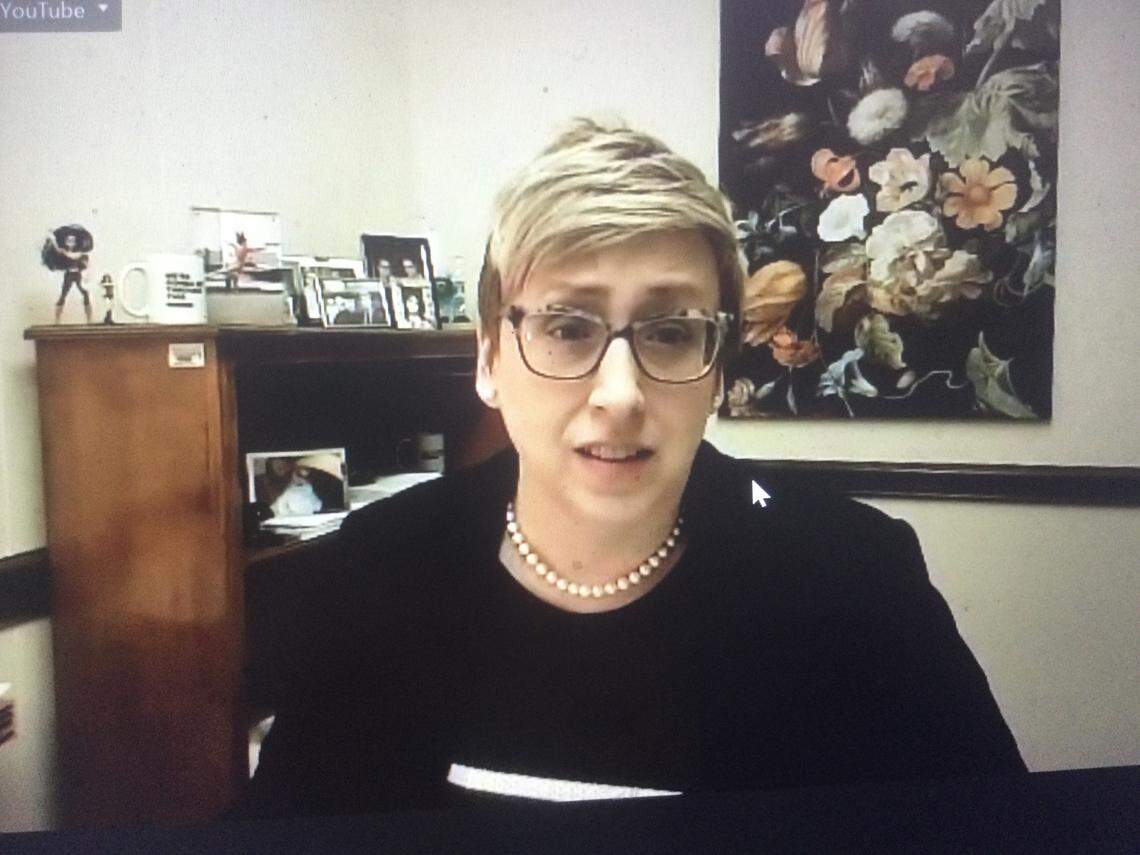
She noted that the current executive orders dealing with COVID-19 will expire March 4 unless the legislature extends them and that a court ruling is needed before then.
Beshear expounded on that later in the day, saying he was concerned that all his emergency orders are in jeopardy.
“It is a critical we get a ruling before then or the Senate and House agree to continue what we have in place that has worked,” he said.
Shepherd directed the parties involved to file with the court by Feb. 19 a list of all currently binding executive orders and emergency regulations that would expire March 4.
Beshear said he didn’t watch much of the hearing but was concerned that the attorney general’s office raised questions about the effectiveness of the mask mandate.
“It is so critical,” Beshear said. “I think every Kentuckian can imagine what it would be like walking through, first of all, a facility that has no capacity limitations and nobody is wearing masks when we are about to beat this virus. We have to be more responsible than that.”
Cubbage presented two witnesses to talk about the effects of the new legislation in the fight against COVID-19 — Dr. Steven Stack, the state public health commissioner, and Nicholas Hart, environmental health manager for the Louisville Metro Department of Health and Welfare.
Both Stack and Hart said the legislation would hamper their work.
Stack said HB 1 would not work because it would be difficult for businesses to translate federal guidelines, which are sometimes vague or contradictory. He said it is better to have a statewide response through public health departments and not to render the executive branch powerless. “We would have no enforcement authority,” he said.
Regarding SB 1, Stack said it would require a full-time legislature to keep up with the changing guidelines.
Hart said the new legislation would mean public health policies in place to fight COVID-19 “almost would have to start from scratch.”
He said he is perplexed how Kentucky health officials would have responded if such laws were in place at the onset of the pandemic.
Maddox peppered Stack and Hart with questions about the basis of the state’s policies and whether they have been successful. The witnesses defended what the Beshear Administration has done.
During the hearing, Maddox noted that the attorney general’s office has filed a motion to dismiss Beshear’s lawsuit.
Judge Shepherd gave the governor’s attorney two weeks to file a response to Cameron’s motion.
This story was originally published February 18, 2021 at 3:35 PM.
