
On the path of the ‘Lost Cause’ in Kentucky, signs of a new one.
READ MORE
Our House Divided
A reporter’s journey through Kentucky’s Civil War history with an eye on today’s divided politics.
Expand All
Editor’s Note: Daniel Desrochers was the Herald-Leader’s political writer for 5 years. This was his final assignment in Kentucky before moving to Washington D.C. to join McClatchy’s Washington Bureau, covering politics for the Kansas City Star.
Analysis
It is steamboat season in Paducah. Over the course of a day, more than 100 people will leave the ship that’s cruising the Ohio River, file onto a bus and arrive at the Lloyd Tilghman House, a Civil War museum owned by the Sons of Confederate Veterans.
There they will see a small, ceramic riverboat in a crowded foyer, a replica of the Jefferson Davis statue that formerly occupied the rotunda in Frankfort, an old violin, a piano, charts and maps talking about the history of the Civil War in the Western theater, a panel detailing the time Ulysess S. Grant kicked Jewish people out of Paducah during the war, several iterations of the flag of the Confederate States of America, more than two dozen Civil War-era weapons, a school project diorama of a Civil War-era fort near Paducah that no longer exists, a portrait of Confederate general and Klu Klux Klan grand wizard Nathan Bedford Forrest, a map showing the troop movements of Forrest’s attack on Paducah, two men dressed in replica Confederate uniforms with buttons that say “SCV” and a kindly man with gray hair and shining blue eyes named Bill Baxter.
Baxter, 73, is not a son of a Confederate veteran. He is not the grandson or great grandson of a Confederate veteran. He is a veteran who served as a colonel in the United States Air Force and advised former Secretary of Defense William Cohen at the Pentagon. He is the volunteer director of the museum.
“I have never taken one red cent (from the Sons of Confederate Veterans),” Baxter said on his back patio as a storm rolled in from the river. “The minute I have to take money for what I do over in that house, they control me. ”
He is the Yankee in the Confederate general’s foyer.
Baxter originally started volunteering at the Llloyd Tilghman House when it was still owned by the city. He fretted, when the Sons of Confederate Veterans purchased it in 2008, that they would make him whistle Dixie, run the Confederate battle flag up the flagpole and give a spiel about how the South would rise again.
They haven’t. He said they’ve allowed him to run the museum without interference, even as members of the local chapter of Sons of Confederate Veterans are some of his volunteers.
“We’re not presenting a Confederate message,” Baxter said. “We’re talking about Paducah’s Civil War heritage and not the Lost Cause.”
Baxter is passionate about the Civil War. He’s fascinated by what made the leaders of the time tick. He likes to talk about how Ulysses S. Grant and William Tecumseh Sherman became friends right there, in Paducah, a friendship forged on Kentucky soil that would go on to shape the outcome of the war and, with it, the trajectory of the country.
But to operate a Civil War site in Kentucky, especially one owned by the Sons of Confederate Veterans, is to bump up against the Lost Cause. The myths of the movement — that the war wasn’t about slavery and was a heroic effort to preserve the southern way of life — have seeped deeply into American culture, perpetuated for more than a century by politicians, organizations like the Daughters of the Confederacy, books like Gone With the Wind and in family stories about the war.
Now, some of the relics of the Lost Cause are being reexamined. Statues across the country are coming down and, when they do, they inevitably result in someone, somewhere, shaking his head, saying that they’re trying to erase history.
There is history in the statues, particularly how they got there in the first place. How a statue of Jefferson Davis was put in the Kentucky Capitol, the only white statue in the rotunda. How former Confederate officers came to be placed on pedestals near where Black people used to be sold in Lexington, even though more Kentuckians fought for the Union than the Confederacy. How, when the old axiom is that history is written by the victors, for much of American history the story of the Civil War has been told by the losers.
And, if parallels are to be drawn from the past to the present, where similarities to the war and its aftermath occur today.
Baxter finds them in former President Donald Trump, particularly in his false claims that the election was stolen, and the stricter election laws that have followed.
“They just constantly are lying to you,” Baxter said. “And that’s what Jefferson Davis and the whole group of them, through their writings and through their publishing and their passing of the Jim Crow laws. It’s all analogous. We’re doing it in a more sophisticated way today probably, but it’s getting done. And it’s just the idea that they’re slowly trying to take back that power that they know that they’re losing.”
In other words, “the Big Lie,” as Democrats like to call it, could become the new “Lost Cause.”
*****
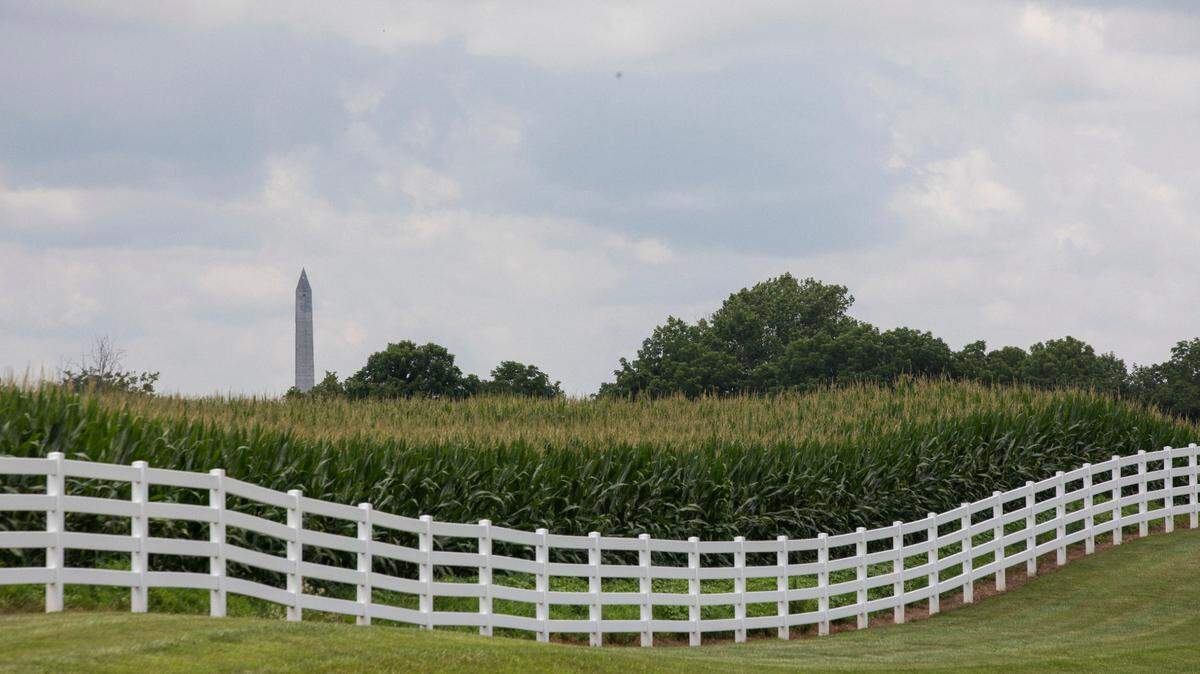
Even when the sun isn’t shining bright in Western Kentucky, even when the corn top’s not ripe and the meadow’s not in the bloom, you can see Jefferson Davis’ monument from about five miles away on U.S. 68.
It looms, the 351 foot concrete obelisk, over the land where Davis was born and briefly lived before his family moved to Mississippi. There, they would at one point own $89,000 worth of human beings — the equivalent of at least $2.9 million today — as David Smith, the park manager of the Jefferson Davis State Historic Site likes to phrase it for children who come through his museum.
If you were hoping to learn that fact, you would have to be there when Smith is roaming about. There is no mention of Davis’ slaves on the panels in the museum, nor the fact that the Civil War was fought over slavery and that Davis believed Black people inferior to whites, despite the fact that the panels were last modified in 2018 after a review with the Kentucky Historical Society. Smith said he likes that he can be the one to provide the context when people come through the museum, 75 percent of whom, he said, have no idea who Jefferson Davis was, they just see the big hulking mass of concrete from the road and stop in to see what the heck it is.
“History is not an unfiltered version of the past, it’s the stories we tell each other to make sense of the present,” said Anastasia Curwood, a history professor at the University of Kentucky. “So what was really important to white Americans in politics after the Civil War was to forget the egregious human rights abuse of slavery as something that the war was fought over.”
Davis was imprisoned for two years after the war for treason until he was released on bail. His charges were later dropped. He struggled to find work and bounced around the south until he settled back in Mississippi. In 1881 he published the book The Rise and Fall of the Confederate Government, which downplayed the role of slavery in the war and laid out the argument that the South had the constitutional right to secede from the Union. He attended ceremonies honoring Confederate soldiers throughout the South and spoke to adoring crowds.
Trump, too, has been writing. Almost every day he sends out press statements, sometimes several statements on a slow Sunday. They range from endorsements of conservative candidates to monologues about how a golf tournament should be played at the course he owns to just one sentence lines like “Who shot Ashli Babbitt?” the woman who was killed by Capitol Police while storming the Capitol.
Like Davis, he has also toured the country speaking.
Rallies have always been Trump’s lifeblood. Here he is the preacher, the maestro, the rock star playing his biggest hits, churning out the lines he knows will make his fans cheer. Lately, he’s been including lines about how the election was stolen from him and celebrating the partisan audit of the election in Arizona, even though the election has been certified and all of the Trump campaign’s legal challenges were dismissed.
In May, 61 percent of Republicans said they believed the election was stolen from Trump, according to a poll by Ipsos and Reuters. There are degrees to which people believe this. Some just believe that there was some suspicious activity at the polls. Some believe there was a vast conspiracy to elect Biden. Others believe that Trump will return to office as President this year.
“It’s based on lies and the erosion of trust in traditional institutions,” said Tres Watson, a former spokesman for the Republican Party of Kentucky. “People have to trust or believe in something and as trust in traditional institutions has eroded, you’ve got to go somewhere and some people have gone to Donald Trump and this America First Movement and therefore they have trusted the lie over veracious levels of fact and reality. Because the facts are being delivered to them by institutions that they no longer trust.”
It can sometimes be difficult in politics to tell whether the voters are leading the politician or the politician is leading the voters. But it is clear, as polls have shown a majority of Republican voters are behind Trump, the politicians are following suit. Some have made pilgrimages to see Trump in an effort to seek his endorsement. Others continue to downplay the insurrection on Jan. 6.
Marisa McNee, a Democrat, said she thinks there is an effort to re-frame the 2020 election and the insurrection in a way that paints Republicans in a better light. But she said she’s not sure she thinks it’s the same as the Lost Cause.
“In the current environment, it’s pollsters who are saying ‘you’ve got a problem and you’ve got to re-message this,’” McNee said.
But Trump still has power in the Republican Party, creating an odd wrinkle in the hyper-partisan nature of today’s politics, where the party line has become not to challenge Trump’s assertions.
Watson, the Republican political operative, said he saw some similarities between the Lost Cause and the claims surrounding the 2020 presidential election. But he said you could potentially have a discussion about some of the truths in the Lost Cause narrative, where the election fraud narrative is just built on a lie.
“In this instance, there’s so little basis in reality that you can’t even have a conversation with these people about it because there’s such a disconnect,” Watson said.
Already, the 2020 Presidential election has started to reshape laws across the country. Several state legislatures have passed elections bills while talking about “election integrity,” despite there being no documented cases of widespread voter fraud. Elections experts say the bills will make it harder to vote, potentially reducing the number of people who have a say in which candidates should get to make the decisions that guide our country at every level.
U.S. Senate Minority Leader Mitch McConnell has said publicly that the election was valid. But he has effectively stopped talking about the election, choosing instead to focus on the Biden administration in the hopes it will better position the Republicans to take the House and Senate in 2022.
He’s dismissed the notion that the new election laws scale back voting rights.
When asked in May if he was concerned that many Republicans don’t view the election as valid, McConnell avoided the question.
“100 percent of my focus is on standing up to this administration,” McConnell said.
***
The message of the Lost Cause wasn’t just proliferated through statues and monuments. It was through textbooks and essay contests about Confederate heroes, through pictures of Robert E. Lee in the classroom and cultural censorship. It was through offering a view of slavery as a benign institution.
The Daughters of the Confederacy helped get a bill passed in Kentucky that banned presentations of Uncle Tom’s Cabin. It was later used to prevent the showing of a boxing match between Jack Johnson, who was Black, and Jim Jeffries, who was white. Johnson beat Jeffries handily.
“It is incredible how much of it was deliberately manufactured by women,” said Amy Murrell Taylor, a history professor at the University of Kentucky. “Women who wanted to pay tribute to the men in their families. Women who felt an obligation, as some historians have suggested, to sort of keep propping up the masculinity of the men who were defeated in this war. Women who were happy to propagate the myth of black rapists.”
But while it was perpetuated by groups like the Daughters of the Confederacy, the Lost Cause narrative first shows up through politicians after the war, said Anne Marshall, a history professor at Mississippi State University who wrote a book about the Civil War memory in Kentucky.
“I think politically, the rhetoric of the Lost Cause and this sort of pro-Confederate sentiment really comes out early on,” Marshall said. “Way before this proliferation of statues and magazines and fiction and these other culture relics of the Confederacy. Kentucky politics is really one of the first places the Lost Cause shows up in Kentucky culture.”
The monuments are the relics of the Lost Cause the general public sees most today.
The Orphan Brigade were around 4,000 Kentuckians who joined the Confederacy after Kentucky lawmakers refused to vote to secede from the Union, led by former U.S. Vice President John C. Breckinridge. You can find their flag at most Civil War sites through Kentucky.
Smith, the park manager of the Jefferson Davis State Historic Site, calls them traitors.
Some of the around 400 surviving members of the Orphan Brigade used to meet up every once in a while to talk about the war. At one of those reunions, in 1907, they talked about putting up a monument to Davis in Kentucky. Seventeen years and nearly $200,000 later — at least $15,000 of which came from the Kentucky General Assembly — Davis had his own concrete monument reminiscent of Washington’s.
There’s a sign at the Samuel May House in Prestonsburg, where the Orphan Brigade recruited Kentuckians to join the Confederate cause. It has the text of a letter the Eastern Kentuckians sent to Jefferson Davis about their recruitment efforts.
“The legislature has failed us,” the letter starts.
*****
Lies are just words until they catch hold. The Lost Cause narrative may be fading, but it hasn’t disappeared.
Confederate heritage has always been present as historians like Taylor and Marshall have studied and taught the War.
“It can be very difficult to present a student with a document and information that challenges something that they hold deeply because it’s rooted in who they are as a family,” Taylor said. “It seems to sort of threaten their family.”
On a July evening, after a storm had rolled through Paducah and the light was fading from the sky, the sign on the Lloyd Tilghman house said “open.” The local Sons of Confederate Veterans were having their monthly meeting.
A group of children were playing outside, some of them wearing the gray confederate caps you can buy in gift stores at Civil War sites. A group of men stood nearby in Confederate uniform, watching a truck as it drove away.
This story was originally published November 28, 2021 at 6:00 AM.