KY Senate moves state budget with pay raises and pension funds. Will tax cuts follow?
The Kentucky Senate approved its own version of the next two-year state budget on Wednesday, with many of the same things that Gov. Andy Beshear and the House had in their budget plans, including long-sought pay raises for state workers and full funding for the beleaguered public pension systems.
However, it’s a smaller budget than the House’s, and there are areas of disagreement.
The Senate version of House Bill 1 does not authorize state funding of full-day kindergarten, unlike the House version. It has $250 million to improve Kentucky state parks that the House budget does not have. And the Senate removed a $10 million-a-year grant pool that lawmakers could spend on local projects at their own discretion, which the House wanted.
In January, Beshear called for state funding in the next budget to subsidize universal preschool for 4-year-olds in Kentucky. But neither the House nor the Senate accepted that idea in their spending plans. Senate President Robert Stivers, R-Manchester, said on KET, “I’m not a fan of pre-K. I think kids need to be kids. Let them be out.”
The Senate budget shows a $12.6 billion General Fund in 2023 and a $13.5 billion General Fund in 2024. The House budget was larger, at $13.1 billion and $13.6 billion, respectively.
Among the places the Senate saved money, it recommends $200 million less than the House on additional debt payments to the state employee pension system, beyond the actuarial requirement in the budget, and it provides less to school districts for transportation and other support costs as well as less for capital construction projects.
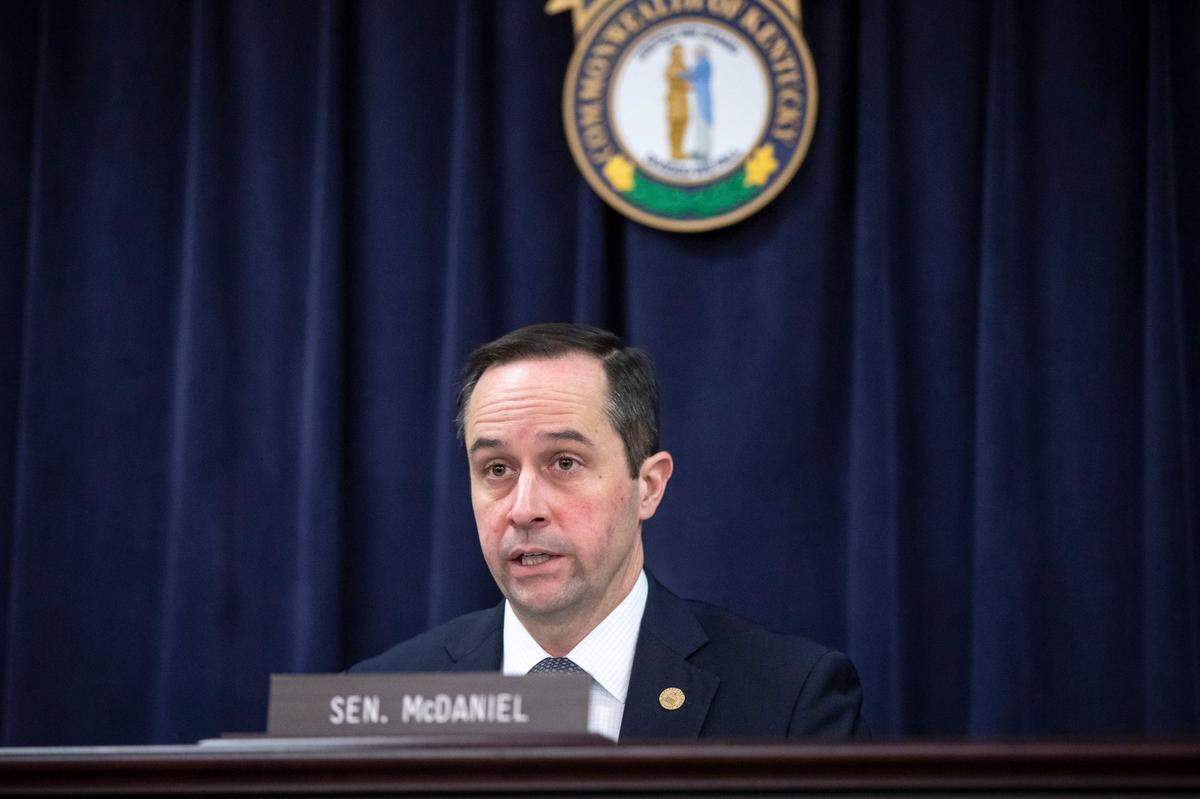
The Senate version would leave Kentucky with $1.75 billion in the “rainy day” budget reserve trust fund and $1.27 billion in unspent money, Senate Appropriations & Revenue Committee Chairman Chris McDaniel, R-Ryland Heights, said Wednesday.
That $1.27 billion in unspent money could be tapped as lawmakers debate several proposed tax changes.
Beshear, a Democrat, called for a temporary reduction in the state sales tax to help Kentuckians deal with the rising prices of inflation. But the House Republican majority wants the gradual elimination of the state income tax and the expansion of the sales tax. The Senate Republican majority wants a one-time income tax rebate.
Fiscal notes prepared by legislative analysts show the House tax plan would cost more than $1.36 billion in net losses over the next two years, while the Senate tax plan would cost $1.15 billion this fiscal year.
The price of the House GOP tax plan is more than the $1.27 billion cushion set aside for lawmakers’ discussion on tax changes, so something else would have to be cut, McDaniel acknowledged to reporters on Wednesday.
“Yeah, certainly. When we leave, we’ve gotta have a balanced budget. So in the event that that were to be implemented, at full implementation, it would certainly result in either some cutting from someplace else or the rainy day fund would have to be reduced,” McDaniel said.
House and Senate budget negotiators will be asked to work out a final compromise over the next week or two.
Thanks in large part to federal pandemic relief spending, Kentucky is in better financial shape than usual, with an anticipated surplus of $1.9 billion when the current fiscal year ends June 30.
This was the first year in recent memory that all new revenue was not consumed by pension and Medicaid spending, McDaniel said.
“We had the ability this year to fund additional priorities in the commonwealth, and we took a very conservative and measured approach to those priorities,” he said.
The top priority was raising the pay of the state workforce, he said.
Most state employees would get a $4,500 raise in the first year of the budget. The Senate bill contains language providing for a “similar” raise in the second year, based on a Personnel Cabinet study of the employees’ positions and cost-of-living by region. Kentucky State Police and social workers would get separate, larger raises.
The House structured its raises a little differently, recommending 6 percent pay raises in the first year and, like the Senate, calling for a salary study in the second year. A few groups awarded special pay raises by the House, such as public defenders at the Department of Public Advocacy, were left out by the Senate.
Although Beshear’s budget proposal called for mandatory pay raises for school teachers, the Senate budget — like the House budget — does not. Both legislative chambers would increase the guaranteed per-pupil SEEK funding for school districts, from $4,000 this year to $4,100 in Fiscal Year 2023 and $4,200 in Fiscal Year 2024.
Given those new resources, plus some additional state transportation funding, school districts should make their own decisions on teacher pay raises, McDaniel said.
“There is plenty of money for teacher raises in there,” McDaniel said. “The problem is, when you mandate raises, it has to flow through the SEEK formula, and it hits different districts differently. So this allows them the flexibility to maintain their own current board policy. And if they want to do raises, absolutely they can.”
Like the House budget, the Senate version would allocate several billion dollars in actuarial required funding for the pension systems of state workers and teachers, which face huge shortfalls, as well as $215 million more to pay down a worsening unfunded liability for the Kentucky State Police pension fund.
This story was originally published March 9, 2022 at 12:18 PM.