
From marijuana to the budget: 8 bills to watch as the General Assembly hits final stretch
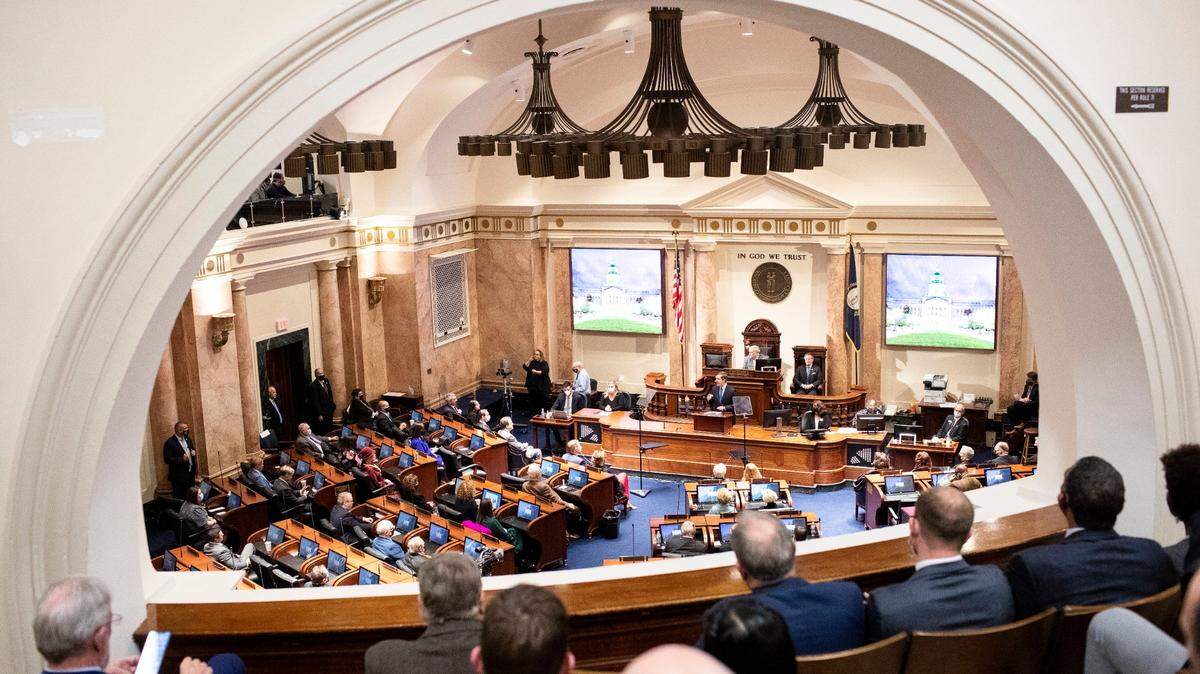
This is the last full week for the Kentucky General Assembly to legislate before the governor’s 10-day veto period begins on March 31. High-priority bills from GOP legislators have advanced through different chambers in recent days, including proposed shifts to Kentucky’s tax structure, major cuts to unemployment and public assistance, as well as an effort to fund charter schools.
Here are eight bills to keep your eyes on in the waning days.
House Bill 136: Legalizing medical marijuana
Following some hubbub over a Democrat-backed bill that would legalize recreational marijuana, a much more conservative bill legalizing the drug in a medicinal context passed the House last week 59-34.
Rep. Jason Nemes is sponsoring the 141-page bill, and says that he combed through the bill with lawmakers who were previously cynical of legalizing medical marijuana. It gained at least one key supporter in the more deliberative Senate in judiciary committee chairman Whitney Westerfield, R-Crofton. Received on Friday, it has yet to be assigned to committee in that body.
Nearly all Democrats and a slim majority of Republicans in the House supported the bill, saying that medical marijuana would provide important relief to people in pain. Republican opponents characterized the bill as a slippery slope for the state to eventually legalize the drug for recreational use.
House Bill 4: Reducing state unemployment benefits
House Bill 4 reduces the benefits that the state provides to unemployed Kentuckians, cutting the current length of time that unemployment insurance is available to Kentuckians in half from 26 weeks to three months.
Supporters say that the legislation will get people re-entering the workforce at a faster rate while critics say the bill makes unnecessary cuts to an important lifeline and will disproportionately impact areas that are already economically depressed.
The bill passed the House and Senate, but not without some serious hand-wringing from Democrats and a handful of Republicans. Sen. Phillip Wheeler, R-Pikeville, tearfully quoted scripture on the Senate floor about caring for the poor and said that the bill will “cause great misery in my home.”
It was vetoed by Gov. Andy Beshear, who added that the bill does not appropriate any money but adds a significant personnel and resource burden to the Office of Unemployment Insurance.
HB 8: Cutting the state’s personal income tax
House Bill 8 would completely reshape Kentucky’s state tax structure. The bill from Rep. Jason Petrie, R-Elkton, proposes an eventual erasure of the state personal income tax in favor of relying more on sales tax. The bill also introduces several new services to which the state’s current 6% sales tax – which currently only applies to a limited number of items excluding food and medicine – would be expanded, but that doesn’t compensate for the major loss in immediate revenue the state would take by shifting from a 5% tax on personal income to 4%. Personal income currently supplies Kentucky with 40% of its revenue.
Further cuts to the tax rate, Petrie has emphasized, will occur only when the state hits certain revenue triggers. For instance, the state’s General Fund would have to pull in more than $21.5 billion for personal income tax rates to get to zero – the fund’s receipts totaled $12.8 billion in the most recent fiscal year, a figure that’s expected to grow in the current year.
Petrie and House Republicans, all of whom voted for the bill in its hasty passage out of the House, claim that such a seismic shift in tax structure will help lure businesses and earners alike to Kentucky, which is bordered to the south by Tennessee. The Volunteer State has never taxed personal income. Critics like the Kentucky Center for Economic Policy have called it one of the worst bills ever, arguing that it’s an unfair handout to the wealthy and a strategy that would cripple future budgets.
After passage in the House, the bill was assigned to a Senate committee two weeks ago but has yet to receive a hearing.
House Bill 1: The budget
House Bill 1 is the reason the General Assembly meets in ‘long sessions’ during even-numbered years. It’s the state’s Executive Branch budget over the next two years. There are separate bills for the state’s judicial branch and legislative branch budgets, but the scale of the executive branch’s budget is the largest by far.
Rep. Jason Petrie, R-Elkton, bucked tradition this year by proposing the House GOP budget that he sponsored before Gov. Andy Beshear presented his own executive budget – a privilege normally conferred to the governor.
As is often the case, the House and the Senate do not exactly agree on all items – though the two GOP-led chambers’ budgets have more in common with each other than the Governor’s. The budget is now undergoing a review process with oversight from both chambers to hammer out differences and disagreements between them.
Big spending items to watch for as the budget is under negotiation: funding of full-day Kindergarten, state employee raises, pension funding commitments, and extra money for state parks.
House Bill 9: The charter school bill
Aimed at opening charter schools in Kentucky, House Bill 9 has gained a significant amount of attention without even being heard in committee yet. It was removed at the last minute from the House Appropriations and Revenue Committee’s agenda last week, to the delight of some Democrats; that’s not to say, however, that the bill couldn’t resurface or have many of its provisions get tucked into a different piece of legislation.
Beshear last week made his stance on the bill clear: he will veto any charter school bill that comes to his desk.
Charter schools were approved in Kentucky in 2017, but the General Assembly has yet to provide a permanent funding mechanism for the institutions.
Senate Bill 194: A $1.15 billion tax rebate
Meant to provide relief to those hit hard by inflation, Senate Bill 194 would rebate up to $500 dollars to Kentuckians in state income taxes. The plan would cost the state $1.15 billion of its current fiscal year surplus, which is projected to close out on June 30 at $1.9 billion.
The measure passed the Senate swiftly last month, but has not been assigned to a House committee. Sponsor Sen. Chris McDaniel, R-Taylor Mill, who is also the Senate Appropriations & Revenue Committee chairman, heralded the effort as equitable since it caps the rebate at $500 per person or $1,000 per household; others were quick to point out, though, that many of the poorest Kentuckians don’t pay income tax and therefore wouldn’t qualify for a rebate.
Can McDaniel’s effort and House Bill 8, which takes away nearly $1 billion in state revenue the first year it’s implemented, coexist?
“They can,” McDaniel said on Kentucky Tonight last week.
House Bill 7: More restrictions on public assistance
House Bill 7, like House Bill 4, places more restrictions on dollars that the state provides to Kentuckians in the hopes of prodding more of them into the workforce. It would place new requirements on people leaving Medicaid and those looking to retain eligibility for some programs; it also creates a public assistance oversight committee and a job placement program for those enrolled for state medical assistance.
Critics have pointed out that the bill would unfairly punish those who misuse their benefits, banning them from any public assistance programs for five years if they’re caught selling their benefits three times. Cabinet for Health and Family Services Secretary Eric Friedlander said that the bill would cut benefits to the lowest-income Kentucky families and that the bill’s passage would necessitate hiring 500 additional employees.
Advocates for the bill say that it ensures that the safety net remains in place for those who truly need it, but that it’s a necessary step toward to “modernizing” public assistance.
The House passed House Bill 7 with all but one GOP member voting for it on Friday.
Senate Joint Resolution 150: Ending the state of emergency, unintended consequences
Senate Joint Resolution 150 was passed with proud support from every GOP legislator in the state as a signal that Kentucky is ready to get back to a “sense of normalcy” as the COVID-19 pandemic begins to wane. However, it got complicated over the last couple weeks.
Sponsored by Sen. Donald Douglas, R-Nicholasville, the measure ending Kentucky’s state of emergency a few weeks earlier than a once-agreed upon mid-April date would cause Kentucky to lose out on $50 million in food stamp benefits according to the Cabinet for Health and Family Services.
It received unanimous GOP support in both chambers, including in the House when Democrats and policy advocates were sounding the alarm about the potential to lose out on those funds.
The resolution was vetoed by Beshear with potential for both GOP-dominated chambers to override.
This story was originally published March 21, 2022 at 2:10 PM.