Complaints, push back grow over new way to expand Fayette County growth boundary

A proposal that would dramatically change how Lexington determines when and how development will occur outside its growth boundary drew criticism from those in the farm community and praise from some developers in a Thursday meeting.
“It’s a monumental mistake of epic proportions,” said Tom Poskin, a board member of the Fayette Alliance, which advocates on behalf of the rural land interests. Poskin said Fayette County has some of the best soil quality in the country. To lose that soil to economic development would be catastrophic, he said.
The public comments came during the Planning Commission’s Thursday subdivision meeting. The planning commission did not vote on the proposal.
It’s not clear when the Planning Commission will continue debate on the plan named after a part of the 2018 Comprehensive Plan, Goal 4.
The proposal, which has been developed by a work group that includes council members, developers and some in the agricultural community, shows more than 97,0000 acres in the rural areas should be preserved. It also lists 27,000 acres that could be developed if and when the city decides growth is necessary.
Under the proposal, the city will decide, using a sustainable growth matrix, if and when the city needs more land for various needs — industry, housing, commercial or retail space.
That determination will be made every five years after the comprehensive plan, which guides growth in Fayette County, is completed.
Under the current proposal, that would occur in 2026. If a specially-appointed task force, named by the mayor and council, determines there is need for more land, developers would submit proposals. The Goal 4 work group has recommended several areas that could be developed.
Those areas — including sections along Winchester Road and near Athens Boonesboro Road and Interstate 75 — were determined to be areas that could be developed based largely on sewer service in those areas, Goal 4 work group members have previously said.
In total, the group recommended 97,309 acres to be preserved for agricultural uses. It identified 27,491 acres as not protected.
The largest area the group determined could be available for development is approximately 13,000 acres along the Winchester Road corridor.
The area in the Athens Boonesboro Road has 5,528 acres. Another section of roughly 1,600 acres is around the Blue Grass Airport. The group also designated hundreds of acres between Georgetown Road and Newtown Pike north of I-75 for agricultural-based companies.
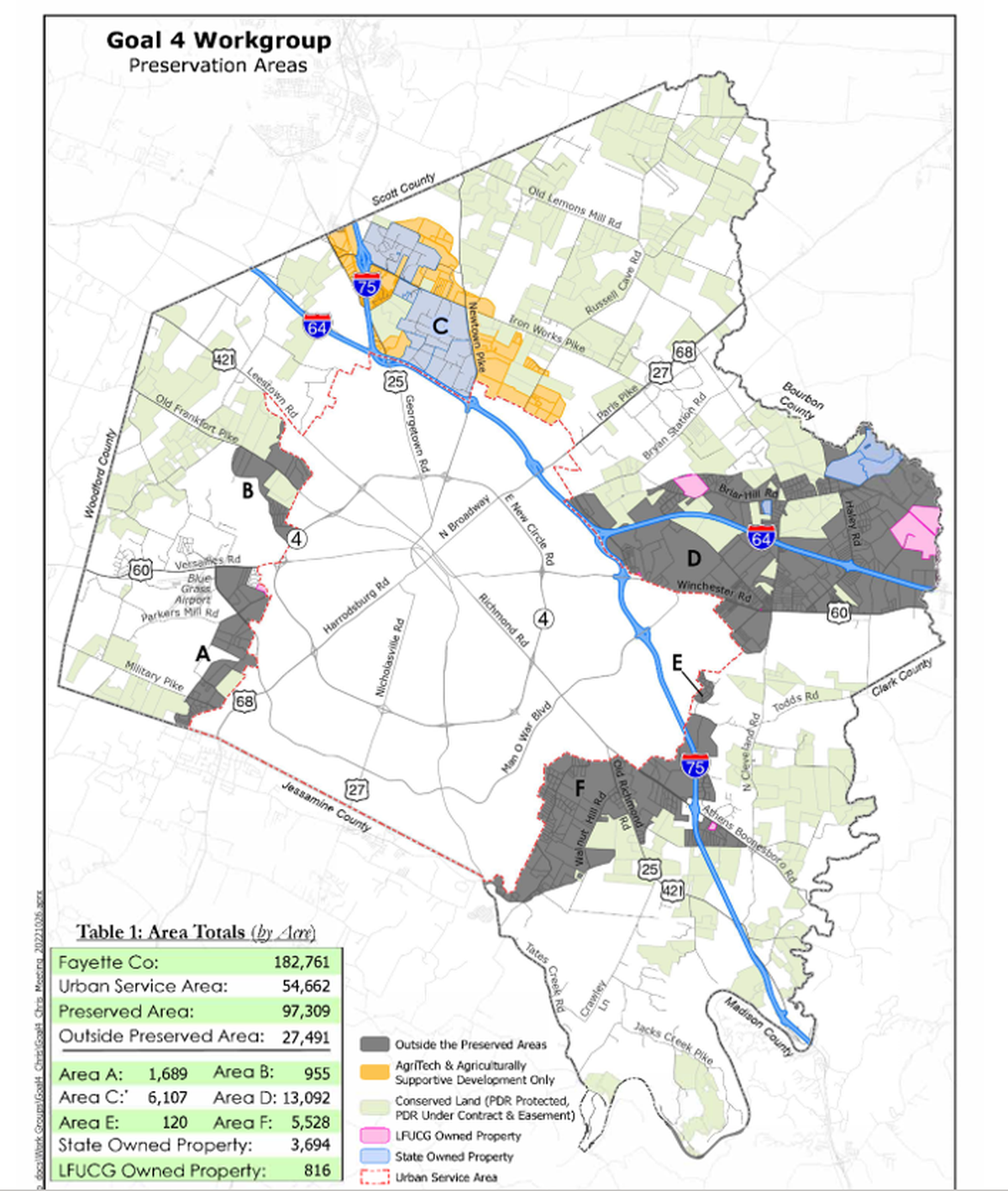
The process
If it is determined that more land is needed for certain needs, developers would submit a master plan or small area plan that would demonstrate the identified need.
For example, if the sustainable growth matrix determines the city needs more housing, the developer must show how their proposal meets that need. Developers would also have to show the fiscal impact to the city and how the development meets the comprehensive plan.
There can be multiple proposals. The planning commission and then the council can choose one or several plans.
Then, the council will vote to expand the boundary and the zone change for the property.
The developer must complete the project in a certain period of time. If those timelines aren’t met, the property is removed from the urban service boundary.
Questions about legality, lack of public comment
More than 20 people spoke against the Goal 4 proposal during Thursday’s meeting. They questioned the data the group used to determine what areas could be serviced by sewer lines, the lack of public input and whether the process was legal.
Margaret Graves, a lawyer and chairwoman of the Bluegrass Land Conservancy, said the proposed process does not meet legal standards on how the urban service boundary should be expanded.
“It is also based on outdated sewerability data,” Graves said.
Brittany Roethemeier, the executive director of the Fayette Alliance, said there was not enough public input into the new process, and the data it used was questionable.
“It was developed on a fast-track timeline without broad community input,” Roethemeier said.
Lexington last expanded the urban service area in 1996 when more than 5,400 acres were added. More than half of those acres still remain.
Moreover, housing built in the 1996 expansion areas was not affordable housing, said Mary Diane Hanna, who is president of the Old Richmond Road neighborhood association.
To say that the urban service boundary needs to be expanded to help with affordable housing is a fallacy, she said.
Hanna said she has received multiple complaints from residents of the Old Richmond Road neighborhood association since the Goal 4 maps were released.
“Expanding the urban service area is a direct attack on the Old Richmond Road area,” Hanna said. She will soon take office as Fayette County Judge Executive, but spoke Thursday in her capacity as president of the neighborhood group.
Developers, business interests support proposal
Dick Murphy, a lawyer who represents developers, said the report does not recommend opening the urban service boundary. Moreover, the 2018 Comprehensive Plan envisioned a new way to determine if and when land should be added to the growth boundary. That involved two parts: a matrix using data to show when land was needed for various uses like housing, industry, retail and office space, and the identification of land that should be preserved and land that could be developed.
That’s exactly what the Goal 4 work group did, he said.
“This doesn’t put a square inch inside the urban service boundary,” Murphy said.
Moreover, the report says debate on the issue of expansion won’t be discussed until 2026.
It took six years after the 1996 expansion for the first home to be completed, Murphy said.
“That is putting us to 2032,” Murphy said. “We have a crisis in housing that needs to be addressed.”
Murphy said others in the business and development community were at the meeting on Thursday but had to leave before the commission got to public comment on the Goal 4 report. The Planning Commission’s meeting on Thursday was nearly six hours long. Public comment on the Goal 4 report was at the end of the meeting.
After the planning commission makes a decision on whether to accept, modify or re-do the Goal 4 report, the issue will return to the Lexington-Fayette Urban County Council for final approval. That will likely take months.
Some in city government also worried the Republican-controlled General Assembly may make try to nix Fayette County’s growth boundary. In 2019, an amendment to a bill would have required all counties to consider agricultural land as available for development under their comprehensive plans. That would have killed Lexington’s growth boundary, many said at the time. The amendment was ultimately withdrawn.