
US Senate money race: Barr leads, Morris gave campaign $3M, Cameron trails
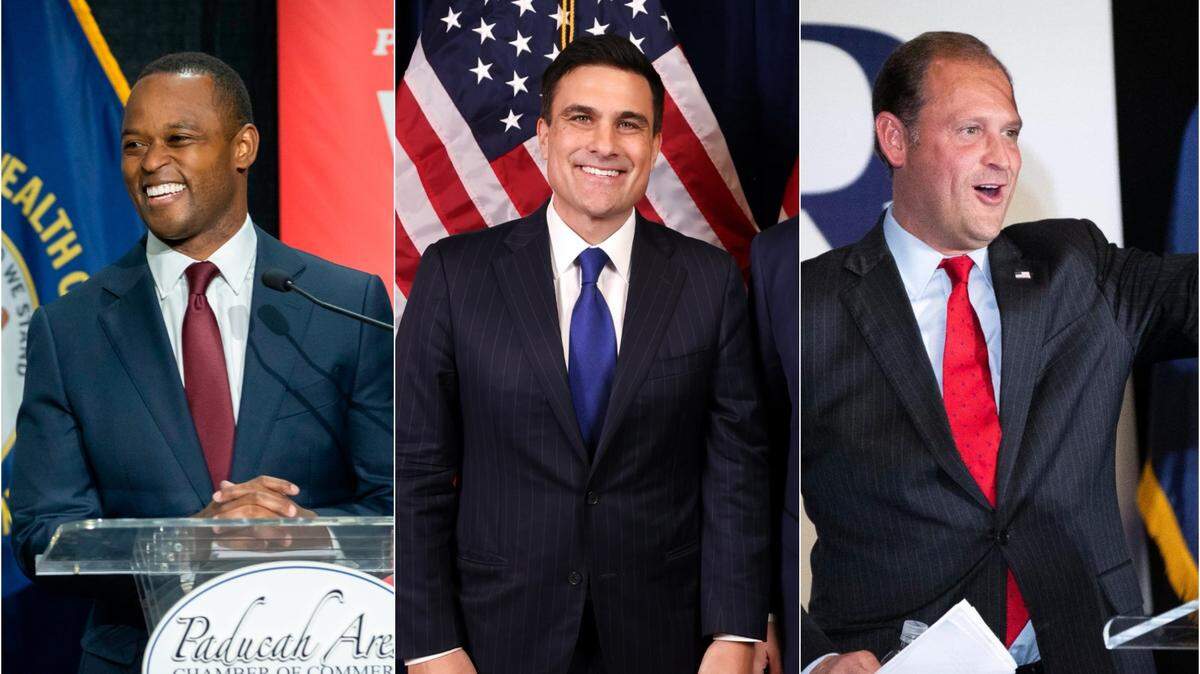
Lexington tech entrepreneur Nate Morris loaned himself more than $3 million to kickstart his campaign for U.S. Senate, and Rep. Andy Barr still has a fundraising lead in the contentious 2026 GOP primary, according to new disclosures.
Morris, who had not held office before launching a high-profile run, gave his campaign seven installments totaling $3,023,000 in the first three months of his campaign. That’s three-quarters of the total funding he’s brought in, according to a financial report with the Federal Elections Commission.
The reports, detailing fundraising efforts from July through Sept. 30, showed that Barr had raised the most from donors during that time. He raised almost $1.8 million, Morris cleared $1 million from donors and former attorney general Daniel Cameron raised $411,000.
Barr had by far the most cash on hand at the end of the period, with close to $6.7 million. Much of that total came from a sum he’d accumulated over years of fundraising for his U.S. House campaigns in Kentucky’s 6th Congressional District, which can be transferred to Senate campaigns.
Morris ended the reporting period with almost $1.1 million on hand, having spent three-quarters of what he’d brought in. Given that rate of spending, he likely has the ability to refill his campaign coffers quickly. Morris is wealthy, having made $41 million in 2022 when the company he founded, Rubicon, went public.
Cameron ended Sept. 30 with $630,000 on hand, a fraction of Barr’s figure.
In every publicly available poll of the race, Cameron has been the clear leader, with Barr in second place and Morris in third.
Michael Faris, another GOP candidate who is speaking at campaign events across the state, ended the reporting period owing more than $15,000. He had raised about $31,000 from February through Sept. 30.
In the GOP race, all three candidates have had political action committees spend in the race to support them. Some political action committees have even directed fire at other candidates, like the one affiliated with the conservative group Club for Growth that has targeted Barr.
The Democratic candidates for U.S. Senate were led by Joel Willett, a former CIA officer who has not held elected office. Willett raised about $320,000, with $200,000 coming from himself, in his first fundraising quarter.
Logan Forsythe, a former U.S. Secret Service agent from Lexington, and House Minority Floor Leader Pamela Stevenson, D-Louisville, raised $40,000 and $42,000, respectively, during the quarter.
Barr’s report
Barr’s fundraising report featured a list of prominent players in Kentucky politics and in Washington. It includes lobbyists, top donors and one sitting governor.
Montana Gov. Greg Gianforte, who served alongside Barr in the U.S. House GOP caucus, and his wife both gave Barr the maximum $3,500 contribution. Another national conservative figure who gave the maximum donation was Ross Perot Jr., the son of third-party candidate and billionaire Ross Perot.
Notable names in Kentucky politics who gave high-dollar donations were Patrick Jennings, who regularly ranks among the highest-paid lobbyists in Frankfort, and Rep. Hal Rogers’ chief of staff, Karen Kelly. Rogers was an early endorser of Barr’s campaign.
Former Kentucky Supreme Court chief justice Laurance VanMeter, a Lexington resident who left the bench after not seeking re-election in 2024, gave Barr $1,000. VanMeter’s son, also an attorney, gave Barr the maximum contribution.
Bill Butler, who founded Northern Kentucky development giant Corporex, gave the maximum contribution. In Lexington, one of the city’s most prominent philanthropists, William T. Young, Jr., gave Barr $3,500. Chip Rupp, the grandson of legendary University of Kentucky basketball coach Adolph Rupp, also made the maximum donation.
A large number of political action committees, including many that had donated to Barr’s previous campaigns for U.S. House, also gave maximum contributions to Barr’s campaign. Donations from committees include PACs representing industry and other candidates or advocacy groups.
Barr’s campaign also received about $452,000 from the Friends of Andy Barr Committee, a joint fundraising group that has been supporting Barr since 2017. Some of the top donors in the state and the financial world continue to help fund the committee. Thomas Wynne, the chief operating officer for Alliance Resource Partners, Joe Craft’s mining company, and Lexington developer Brett Setzer gave the committee more than $20,000 in the first months of the year. Texas billionaire Darwin Deason and his son, Doug, gave the group a collective $35,000 in September.
Overall, the Barr campaign has received $1.28 million in transfers from other committees like Friends of Andy Barr since 2025.
Barr spent about $1.23 million from July through September.
Morris’ numbers
Though the bulk of Morris’ funds came from his own pocketbook, Barr’s haul from outside donors did not outpace Morris’ by a wide margin. Morris has strong experience raising money both for business ventures and other political campaigns.
Morris’ more than $1 million in contributions came from all over the country and from some of the biggest donors in the state.
During this reporting period, Morris received $3,500 from former U.S. ambassador to the United Nations Kelly Craft, who had previously given the maximum amount to Barr. That leaves Cameron as the only one without a check from one of the leading in-state donors. Cameron beat Craft in the 2023 GOP gubernatorial primary.
Kenny Troutt, the billionaire owner of Winstar Farm, and his wife, Lisa, gave Morris the maximum donation. Like Craft, they also gave maximum donations to Barr.
Several of the top-dollar donations to Morris came from Texas. The Lone Star State is home to the family of Morris’ wife, Jane Mosbacher Morris. She is the daughter and granddaughter of Texas businessmen and cabinet officials who served under the administrations of George H.W. Bush and George W. Bush. Multiple members of the Mosbacher family gave Morris a $3,500 donation.
Other big names in Texas include Javier Loya, who became the first Hispanic NFL owner when he purchased a minority stake in the Houston Texans, and the family of the late Texas power broker Walter Mischer.
Noted early adopter of the cryptocurrency Bitcoin Mike Komaransky also contributed the maximum amount to Morris’ campaign.
What Cameron has raised
While Cameron’s fundraising totals aren’t exactly dwarfed by Barr and Morris, he does not have the luxury of starting with millions from a previous campaign account like Barr, or the ability to self-fund like Morris.
Still, Cameron’s $630,000 on hand puts him well behind the competition in a race that will undoubtedly get expensive.
Several of Cameron’s top donors came from people west of Interstate 65, including donors in the Bowling Green area and farther west. He also saw some big donations from Northern Kentuckians.
One example is Keith Dickens, of Paducah, the president of beverage distributor Pepsi Midamerica.
While Cameron is not running ads on television like his top two opponents, he has been spending on direct mail. Mail advertisements to the tune of about $137,000 made up a big chunk of his campaign spending in the past quarter, which totaled to $312,000.
The Democrats
Willett out-raised both Stevenson and Forsythe with his campaign haul. Though the bulk of it came from his $200,000 self-loan, the remaining $120,000 came from others.
High-dollar donors for Willett clustered around the Louisville area, where he’s from, and the Washington, D.C., area, where he lived and worked before moving back to Kentucky this year. Willett recently stepped down from leading a government contracting company; around the same time, as the Herald-Leader reported he was mulling a U.S. Senate run, his security clearance was revoked by National Director of Intelligence Tulsi Gabbard.
Willett ended the reporting period with $315,000 on hand.
Stevenson ended the period with more debt than cash on hand. Her campaign had about $25,000 on hand and $64,000 in debt or loans.
Forsythe, who announced the same week as Willett, raised $40,000 and ended with about $38,000 on hand. Many of Forsythe’s contributions came from Lexington, where he lives, or Lyon County, where he’s from.
This story was originally published October 16, 2025 at 8:01 AM.