Darkness after the storms: One family’s fight to recover after Ky. tornadoes took everything
READ MORE
After the Storms
As organizations shift to long-term recovery following Kentucky tornadoes, many in Western Kentucky are bracing for the long-term impact of trauma to settle across communities.
Expand All
Standing in the living room of his grandmother’s Dawson Springs trailer, Skyler Lohse begged her to leave with him.
“I’m trying to convince her to leave, like come on mamaw, we gotta go. There’s a really bad storm coming, I can hear it in mom’s voice,’” Skyler said. It was 10:22 p.m., he remembers, on December 10, 2021.
In the preceding half hour, his phone repeatedly pinged with messages from his mom, sister, and friends warning him of the coming thunderstorms. Fretting, and taking shelter in the basement of her apartment building across town, Toskia Adamson finally called her son to make sure he was safe.
“Y’all need to get inside,” she ordered. Skyler asked after his mamaw, Geneva Adamson.
“She’s home. She’s not leaving,” Toskia told him.
On Friday, the National Weather Service and Gov. Andy Beshear had alerted Kentuckians that a line of severe storms would rake across the state that Saturday night, some with a high probability of producing “longer-lived tornadoes, supercells, and squall lines.”
Toskia, 39, lives a three-minute drive from Geneva on the south side of Dawson Springs in a multi-unit apartment building. She spent much of that Saturday pleading with her mom to come stay with her for the night, in a building with sturdier walls, a foundation, and a basement. But Geneva wouldn’t budge, and now the storm was here.
“We can’t just leave her up there,” Skyler told his mom.
The thunderstorm that minutes later spawned an EF-4 tornado was already roaring, bright with lightning and dumping rain when he piled his nine dogs – two had recently borne seven puppies – into his car and sped the two blocks from his trailer on East Hall Street to his grandmother’s on East Walnut.
Once inside, he followed her around the trailer as she paced, unconvinced she should leave; like many Kentuckians, she’d lived to see many severe thunderstorms.
At 10:27, “the wind picked up tremendously. I said, mamaw, we gotta go, and by the time she says, ‘Yeah,’ I go to grab for the door, it hits 10:32 p.m., and I heard this really deep humming sound. Like a train on railroad tracks, but without the vibration,” Skyler said. “It was super smooth.”
“And then I see the trailer just start crumbling, like a pop can.”
As the tornado ate through the trailer, dislodging and gnarling the steel frame, crushing the walls, lifting the floor off its bed and tilting it, Skyler and Geneva, clutching one another, started to fall.
“I see the walls start collapsing in, and my thought process is like, goodness, I hope this is it. I hope maybe just a wall falls on us,” Skyler said.
But just as the walls begin to collapse, “we get shot up through the roof of our trailer.”
Both are sucked out into the open sky. It’s black, like outer space.
He can’t maintain his grip on his 67-year-old grandmother, and she tumbles away, mid air. The tornado sucks his shoes off.
Skyler, who estimates he was heaved 25 feet off the ground for three-to-five seconds, momentarily loses track of which way is up. His twisting body is peppered with debris, “like there was a 100 people around you, smacking you everywhere with hammers.”
While he was airborne, “I was just praying to God: if I die, please make it quick. And as soon as that thought process went, I hit the ground. That’s when I thought I was dead, and then I looked up in the air and I see the lightning, and I feel the rain.”
His ears ring from the sound void left by the twister, which continued its rampage toward Bremen. Skyler, on his back, lifts his head to scan the ruins around him for close to a minute, looking for his grandmother.
He finally spots her 20 or so yards away, pinned under his car. Wind had tossed it, and it had landed on its top, and now there was a gap of about two inches between Geneva’s head and his cracked windshield.
As Skyler moved to lift himself off his back, a white hot pang throbbed in his left arm. He looked down to see a deep laceration. One of his arteries had been cut, and with each quick pump of his heart, blood was leaving his body.
He’s running now, barefoot, toward his grandmother, trying to keep his injured arm still. He shouts at her. She’s conscious. Skyler can barely move his left arm, let alone lift a car, so he starts to run toward downtown, shouting for help.
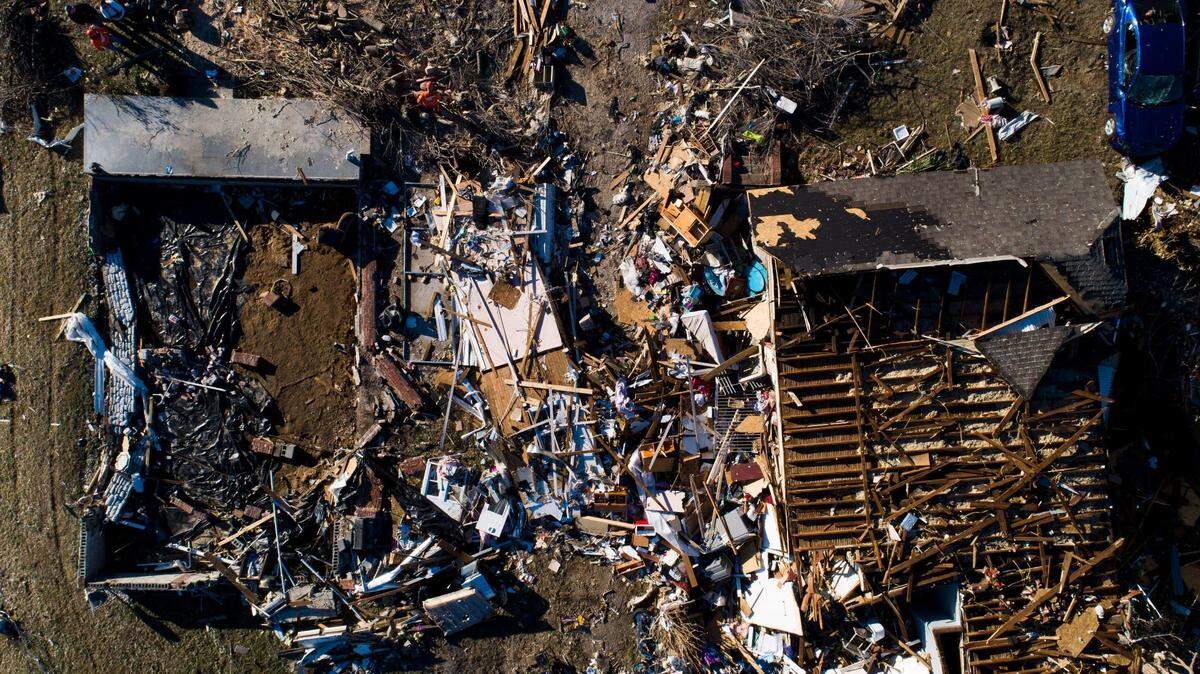
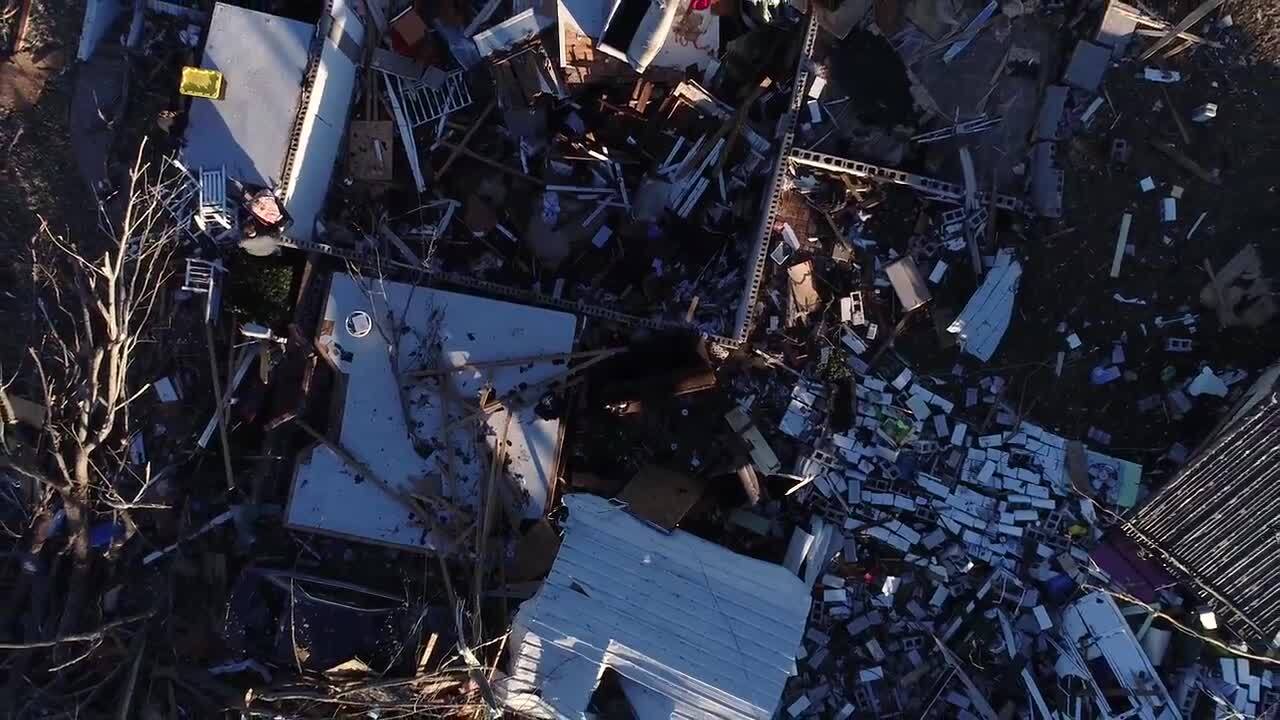
The north side of Dawson Springs sits on a hill, elevated above the downtown. In a matter of seconds, the tornado had uprooted and blown apart hundreds of trees and flattened dozens of homes four blocks in every direction from where Geneva lived. Homes and buildings weren’t just damaged, many just disappeared, debris and keepsakes flung tens of thousands of feet into the upper troposphere.
Many people were trapped under collapsed homes and screaming. The odor of gas was pungent. A man that Skyler couldn’t see shouted for anyone to hear: “Don’t light a cigarette! Gas is leaking everywhere.”
“It looked and smelled like a damn war zone,” Skyler said.
He found three people able to help in one direction, and three in another, and together they ran back to his grandmother. In shock from the pain in his arm and the adrenaline pulsing through his body, Skyler didn’t notice the eight puncture holes in his feet – three in one, five in the other – from running barefoot on nails, glass, and other sharp-edged rubble.
Five people heaved the car up enough for a sixth man to grab Geneva’s arm and pull. He couldn’t pull her on his own, so Skyler used his injured arm to drag her out. Then, prostrate from losing blood, he collapsed next to her.
“As I did that, my arm was just telling me no more, that’s it. More blood just started shooting out. And now I’m over here fading in and out, laying beside my mamaw.”
They were side to side on their backs. It was still raining. Geneva complained of leg and shoulder pain. She didn’t know it yet, but her ankle was lacerated, and she’d suffered multiple broken bones and strains in her leg and upper body.
Over and over, she kept telling him he was right, that she wished she’d listened and left sooner. Skyler tried to console her. In shock herself, she repeated pleas for him to get help, even though help was already on its way.
“I’m out of energy,” Skyler told her, his eyes closing. “I can’t move myself.”
Just before he lost consciousness, a man set one of Skyler’s seven puppies on his chest. Most of the others had died, including one of their parents, who was lying nearby, crushed under the trailer frame.
“I thought, ‘Oh my gosh, it’s my dog.’ Then I passed out.”
‘Scared and anxious’
Skyler and Geneva are two of thousands of people whose homes were demolished in the historic quad-state tornadoes that scoured a path roughly 250 miles across four states, leaving the bulk of its destruction in Kentucky.
The storm system flattened historic downtowns, tossed cars with ease, and detonated homes, killing 80 people, more than any other tornado in the state’s history. Winds were so strong at times, tornadoes etched their paths into the earth, removing several inches of topsoil, debarking trees, and suctioning items out of the lowest level of the atmosphere to heights higher than Mt. Everest.
Not only did it displace hundreds of people — exacerbating a housing shortage that preceded the storms — many have filed for federal assistance from the Federal Emergency Management Authority but most have not yet been compensated, though the window to file an appeal is still open. The deadline to apply for federal aid is March 13.
But now, nearly three months later, as aid organizations shift their efforts from short-term response to long-term recovery, many are bracing for what it will look like when trauma’s impact settles across whole communities — a byproduct of living through severe natural disasters that’s typically delayed but can last a lifetime.
“We can walk along beside of them and see all those [tangible] things restored,” like getting people back to permanent homes, helping them buy new cars, and get back to work, said Misty Thomas, executive director for the American Red Cross western Kentucky chapter. “But my heart worries about the long-term effects of mental health in our communities.”
For many who lived through the worst of the tornadoes’ wrath, like Skyler and Geneva, their lives were crimped with acute trauma, recovery from which is arduous. Geneva, who is still in an inpatient facility recovering from her injuries, was recently diagnosed with post-traumatic stress disorder.
Skyler has not been formally diagnosed with PTSD, but he feels strongly that he’s living with it.
Until he can move into a more permanent home, Skyler is staying with his girlfriend at her home in Mortons Gap, a 25-minute drive from Dawson Springs. Earlier in the month, when meteorologists forecast overnight thunderstorms in western Kentucky, Skyler didn’t sleep.
“I’m staying up all night because there’s supposed to be more bad weather and more than likely tornadoes, and I pray we make it through it and [that I,] myself make it through,” he texted.
A week later, when torrential rain and storms swept across the state once more, Toskia said her son called at 7:30 a.m. “to wake me up to get prepared just in case. He’s OK, but scared and anxious.”
‘Uptick in mental health issues’
In the months and years after the city of Joplin, Missouri endured utter devastation from an EF-5 tornado in 2011 that left most of the city in ruins, killing 161 people and costing nearly $3 billion in economic losses, mental health researchers noticed several troubling behavioral trends.
Experts from the University of Missouri’s Health and Behavioral Risk Research Center surveyed more than 800 survivors six-to-seven months after the tornado, and then again at the two-and-a-half year anniversary. Their 2015 study found that emotional ramifications were often delayed, and that it may have correlated directly with a lack of mental health support services.
In the first round of surveys six months out, close to 13% of participants showed signs of probable PTSD. At two-and-a-half years post-disaster, that amount more than doubled to nearly 27%. For both surveys examining probable PTSD and depression, more than 85% of people reported talking to a mental health or religious professional “not at all, or very little.”
Children, especially of parents who developed PTSD or depression, were more likely to exhibit borderline or abnormal behavior, the study found.
“Mental health care is really one of the top three things people need most when we go into disaster case management,” said Debi Meeds, a long-term recovery planner with the American Red Cross. A resident of Mt. Vernon, Missouri, Meeds is a former regional executive for the Red Cross, and chaired a similar long-term recovery group in the first year after the Joplin tornado.
After disasters, Meeds said, “incidents of abuse and neglect go up, both domestic and child, and incidents of suicide go up.” To try and curb those rates, it’s incumbent on communities and aid groups to “make sure services are available when they’re needed.”
“After Joplin, we did a huge campaign about suicide, because we knew that statistically, that would happen,” Meeds said. Indeed, it did, and in the months following the 2011 tornado, calls to a local hospital’s mental health center hotline more than quadrupled.
This tracks with Audra Hall’s clinical experience as coordinator of emergency services at the Pennyroyal Center, an outpatient behavioral health clinic with six locations across western Kentucky.
“I want to prevent as much of that as we possibly can, to make referrals, to get people connected to mental health services so we don’t see an increase in those [behaviors],” Hall said of the abuse and suicide rates.
Nearly three months after the Western Kentucky tornadoes, agencies like the Red Cross and Pennyroyal have begun transitioning from a response mode of care to a recovery one. Immediate needs, like finding families temporary and long-term housing, making sure they have food and have applied for financial reimbursement for losses, will be handed over to long-term case workers. In its place, affected communities are forming long-term recovery groups, like the one Meeds belonged to in Joplin, to focus on doling out mental health services.
“Just like if someone were in a medical emergency and needed CPR, the same thing is needed psychologically,” she said.
Some health care facilities across the region have begun seeing a spike in patients needing mental health services since early December, including Baptist Health Deaconess Madisonville, a regional hospital that has treated many tornado survivors, including Skyler, for physical injuries.
“We have seen an uptick in mental health issues related to the trauma of the event, as well as the stress after, with finding new homes and jobs,” spokesperson Kristy Quinn said last week.
But that demand has not presented across the board. Hall says that’s because it’s still too early.
“Unfortunately after a disaster, a lot of people don’t reach out for help immediately, [so] we don’t see an uptick in demand until later on,” she said. It’s largely a product of priority — in the hierarchy of needs following a disaster, people tend to seek out tangible needs like shelter and food first, she said.
Rather than wait for survivors to seek those services out, Hall and others are going to them.
Pennyroyal is one of five Community Mental Health Centers providing short-term counseling interventions with storm survivors through a $429,686 FEMA crisis counseling grant, according to the Cabinet for Health and Family Services. The effort, called Project Recovery Kentucky, involves going door to door and making face-to-face contact with people who survived the storm to provide “psychological first aid,” Hall said.
In the first month after the tornado, Pennyroyal made contact with 1,400 survivors.
Often the first step in these 10-minute visits is to let people know that a range of behavioral responses to trauma are normal; irritability, inability to sleep, physical exhaustion, loss of appetite, anxiety, restlessness, disassociation or a feeling of numbness, even trouble with memory are all expected responses, Hall said.
The hope is that these brief crisis counseling visits will precede a longer evaluation with a counselor, if need be. But early intervention is key.
“The earlier we can provide people with intervention and support, the less likely they are to develop an actual mental illness from the disaster effect,” she said.
‘We’re going to figure this out’
Two months after the tornadoes, on a windy weekday afternoon in downtown Dawson Springs, Toskia Adamson stood on the vacant dirt lot formerly occupied by her mom’s trailer.
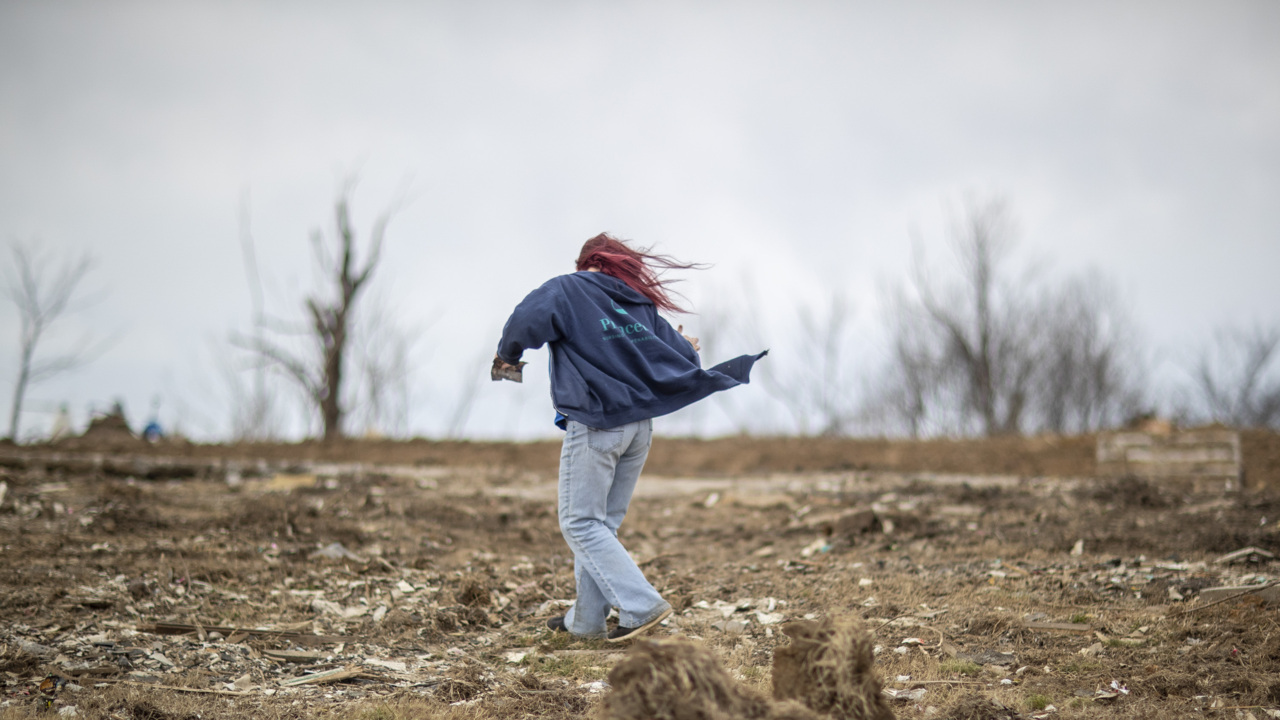
It’s on the northern-most street that runs from east to west in Dawson Springs, near the peak of the hill that slopes toward downtown. Once dotted with grids of trees, small and large homes, and a playground, it’s now an expanse of dirt. The trees that survived the storm are leafless and skeletal.
The buildings and housing stock on the south side of Dawson Springs, where Toskia and her daughter live, were relatively untouched. But most of the community’s houses were on the city’s north side, where Geneva and Skyler lived. In total, roughly 75% of the city’s houses were destroyed.
Toskia doesn’t have a car at the moment — she was sharing Skyler’s before the tornado destroyed it — so she spends a lot of time walking around the place where she has lived for 36 years. But much of it is unrecognizable. Other parts of it were just erased, reverted to open land with no semblance of the homes that once stood there or the families that lived in them.
“I get lost up here now. That’s how bad it is,” she says, looking out over the crumbled steel frame of her mom’s trailer. A block away toward downtown is where Skyler lived. It, too, is just a lot of dirt.
Even though Toskia has no physical scars, the night of the tornadoes, when she searched for her son and mom for five hours, not knowing if they were dead or alive, traumatized her. She has since become the emotional pillar for her family. For days, she drove back and forth between hospitals in Madisonville and Louisville, where her son and mother were taken for their physical injuries.
Death and horror are all around her. Wanting to show proof of the damage to Skyler and Geneva’s trailers when she helped both apply for FEMA aid, Toskia revisited the lots formerly occupied by their trailers in the days after the tornado. But clean-up crews and emergency responders cut that venture short – as they combed through rubble, they were still finding bodies.
Geneva now calls Toskia every day from a local nursing home, where she’s temporarily living while she works through her injuries and processes her experience with a counselor. Even vague mention of that night summons vivid flashbacks.
Toskia just helped her son buy a truck, and she’s in the process of helping both find more permanent housing. Recently she secured one of the mobile homes the state bought for tornado survivors for Skyler and his girlfriend.
“Just trying to comfort him on top of helping my mom, it’s just so much right now,” Toskia said, her voice cracking. “I have to laugh about it, [otherwise] I’ll put myself into a mental distress.”
A few weeks earlier, when Skyler found out he received very little assistance from FEMA, and would need to file an appeal, he got overwhelmed, his mom remembers.
“He was all tore up, and I told him, ‘We’re going to figure this out, like we have been,’” she said. “He’s so busy trying to get things back to normal. I try not to be the bearer of bad news, but it’s never going to be normal again.”
This story was originally published March 6, 2022 at 5:00 AM.