Abortion rights in KY: See Herald-Leader coverage of the issue from 1984 to present
READ MORE
How KY groups are fighting to ensure abortion access
An eight-day freeze on abortion in late April served as a teaser for the post-Roe reality that’s expected to come any day in Kentucky. As the country waits for a decision from the U.S. Supreme Court, here’s how organizations in the commonwealth are preparing.
Expand All
‘It’s still health care.’ In final days of Roe, KY groups quietly prepared to ensure access
Abortion rights in KY: See Herald-Leader coverage of the issue from 1984 to present
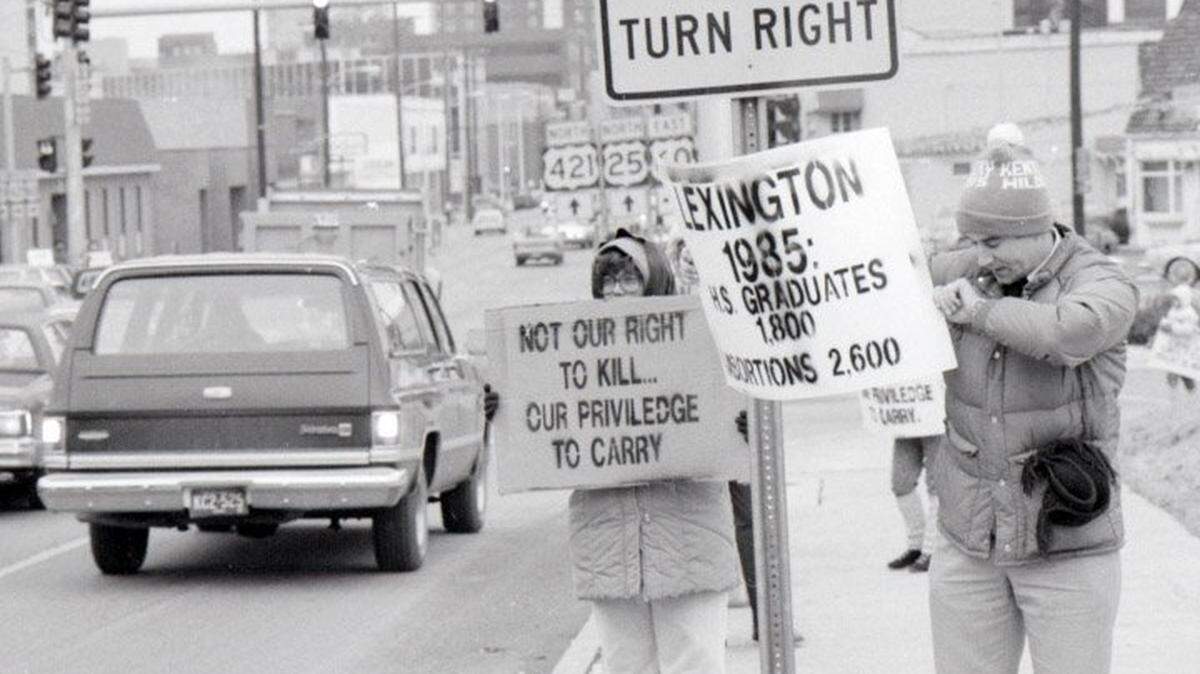
Kentucky’s abortion history as seen through the lens of Herald-Leader photographers

Kentucky reproductive rights groups prepare for likely reversal of Roe v. Wade
To provide some historical context for the Herald-Leader’s special issue on reproductive rights, we searched our archives for relevant news coverage and opinion pieces on the topic from the past few decades.
These articles appear as they were originally published, including any corrections. Some are abridged to remove sections irrelevant to reproductive rights. While many are from Herald-Leader staff, there’s also wire stories attributed to the Associated Press, other services and letters to the editor.
Explore the history of reproductive rights in Kentucky, from court rulings, to protests, lawsuits and more. One article from 1992 provides interviews from patients and medical staff inside an abortion-providing clinic. Others give perspectives from people who support and oppose the right to abortion, with outlooks from politicians and protesters alike.
Here’s what we found in the Herald-Leader archives.
A surprising but welcome victory for in vitro clinics
Editorial, published April 3, 1984
It’s not unusual for the closing hours of a legislative session to bring some unexpected developments. Sometimes those developments are even commendable, as in the last minute passage of a law allowing in vitro fertilization at public hospitals.
In vitro fertilization is a medical procedure that allows couples who might otherwise be unable to have children to become parents. Its merits are obvious to those people who have enjoyed its benefits. Unfortunately, the Right to Life lobby opposes in vitro fertilization, and up until last Friday had successfully blocked legislation to allow in vitro clinics at the University of Kentucky and University of Louisville hospitals.
On Friday, though, an amendment allowing in vitro clinics at public hospitals was tacked onto an unrelated House bill. Two of its supporters were Rep. Pat Freibert and Sen. Jack Trevey, both Fayette County Republicans. Another was Rep. Greg Stumbo, a Floyd County Democrat.
It took a while for the measure to pass both houses, largely because of the fear of some representatives that it might allow abortions at publicly supported hospitals. But it eventually passed, thus giving some childless Kentucky couples a chance to use the in vitro process without traveling out of state.
The passage of this bill marks one of the few times this session that the Right to Life lobby has failed to achieve its goals in the legislature. That might be attributable to the fact that Right to Life had angered some of its strongest supporters with heavyhanded tactics in the closing days of the session.
Whatever the reason, though, the legislature’s decision to allow in vitro clinics at UK and U of L is good news for childless Kentuckians who want to be parents. It put a bright final note on what was in many ways a rather dismal legislative session.
Right to Life board assails bombings
Herald-Leader staff report, published Jan. 9, 1985
The board of directors of the Kentucky Right to Life Association Inc. spoke out this week against the use of violence to close abortion clinics.
In a joint statement, Albert J. Arbogast, president of the Kentucky Right to Life Association, and Margie Montgomery, executive director, said they “support peaceful picketing and sidewalk counseling outside abortion chambers, hospitals, (and) aborting doctors’ offices as (an) expression of the First Amendment rights of those who speak for the unborn victims of abortion. We neither condone nor approve the bombing of abortion clinics.”
Mrs. Montgomery said in a telephone interview that tactics such as the recent bombings in Florida were unjustified. No Right to Life groups have been involved in such incidents, she said.
The Louisville group has a “sidewalk counseling program,” she said, in which members attempt to talk with women going into clinics or doctors’ offices where abortions are performed. However, members are careful to do their counseling on public property only and to avoid blocking doorways or pressing their literature on women, she said.
Arbogast said Right to Life members in Lexington were “not into sidewalk counseling.”
“But that’s not to say we won’t be,” he added.
A peaceful demonstration by several anti-abortion groups is planned at the Fayette County Courthouse on Saturday, Jan. 26, he said. The event will mark the 12th anniversary of the U.S. Supreme Court’s legalization of abortion on demand.
Kentuckians at rally defend right to have abortion
By Mary Ann Roser, Herald-Leader, published April 10, 1989
WASHINGTON — It would have been far easier for Jeanie Sackett if she had stayed home in Lexington and watched yesterday’s massive abortion-rights march on the evening news.
She would not have had to rush home from her job on Saturday, pack a knapsack and sit on a bus for 10 hours. She would not have had to march all day, her arthritic back aching, only to face another grueling bus trip home and an 8 a.m. class today.
But Ms. Sackett — who told of her own abortion — said staying home was not an option. Nor was it for many of the estimated 250 Kentuckians and at least 300,000 other people who swarmed the nation’s capital yesterday, chanting, waving banners and singing.
“I had to be here today. I think there is a time when one has to stand up and be present,” said Mitzi Friedlander, 59, of Louisville. She is a professional narrator for the Library of Congress’ “talking books” program who became interested in the abortion issue 15 years ago when she did the reading for the book Our Bodies, Our Selves.
Ms. Friedlander, who told of a friend who nearly died of an illegal abortion in Chicago during the 1940s, said that the time to stand up had come.
Ms. Sackett, 45, agreed.
“I marched in the ‘60s against the war and for women’s rights,” she said. “I feel the women of this country gained a lot of freedom during that time, but since then, I see a lot of what we worked for in jeopardy.”
The Supreme Court is about to consider a case that could jeopardize legal abortions nationwide. In Kentucky, a law took effect Friday that requires minors to get permission from their parents or a judge before having an abortion.
While she was a married mother of three children, Ms. Sackett had an abortion after she became ill and was hospitalized for a series of tests. Unaware that she was pregnant, hospital workers performed X-rays that would have resulted in a deformed baby. With backing from her husband, she terminated the pregnancy.
Like many others at the march, Ms. Sackett, now divorced and a nursing student, wore buttons showing a coat hanger that said “Never Again.” She said she found the march energizing.
A similar feeling inspired Leslie Marlin, 37, of Louisville to come.
At 35, Ms. Marlin faced an unwanted pregnancy and a boyfriend who did not want to be a father. She opted for an abortion.
“I was very conscientious about using birth control,” she said. “I used to think that women who got pregnant and didn’t want to had been careless or weren’t very smart. I found out the hard way that wasn’t always true.”
Ms. Marlin, a legal secretary who also voluntarily escorts women to a Louisville abortion clinic, endures the taunts of picketers calling her a “baby killer” because she believes in the right to choose.
Other Kentuckians at the march said they have never had an abortion but came to defend that right.
“I don’t think I could choose an abortion for myself, but to have the choice is something we’re fighting for,” said Robin Miller, a 20-year-old student.
Ms. Miller, who struggled to hold a banner against a vigorous wind, was among 40 Berea College students and faculty members at the march. Students from the University of Kentucky also came, including John Cutler, 22, who accompanied his girlfriend, Janet Close, 21.
“We have to change the social consciousness of this nation,” Cutler said. “It makes me very angry when people are discriminated against.”
The problem with abortion, Ms. Sackett said, is that opponents feel just as strongly that they are right. Consequently, she said, there is no way to resolve the issue to make everyone happy.
“I’m writing a term paper on abortion, and that’s my last sentence,” she said. “There is no solution.”
Teen girls leaving Ky. to get abortions
Associated Press, published June 5, 1989
LOUISVILLE — Instead of decreasing abortions, a new state law requiring teen-agers to obtain parental or judicial consent before having an abortion is apparently sending young women to other states for the procedure, directors of Kentucky abortion clinics say.
The 2-month-old law has prompted some girls to inform their parents of unwanted pregnancies instead of keeping their condition a secret, they said.
But most teen-agers who want abortions without parental consent are coming up with the money to travel to neighboring states that do not have the requirements, the directors said.
Traveling to another state for an abortion is less intimidating than facing the local court system for girls who do not want to tell their parents, said Patty Culwell, director of Women’s Health Services in Louisville, and Dona Wells, director of the EMW Women’s Surgery Center in Louisville and the EMW Women’s Clinic in Lexington.
Margie Montgomery, director of the anti-abortion group Right to Life of Louisville, said she did not know of any pregnant teen-ager who had forgone an abortion as a result of the new law.
But Ms. Montgomery said she had heard from protesters “outside the abortion ‘mills’ that there are less young people going in there than there used to be.”
Ms. Culwell agreed with that assessment, saying that about 8 percent to 10 percent of the teen-age clients at Women’s Health Services are now going elsewhere for abortions because of the parental consent requirement. She said about 25 percent of the clinic’s clients are minors.
Clinic directors in Ohio, Illinois and Tennessee say they have noticed an increase in the number of pregnant teen-age Kentucky girls seeking abortions in their states since the Kentucky law went into effect.
Ann Mitchell, director of the Elizabeth Campbell clinic in Cincinnati, said Kentucky girls who come to her clinic for abortions often are poor and have many problems besides their unwanted pregnancies.
Ms. Mitchell said young girls trying to deny the fact they are pregnant may delay traveling to other states for abortions, which may add to the risks of the procedure or make them too late to get an abortion. The Campbell clinic performs abortions only through the 18th week of pregnancy.
“It’s a tragic repercussion of a punitive law,” she said. “To pass a law that punishes the most disadvantaged among all teens, the most troubled, the most desperate . . . is idiotic.”
Annie Baker, director of the Hope Clinic in Granite City, Ill., near St. Louis, said between 20 and 30 teen-age girls from Kentucky had gone there for abortions since the law took effect. No pre-law figures were available because the clinic did not previously keep track of Kentucky clients, she said.
Under the law, a girl who is under 18 and unmarried must get approval from both parents or from a judge before having an abortion.
Those familiar with the law also say teen-agers may find it difficult to remain anonymous when they go to court, despite safeguards in the law designed to ensure confidentiality of the hearings.
Ms. Wells said that while waiting recently outside a closed courtroom to testify in a case not involving parental consent, she was told she could not enter because “confidential abortion proceedings” were under way.
“People will know what’s going on,” she said.
Chief District Judge Donald Smalley said at least one girl had gone to court in Jefferson County seeking to obtain an abortion. Other teen-agers have gone to the courthouse intending to file an application for a hearing but have then changed their minds, he said.
Smalley has taken steps to conceal the identity of judges in abortion hearings out of fear of political retribution.
He has decreed that copies of orders signed by judges in such cases will not bear the name of the judge. Instead, the signature line on certified copies will say, “signed by Jefferson County district circuit judge.”
“The rationale behind it is that this is a highly volatile issue and it’s a political issue and any judge who is doing his or her duty under the law could be penalized politically if it became known that they did or did not allow an abortion,” Smalley said.
Lawmakers want abortion rules reviewed
Associated Press, published Sept. 23, 1990
FRANKFORT — Some legislators are calling for a review of the state’s abortion regulations following the closing of a Louisville clinic last week.
State Rep. Tom Burch, co-chairman of the interim joint Committee on Health and Welfare, said Friday that he expects to call representatives of the Cabinet for Human Resources before the committee Oct. 17. He said he will ask them why they allowed the abortion clinic, Women’s Health Services, to operate without a license and under unhealthy conditions for so long.
“We want the women who are having these abortions to be in a clean and sanitary place, not to be in what would be considered a back alley,” said Burch, D-Fern Creek.
State Rep. Bob Heleringer, an abortion foe, is another committee member. He said Friday that he thought the time had come to “require that these clinics be as regulated and as safe as hospitals or any other health facilities.
“The pro-abortion lobby has been successful in separating these facilities from any kind of reasonable regulation,” said Heleringer, R-Louisville. “And that can only lead to the situation that we have found in Louisville.”
State inspectors testified last week in Jefferson Circuit Court that the Louisville clinic should be closed. In addition to its lack of a license, officials said they found unsafe, dirty conditions and inadequate staffing during investigations of complaints in June and April.
The physician who operates that clinic, Dr. Ronachai Banchongmanie, had promised since 1988 that he would obtain a surgical center license. He says he still is trying to do so.
Banchongmanie testified Wednesday that he performs an average of 15 to 18 abortions a day. But the doctor argued that he does not need a license because the abortions are simply part of his obstetrics and gynecological practice.
Cabinet for Human Resources spokesman Brad Hughes said Friday that the cabinet’s lawyers “have already admitted that they dropped the ball and did not act with proper speed to go into court to shut them down.”
Hughes acknowledged that the state made a mistake in not checking up on the facility while its license application was pending. But he praised the cabinet for reacting to complaints immediately by sending inspectors.
“I don’t think it (the cabinet) took too long in responding to the complaints,” he said.
State officials acknowledge that other Kentucky physicians regularly perform abortions in their offices without special surgical center licenses. But they say there are no clear guidelines on licensing.
Patricia Campbell, a regional program manager for the cabinet, testified at Banchongmanie’s hearing that the state does not require a license for any specific number of abortions. She said a decision is made “based on what is normal and customary” practice in a doctor’s office.
“We would agree that it is an interpretation and an evaluation on a case- by-case basis,” Hughes said. “The law is no more specific than that.”
Dona Wells, executive director of EMW Women’s Surgical Center in Louisville, said she believed more detailed regulations should be written to ensure more careful monitoring of abortion services.
EMW’s Louisville operation has a license, but its Lexington facility does not. Wells said the Lexington operation is not licensed because its staff performs only first trimester abortions and does not do tubal ligations or use general anesthesia.
Other Kentucky physicians “do first trimester abortions in their offices . . . on a fairly large scale,” without special licensing, Wells said.
Hughes said he was not aware of the Lexington clinic but would look into it.
Wells, who recently completed a term as president of the National Abortion Federation, a network of abortion providers, said she favored separate regulations for clinics that perform second-trimester abortions or those involving general anesthesia.
Pro-life groups’ inaccuracies
Commentary, published Nov. 15, 1990
The so-called “pro-life” movement tries to hide its basic lies with all the media uproar concerning closing abortion clinics and parental consent laws. The movement apparently believes it can cover its untruths y convincing the public to side with it on other topics.
A recent leaflet printed by a Kentucky group stated that “aborted babies feel pain.” No medical evidence was offered to support this opinion. The same source reported that it is “legal to abort a baby up to the moment of birth.”
This is untrue. The anti-choice supporters even feel the need to create their own language — using words unknown to Webster’s Dictionary, such as “abortuary.”
Also on their agenda is having Planned Parenthood removed from school. Is it logical to want to stop sex education and distribution of birth control, the very things that would prevent unplanned pregnancies and abortions? The leaflet also urges stocking public places, such as doctors’ offices and libraries, with “right-to-life” propaganda, including pictures of “aborted babies. It’s strange how their pictures do not resemble the medical textbook illustrations of a three-month-old fetus (when abortions take place). The right-to-lifers are encouraged to “get students involved,” spreading their fictions to children.
These self-proclaimed “God’s chosen people” add that it is their constitutional right to have a choice.
ANGELA MULLINS
LEXINGTON HERALD-LEADER
DATE: SATURDAY, November 17, 1990
PAGE: A12 EDITION: FINAL
SECTION: COMMENTARY LENGTH: SHORT
CORRECTION
A portion of Angela Mullins’ letter in Thursday’s Herald-Leader was inadvertently omitted. The affected portion of the letter should have read: It’s strange how their pictures do not resemble the medical textbook illustrations of a three-month-old (when most abortions take place) fetus.
Anti-abortion group not barred from handing out leaflets referring to doctor
Associated Press, published Aug. 23, 1991
LOUISVILLE — A judge refused to bar an anti-abortion group yesterday from distributing leaflets at the Kentucky State Fair that refer to a Louisville doctor as a “mass murderer.”
Jefferson Circuit Judge Ellen Ewing ruled that there was insufficient evidence that the brochures distributed by a group called Kentuckiana Rescue would irreparably harm Dr. Ronachai Banchongmanie, operator of a clinic where abortions are performed.
Banchongmanie, who operates Women’s Health Services, filed the lawsuit Wednesday against Kentuckiana Rescue and George Lambert, one of the people working at the group’s fair booth.
The suit asked for an immediate court order to forbid the group from distributing information that the doctor claims is “libelous and malicious.” But Ewing ruled that the doctor had another legal course available to him — a libel lawsuit that seeks monetary damages.
The brochure contains a photo of the doctor and his name, and under the heading “occupation,” lists him as “abortionist; baby-killer; mass murderer.”
In an interview after the hearing, Banchongmanie’s attorney, John T. Fowler III, said he would ask Kentuckiana Rescue for a retraction, as Kentucky libel law requires. He said he must allow the group time to respond before proceeding with a full-fledged libel suit.
The fair, which began at the fairgrounds in Louisville on Aug. 15, will end Sunday. Officials of the anti-abortion group could not be reached for comment on whether they would retract the statement.
Rose Schaeffer, a spokeswoman for the group, said after the hearing that the organization did not produce the leaflets and had only allowed them to be distributed along with other pamphlets at the fair booth.
The leaflet asks why Ronachai Banchongmanie (pronounced Ron-a-KYE Bon-cha- MON-ee) is allowed to remain on the staff at St. Anthony Medical Center, “a Catholic hospital.”
The brochure urges readers to contact the hospital and “ask them why this killer is on their staff at all.”
Another item being distributed at the booth is titled “Rescue Report.” Dated Jan. 10, the newsletter refers to a hearing involving Banchongmanie before the Kentucky Board of Medical Licensure.
Despite hearing testimony about “abysmal conditions found at his two killing centers” dating to 1985, the newsletter says, “state board members disregarded all the evidence to make an expedient decision.”
The licensure board decided in May not to discipline Banchongmanie after news reports last fall prompted an investigation.
Those reports said a Circuit Court judge had ordered the clinic closed for operating without a license and said the state Cabinet for Human Resources had cited the clinic for being dirty and understaffed.
The clinic was closed in September and allowed to reopen in October.
Rowena Hegele, whose phone number was listed on the “Rescue Report” and who identified herself as a volunteer for Kentuckiana Rescue, declined to comment on the libel allegations. She said the group has hired an lawyer to represent it.
The board’s general counsel, David Carby, said in May that a board inspector made an unannounced visit this year to Women’s Health Services and found it to be “clean and orderly.”
A consultant for the board also reviewed medical records of 10 randomly selected patients at the clinic and “found no major problems or concerns with his medical records or quality of care,” Carby said.
Senate OKs revoking abortion advice ban
Herald-Leader wire services, published Sept. 13, 1991
WASHINGTON — The Senate approved legislation yesterday revoking a ban on abortion counseling by federally financed clinics and allowing taxpayer-paid abortions for women who are victims of rape or incest.
The measure, adopted 78-22, faced a veto threat from President Bush.
The abortion provisions were part of a bill providing $204 billion for the departments of Health and Human Services, Education and Labor for fiscal 1992. The new fiscal year begins Oct. 1.
Kentucky Sens. Wendell Ford, a Democrat, and Mitch McConnell, a Republican, voted for the spending bill.
Hopkins advocates abortion clinic ban
Staff, wire reports, published Oct. 29, 1991
Larry Hopkins, the Republican candidate for governor, said yesterday that he would close all of Kentucky’s abortion clinics if elected. However, when questioned, he acknowledged that the laws would have to be changed first.
Hopkins’ latest comments on abortion came in an interview with WYMT-TV (Channel 57) in Hazard.
There will not be any abortion clinics “on the main streets of Hazard and Hindman,” Hopkins said. “I’m telling you that if I’m elected governor, there won’t be any abortion clinics in Kentucky.”
Hopkins, the U.S. representative from Lexington, was silent when asked how he intended to achieve that goal if the General Assembly did not approve. However, a member of Hopkins’ campaign staff said later that the candidate was speaking hypothetically.
“I think he’s just emphasizing what his position is on that,” aide Larry VanHoose said. “If they were to have a right-to-life law, it would obviously outlaw abortion clinics. That’s what he’s talking about.”
At a later campaign stop in Mount Vernon, Hopkins said that he would not try to close abortion clinics without a law authorizing such action.
“Obviously if a state law is passed in Kentucky and Roe vs. Wade is struck down and they outlaw abortions in this state, then there’s not going to be any abortion clinics,” Hopkins said.
Hopkins has had difficulty articulating his position on abortion since the Republican gubernatorial primary.
He told the Herald-Leader in March that he did not favor changing any of the state’s abortion laws. When the article appeared, however, Hopkins’ campaign put out a statement saying that he would outlaw abortions except in the cases of rape and incest and when the mother’s life is in danger.
After the Oct. 8 debate, Hopkins told reporters that he would not oppose jailing women who have abortions.
But his campaign staff issued a quick reversal, saying that Hopkins would discourage lawmakers from assessing criminal penalties on women.
During recent campaign appearances, Hopkins has been more vocal about the abortion issue.
In Pikeville on Sunday, Hopkins used an argument often used by anti- abortion forces in differentiating himself from his Democratic opponent, Lt. Gov. Brereton Jones.
Jones has said that during the first three months of pregnancy women should have the right to decide whether they want an abortion.
“My opponent . . . is for unrestricted abortion in the first trimester,” Hopkins said during a rally in Pikeville. “So we’re talking about sex- selection.
“That means that if a family goes in, and the doctor says, ‘Congratulations, you’re going to have a girl,’ I’m going to be able to say, ‘No. We didn’t want a girl. We wanted a boy. So, therefore, I’m going to have an abortion.’ “
Note: We trimmed this story to remove a section at the end that was not relevant to reproductive rights.
Inside a clinic: ‘What am I supposed to do?’
By Susan White, published March 15, 1992
At 8:15 on a Friday morning, a single car sat in the parking lot at the EMW Women’s Clinic on Burt Road.
A stuffed dog was attached to the car’s dashboard, and the young couple inside stared past the dog’s head at the clinic’s front door.
Inside, the staff was preparing for a busy day: 17 abortions; seven follow- up visits. And the doctor — who would drive from his home in Louisville — was going to be late because he was still in surgery.
Everyone would have to wait, would have to be patient.
But for the women who soon began filling the small waiting room — most of them with friends, husbands or boyfriends — the waiting would be excruciating.
Abortions done in the first 12 weeks of pregnancy, which are normally the only abortions the EMW doctors perform in Lexington, take three to five minutes.
But counseling, laboratory tests, taking pills and waiting for the doctor make getting an abortion a test not just of the body but of the nerves.
The first woman to check in, at 8:30, doesn’t leave until almost noon. She is in her mid-30s, slim, wearing faded jeans. Like most of the other women there that day, she would soon be trading bits of her life for theirs, talking to pass the time, to calm the fear. The first step in the waiting process was the shortest.
After about five minutes in the waiting room, each woman was taken to one of the clinic’s bathrooms to provide a urine sample for a final pregnancy test.
From the bathroom each went to another waiting room filled with overstuffed chairs.
When eight women were gathered, Elizabeth Strom, the clinic’s administrator, came in to explain what would happen next.
A nurse would take each woman’s pulse and blood pressure, draw a blood sample and chart her medical history.
Each would receive medication: two Ativan tablets to help her relax, two Anaprox to reduce pain and cramping.
The doctor would do a pelvic exam, then inject Xylocaine, a painkiller, into the uterus.
“It will pinch or sting,” Strom said, using a plastic model of a uterus to demonstrate. “It’s like having a shot of Novocain in your mouth.”
Strom said the abortion alone would take less than five minutes and was as safe as “going to your doctor’s office and getting a shot of penicillin.”
Afterward, there would be some bleeding. Maybe for a day or two, maybe for a couple of weeks.
Strom ended her talk by asking the women to campaign to keep abortion legal.
“We are facing some real critical times,” she said earnestly. “I don’t want a state agency telling me when I can reproduce, and I hope you don’t either.” After Strom left, the women talked among themselves.
The woman in her mid-30s spoke fast, almost compulsively.
She had supported herself since she was 20. She had no health insurance. She stopped using birth control pills five years ago because they made her sick. The rhythm method had worked just fine, until . . .
“One night the gentleman I’ve been seeing and I had a couple of drinks. I knew immediately what had happened. I kick myself in the butt every day.”
This was her fifth abortion.
She had one when she was 16. Another after she was raped at 18. Two more when she got pregnant while using birth control pills.
She had had no doubts about the earlier abortions because in those days she had trouble controlling her temper and feared she would hurt a child.
This time was different, though.
“I’m approaching middle age,” she said as the younger women watched her face, trying to understand. “I’m wondering whether a life alone is what I want.”
The others sat silent for a few moments.
Then a woman in her early 20s spoke up.
“If you don’t have any insurance, what are you supposed to do?” she asked. “I called one of those 800 numbers put out by the anti-abortion groups, and the woman told me, ‘Well, I can’t pay for your child.’
“What am I supposed to do?”
Her husband didn’t know she was having the abortion.
“Why should I tell him? There’s no sense in even saying anything.”
Adoption wasn’t an alternative, they all agreed.
“I could not lay and sleep at night wonderin’ if it’s being fed, being taken care of,” one woman said as the others nodded. “This is the best situation for me. But regardless of what you feel, when you walk out of here you’re not going to be the same. You just can’t be.”
“You just got to cope with it,” added another, her face pale above her bright sweat shirt. “You got to put it aside when it’s done, or it’ll drive you crazy.”
One by one, the women were called into Strom’s office for counseling.
Each woman signed a consent form and handed Strom the fee: $300 in cash, which also covered a follow-up visit in two weeks.
Then Strom asked the three most crucial questions:
“What made you decide to have an abortion?”
“Have you considered other options?”
“Have you decided what form of birth control you’re going to use?”
Each story was different.
“The gentleman I’m having a relationship with offered to do what was proper,” the woman in her 30s said when it was her turn, the words spilling out again. “He likes me a lot. He loves me a little. But our relationship is not where he would want to marry me if the circumstances were different.”
She paused and shook her head.
“I just don’t feel I could spend the rest of my life with someone who had married me under those circumstances.”
She had thought about having the baby, but she didn’t have the financial or emotional resources to care for it alone.
“You know, I grew up thinking I didn’t need a man or children to be complete,” she said. “But in the last couple years, I’ve had to fight to keep that thought.”
She had been struggling with the birth control question, too. She is considering sterilization.
The next woman, a college student, carried a textbook and a Stephen King novel. She was comfortable with her decision. So was her husband. They just couldn’t afford a baby.
She watched intently as Strom showed her the various birth control devices and explained their good and bad points.
As they talked, the sound of children’s voices drifted in from the child- care center next door.
After the blood tests were done, the medical records completed and the pills swallowed, the women were left together in the last waiting room to consider again what was to come.
A girl in her late teens, her hair tied back with a big bow, was already woozy from the medication. Her boyfriend wanted her to have the baby. In fact, his whole family wanted her to have the baby.
Her mother supported her decision.
“I’m too young. I want to get through school, get my life together before I have a baby,” she said, pulling her knees to her chest and squeezing into the corner of her chair.
“I never thought I would be getting an abortion,” the woman next to her murmured.
“Me either,” the girl with the bow said, closing her eyes. “And I hope I never have another one because I just couldn’t go through this again.”
A pretty girl with fluffy hair and delicate gold rings on her fingers seemed close to tears. Her fiance wanted her to have the abortion. But she wasn’t sure.
A heavy-set woman, 27, with four children at home, nodded in sympathy. Her eyes were watering, too.
“It’s not that my husband and I don’t want the baby,” she said wearily. “We just can’t afford it.”
When Strom walked by, the woman called out to her.
“What if we was to change our minds?”
Strom smiled reassuringly.
“Anytime up until you’re in the procedure room, it’s perfectly OK.”
EMW clinic returns all or most of the fee if a woman changes her mind. But in the year and a half Strom has worked there, only about five women have walked out.
Nobody left that Friday.
It was close to 11 before the doctor, Samuel Eubanks, arrived from Louisville.
He and his partner, Dr. Ernest Marshall, bought the clinic in 1989 from Dr. Ralph Robinson, one of the few Lexington doctors who performed abortions.
Since then, Eubanks, 50, and Marshall have taken turns going to Lexington twice a week. They also own EMW Women’s Surgical Center in Louisville, the only outpatient facility in Kentucky that is licensed and accredited to perform second trimester — through 22 weeks — abortions.
The doctors also have offices in Louisville where they see other patients.
When Eubanks went into the procedure room, a woman was already lying on the examining table, her feet in metal stirrups. A medical assistant stood beside her, making small talk to help her relax. A nurse stood at the foot of the table. Everyone wore blue scrub suits.
On the ceiling, a poster of actor Patrick Swayze looked down on the young woman — it was another attempt to make the patients relax.
But the woman never looked up. Her eyes were focused instead on her knees and on the doctor’s face.
Eubanks talked to her as he worked.
“First, I’m going to examine you,” he said. “It won’t hurt.”
Her body tensed.
“You’re about eight weeks pregnant,” he said, continuing to chat.
What was she studying in school? Did she have a job?
He used tongs to pick up a piece of antiseptic-coated gauze.
“I’m washing out the vagina.”
He raised a long hypodermic needle.
“You might feel a sting now.”
The woman squeezed her eyes shut.
“You’re doing super, just super,” he said, withdrawing the needle.
The woman flinched when Eubanks inserted the dilator into her cervix.
She flinched again when he inserted a long plastic tube, which was connected to a small vacuum machine on a rolling cart.
“You might feel some cramps now. And you’re going to hear the machine coming on as I suction the uterus.”
There was a hum in the room, like the vibration of a refrigerator motor.
Immediately the tube filled with blood and tissue. The young woman reached for the medical assistant, who held her hand and stroked her arm.
The hum stopped.
“Now I just have to make sure everything is out,” Eubanks said, looking again into her uterus.
The woman kept her eyes squeezed shut.
The hum began again, but this time it lasted only a few seconds.
Then the doctor pulled his stool away from the examining table and his assistant patted the woman on the back.
“That’s it?” the woman asked, sounding puzzled as she was helped into the recovery room.
The doctor poured the fluids the machine had extracted into a small, plastic strainer. He held it under running water until just the solid matter remained, enough to cover the palm of a man’s hand if the thin fragments were laid side by side.
The largest clump was about the size of a jagged 50-cent piece.
“The fluffy, white cottony stuff is the placenta,” Eubanks said, pointing to the largest clump with a metal probe.
“That’s what’s left of the fetus,” he said, pointing to a darker spot of red, perhaps the size of a dime, in the center.
EMW sends all the tissue to a pathology lab, where it is tested to make sure nothing was left inside.
In the recovery room, the woman whose abortion had just ended settled into one of six reclining leather chairs. Each had a blanket folded over the back. Boxes of Kleenex and basins for nausea sat on tables beside the chairs.
The recovery room nurse passed out butter cookies and Sprite, checked blood pressures and smiled sympathetically.
“I thought it lasted a long time. It felt like it was an eternity,” the newcomer said to the room’s other patient, who lay quietly in the chair next to her. “It doesn’t hurt a bit now. I’m fine.”
Her voice was filled with relief.
Before each woman left, the nurse recited a list of instructions — no tampons, no douching, no tub baths, no vaginal sex for the next week — and gave her a 24-hour phone number that is staffed by a nurse, in case she had questions later.
Each woman was also offered a free one-month supply of birth control pills.
“I began doing abortions when I was just starting my practice,” Eubanks said. “To be frank about it, I needed the money.
“But now I’m converted and convinced. Somebody needs to provide this service.”
He said that just that morning, in Louisville, he had performed an abortion on a woman in her 17th week of pregnancy. Her baby would have been born without a brain stem or spinal cord.
“If abortions had not come into being, we would not have been able to do that for her,” he said.
Eubanks refuses to be bothered by the protesters who gather at his Louisville clinic — or by those who imply, more subtly, that there is something wrong with doing abortions.
“I was raised in Memphis. I’m from the South. I always knew I wasn’t going to be one of the fair-haired boys in Louisville. So as long as I felt that what I was doing was legitimate and was needed, I felt it was right.
“I think most people agree with abortion,” he said with a small smile, “but they don’t want their name associated with it.” In 1991, 1,273 women had abortions at EMW’s Lexington clinic.
Anti-abortion bills stall despite pleas meeting tense; GOP still hopes to save measures
By Jack Brammer and Eric Gregory, published March 26, 1992
FRANKFORT — In an emotionally charged meeting where three state troopers stood guard, a Senate committee yesterday dealt a severe setback to supporters of three bills to restrict abortions.
The committee did not act on the bills. Unless the bills get out of committee, they will die there.
Sen. David Williams, R-Burkesville, called the Senate Judiciary Committee’s inaction on the bills “a miscarriage of justice.”
Even a last-minute attempt by Gov. Brereton Jones to dislodge one of the abortion bills did not work.
In desperation, Senate Republicans filed petitions to bring each of the bills out of committee today and to the full Senate for a vote. It takes 20 votes in the 38-member Senate for a discharge petition to be successful.
Senate President Pro Tem John “Eck” Rose, D-Winchester, predicted the Republicans’ tactic would not work. After a closed meeting of the Senate’s 27 Democrats, Rose said support was “overwhelming” to keep the bills in committee.
He said some Democrats were upset with how Republicans on the Senate committee treated Chairman Sen. Kelsey Friend, interrupting him frequently and questioning his judgment.
Friend, D-Pikeville, said he had never been treated so shabbily. “I have never seen any chairman take any more abuse than I did today. But that’s the right they’ve got. They don’t bother me, but that does bother a lot of people.”
He said the abortion bills were not considered by the committee because “it was clear that most members didn’t want to.”
He also said time ran out to act on the bills. After two hours, the committee had to adjourn so members could attend the full Senate session. The bills have been in the Senate committee since March 4, after winning House approval.
Senate leaders question passing any abortion bills until after the U.S. Supreme Court rules this summer on a challenge to Roe vs. Wade, the landmark case that legalized abortion nationwide. Kentucky now follows that court ruling, allowing unrestricted abortions in the first three months of pregnancy.
The abortion measures at issue in Kentucky’s General Assembly are:
House Bill 479, which would require girls under 18 to get written permission from one parent or a judge for abortions. The only exception would be medical emergencies.
The governor asked Friend before yesterday’s meeting to move this parental consent bill out of the committee, said Jones’ spokesman, Bill Griffin.
HB 565, which would require women seeking abortions to be given details of the abortion process and wait at least 24 hours after visiting a doctor before an abortion could be performed.
HB 203, which would require the state to license any office performing abortions and order the Cabinet for Human Resources to establish regulations for abortion clinics.
Supporters and opponents of the bill packed the Senate committee meeting room, each sitting on opposite sides. Many people had to wait in the hallway, where there were several arguments.
Before the meeting began, some abortion opponents quietly sang “What a Friend We Have in Jesus” in the hallway. They wore stickers urging legislators to vote for the bills.
Throughout the meeting, the panel’s three Republicans — Williams, Tim Philpot of Lexington and Walter Baker of Glasgow — tried several times to bring the bills up for consideration.
Each time, Friend ruled their motions out of order and said he wanted to stick to the agenda, which included bills on domestic violence. Philpot then would ask for a committee vote on whether he was out of order.
Five of the six Democrats on the panel voted against Philpot. Sen. Joe Meyer, D-Covington, abstained.
As the meeting wound down, the Republicans tried to hurry through the committee’s agenda but to no avail.
Near the end, Williams, a candidate for the U.S. Senate this year, told Friend he was offended that the abortion bills were not being considered. That drew applause from many abortion opponents.
On his way to the Senate chambers, Friend was flanked by three state troopers. He said another committee meeting was doubtful during this session, unless members wanted to bring up other bills.
Tina Hester, the pro-choice projects director for the state chapter of the American Civil Liberties Union, called the meeting “a great victory. I’m glad that Kelsey was able to stand up to a very vocal minority today.”
Margie Montgomery, head of Kentucky Right to Life, said she had more than 55,000 signatures of people from across the state who want legislators “to pass legislation to protect women and babies.”
“We’re really upset over the failure today to protect minors, parental rights and to respect family values,” she said.
“Democracy was not allowed to work today.”
Hilda Pullen of Lexington, a board member of Kentucky Right to Life, said the committee meeting “will do a great deal to mobilize pro-life families, particularly in the election process.
“We now know where the blockades are in the legislature.”
Anti-abortion activist takes pride in record of arrests at protests
By Jack Brammer, published May 7, 1992
Denny Ormerod has been arrested 10 times, and the Republican candidate for U.S. Senate says he is proud of every one of them.
All of Ormerod’s arrests were for civil disobedience during his public protests with Operation Rescue, a group that opposes abortions and advocates the closing of abortion clinics.
“My first arrest was in Atlanta in ‘88,” he said. “There have been arrests in Washington and Lexington. My longest jail time was five days.”
Ormerod, 38, is running on a campaign “to get people to turn to God.”
“In the realm of government there are so many policies that affect families and children in adverse ways,” said Ormerod, a Louisville machinist.
“At the top of that list is abortion. I don’t think abortion is justified under any condition except when the mother’s life is in danger.”
Ormerod does not like to be called a one-issue candidate.
“I have views on many subjects. Just ask me,” he said. “I also don’t like no-fault divorce.”
Ormerod, who is divorced, said he has been a born-again Christian since 1977.
In 1988, he joined Operation Rescue, having been a member of Kentucky Right to Life.
“My religious views have led me to take this stand against abortion,” he said.
“I am non-violent and am straightforward about this. I don’t want to do anything in the dark like abortionists do.”
Ormerod said he entered the U.S. Senate race “to show people that Wendell Ford has given lip service to pro-life but has not done anything to curb abortions. He has caved in to liberal Democrats.”
The candidate thinks he has “a pretty good shot in the Republican primary if I can get out my message.”
“Neither one of the other two candidates has generated much excitement.”
Ormerod joined the Republican Party in 1986.
“I was attracted to the party by Ronald Reagan but I’m sorry social issues got put on a back burner during his administration.”
Ormerod has not raised any money for his campaign but said he expects help from “Joshua Project,” a national organization in Washington that assists Christians in winning public office.
Note: This story was abridged.
2 Lexington clinics vandalized anti-abortion groups say they’re not responsible
By Bob Segall and Brenda Rios, published May 22, 1992
The doors to the EMW Women’s Clinic and the Lexington Surgery Center were wide open yesterday, but both medical centers closed after vandals pumped a noxious chemical into the buildings.
Administrators from both facilities said they think the vandalism was done by anti-abortion activists, a claim that Lexington anti-abortion groups deny.
Police were called to the Lexington Surgery Center, 1725 Harrodsburg Road, about 5:40 a.m. when an employee opening the office noticed obscenities painted on the entrance and a rancid smell inside.
The odor was caused by butyric acid — commonly used as a flavor enhancer in food, but an irritant to the eye, nose and throat in its pure form, said Pat Dugger, director of the Division of Environmental and Emergency Management.
The acid was pumped into the building under the front doors, said Bemedji Asher, administrator of the Lexington Surgery Center.
Asher said she thinks her center, which does not perform abortions, was vandalized by mistake.
“We don’t do nor have we ever done abortions in this facility,” Asher said. “We feel like it was definitely a case of mistaken identity or they hit the wrong building.”
The office of Dr. Hamid Sheikh, who does perform abortions, is in Physicians Mall — a building adjacent to the Lexington Surgery Center and connected to it by a walkway.
The odor inside EMW Women’s Clinic, which is less than three miles away from the Lexington Surgery Center, was also caused by butyric acid, Dugger said. The acid was pumped through a hole in the back of the clinic where a brick had been removed.
EMW, 161 Burt Road, performs 25 to 30 abortions a week, said Elizabeth Strom, clinic administrator. She said this was the first time the clinic had been vandalized.
“I’m surprised this happened in Lexington because we’ve had such strong support from the community,” Strom said. “This is a terrorist activity in an attempt to prevent people from making individual choices about their lives.”
No suspects have been identified, said Maj. David Petitt of the Lexington fire department.
Tina Hagan, education and publicity chairwoman for Right To Life of Central Kentucky, said her organization was not involved in any way with either incident.
“We believe we were set up,” Hagan said. “We’ve always been peaceful demonstrators.”
Hagan said that Right To Life and Women For Life, another anti-abortion group, have offered a $1,000 reward to anyone with information leading to the arrest of the vandals.
Forty children in a daycare center next door to the EMW Women’s Clinic were forced to evacuate the building while police and workers from the Division of Environmental and Emergency Management were identifying the substance.
No one required medical treatment as a result of the fumes.
Two abortion clinics in Louisville, including an EMW Women’s Surgical Center, were vandalized in an identical manner in April. Butyric acid and painted slogans were also found in April at clinics in Dallas; Omaha, Neb.; and Midland, Mich..
Asher and Strom said their facilities will be reopened today.
19 in Louisville arrested in abortion clinic protest
Staff, wire reports, published Jan. 24, 1993
LOUISVILLE — At least 18 protesters and one patient were arrested during an anti-abortion demonstration outside an abortion clinic yesterday.
At least 50 protesters carrying anti-abortion signs marched around the clinic.
Police said the protesters who were arrested blocked the entrance to Women’s Health Service in downtown Louisville. One patient was arrested for assaulting a protester.
Rowena Hegele, a spokeswoman for the protesters, said the demonstration was planned in response to President Clinton’s actions Friday, when he lifted the “gag rule” on abortion counseling at clinics that receive federal money and ordered a review of the ban on an abortion pill made in France.
Hegele said Clinton is sending the wrong message to young people, and anti-abortion activists are scared.
About a dozen pro-choice activists served as escorts for women who wanted to get into the clinic. Mary Jo Carroll, a spokeswoman for the pro-choice group, said they escorted about 30 women wanting abortions into the building.
Abortion: Parents would have to know state’s consent law expected to take effect in mid-July
By Barbara Isaacs, Lifestyle, published April 26, 1994
Hate to bum you out right before the romance and candlelight of prom night, but here’s something to think about: If you get pregnant this spring and abortion is something you’d consider, there’s a new law you might need to know about.
In mid-July, a state law is due to take effect that would mean that unmarried girls younger than 18 would need the permission of one parent or a judge’s order to get an abortion. Parental-consent laws, as they are called, are in effect in 37 states, though such laws are enforced in only 25 states right now.
Like most teens, you’re probably wondering why you’d even need this information: The last thing you’d ever plan is to become pregnant — or get someone pregnant.
“They don’t believe they’re going to get pregnant anyway,” said Dona Wells, executive director of EMW Women’s Surgical Center, a Louisville clinic that performs abortions. Never mind that more than 1 million teens get pregnant each year and that 24 percent of all abortions in the United States are to women under age 20.
To give you a different perspective, between July 1, 1990 and June 30, 1991, 2,069 Kentucky teens obtained abortions in this state. (That’s the most recent number available.) But during the same time, 9,438 Kentucky girls gave birth. That year, Kentucky ranked second highest in the nation in the percentage of white infants born to teens.
But most Kentucky teens don’t see the issue as something they really need to be concerned about.
“I think most people don’t know,” Henry Clay senior Jonny Fink said about parental-consent laws. “But when they have a reason to know, they find out real quick. But I’d say most people don’t talk about it.”
“Most girls just have the baby,” said Mandy Abnee, a junior at Nicholas County High School. (According to the most recent statistics from the Alan Guttmacher Institute, which performs reproductive health research, about half of teen pregnancies end in birth, 37 percent in abortion and 14 percent in miscarriage.)
Opponents of the parental-consent bill, which was signed earlier this month by Gov. Brereton Jones, say that the law would make it more difficult for girls to get an abortion and make no exception for victims of rape or incest. And they wonder: If teens don’t need permission from a parent to bear a child or give it up for adoption, why should they need permission to end a pregnancy?
“My family’s close-knit,” said Rashona White, a Henry Clay freshman. “But for those who are not fortunate to have those people to go to, they may try to do the abortion themselves.”
It’s not common, but it has happened: In 1988, 17-year-old Indiana honors student Becky Bell died after trying to induce an abortion herself. She didn’t want to disappoint her parents, who favored the existing parental-consent law in Indiana. Since then, they’ve crusaded against the laws.
“I believe the result of this law is that more and more teen-agers in Kentucky are going to have unwanted children,” Wells said.
Jan Harman, executive director of Planned Parenthood of Lexington said the biggest effect will be on two groups: girls from abusive families with poor communication and girls, like Becky Bell, who are high achievers and who don’t want to disappoint their parents.
For teens who want an abortion but don’t want to tell their parents, there is one other option, called a “judicial bypass.” The girl would have to appear before a judge to get permission for an abortion. But for rural girls who already must make a trip to Louisville or Lexington for an abortion, it would be difficult to keep those travels secret.
Margie Montgomery, executive director of Kentucky Right to Life, which opposes abortion, thinks such decisions shouldn’t be made by a girl alone.
“It’s logical that a minor girl living at home with one or both parents would want parental input,” Montgomery said. “Especially since abortion is a very risky procedure, not only physically but emotionally. . . . It’s a safety net for youngsters.”
For help:
EMW Women’s Surgical Center in Louisville, (800) 292-2189; clinic in Lexington, 278-0331.
American Civil Liberties Union of Kentucky, (502) 581-1181.
Right to Life of Kentucky, (502) 895-5959.
Planned Parenthood, 252-8494.
Close the abortion clinics
Opinion, published Feb. 5, 1995
After reading Cal Thomas’ commentary Jan. 12, “Clinic Killers won’t end abortion,” I was compelled to write.
As a pro-lifer, completely against abortion, I agree with him. Politicians take heed. Pro-lifers of both parties won the November elections. As an ordinary citizen, woman, mother, wife, there is always a way to raise a child. God will show you the way.
Every day in Lexington babies are killed. The abortion clinics say they perform other services for women, such as pap smears. This is an excuse. These services can be performed by a doctor or a health department. But then the abortion clinics could not claim they help people. I say close the abortion clinics. Make it law. Have you ever heard of abstinence?
Let’s start in Lexington with the Urban County Council, then to Frankfort. Lawmakers can bring this up before the House and state Senate, the Kentucky Supreme Court, the Supreme Court. Murder is against the law. We are in the Bible belt, lawmakers will have support.
Let’s do this with peace and harmony and start now.
As Socrates said: Give the people complete freedom to do as they will and they will destroy themselves.
TERESA MASON
WINCHESTER
Foes of abortion expect a more receptive Senate
By Bill Estep, published Jan. 9, 1997
FRANKFORT — Abortion foes are gleeful over the prospect of new limits on abortion because of Republican-fueled leadership changes in the state Senate.
Pro-choice Senate Democrats have used their control of committees to bottle up abortion measures in recent years. New Senate President Larry Saunders, D-Louisville, who opposes abortion, says he’ll let any measure with majority support come to a vote.
It’s also possible Republicans will get control this week of a Senate committee or two with jurisdiction over abortion bills, increasing the chances of passage.
“We’re expecting good things,” said Margie Montgomery, head of Kentucky Right to Life.
The House last year passed a bill requiring women who seek abortions to be briefed on fetal development and to wait 24 hours, but the bill died in the Senate.
That bill would appear to have a very good chance of passing now, though Gov. Paul Patton has said he does not support it.
Montgomery said her group is looking at such other measures as regulating abortion clinics and banning late-term abortions, which are not performed in Kentucky now, but could be, she said.
Beth Wilson, director of a pro-choice program for the American Civil Liberties Union in Kentucky, said the Senate’s changes greatly increase the chances for the 24-hour waiting period to pass.
“... The obvious winners here are the people who oppose reproductive freedom,” she said.
Senate Minority Leader Dan Kelly, R-Springfield, said the Senate GOP’s agenda has been and will be much broader than abortion. It includes issues such as improving education, more money for detention and treatment for juvenile offenders, tax cuts and job growth. Laws to “protect innocent life in all stages” have been listed as one of the Senate GOP’s goals, however.
Abortion was the subject yesterday when Rep. Tom Riner, a Louisville Democrat and Baptist minister, angered some in his party by nominating himself for speaker pro tem in the House.
Riner said that the man in the job now, Democrat Larry Clark of Louisville, had blocked abortion limits in the past and that leaders would continue to thwart the support of most members for abortion limits if Clark kept his job.
Rep. Jim Wayne, D-Louisville, said Clark has proved his pro-life credentials by helping abused children and people with disabilities.
“To even imply that this man is not pro-life causes me to be angry,” Wayne said.
Clark won 72-23. All the votes for Riner were Republicans’.
Cover for legislators two bills about abortion would work against women
Editorial, published March 19, 1996
Considering the results of last fall’s governor’s race, it’s perplexing that Democratic lawmakers are so eager to take a chisel to women’s rights.
Pro-choice voters helped make Paul Patton governor. He beat an anti-abortion Republican. And yet, not six months after Patton’s victory, Democratic lawmakers are running scared of the one-issue activists.
Two bills that advanced last week would make it harder for adult women to obtain safe, legal abortions. The bills are part of a campaign to curtail access to abortion. If they succeed, you can be sure the anti-choice folks will be back in two years with more ideas for involving government in what should be a private decision.
Under Senate Bill 171, which could come up for a Senate vote this week, legal abortions in all likelihood would be available only in Louisville. That’s because clinics, even those that perform nothing but first-trimester abortions under local anesthesia, would have to meet the same state standards as ambulatory surgical centers that administer general anesthesia and perform more complicated procedures.
Complying with the more stringent standards would cost EMW Women’s Clinic in Lexington an estimated $500,000, probably forcing it to close, said the clinic’s executive director Donna Wells.
The few private physicians who perform abortions could continue to do so in their offices. But Sen. Tim Philpot, R-Lexington, plans an amendment making the stringent standards apply to physicians who perform abortions. No matter the final form, the bill would have a chilling effect. That’s what its sponsors want. Its goal is to further discourage the medical community from providing abortions, making the procedure even more inaccessible to rural women.
The legislature should go ahead and enact the stringent standards for second- trimester abortions. That would protect the public. In Louisville, EMW Women’s Surgical Center voluntarily follows the standards for ambulatory surgical centers because it performs second-trimester abortions under general anesthesia.
But the only reason for imposing stricter standards for first-trimester abortions is to protect lawmakers from the wrath of the right-to-lifers at election time.
Senators should test their backbones and stand up for the rights of women by killing SB 171. The same goes for House Bill 362, which imposes a 24-hour waiting period on women seeking an abortion. It cleared the House on Friday.
Thanks to an amendment by the House budget committee, the bill reached the Senate minus any civil penalties against abortion providers.
The measure still imposes an undue burden on women seeking an abortion by requiring them to make two trips to a doctor, one for a state-mandated briefing and again for the abortion. The double-visit requirement is probably unconstitutional. It’s certainly unfair and an insult to Kentucky women.
The reason for imposing stricter standards for first-trimester abortions is to protect lawmakers.
ACLU drops appeal over abortion ruling
Associated Press, published Sept. 5, 1996
LOUISVILLE — The American Civil Liberties Union of Kentucky has dropped an appeal over “medically necessary” abortions for poor women.
The Kentucky Supreme Court recently approved a settlement that the ACLU negotiated with the state to drop the appeal on the condition that it could be refiled later.
The ACLU apparently decided that changes on the Supreme Court made it unlikely that the group could win. Some lawyers say the court has tilted to the right.
The lawsuit was an attempt to force Kentucky’s Medicaid program to pay for “medically necessary” abortions. Kentucky will pay for abortions when pregnancy threatens an indigent woman’s life or when she is the victim of rape or incest.
The ACLU had appealed an August 1995 ruling by Jefferson Circuit Judge Thomas Wine that Kentucky Medicaid does not have to pay for abortions considered “medically necessary” but not essential to save the woman’s life. Wine ruled in a case brought by two women, including one who had undergone a kidney transplant.
The ACLU’s attorney, David Friedman, declined to say why the appeal was dropped. But Beth Wilson, who heads the the group’s Reproductive Freedom women of Kentucky. The composition of the court is just not what it used to be.”
The ACLU appealed Wine’s decision directly to the state Supreme Court. At the time, similar challenges had succeeded in 13 of 15 states where they had been filed.
Paul Linton, an attorney for the anti-abortion group Americans United for Life, based in Chicago, said the decision to withdraw the case seems to show the ACLU knows it would lose.
In the last year or so, three members of Kentucky’s high court have retired or died, possibly changing the court’s ideological makeup.
The biggest tilt may have occurred when Thomas Spain of Madisonville retired and J.W. “Bill” Graves of Paducah, who is widely thought to be more conservative, was elected to replace him.
Justice Charles M. Leibson, a strong advocate of individual rights, retired last year soon before he died; his appointed replacement, former Jefferson County Commonwealth’s Attorney Nick King, is thought to hold similar political views, court watchers say. King faces a runoff in November against Court of Appeals Judge Martin Johnstone.
Conservative Justice Charles H. Reynolds of Bowling Green died in January and was replaced by Walter Baker, a former state senator. In the Senate, Baker represented Glasgow as a Republican, but he voted with the Democratic majority more often than any other GOP member.
Parenthood to use drug in abortions
By Warren King, Seattle Times, published Sept. 12, 1996
SEATTLE — Planned Parenthood will begin offering non-surgical abortions next month using a drug employed for years in cancer chemotherapy, the group’s officials announced yesterday.
The national Planned Parenthood organization has received permission from the federal Food and Drug Administration to use the injectable drug, methotrexate, in a trial involving 3,000 women nationwide. The drug already has proved safe and effective in smaller-scale tests, a Planned Parenthood official said.
“It will increase access and it will increase choices for women having abortions who may not want a surgical procedure,” said Chris Charbonneau, president of Planned Parenthood of Western Washington.
The drug, which stops cell division, would be given during the first month of pregnancy. If the fetus is not expelled in seven days, misoprostol, normally used to prevent gastric ulcers, would be administered to induce uterine contractions.
Charbonneau said Planned Parenthood officials asked the FDA for permission to use methotrexate because they anticipate the French abortion drug RU486 will be in short supply. The FDA is expected this month to approve the use of RU486, which induces an abortion in about four hours.
Charbonneau said Planned Parenthood probably will prefer to use it for non-surgical abortions once an American manufacturer is found.
Methotrexate’s side effects may include nausea, diarrhea, abdominal cramping, hot flashes and mouth sores, Charbonneau said. Misoprostol causes similar side effects, plus fever, chills, uterine cramping and bleeding.
Charbonneau said some private physicians began to offer methotrexate abortions about a year ago, once early tests showed that it worked.
It is legal for physicians to prescribe a drug for purposes other than those for which it is approved, but they can be more vulnerable in lawsuits if something goes wrong from such use.
Film examines drop in access to abortions
By Angie Muhs, published Nov. 14, 1996
It has been more than 30 years since Dorothy Fadiman scraped together $600 cash and underwent a back-alley abortion, blindfolded and without anesthesia. Afterwards, she landed in intensive care.
For years, she didn’t talk about the experience. Then, she decided the world needed to know, so she made a film that detailed women’s experiences before abortion was made legal.
But access is eroding now — even though abortion is legal — because of legislative restrictions, a doctor shortage and threats of violence, said Fadiman, a California director who will appear tonight at a reception to benefit the ACLU of Kentucky’s Reproductive Freedom Project.
A special showing of Fadiman’s newest film, The Fragile Promise of Choice, will follow the event.
“I made the film because I thought it was crucial for people to know,” said Fadiman, 57. “What seemed like nibbling restrictions are compounding into a crisis.”
The film has a Kentucky connection. A Frankfort obstetrician-gynecologist, Dr. Connie Gayle White, and one of her patients were interviewed about the patient’s efforts to obtain an abortion after learning 18 weeks into her pregnancy that her fetus had no brain and no chance of surviving.
In that case, the ACLU of Kentucky got a court order to get Medicaid funding for the woman, who could not afford to pay for the procedure, said Beth Wilson, director of the reproductive freedom project.
White, who does not perform abortions, said she agreed to speak with Fadiman because she wanted people to know about the anguish she has seen many of her patients suffer.
“I just want people to know that women are not just getting up in the morning, having coffee and deciding, ‘Oh, I don’t want to be pregnant anymore,’ she said. “People are making heart-wrenching, difficult, agonizing decisions about this.”
Fadiman, an Oscar-nominated director, has now made three films about abortion. The first dealt with illegal abortions, and the second traced the process by which it became legal.
For The Fragile Promise of Choice, Fadiman traveled around the country.
She interviewed a Montana doctor whose clinic was firebombed and an Alabama clinic director who treated a young woman who had douched with Clorox to try to make herself abort.
“We really made an effort to have people speaking from the first-person, about what happened to them,” said Fadiman, who will also speak today to a University of Kentucky class. “No one can say, ‘Oh, that’s just a story.’”
But Fadiman, who said she initially intended to make only one film about abortion, said she thinks many people don’t recognize the scope of the problem.
“We’ve got a situation here which is compounding so quickly that most people can’t keep up with it,” Fadiman said. “The result is that girls are going back into the back alleys.”
But Margie Montgomery, executive director of the Kentucky Right to Life Association, said she disagreed with Fadiman’s view.
“As far as an erosion of abortion ‘rights’, I don’t call it a right at all,” she said. “The ACLU should be in the forefront of defending the civil liberties of the pre-born babies, and unfortunately, they’re not.”
Kentucky ranks near bottom for women’s issues
By Bob Geiger, published Nov. 20, 1996
WASHINGTON — Kentucky is one of the worst places in the country to be a woman, according to a report released yesterday that ranks the economic and political status of women in all 50 states and the District of Columbia.
Kentucky’s low levels of educational attainment and high levels of poverty are well documented, so it’s not surprising that the state ranks toward the bottom in terms of women living in poverty and women with college degrees.
But Kentucky also ranks 48th in the percentage of businesses owned by women, 47th in the percentage of women who hold managerial or professional jobs, and 49th in women in elected office.
Kentucky women in year-round, full-time jobs earned just 62.9 cents for every dollar earned by their male counterparts, the study found, ranking Kentucky 44th.
The study was the first of its kind to compare the status of women on a state-by-state basis using a variety of economic and political indicators. It was conducted by the Institute for Women’s Policy Research, a non-partisan, Washington-based think tank that focuses on women’s issues. Heidi Hartmann, director of the institute and author of the study, said the study was financed by the Ford Foundation.
Virginia Woodward, executive director of the Kentucky Commission on Women, said the report verifies what the commission’s own statistics have shown: that women in Kentucky are “second-class citizens.”
She said 1990 Census data indicated that in Kentucky, on average, a woman with a bachelor’s degree earned $17,573 — less than the $20,800 earned by a man with a high school education.
That disparity is one reason the commission pushed for a pay-equity bill for state workers in the 1996 General Assembly, Woodward said. The bill was defeated.
She said Kentucky still lives with the legacy of a time when women were not encouraged to pursue a college education or a career.
Hartmann said the South in general fared poorly in many categories in the study. She added that the status of women also was higher on the East and West Coasts as opposed to the heartland.
Women tend to do better where there is a more service-oriented economy, she said. The middle of the country has tended to rely more on manufacturing and agriculture, she said, and women are not as likely to get ahead in those areas.
The other states that ranked worst fall into the same mid-South region as Kentucky: Arkansas, Tennessee and Mississippi.
Woodward said she was stunned to hear that while women’s businesses have been growing quickly around the country, Kentucky ranks 48th in the percentage of businesses owned by women. Economic development officials in the state need to nurture women-owned enterprises, she said.
One area in which Kentucky fared above average was health-insurance coverage. Eleven percent of Kentucky women lacked insurance, ranking the state 21st.
The study also ranked states on reproductive issues, looking at such factors as laws that restrict abortions or require that minimum hospital stays be provided for new mothers, which Kentucky has. Kentucky ranked 43rd.
State Senate Leader: 2 anti-abortion bills have chance
Associated Press, published Jan. 23, 1997
COVINGTON — The new leader of the state Senate doesn’t expect a flood of anti-abortion legislation to emerge from the 1998 legislative session, but he says two bills do have a chance to pass.
One covers a 24-hour waiting period for women wanting an abortion and the other deals with the regulation of clinics, Senate President Larry Saunders said.
Bills that attempt to ban abortion entirely or put too many restrictions on the procedure will not make it through the legislative process, Saunders, D-Louisville, said.
In an interview Tuesday, Sanders described himself as a pro-life Catholic troubled by the entire abortion issue and cognizant of both sides.
Saunders, who became Senate president earlier this month after aligning himself with 18 Republicans and four other Democrats, said his election doesn’t mean that conservative Republicans will get their way.
He noted that the coalition included some liberal Democrats.
Saunders said he will vote for anti-abortion legislation only if it passes a four-point test:
The bill should be constitutional, as determined by the Legislative Research Commission and constitutional scholars.
It should not be for the purpose of debating the morality of abortion.
It should serve a valid purpose.
It should be narrowly defined.
For instance, Saunders said, a bill forcing doctors to show a woman seeking an abortion pictures of aborted fetuses would not serve a valid purpose or be narrowly defined. He would oppose it.
Abortion opponents have friend on panel
By Bill Estep, published March 23, 1997
Kentuckians who oppose abortion have new reason to celebrate.
State Sen. Tim Philpot, the Lexington Republican who has been one of the legislature’s most persistent voices for more controls on abortion, took over running the interim Judiciary Committee last week.
That’s the committee where former Sen. Kelsey Friend, a Pike County Democrat and longtime chair of the committee, killed abortion legislation by simply not calling it up for discussion.
Those days are over, said Philpot, who got the gavel as a result of the January coup in which Republicans provided the votes for Sen. Larry Saunders, D-Louisville, to become Senate president.
Philpot said he won’t kill any bills, and any measure assigned to the committee will get a hearing.
(Philpot couldn’t resist when Sen. David Karem of Louisville, floor leader of the Senate Democrats, wanted to comment on a proposal. Karem has differed with Republicans over their complaints that majority Democrats stifled GOP initiatives.
(Said Philpot: “I’ll let you speak anytime, senator. You’re one of my favorite senators.”)
In political terms, Philpot’s stance means a lot more traction in the legislature for new controls on abortion - most likely regulation of clinics and a rule requiring women to wait 24 hours before getting an abortion.
The pro-choice side has voices on the committee to work for compromise, including Rep. Mike Bowling, D-Middlesboro, the co-chair, so the bills that emerge may not go as far as the pro-choice people fear. But there is a great chance some form of those proposals will pass the legislature in 1998.
This story was abridged.
Pikeville nurse sues to protect free speech on abortion opposition
By Brian Bennett, published July 16, 1997
A nurse who was fired after passing out anti-abortion pamphlets at work has sued her former employer under a little-known state law that protects the speech of nurses and other hospital employees with regard to abortion.
The state law prohibits an employer from taking any disciplinary action against nurses or other employees who makes a “statement or other manifestation of attitude... with respect to abortion.”
It was enacted in 1974 as part of a law banning abortions in publicly funded hospitals, said the law’s primary sponsor, former state Sen. Clyde Middleton, R-Covington.
The legislation originally was drafted by Kentucky Right to Life; its primary purpose was to defend nurses who didn’t want to participate in abortions, “but I think the language of the bill also protects their freedom of speech,” Middleton said.
Last November, nursing supervisor Kimberly Mills placed pamphlets in the mailboxes of six other nurses at a home health branch of Appalachian Regional Healthcare Inc. in Elkhorn City. The pamphlets were from a group called Kentucky Nurses For Life, which bills itself as an organization “dedicated to promoting the quality and dignity of all human life.”
The pamphlet asked for new members to sign up and described the group’s mission.
“Educate your patients and those with whom you come into contact with as to the true facts concerning abortion, infanticide and euthanasia,” the pamphlet said. “Refuse to participate in the destruction of life.”
Less than a month after distributing the pamphlets, Mills was fired. In June, Mills, who now lives in Pikeville, filed suit against ARH in Fayette Circuit Court. She is seeking unspecified compensatory and punitive damages.
In the suit, Mills, 40, says she often received literature in her mailbox, some of which was political. She said in the lawsuit that she put the pamphlets in the mailboxes after regular working hours and that ARH violated the state law about abortion-related speech by firing her.
But, in an answer to the lawsuit filed Wednesday, attorneys for ARH said Mills’ distribution of the pamphlets was against company policy on solicitation and it was only one of several reasons why she was fired. And ARH attorneys argue that the state law protecting abortion-related speech is “unconstitutionally vague.”
The case hinges on that law because, while the First Amendment of the U.S. Constitution guarantees freedom from government intervention into speech, that freedom does not apply to private employers.
“If it were not for that Kentucky statute, it would be much more difficult to make a case here, if at all,” said Mills’ attorney, Frank Manion, who works at The American Center for Law and Justice in New Hope, a non-profit law firm that specializes in free speech cases.
It is perfectly legal for a private employer to ban certain types of speech at its workplace, said Manion, Jon Fleischaker, a First Amendment attorney in Louisville, and Everett Hoffman, executive director of the Kentucky chapter of the American Civil Liberties Union.
Employers should be allowed to decide what type of speech occurs on the job, “as long as they do so in an even-handed manner,” Hoffman said. But, he said, once an employer allows a certain type of literature, he or she “better allow everybody the same rights.”
ARH’s lawyer, Lynn Schrader, and an ARH spokeswoman declined to comment on the lawsuit.
Herald-Leader Staff Writer Jack Brammer also contributed to this report.
Abortion Amendment Filed
Herald-Leader Frankfort Bureau, published Oct. 3, 1997
FRANKFORT — A Northern Kentucky senator filed an amendment to a health insurance bill that would create a 24-hour waiting period for women seeking abortions.
Sen. Gex Williams’ amendment did not come up for discussion during a committee meeting yesterday, and Williams said he may not even seek to have it discussed when the panel resumes work on Monday.
Legislators can ask that their amendments be withdrawn.
“Since the core bill is in trouble, there’s no sense putting an amendment on a bill that’s in trouble itself,” said Williams, R-Verona. “You put an amendment on a bill that’s going to pass.”
Senate President Larry Saunders, who has the authority to rule that amendments are not germane to the subjects of bills, said yesterday that he had not read Williams’ amendment. “I’d rather not say if it’s germane until I’ve read it,” said Saunders, a Louisville Democrat.
Senate panel votes to ban late-term abortions
By Angie Muhs, published Feb. 19, 1998
FRANKFORT — A bill that would ban some late-term abortions sailed easily through the Senate Judiciary committee yesterday, with activists on both sides predicting passage by the full Senate.
Senate Bill 121 would ban so-called partial-birth abortions, in which the fetus is brought part of the way into the birth canal before the procedure is completed.
But abortion opponents and pro-choice advocates differed sharply on just how many abortions the bill would stop annually: Estimates ranged from more than 1,000 to as few as 200, based on recent state statistics.
SB 121, sponsored by Sens. David Boswell, D-Owensboro, and Bob Leeper, D-Paducah, is only the first in a series of bills aimed at restricting abortions in Kentucky. Other legislative committees today are expected to consider requiring women to get information about abortions and then waiting 24 hours before having the procedure, and a bill to regulate abortion clinics.
Yesterday’s 10-1 vote elated anti-abortion activists, who had been stymied in the past by political maneuvering that left similar bills bottled up in committee.
“It’s very significant that we’re having this hearing at all,” said Sen. Tim Philpot, R-Lexington. “My hope and prayer... is that today will not be the end of anything. Today will merely be the beginning.”
Pro-choice advocates agreed that the General Assembly appeared poised to move toward more restrictions on abortion. They called the trend disturbing.
“This is a state with a whole lot of restrictions already, and we are headed to the very top with the number of restrictions,” said Beth Wilson, director of the American Civil Liberties Union’s Reproductive Freedom Project. “It’s a sad day in Kentucky when women get sold out for politics, and that’s exactly what’s happening here.”
Said Elizabeth Strom, president of the Kentucky chapter of the National Organization for Women: “No government or religious group should dictate or impose one particular view on the moral decisions of others.”
‘Will of the people’
Senate President Larry Saunders — who had pushed for new legislative rules that cleared the way for more abortion bills after allying with conservatives to win his post last year — said he expects the bill to pass the Senate.
“The will of this committee is also, I believe, the will of the Senate, the will of the legislature, and more importantly, the will of the people of the commonwealth of Kentucky,” Saunders said.
The meeting featured an unusual joint appearance by the state’s four Roman Catholic bishops, who testified in favor of the ban.
“Senate Bill 121 provides you with an opportunity to say no to this slippery slope taking us perilously close to infanticide,” said Bishop Robert Muench of Covington.
The ACLU’s Wilson told the committee that the bill could effectively ban any abortion beyond 12 weeks of pregnancy. But Margie Montgomery, the executive director of Kentucky Right to Life, said the ban would apply only to abortions after 20 weeks .
No debate before vote
Of Kentucky’s 7,000 abortions in 1996, 199 were performed after 20 weeks of pregnancy, according to the state figures. Those same statistics show that 1,023 abortions were performed on women who were at least 13 weeks pregnant .
Only two clinics in Kentucky currently do second-trimester abortions, and none do abortions past 23 weeks, Wilson said.
The committee did not question any of the witnesses who testified. Nor did it debate the issue before taking a vote.
The lone vote against the bill was from Sen. Nick Kafoglis, a Democrat and retired obstetrician from Bowling Green. He said he opposed the measure because it would interfere with a doctor’s ability to use his or her best medical judgment about what type of procedure was most appropriate.
Hilda Pullen, legislative coordinator for Kentucky Right to Life, said abortion opponents were thrilled.
“We’ve worked long and hard,” she said. “There is a new day, as far as the leadership in the Senate.”
Wilson said she expected the bill to be approved by the Senate.
“These legislators are not listening to reality,” she said. “They’re listening to a small band of loud, radical extremists who are misleading them.”
Abortion fight’s front line: Fear, shouts and the Supreme Court
By Greg Stohr, published Oct. 12, 2021
A woman seeking to end a pregnancy in Kentucky after 14 weeks has one choice: She enters a brick building on the edge of downtown Louisville after running a gantlet of abortion opponents determined to change her mind.
Patients coming to the EMW Women’s Surgical Center on a recent Tuesday navigated as many as 10 protesters, including a preacher with a microphone, a man and boy holding “abortion is murder” signs and a woman who tried to redirect people to the anti-abortion pregnancy center next door.
“These abortionists are serial killers!” one called out as a young woman opened the clinic’s glass front door. “They don’t care about you, baby!”
The clinic is now part of a U.S. Supreme Court term that could gut the constitutional right to abortion and allow sweeping new restrictions in much of the country. It’s also a place where the passions of the abortion fight play out on a near-daily basis, as women exercise what at least for now is their legal right and opponents do whatever they can to intervene.
“Patients can come in with elevated blood pressure, elevated pulse,” said Ernest Marshall, the clinic’s owner and one of three doctors who founded it 40 years ago. “We don’t know whether they have cardiovascular disease or they’re just scared to death from the protesters.”
The justices hear arguments Tuesday in a case stemming from EMW’s challenge to a Kentucky law that would outlaw the most common abortion technique after the 15th week of pregnancy. At issue is whether Kentucky’s attorney general can take over defense of the law at a late stage in the litigation.
The case is a prelude to a bigger clash in December, when the conservative-majority court will consider a Mississippi bid to overturn Roe v. Wade, the landmark 1973 ruling that legalized abortion nationwide. The high court also could be asked again to intervene in a fight over a Texas law that bans abortion after six weeks of pregnancy.
The abortion issue has divided Americans for decades, helping to swing elections and becoming an unofficial litmus test for high court nominees. Most Americans support a legal right to abortion, though many back restrictions, too. Studies show that limits on access are a crucial economic issue, particularly for the low-income women and racial minorities who absorb the brunt of the impact when access to abortion is restricted.
U.S. states in recent years have tried to scale back abortion rights with hundreds of new laws. At the same time, nations that have long barred the procedure, including Mexico and Ireland, have gone in the other direction, decriminalizing or at least liberalizing a woman’s right to end her pregnancy.
Praying the Rosary
EMW is one of only two Kentucky abortion clinics, both in Louisville, and the only one where a patient can get a procedure after 14 weeks of pregnancy.
Protesters gather five days a week in the early morning hours — praying and placing signs outside the one-story building, which is just steps away from the city’s downtown hotels and office towers.
The abortion opponents on Tuesday included Carolyn Whalen, a regular outside the clinic who was part of a group of Catholics praying the Rosary.
“I just believe a baby is a baby when it is conceived. It’s a human life,” said Whalen, 83. She was there trying to speak up for the baby because “it can’t speak for itself.”
Nearby, a handful of volunteer escorts gathered as well, easy to spot in their bright orange vests. Other escorts set up outside the parking garage behind the clinic, ready to direct patients to the entrance and offer help to any who might want it.
Safety Zone
As soon as the clinic opened at 8 a.m., patients began arriving, some alone and some with a companion or two.
A woman with a black T-shirt saying “Cheer Mama” parked in the garage and walked around to the front with an escort by her side. Another woman came from the same direction with a hoodie pulled over her head, making a beeline for the glass doors as the protesters tried to speak with her.
Others were dropped off in front of the building, where they could take advantage of the new 10-foot “safety zone” created by a city ordinance this year. By law, people aren’t supposed to linger within the zone, which is demarcated by two yellow stripes, though abortion-rights advocates say adherence to the rule has been mixed.
“Sir, stand up for that child!” someone shouted at a man who accompanied a woman.
Hunter Norwick, a part-time pastor at Reformation Church of Shelbyville, 30 miles to the east of Louisville, spent much of the morning using a microphone to preach toward the clinic, quoting the Bible and calling on the people inside not to “sacrifice your child to Satan.”
“We’re trying to warn them because we do love these people,” said Norwick, 30, in an interview.
Few if any women seemed to heed him. By 9:30 a.m., 13 patients had gone inside, according to Donna Durning, who’s been coming to the clinic for 27 years and uses a hand counter to tally people who appear to be patients.
Genetic Disorder
One woman did stop, spending 20 minutes telling a handful of protesters about her daughter-in-law, who was 21 weeks pregnant and had just entered the clinic. The woman, a nurse who asked to be identified only as Leesa, said her daughter-in-law learned six days earlier that the fetus had a rare genetic disorder known as bilateral renal agenesis, which meant the child had no kidneys and, according to doctors, no chance of surviving.
“This baby is very much wanted, but when this baby is born, this baby will die,” Leesa told the group, at times with tears in her eyes. “If she had to carry this baby to term, all she’s going to do is grieve herself to death.”
The protesters weren’t convinced; one said that God “can reverse this curse.”
But they listened and even said a prayer with Leesa, offering a moment of understanding amid the discord.
Courtney Bennett, who had an abortion at EMW last year after learning her baby had congenital anomalies, said that after seeing the crowd out front, she and her partner abandoned their plan for him to walk her to the clinic door.
“Here you are, at least for us on one of the hardest days ever, and you’re having to figure out how to walk through a sea of sharks,” said Bennett, who was 42 at the time. “But ultimately I made the decision and said, ‘Just pull up front, I don’t want you to walk me in,’ because I did not want him to have to then walk back through everyone.”
Abortion Politics
The Roe decision marked a watershed moment for American women by providing a nationwide guarantee at a time when most states sharply restricted abortion. It survived a major challenge in the 1992 Planned Parenthood v. Casey case, when the court reaffirmed Roe while modifying its legal standard. Casey said states can’t impose significant restrictions until the fetus becomes viable — that is, capable of living outside the womb — a point that occurs some time after the 20th week of pregnancy, as measured by the woman’s last menstrual period.
In the half-century since Roe, greater abortion access alone has caused a 2-percentage point increase in women’s participation in the workforce, according to a 2019 study by the Institute for Women’s Policy Research, a nonprofit, nonpartisan Washington think tank that champions equality issues for women. The impact on Black women has been especially pronounced, with workforce participation up by 7 percentage points and college graduation growing by almost 10%, the report found.
Politics have changed the court since then. With the help of some church leaders, Republicans galvanized U.S. voters around the fight against abortion. Donald Trump won the presidency after saying he’d nominate only justices who would oppose abortion and rewarded his supporters by appointing three people who so far have voted against abortion rights. The court now has a 6-3 conservative majority.
Democrats use support of abortion rights as a yardstick for judicial candidates as well, but last confirmed a Supreme Court nominee in 2010. Democrats are already seeking to motivate voters by pointing to the Supreme Court’s refusal to block this year’s restrictive Texas law from taking effect, with the Biden administration fighting the measure in the courts.
‘Gruesome Thing’
Kentucky’s law would affect 10 to 15% of the more than 3,000 abortions EMW performs each year. Approved overwhelming in 2018 by the Kentucky General Assembly, it’s one of a dozen anti-abortion measures the state has enacted in the last four years.
The law, which bars abortion if it “dismembers the living unborn child,” is aimed at dilation and evacuation, or D&E, a procedure that involves removing the fetus in a way that typically causes the tissue to separate. The measure applies after the 13th week of pregnancy and makes an exception for medical emergency.
“If this dilation and evacuation procedure is to occur, we want there to be humanity and compassion shown to that child, meaning that that child doesn’t feel the pain of being dismembered,” Attorney General Daniel Cameron said at a press conference last week. “It’s a gruesome thing to talk about, but it is a reality.”
In court papers, Cameron argues that providers could use one of three techniques to cause fetal death before performing the abortion. But abortion-rights advocates says those methods aren’t feasible and would add needless risk.
“To add a second surgical procedure with this complication and risk makes no sense,” said Marshall, the EMW doctor and owner. “They want you to do two surgical procedurals to a patient when you only need to do one surgical procedure that’s proven to be safe.”
Medical associations including the American College of Obstetricians and Gynecologists and the American Medical Association told a federal appeals court that D&E is the safest second-trimester abortion procedure and “results in fewer medical complications and involves the administration of fewer drugs than alternative procedures.”
The brief also said the measure was based on the misguided notion that the fetus can feel pain at that stage of pregnancy. “The clearly established medical consensus is that fetal pain perception is not possible before at least 24 weeks,” the medical associations said.
EMW says it stops performing abortions at 21 weeks, 6 days, as required by Kentucky law.
Defending the Law
For the Supreme Court, the issue is whether Cameron can take over the state’s defense of the law.
“The precise question before the court in EMW is a narrow procedural one,” said Alexa Kolbi-Molinas, an American Civil Liberties Union lawyer who’ll argue on behalf of EMW on Tuesday. But the case “is a critical part of the fight to oppose attempts by anti-abortion politicians to push abortion care out of reach and erode reproductive freedom in this country.”
Cameron sought to intervene after an appointee of Democratic Governor Andy Beshear decided to drop the matter after the state lost an appeals court decision. A federal appeals court barred Cameron from getting involved.
“A court of appeals cannot close the courthouse doors when a state seeks only to hand off the defense of state law from one official to another without otherwise delaying the matter,” Cameron argued in a filing in the case, known as Cameron v. EMW Women’s Surgical Center, 20-601.
Should the Supreme Court let Cameron intervene, the fate of Kentucky’s law could hinge on the Mississippi case, which centers on the state’s ban on abortion after 15 weeks. The high court is scheduled to decide that case by late June.
Kentucky is also among about a dozen states with trigger bans that would take effect — and make abortion largely illegal — if the Supreme Court overturns Roe v. Wade.
This story was originally published June 23, 2022 at 8:00 AM.