‘It’s still health care.’ In final days of Roe, KY groups quietly prepared to ensure access
READ MORE
How KY groups are fighting to ensure abortion access
An eight-day freeze on abortion in late April served as a teaser for the post-Roe reality that’s expected to come any day in Kentucky. As the country waits for a decision from the U.S. Supreme Court, here’s how organizations in the commonwealth are preparing.
Expand All
‘It’s still health care.’ In final days of Roe, KY groups quietly prepared to ensure access
Abortion rights in KY: See Herald-Leader coverage of the issue from 1984 to present
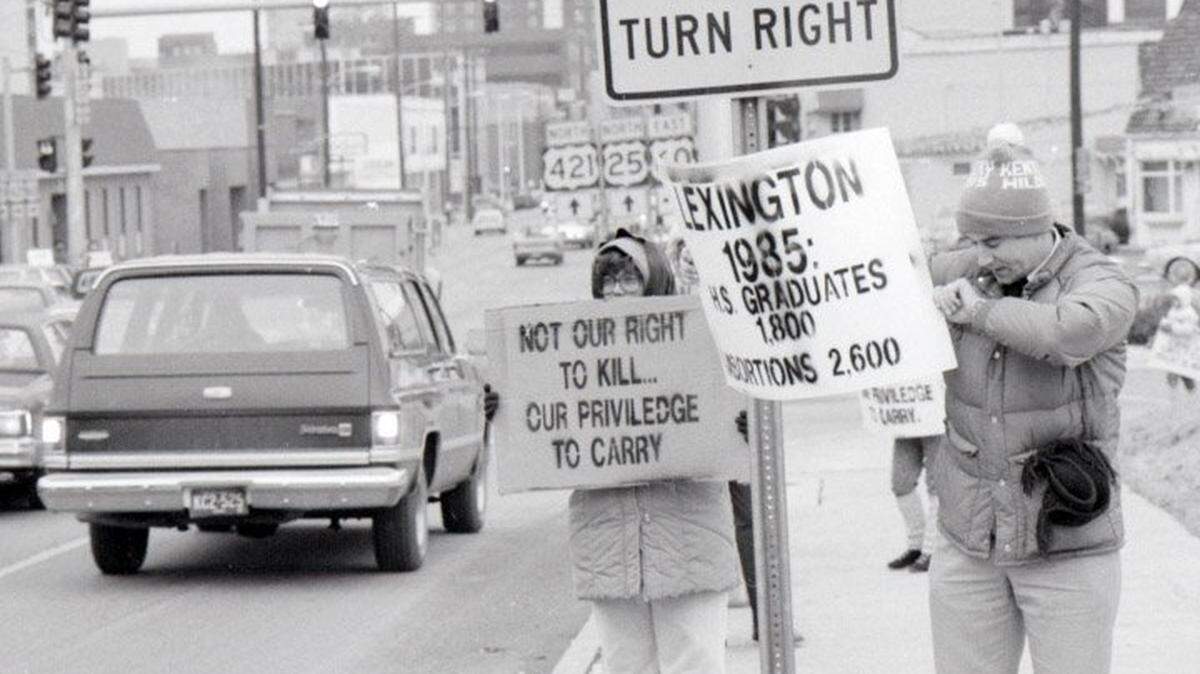
Kentucky’s abortion history as seen through the lens of Herald-Leader photographers

Kentucky reproductive rights groups prepare for likely reversal of Roe v. Wade
On a recent June morning, in a stuffy, second-story room in downtown Louisville, Ashley Jacobs scanned a spreadsheet of women’s names on her computer screen. Each had called the Kentucky Health Justice Network in the last month in need of money to pay for their abortions.
Jacobs, operations director for the nonprofit, readied the list of questions she poses when she returns hotline calls, and played the first message, left by a woman who’d called that morning on her drive to work.
“I was just hoping to get a call back,” the woman said into her phone, audibly sighing.
Clearly stressed, her voice shaky, she wouldn’t be free to talk again until the end of the work day. Her abortion was scheduled for the following week, she said, and “I won’t have my paycheck in time, and I just need some help so I can…” She trailed off. “I’ll just explain on the phone,” she said, sounding embarrassed. “I’m sorry, I’m just nervous.”
In any given week, Jacobs and other KHJN staff hear from roughly 40 people needing help paying for an abortion. It was mid-June, and so far the ages of callers that month ranged from 17 to 41. Many already had children.
Like the first caller that morning, most had scheduled their abortion at one of Kentucky’s two remaining clinics, both in Louisville — EMW Women’s Surgical Center and Planned Parenthood. Costs for each, determined by how far along a person is in their pregnancy, ranged from $700 to $1,200.
This is typically how the process goes, people interviewed for this story said — if someone needs an abortion but can’t pay for all of it, they schedule an appointment and then begin making a series of calls to financial aid organizations, almost like fundraising, to cobble together enough money to pay for their health care. In Kentucky, KHJN and the A-Fund, Inc., which raise money primarily through donations and grants, are the biggest local donors to this end. The National Abortion Federation also dispenses money for individual abortions.
While most hotline callers lived in Louisville, others phoned in from Lexington, Harrodsburg, Richmond, Paducah, Danville, Taylorsville, Hopkinsville and Nashville, Tennessee. Nearly all were 10 or fewer weeks along in their pregnancy.
Later that afternoon, KHJN called the woman back and pledged $100, as the group does for all surgical abortions. For medical abortions, they pledge $50.
At the time this story was first reported, Kentucky was teetering on the edge of a new reproductive rights era, with an outright ban on the procedure looming over those who give and want to access abortion care. On Friday, the leaked U.S. Supreme Court draft opinion overturning Roe v. Wade became a reality. The high court struck down the landmark case in a 6-3 vote, felling half a century of federal protections for the procedure, handing the reins instead to states. In Kentucky, that meant abortion became illegal immediately, thanks to a 2019 “trigger law” that includes no exceptions for rape, incest or teens seeking the procedure.
Though Planned Parenthood and the American Civil Liberties Union of Kentucky, on behalf of EMW, have vowed to sue the state in an attempt to block the trigger law from being enforced, nearly all abortions are now illegal.
Jacobs knows that the $100 and $50 pledges is a drop in the bucket, now that Illinois is among the closest reliable “receiving states” capable of taking on the roughly 4,000 Kentuckians who get abortions every year. The group is planning to grow its network of volunteers willing to drive patients to their appointments, as well as boost donations for gas money, child care and hotel stays.
But Erin Smith, executive director for KHJN, knows the repercussions of a statewide ban will burrow deeper than just affordability.
“If you take it away, you are forcing people to give birth. You’re forcing people to have kids, and at the same time, Kentucky has not done enough to guarantee a good quality of life for these children,” they said.
‘It just will not be available’
Kentucky’s abrupt transition into an abortion desert is a reality that health care providers and advocacy groups have long braced for. Since the state’s only remaining clinics are in Louisville, the option of abortion is already inaccessible for many living in far western, south central and Eastern Kentucky.
That’s why KHJN and the A-Fund, Inc. try to bridge the financial gap. Both saw a donation boon after the leaked opinion in May. Between late April and mid May, the A-Fund, which typically raises a few hundred dollars a month, received close to $28,000, said President Kate Cunningham.
Likewise, in a typical month KHJN raises maybe $10,000, Jacobs said. In May, the organization raked in close to $150,000 from donations across the country.
But the extra money those groups are able to provide, even on top of the gas money KHJN doles out and, if need be, a hotel stay, is simply not going to ensure access to everyone. The average one-way driving distance for a Kentuckian to get an abortion just jumped from 70 miles to roughly 260 miles. Many will not have the resources to take what’s likely to be a multi-day trip across state lines.
“That, alone, will be cost-prohibitive and time-prohibitive for the most at-risk and vulnerable, which are going to be disproportionately Black and Brown communities,” said Dr. Alecia Fields, an OB-GYN who drives from outside Louisville once a month to provide abortions at Planned Parenthood. “It just will not be available to all patients.”
Though most abortions are now banned in Kentucky, Planned Parenthood will stay open to fulfill other reproductive health care needs, like birth control and sexually transmitted disease testing, she said, and staff will point patients toward safe abortion care in other states.
“We know that whether abortion is legal or not, it will continue,” Fields said earlier this month. But “the scary thing is, we don’t know where patients will end up.”
Outlawing the procedure will force some who can’t afford to travel hundreds of miles to carry pregnancies to term, as Smith said. For others, they will find ways to get an abortion without medical supervision, potentially putting their lives at risk. But really what it does is force women to make choices in isolation, Dr. Fields said.
Even before the ban, many patients already know they lived in a state hostile to abortion. Clinic staff and physicians like Fields are sometimes the only people patients open up to about their decision. By outlawing the procedure itself, states like Kentucky are also outlawing the in-person counseling that accompanies that type of health care.
“A lot of my patients think they’ve never met anybody who’s had an abortion. They think that they’re the only ones, but they’re most definitely not,” she said. “People just aren’t talking about it,” but “it’s still health care, and it’s still needed.”
‘She felt like she didn’t have a choice’
Stevie Benge is usually the first person patients see when they walk through the door of Louisville’s Planned Parenthood clinic.
As medical receptionist, Benge strives to cut through the shame and stigma that hovers like a shadow over the office to instead curate a normal, welcoming atmosphere.
Her conversations are often brief and to the point, including on Fridays when licensed physicians provide abortions. Patients of all ages and backgrounds fill out paperwork about their medical history and health insurance. Benge answers any clarifying questions they may have, and then asks them to have a seat.
Most of the time, it’s no different than a dentist’s or a pediatrician’s office — while patients wait for for scheduled pap smears, sexually-transmitted disease tests, birth control consultations, or abortions, they thumb through magazines, scroll on their phones, or watch the TV mounted in the corner of the room. Some come with their children in tow.
This calm tone turned frantic in late April when House Bill 3 became law for eight days and halted all abortions in the state. The law caps abortions at 15 weeks, bans the mailing of abortion pills, limits a minor’s access to the procedure and sets up a broad network of certification, monitoring and paperwork to track information about each abortion performed in Kentucky.
Immediate compliance was impossible, so EMW and Planned Parenthood sued the state in federal court. A little over a week elapsed before a judge validated their complaints by blocking most parts of the law from taking effect.
That eight-day freeze served as a teaser for the post-Roe reality that is now crystallizing across Kentucky.
HB 3 was passed late in the day on a Wednesday. Benge remembers making a flurry of calls to patients scheduled for abortions that Friday to let them know the procedure they’d planned for wouldn’t happen. Others who couldn’t be reached beforehand were turned away when they showed up Friday morning.
“Patients that walked through the door were suddenly having to sit with their feelings for quite awhile before we could even figure out what to do next,” Benge said. “It was a mix of anger and frustration, desperation and just hopelessness. Basically everyone cried. I can’t imagine what it feels like, being told that you may not have any bodily autonomy.”
Patients instead were directed to Planned Parenthood clinics in Bloomington, Indiana, 100 miles away, or Indianapolis, 135 miles away. Some couldn’t afford to make the trip for lack of money or reliable transportation. Others couldn’t afford to take a full day off from work.
“We had some people that just absolutely could not make it work,” Benge said. “For all the people who stayed and figured it out, you had others who just got hit with that information and then just left. And those are the hardest ones.”
Benge remembers one patient in particular, a woman in her early 20s, that left without setting up an appointment in Indiana.
“We gave her the information, and she immediately started crying. Her whole face glazed over, and in a very exasperated tone said, ‘Well, I guess I’ll keep this baby, then,’” Benge said.
“She felt like, with the information we gave her, she didn’t have a choice but to stay pregnant.”
‘About all we can do’
Around the same time Benge was helping patients reschedule their abortions out of state, Kate Cunningham’s phone rang.
Cunningham, executive director of the oldest abortion fund in the state, was on her way back to Kentucky from the west coast. She answered and was greeted by a staff member at EMW Women’s Surgical Center.
They were calling on behalf of a patient from west Kentucky who was scheduled for an abortion. But since all had stopped as a result of HB 3, EMW needed to find a clinic in another state. Not only that, but the patient needed help paying for it.
The A-Fund, which has been helping fund Kentuckians’ abortions for 30 years, raises money to supplement abortion costs for people who can’t foot the entire bill themselves. In 2020, 4,104 abortions were provided in the state. The A-Fund helped pay for a third, Cunningham said.
To make the transfer of money easy, the organization has for a dozen years set up a block grant at EMW that clinic staff know to pull from if a patient needs help. At the end of each month, the group receives a breakdown of how much was spent and replenishes the fund accordingly.
Cunningham typically doesn’t talk directly to staff, but that day she received a handful of calls.
“I was in the airport getting these calls because clinic staff had my number handy, and then I would just make a commitment,” Cunningham said.
That week, the A-Fund spent $900 for five women from Paducah to Elizabethtown get abortions at the Hope Clinic in Granite City, Illinois, near St. Louis, close to 260 miles, or a four-hour drive, from Louisville.
Recalling her conversation with the Illinois clinic that week, Cunningham said, “We’ll send you $1,000, use it [whenever] a Kentucky woman comes to you and says she’s $100 or $200 short.” Then, “you report back to us at the end of the month, and we’ll replenish the fund.”
The A-Fund has long standing relationships with clinics outside of Kentucky for this very reason. As the General Assembly has restricted abortion access over the last six years, organizations like the A-Fund and KHJN have relied on regional clinics in Illinois, Ohio, Tennessee and Indiana to meet patient needs when state law has interfered.
But that list is shrinking, too. If Roe is overturned, laws in virtually every state in the south and midwest, except Illinois and Virginia, will make abortion access unreliable for Kentuckians.
“We recognize that women having to travel out of state to get basic medical care increases their out-of-pocket costs and their personal costs, therefore they have less money for the abortion,” Cunningham said. “We’re committed to significantly increasing the amount of funding we can provide a particular patient. But that’s about all we can do.”
Hope Clinic staff have already noticed an increase in patients visiting from Kentucky, who were likely spooked by passage of HB 3 and the leaked Supreme Court draft opinion. From March to April, the number of Kentuckians who visited the Illinois clinic for abortions ballooned by 160%, said Hannah Dismer, education and research coordinator at the Illinois clinic. From March to May, it doubled.
It’s only a matter of time before that becomes the new normal, Dismer said. While 13 states, including Kentucky, already have trigger laws that ban abortion outright or in a matter of days now that Roe has been overturned, more than half of all states are expected to severely limit access, dramatically reducing the number of clinics nationwide. What’s expected to emerge, instead, is a handful of regional abortion hubs that serve multiple states.
The Hope Clinic is one of them.
“We’ve seen people from all across the country travel to us for years for later abortion care,” Dismer said earlier this month. But increasingly, “it’s for all abortion care.” In 2021, the clinic served patients from 19 states. So far this year, it’s 21 states.
Dismer, who also provides post-abortion counseling and manages the clinic’s patient education and counseling team, said they see Kentuckians “almost every day.”
“We’ve been in this preparation mode for years because we’ve known this or something like this was coming,” said Dismer, who said the clinic is preparing for its patient pool to grow by at least 40% this year because states like Kentucky will shut down access.
Because change is on the horizon, the A-Fund has begun depositing $1,000 a month into its new block grant at the Hope Clinic “with every intention to increase that as they see a higher number of women travel from Kentucky,” Cunningham said.
In the meantime, the A-Fund is continuing to pay for abortions at EMW while they still can, Cunningham said. In April, close to 100 women used A-Fund money to get abortions at EMW, and Cunningham’s group fronted $14,400 to pay for a portion of each.
‘I wish there was more we could give’
Back at KHJN’s office, Jacobs continued ticking through hotline calls.
She dialed the number of a woman with an appointment the following day at EMW. The woman answered and Jacobs asked if it was a good time to talk.
She was in her late 20s and roughly six weeks along in her pregnancy. The procedure would cost $700. Jacobs asked if she had stable housing, emotional support and the means to pay at least $300 for her abortion.
The woman said yes, but she couldn’t cover the remaining $400.
“Have you contacted the National Abortion Federation, yet?” Jacobs asked. “They’re going to give you the largest portion of funding if you qualify.”
She hadn’t but said she would. Jacobs said KHJN could pledge $50.
“Thank you,” the woman said.
They hung up.
“I wish there was more we could give,” Jacobs said almost to herself.
These were the final days of abortion access in Kentucky. Up until the fall of Roe on Friday, the group continued doling out money for in-state abortions. Now, the organization is readying to help ferry people across state lines.
“We all knew it was coming, but it still hurts,” Smith said Friday. “People are going to be traveling significantly further, but it has to be done. We’ll do our best to help. That’s all we can do — do the best with what we have.”
This story was originally published June 23, 2022 at 8:00 AM.