‘Rough living.’ E. Kentucky flood victims spending winter in storage sheds, campers
READ MORE
Housing a key issue after Eastern KY floods
Expand All
Randall Robertson and Vicie Holland waded knee-deep through water to escape a flood that ultimately rose over the top of their mobile home in Perry County last July, destroying their house, vehicles and belongings and killing two of his hunting dogs.
They stayed in a church for three weeks before moving to a camper trailer a friend loaned them, but the uninsulated trailer was cold and Robertson didn’t want to spend the winter in it.
He ended up buying a storage building, 10 feet wide and 32 feet long, to put on the lot that flooded. It was just a shell; he finished the inside with insulation and drywall and installed water, electricity and propane heat.
It’s cramped — “rough living” as Robertson says — and when it rains he can’t sleep because of worry about Lost Creek surging out of its banks again, but he felt it was the best option for a place to live.
“Quickest thing I could get ahold of,” said Robertson, a retired coal miner. “There was just no place to go.”
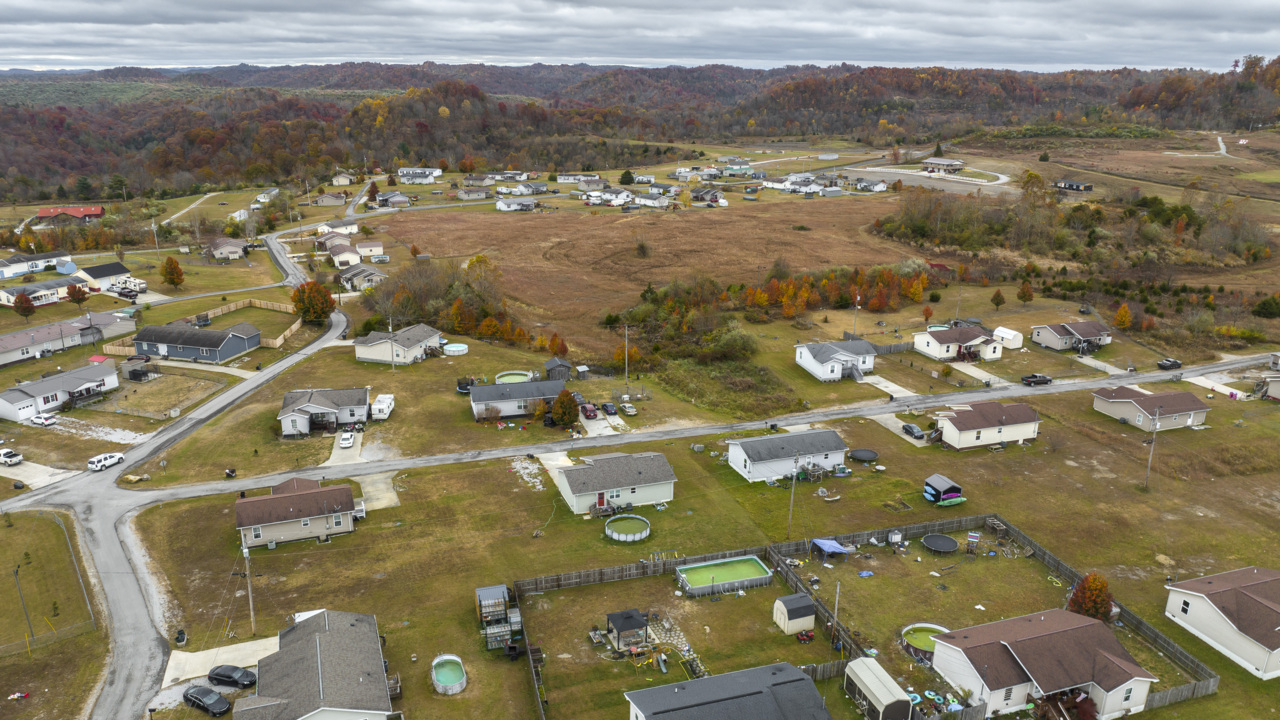
Across the counties hit hardest by flooding in Eastern Kentucky just over six months ago, some residents have made homes in storage sheds or put new or used mobile homes back at sites that flooded. Hundreds are spending the winter in campers, and some are living in substandard houses, according to housing advocates.
Their living situations point to a shortage of affordable, good-quality housing in the region that was critical even before the flood.
The shortage resulted from a number of factors, housing advocates said, including the relatively high level of poverty in the area, lack of funding to build new housing to rent or buy, and little development by the private sector.
“Before the flood, the need was huge. We really had a housing crisis,” said Scott McReynolds, executive director of the Housing Development Alliance, which builds and repairs houses for low-income people in Breathitt, Knott, Leslie and Perry counties. “Fundamentally, we had a broken housing market.”
‘I don’t like it’
A number of people who lost homes, vehicles and property in the flooding said the money they got from FEMA hasn’t been enough to get them into housing comparable to what they had.
Only 20% of those who applied for aid received more than $20,000 under the largest disaster-aid program for individuals, according to the Ohio River Valley Institute.
Jack and Sherry Alsept, whose mobile home in Perry County was damaged too badly in the flood to move back into, felt the $30,000 check they got from FEMA was not large enough given the loss of their home, vehicles, outbuildings and property, which Alsept estimated at more than $200,000.
A mobile home would cost far more than they received, Alsept said.
As the months wore on, first in a tent beside their house and then in camper trailer in their yard, they decided to get a 14-foot by 24-foot storage building — a shell Alsept will have to finish — to put on the hill across the road from the spot where their home flooded.
Alsept said he was getting sick of living out of plastic bins in the cramped camper.
“I’m just getting something with more room,” said Alsept, who worked in construction and mining and as a truck driver. “I’d give anything to have a bathroom big enough to turn around in.”
Chad and April Stivers and their son Zack, who is 12, lived in a tent in the yard of their flooded house and later in a 16-foot by 12-foot building a pastor built for them before finally receiving a camper trailer.
They still stay at the small building some nights in order to work on repairing their home, and because of concern about looting, “bumping into each other every time you turn around,” April Stivers said.
“There was just literally nowhere” when they looked for other housing, she said. “Half the county got flooded.”
.Jennifer Hunt and her husband, Keith, are a bit of a rarity in the area devastated by the flooding because they had flood insurance on their mobile home in Perry County that was inundated by Troublesome Creek.
Most people didn’t because of the cost. Of the people who applied to FEMA for help after the flood, only 4% had flood insurance.
The Hunts hope the insurance money will be enough to cover the cost of building a new house on higher ground.
Until then, they are sleeping in a tent in the yard of her mother’s home for lack of anyplace else to stay. Their daughter and two other family members displaced by the flood share the two-bedroom house with her mother.
Hunt said they use extension cords from the house to run heaters in the tent.
“I don’t like it, but there ain’t nothing you can do,” Hunt said.
‘More people living on less’
The poverty rate in Appalachian Kentucky averaged 23.5% between 2016 and 2020, meaning more than 75% of residents had incomes above the poverty line.
However, the poverty level in the region was nearly twice the U.S. rate of 12% over that time, and in several of the counties that had the most flooding damage, the rate was even higher, according to information from the Appalachian Regional Commission.
In Breathitt County, for instance, 33.4% of residents had incomes below the poverty line. The rate was 31% in Knott County and 29.7% in Letcher County.
A relatively high number of people in the area are considered very low income.
In Breathitt County, 14.7% of households received income and benefits totaling less than $10,000 in the five-year period from 2017 to 2021, and 41.6% of households lived on less than $25,000, according to the U.S. Census Bureau.
In Knott County during that period, 15.5% of households received less than $10,000, and 35.8% received less than $25,000.
“Most of the issues fundamentally go back to economics,” McReynolds said. “We have more people living on less money than just about anywhere else in the U.S.”
With a sharp decline in the coal industry beginning in 2012, there aren’t as many good jobs in the private sector as before in several of the counties hurt most by the flooding, and many people are not in the workforce.
In Knott County, for example, the employment rate over a five-year period was 34.4%, compared to 55.1% for Kentucky as a whole, according to Census data.
In Breathitt County the rate was 39.5%, and in both counties more than 30% of the residents were disabled. One common form of disability payment in the region, called SSI, is capped at $914 a month for an individual in 2023.
The median household income in Appalachian Kentucky between 2016 and 2020 was $39,501, compared to $64,994 nationally, according to Census figures.
The bottom line is that many people don’t have much to spend on housing.
Melissa Bryant is an example. After the mobile home she lived in in Breathitt County was destroyed in a flood in 2021, she lived in a small wooden building until the flooding last July destroyed it as well.
FEMA offered her a trailer, but she wouldn’t have been allowed to take all of her 15 dogs and didn’t want to leave them, so she turned it down and lived in a cargo trailer at the lot for several months, until she received a camper trailer through a church.
She has no electricity, however. She shares the camper with several dogs, uses a small propane grill and a kerosene heater for warmth, has candles and lights that use batteries, and heats water to wash clothes by hand.
Bryant worked several years for a landscaping company, but her former employer, Doyle Turner, said she had back problems. She has done odd jobs since but hasn’t had regular work for years, so she has little money for housing or anything else.
Bryant has gotten by on donations recently, including food, propane and kerosene that Turner brings.
“Take their worst and times it by 10,” she said when asked to describe her situation. “You just adjust to whatever you have to do to get through to the next day.”
‘We have a shortage’
Non-profit housing organizations use a mix of money from donations and taxpayer-funded sources when building houses in the region for lower-income people in order to keep the mortgage cost down.
Creating good, affordable houses helps build wealth and improves the tax base, housing advocates say.
However, money from government sources hasn’t met the need for rental units or single-family homes in Kentucky for decades, according to housing advocates.
For instance, one key source to building rental housing is a federal tax credit administered through the Kentucky Housing Corporation, a quasi-state agency.
Developers use the credits — which are awarded on a competitive basis — to offset the cost of building affordable multi-unit rental housing for low- to moderate-income people.
The agency recently announced it had received 33 applications requesting more than $28 million in credits, but had been able to fund only 13 projects with $12.5 million in credits.
“They can never fund as many projects as come in,” said Adrienne Bush, executive director of the Homeless and Housing Coalition of Kentucky.
Across Kentucky, there is a shortage of more than 78,000 rental units that would be affordable and available to people with extremely low incomes, according to estimates by the National Low Income Housing Coalition.
“We have a shortage statewide of affordable units,” said Wendy Smith, deputy executive director of the Kentucky Housing Corporation.
In the 5th Congressional District in Eastern and Southern Kentucky, the shortfall of rental units for people with 50% or less of the median income level in the area is nearly 30,000 units, according to the coalition.
The funding Kentucky has received under the largest federal block-grant program to build affordable housing increased from $12.6 million in 2020 to $15.5 million in the current fiscal year, according to information from the Kentucky Housing Corporation, but still fell far short of the need as building costs rose.
And funding for another federal program through the U.S. Department of Agriculture to build single-family housing for lower-income people has been flat nationwide for decades, said Jim King, CEO and president of the Federation of Appalachian Housing Enterprises, or FAHE.
“The lack of national housing policy that is backed up with solid funding has made places like Appalachia, other rural persistently poor and urban neighborhoods marked by poverty to be particularly vulnerable, so one disaster creates a huge problem,’ King said.
The Housing Development Alliance estimates that before the flood, 40% of the people in its area were “inadequately housed,” meaning they lived someplace that was substandard or over-crowded or stretched thin by the cost.
“There’s a tremendous number of houses that would need a significant amount of work to meet any kind of reasonable standard,” said McReynolds, head of the organization.
More than half the homes designated as destroyed by FEMA in the flooding in Kentucky last summer were mobile or manufactured homes, according to data compiled by Eric Dixon at the Ohio River Valley Institute.
Many were located near rivers and creeks because there is little other flat land outside those spots.
A 2016 study by the Virginia Tech center, which was supported by FAHE, found that mobile and manufactured homes made up between 27% and 34% of the occupied housing in southeastern Kentucky, with some of the highest concentrations in Breathitt, Perry, Knott and Letcher counties.
A relatively high percentage of the mobile homes in Eastern Kentucky were older units that are more likely to have problems such as little insulation, leaky roofs and deteriorating foundations, the study said.
Little private development
The housing market in the area hit by flooding last year was also tight because of a lack of private development, according to real-estate agents and housing advocates.
It is common in areas with more economic opportunity for developers to build houses in anticipation of selling them, but that is not the case in much of Eastern Kentucky, said Seth Long, executive director of HOMES Inc., which is based in Whitesburg and builds affordable houses for low-income people.
“That transaction does not happen in this county,” Long said.
Long said the non-profit agency is the only housing developer in Letcher County. The organization is rooted in part in a Mennonite ministry; the name stands for Housing Oriented Ministries Established for Service, Inc.
Steep terrain, ownership by coal and land-holding companies, and a lack of clear title to many properties handed down though generations of heirs also create barriers — and add costs — to housing development, Long said.
Long said people in the area sometimes hire carpenters to build homes for them.
That process does not result in a public sale, Long said, which is important because those comparable sales are used in appraising houses for home loans, creating a situation in which the cost to build a house will be higher than the appraised value.
It can be difficult for appraisers in the area to find sales of comparable properties, said Ricky J. Campbell, vice-president and senior lender at Whitaker Bank, which has offices in Eastern and Central Kentucky.
“The lack of comparable properties coupled with inflated cost of building materials does sometimes make it difficult for a property to appraise for its cost to build,” Campbell said.
Non-profit housing agencies use other funding such as grants to make up the gap between the construction cost of a house and the appraised value so that a homeowner can get a loan, but private developers can’t do that.
In towns in Eastern Kentucky that have good jobs in the healthcare field, education and successful businesses, there are subdivisions with attractive, higher-end houses that hold their value well, said Rick Newsom, president of Community Trust Bank, headquartered in Pikeville.
However, the housing market in many rural areas is depressed because people have had to move away to find work, Newsom said.
Many people who remain in rural areas are likely to make less money or live on a fixed income, often living in houses passed down from one generation to the next, which may be substandard, he said.
“There will be some nice homes dispersed among these rural areas, but it does negatively impact the market value of the nicer houses,” Newsom said.
Newsom said prices to build a desirable new home or buy a manufactured home “have escalated well above affordability for many,” with inflation and rising interest rates as factors.
‘You make do’
Widespread damage from the flooding last summer made the housing market even tighter.
The flooding destroyed or caused major damage to more than 2,100 residences, according to the American Red Cross Bluegrass Chapter, with most of the damage concentrated in Knott, Breathitt, Perry and Letcher counties.
“We don’t have a good supply of houses right now that are available for these people that have been flooded out,” said Martha Greer, who has been a real-estate agent in the Hazard area for 45 years.
That is why people are turning storage sheds into homes or putting mobile homes back in places that could flood again, McReynolds, the Housing Development Alliance director, said.
“When you don’t have a lot of money you make do,” he said.
It would take a significant amount of money from state and federal sources to create an adequate amount of affordable housing in the area that is above the floodplain, advocates said — perhaps into the hundreds of millions of dollars.
But with enough funding and proper planning, the disaster creates an opportunity for a better future, they said.
“We need to come out the other side better off,” Long said.
This story was originally published February 16, 2023 at 10:00 AM.