
La Niña forecast to bring ‘rollercoaster’ spring weather to KY. What to expect
The recent warm-up in Central Kentucky is expected to be followed by a cold spell early this week that will place temperature highs back near freezing again.
According to a National Weather Service meteorologist, you can expect that pattern to continue well into March. A weak La Niña is playing a big role as it transitions to El Niño by summer, bringing some volatile weather along the way.
For insights into the general weather trends expected to influence conditions this spring, we reached out to Mark Jarvis, a meteorologist with the NWS in Louisville.
In addition, the latest outlooks from the Climate Prediction Center within the National Oceanic and Atmospheric Administration offer some signals of what to expect from spring in Kentucky this year. Here’s what to know.
What’s driving ‘rollercoaster’ temperature swings early this spring?
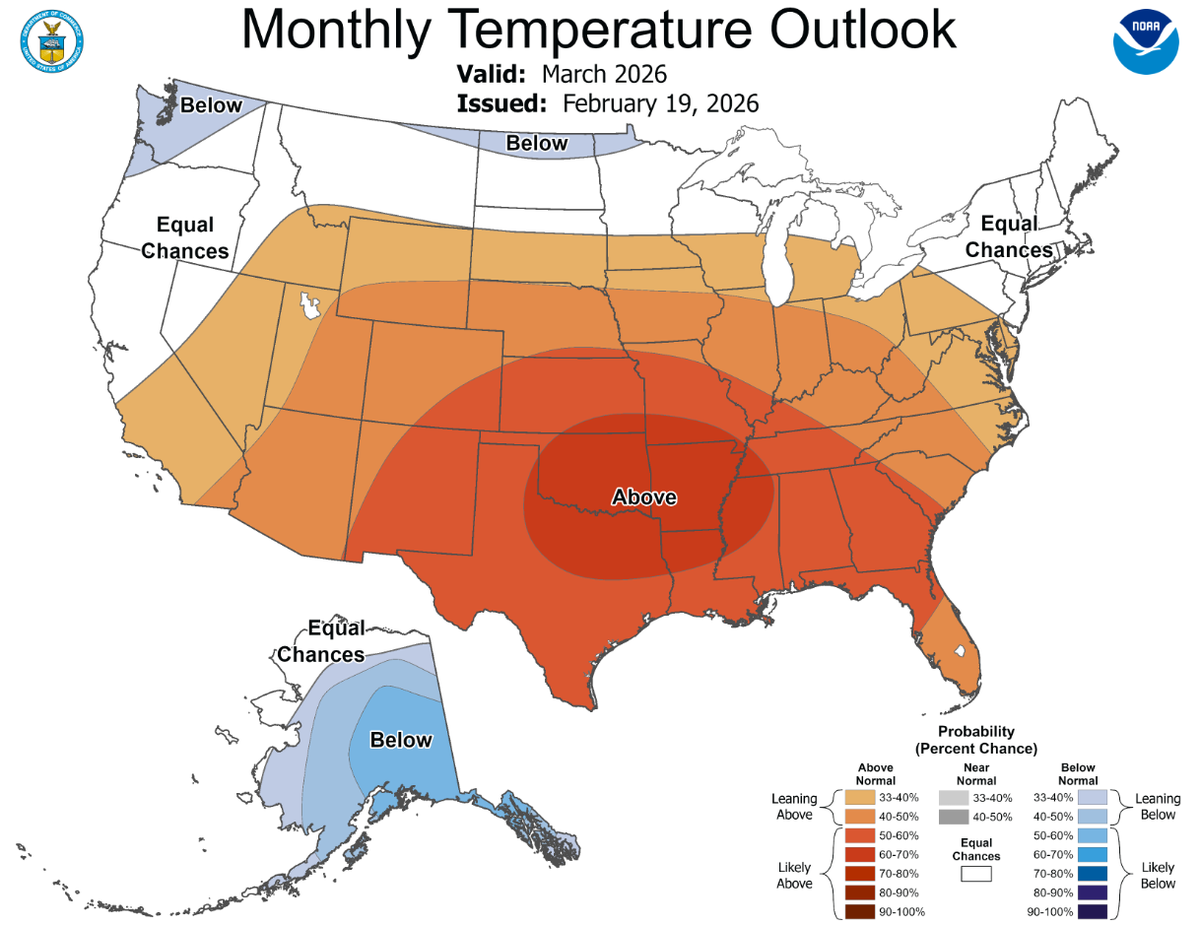
Early spring could be a warmer one for Kentucky, if NOAA’s latest Climate Prediction Center outlook is any sign.
Kentucky is leaning above normal, the probabilistic outlook for March shows, with a 33 to 50% chance of above-normal temperatures. Zooming out to the three-month outlook for March, April and May, most of the state has a 33 to 40% chance of experiencing above-normal temperatures.
During a typical March, Lexington residents can expect temperature highs in the mid-50s, with an average high of 56 degrees Fahrenheit. Overnight lows in March can dip into the mid to low 30s. The average temperature low for the month is 36 degrees, Jarvis told the Herald-Leader.
That being said, the weak La Niña conditions observers are seeing in the Pacific Ocean are likely to produce “rollercoaster” like temperature swings in Kentucky, Jarvis said.
What that means in practice is large warm-ups in advance of storms, followed by deep temperature plunges left in their wake.
La Niña is the cold phase of the El Niño-Southern Oscillation Cycle, or ENSO. Its unusually cool sea surface temperatures in the central and eastern Pacific Ocean strengthen the trade winds that blow from east to west along the equator. This has the general effect of bringing warmer, drier weather across the Sun Belt, while northern states see more cool and wet weather. Kentucky sits between the two extremes.
According to Jarvis, the latest forecasts continue to confirm this La Niña pattern is diminishing, and it’s expected to change over to its warmer El Niño counterpart by the summer.
That volatile transition is likely to be noticeable in March, Jarvis explained.
Weak La Niña winters typically have a 30 to 40% chance of being warmer than normal, but “it is common to have blasts of arctic air during the month, and these cold spells can last up to 1-2 weeks at a time,” Jarvis told the Herald-Leader.
“Current hemispheric patterns are favoring a warmer period of weather here as we close out February,” Jarvis wrote to the Herald-Leader in an email. “However, there continues to be a signal in the longer term guidance that the early part of March may trend cooler than normal. Our overall confidence in this is a little below average. We feel that ‘roller coaster’ swings in temperatures are very likely and that may end up keeping our monthly temperature average below normal this year.”
Severe thunderstorms more likely this year between April and June
Kentucky may also be in for a wetter spring, according to the latest outlooks from the Climate Prediction Center.
For March, the CPC outlook is pointing toward a 33 to 50% chance of above-normal precipitation. As a baseline, the Lexington area typically gets 4.5 inches of precipitation in March.
In the three-month outlook between March and May, there’s a 33 to 40% chance for most of Kentucky.
On this point, there’s agreement between the CPC and local forecasters, with Jarvis reporting that “forecast confidence in higher than normal precipitation is very high.”
Outbreaks of severe thunderstorms are often more common during La Niña years, Jarvis noted.
“With the expectation of the large temperature swings, we think it will be common to see a few scenarios where we have strong/severe storms moving through the state,” Jarvis noted.
There’s also the possibility of cold spells strong enough to produce minor snow accumulations, though chances for snow decrease significantly by late March, Jarvis said.
On the whole, it’s fair to expect an active spring with the weak La Niña in play, especially when it comes to severe thunderstorms. Under those conditions, “outbreaks of severe thunderstorms during April, May, and into June are higher than normal,” Jarvis wrote.
Do you have a question about weather or the environment in Kentucky for the Herald-Leader? We’d like to hear from you. Fill out our Know Your Kentucky form or email ask@herald-leader.com.