Complaints piled up as Maxwell St. project moved forward. Don’t reward ‘demolition by neglect.’
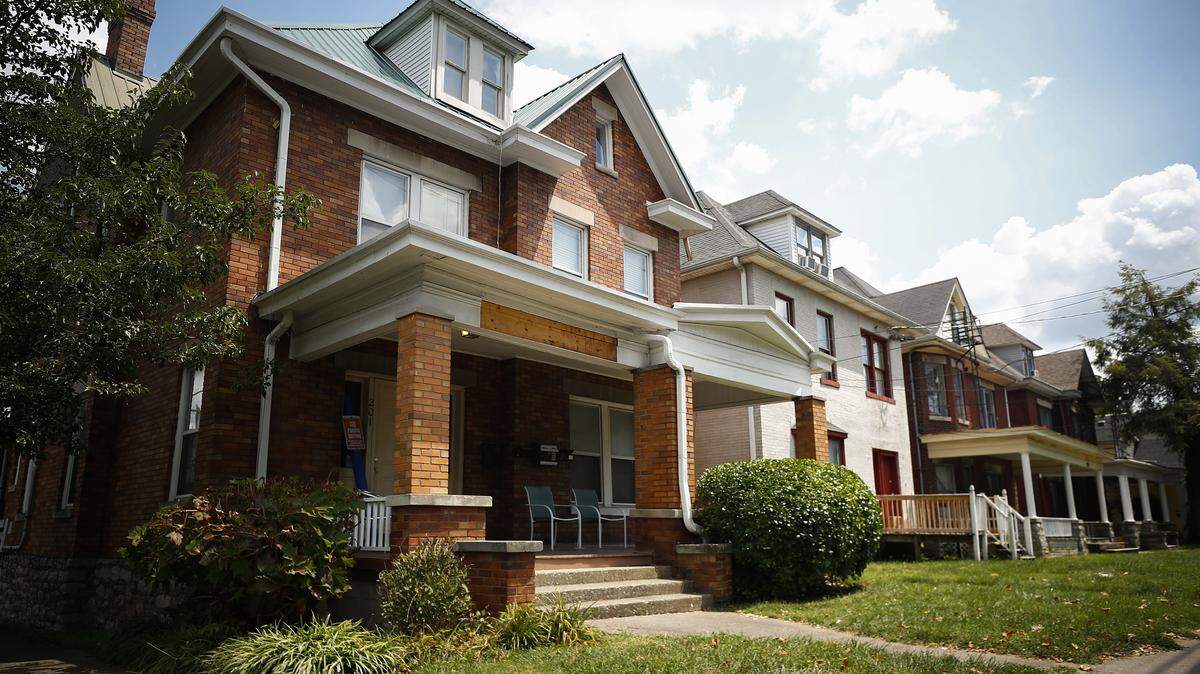
On April 1, Lexington’s code enforcement office issued an inspection report for 221 East Maxwell Street, a once handsome wood frame house built 119 years ago.
The 12 findings, based on an anonymous complaint, required serious repairs that come after years of University of Kentucky student habitation: Replace floor of exterior porch, replace missing siding, re-anchor gutters, replace broken ladders and stairs, repair broken windows, install guard rails.
Officials set up a compliance schedule for the house’s owner, Lexington Village LLC, which owned seven contiguous properties on the block. But by October, nothing had been fixed. Instead, the company was given an extension until Oct. 24, when a Planning Commission meeting was scheduled.
The same thing happened at 209 East Maxwell. A compliance schedule was set up in December 2018 for Lexington Village LLC to repair broken windows and a back deck that was rotting off the house. That compliance deadline was also extended to that Oct. 24 Planning Commission meeting.
And what was due to happen at that Planning Commission meeting? A zone change that would allow a development company to buy the seven historic properties in a federally designated historic district, tear them down and build a 10-story student apartment building in their place.
An open records request revealed trash and housing upkeep problems at all of the properties, but those citations are currently being appealed by Lexington Village’s attorney, Nick Nicholson of Stoll, Keenon and Ogden. He declined to comment on them.
Why would a landlord fix years of deferred maintenance when they know the buildings are going to be sold and torn down? They’re still in disrepair because the initial zone change hearing was delayed and is scheduled for this Thursday.
“Demolition by neglect” won’t even be on the agenda. It should be.
‘Not moving real fast’
At 225 Maxwell, broken windows and other problems were supposed to be corrected by Oct. 24. When an inspector returned on Oct. 25, 10 out of 15 violations remained unresolved, according to documents.
Alex Olszowy, code enforcement director, said Lexington Village has started doing some work. They currently have fines totaling $2,200, although those are also under appeal.
“I won’t say they’re not doing anything,” he said. “But they’re not moving real fast.”
My open records request only went back five years, and inspectors only started looking at the Maxwell properties in 2018 and 2019, although it could have happened years before. Code enforcement has to act off complaints. Since 2018, the records show there have been more than 200 findings of trash or housing upkeep problems among the seven properties.
“They filed appeals, they’ve stated they need more time,” Olszowy said. “If they were going to tear them down, they didn’t want to put a ton of money, but if they’re occupied, they still have to maintain them.”
This “demolition by neglect” is one of the many reasons that on Thursday, the Planning Commission should reject a zone change that would allow both the demolition of these historic houses and the construction of an apartment building for University of Kentucky students that would be out of place in a residential neighborhood. This whole situation demonstrates how city rules and regulations can work by the book and still result in irreversible mistakes.
Let’s go back a couple of decades, when neighborhood associations were trying to get historic protection, or H1 zoning, for the many wonderful houses and cottages throughout Maxwell, Aylesford Park, Transylvania Park and Woodland. That’s when uber-lawyer Bill Lear and family owned the Maxwell block and a lot more. According to our archives, he agreed not to oppose the process if his properties weren’t included in the historic district. He knew, apparently, that it takes a lot more money to keep H1 structures up to snuff with city authorities, especially with the wear and tear of student renters.
Lear sold the properties in 2015 to Lexington Village. According to the city records and citations, these houses, most of them more than 100 years old, have since been allowed to degrade to a point that demolition might make sense. We’ve seen it before. Just look at all the empty parking lots downtown that used to hold historic properties that were allowed to deteriorate to the point that actual demolition didn’t seem so distasteful. Or remember the Woolworth’s and other historic buildings on the CentrePointe-now-City Center block that were practically falling down before they were torn down.
That’s why the H1 zone was created. Without it, there are no protections for historic structures.
Thursday’s hearing will be all about the new 2018 Comprehensive Plan, which emphasizes infill in our urban areas in order to take development pressure off our unique rural landscapes.
The new developer, Aptitude Development of Elmwood Park, N.J. put together its plan to build an apartment building on the Maxwell block, telling the planning office that Maxwell should be considered a downtown area with high-density housing. City planners agreed, although they balked at the height and said the building should be lower.
Vida Vitagliano, who lives on Stone Avenue, has watched the Maxwell block in increasing dismay.
“Lexington Village has consistently rented to hardcore partiers, does not respond to complaints about aforementioned partiers, and doesn’t keep up with the damage for the past several years,” she wrote in a letter to the Planning Commission. “They have been standing off with Code Enforcement despite many complaints. The disrepair is obviously being leveraged as an excuse to raze them.
“This proposal doesn’t seem to have anything to do with what’s best for us residents, our neighborhood, the campus area, or the city,” she added. “This zone change and demolition is not what’s best for us. This is development by way of neighborhood coercion and property neglect for corporate profiteering.”
Bob Wiseman, a former Lexington Commissioner of Public Works, among many other titles, also wrote to the Planning Commission: “Lexington is unique for reasons beyond just our rural areas,” he noted. “We are blessed with active and vital neighborhoods abutting downtown. It is likewise a vital part of our tourism industry. It was achieved with decades of fighting against blind “ urban renewal” based on demolition. Why in the world would we as a community desire to go back to demolition and urban renewal? Preservation of our historic structures is an important community value.”
Another community value is infill, and there are lots of good projects going up around town, from a new apartment complex rising from the moonscape of Martin Luther King Blvd, to the Community Ventures project on the corner of Third and Midland to a senior citizen complex going up behind the Meadowthorpe shopping center. Oh yes, and another big apartment building for students on Angliana, that’s also up for approval by the Planning Commission on Thursday with little to no opposition.
The Planning Commission should turn down this Maxwell Street proposal. Then the city should put more teeth into code enforcement to stop landlords practicing demolition by neglect. The city should also create new rules that stop infill creation at the expense of historic buildings and neighborhoods. We have plenty of room for future infill, it doesn’t have to come at the expense of the past.
This story was originally published November 20, 2019 at 10:21 AM.