Mary Tucker’s unorthodox journey to rifle stardom could help UK win another NCAA title
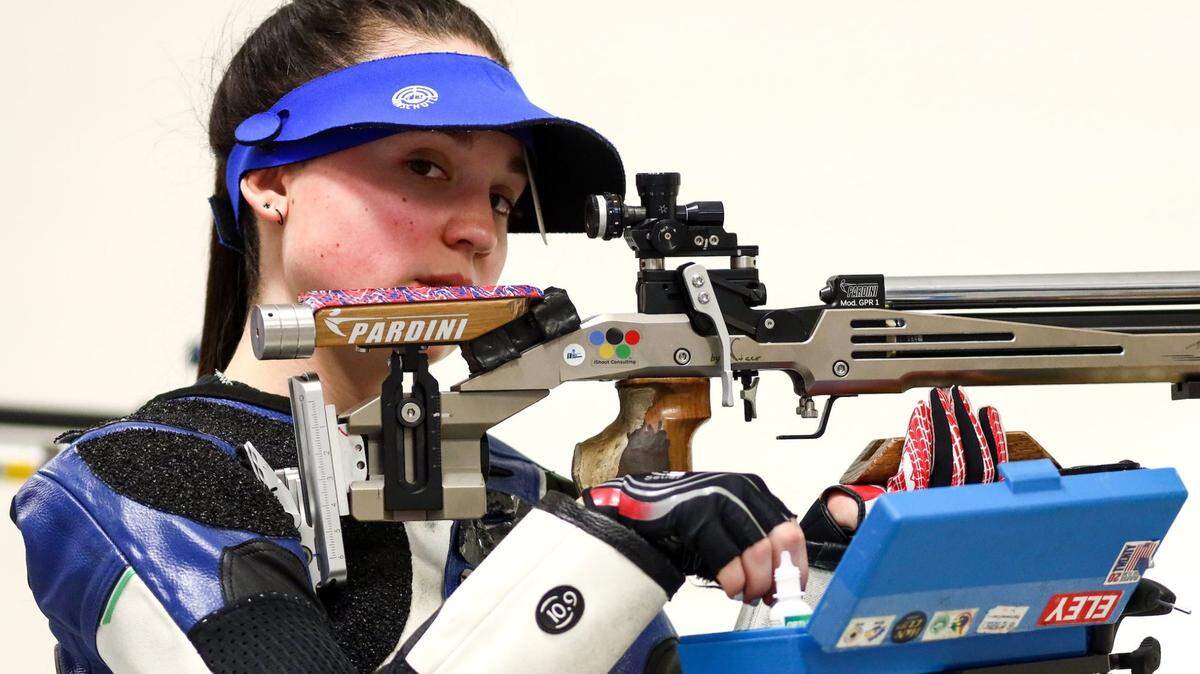
Mary Tucker keeps chasing perfection, while knowing she probably will never attain it.
But already during her time in the sport of rifle, Tucker has made it a point to achieve farfetched goals.
The Kentucky junior and one-time Olympian didn’t enter a national rifle competition until 2017, but she’s ascended to become a star at the collegiate, national and international levels.
The North Carolina native — who began shooting rifle during her high school years in Florida, where she was also a champion equestrian rider — won three NCAA championships last year as a sophomore: Smallbore individual, air rifle individual and overall individual.
She was a large part of last year’s Kentucky rifle team that won the NCAA team title, the third national crown for head coach Harry Mullins and the Wildcats program (UK also won the NCAA team rifle championship in 2011 and 2018).
“This sport, it’s really nice, but also kind of annoying in the sense of that there is perfection and it’s not really that achievable,” Tucker told the Herald-Leader. “We test these guns a lot and they’ll never shoot a perfect score just because of the way that they’re made. We’re all striving for that perfect score and people just keep getting closer and closer. . . . There’s always something going on, there’s always people who are going to be better.”
But few are better right now than Tucker, who tied the NCAA record for smallbore score, shot a perfect 600 score in air rifle and tied the NCAA record in aggregate score (twice posting an aggregate score of 1,195) during her title-filled sophomore season.
Then came the honor of representing the United States during the Tokyo Olympics last summer, with Tucker collecting a silver medal in the 10-meter air rifle mixed team event.
Tucker first qualified for the Tokyo Olympics while still a freshman in February 2020, just one month before COVID-19 shut down the sports world and eventually led to the postponement of the Tokyo Olympics from 2020 to 2021.
The postponement of international rifle events hit Tucker hard, and she took a three-month break from shooting before her sophomore season.
She couldn’t even bring herself to touch her guns.
When she resumed practicing in summer 2020, her scores soared.
“I think that break definitely helped me,” Tucker said, adding that it was nice to return to the sport with her Olympic spot secured. “I could just focus on, ‘OK, let’s get my scores back to where they were and let’s just be better than we were.’”
Then came the record-breaking sophomore season, Tucker’s Olympic debut and a silver medal.
Tucker also created more history in Tokyo, becoming the first UK rifle athlete to qualify at an Olympics in both smallbore (she finished 13th) and air rifle (she finished sixth).
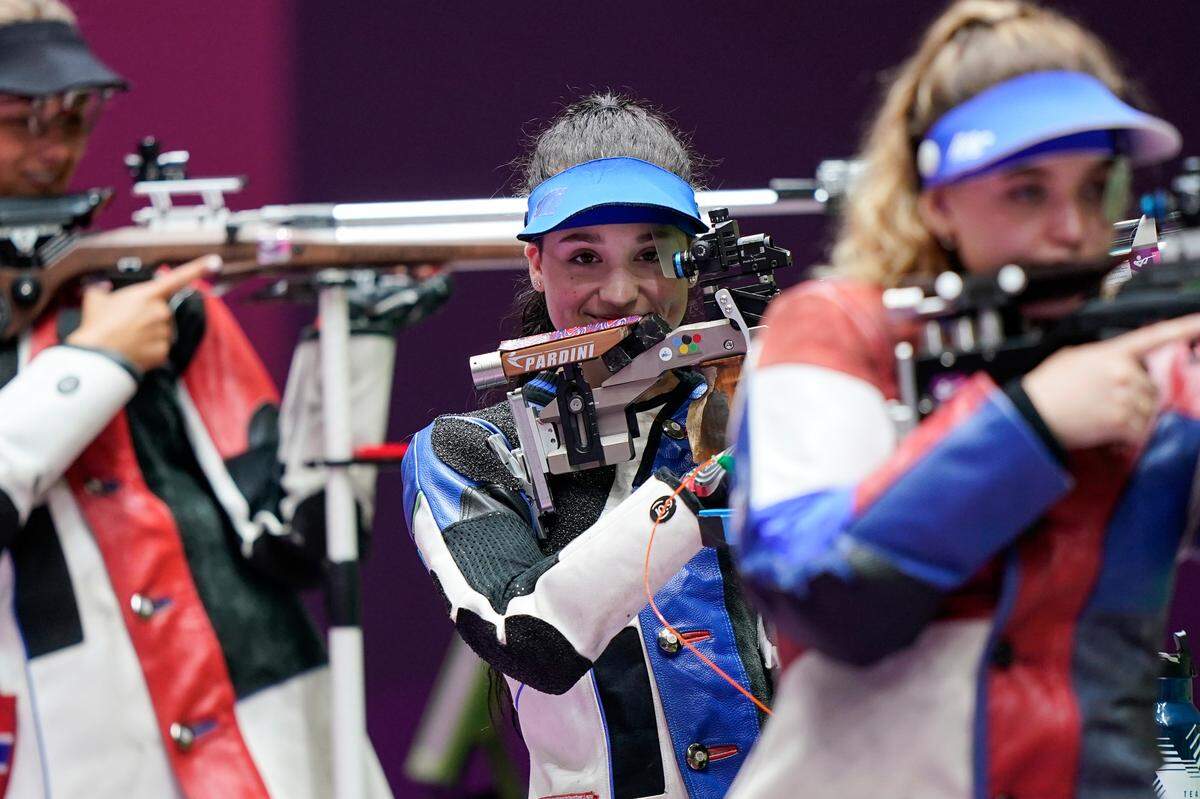
Tucker compared the Olympic experience to that of an International Shooting Sport Federation World Cup.
Tucker has experience in those as well, winning a gold medal in 10-meter air rifle in the March 2021 ISSF World Cup.
“It wasn’t that different on the range. Off the range was pretty different though. I will say the Olympic Village was really cool,” Tucker explained. “I do wish we got to go out and see Tokyo a little bit. We drove through the city because it was about an hour drive to the range. So we got to see that part of the city at least and it was so cool. I really want to come back and go actually see everything, so that’s on my bucket list is going back actually seeing the city.”
It was success on the international stage that helped bring Tucker to Kentucky in the first place.
Mullins, the UK rifle head coach, said he was on a recruiting trip in Germany while monitoring the results of a United States national rifle event when he saw Tucker’s name pop up repeatedly.
That’s when Mullins began researching the athlete widely known as the “rebel child” of shooting.
Tucker hunted throughout her youth and her father was in the military, but she joined the rifle team at Sarasota Military Academy in Florida because her mother Jennifer didn’t want her to.
Tucker quit the team toward the end of her freshman year of high school, and soon linked up with her personal coach, Jayme Shipley, who was located two hours south in Naples, Florida.
Between work with Shipley and several self-taught techniques, Tucker grew to become a champion shooter.
Tucker would watch YouTube videos to learn the proper equipment and positioning to succeed at an elite level.
“They’re all standing like this. I’m gonna stand like that. OK, they all have that kind of gun, I’m gonna get that kind of gun,” Tucker recalled. “I was just copying everybody who was like in these videos. I mean, it seemed to work pretty well. I definitely attribute most of my fine-tuning skills to my coach, but (the YouTube videos) got me a really solid base and my positions are very similar to how they were then, even now.”

Now means Tucker starring both for Kentucky in collegiate action and the United States at international competitions throughout the year.
Even before coming to UK, Tucker moved to Colorado to be at the U.S. Olympic Training Center, a decision she described as “definitely something people don’t do.”
“I had literally been shooting for maybe a year, and I was just like, ‘I’m gonna move from Florida to Colorado.’ That’s far, that’s altitude, that’s snow. So it was very risky,’ Tucker said. “But I am very confident in myself and I’m very confident in my abilities and what I’ll do, so I knew that this was it, this is what I was going to do, and I needed to be better. So I was like, what better place to go than the Olympic Training Center?”
Tucker is rarely in Lexington now, and said she will only be at UK for about 40 days this semester due to travel for competitions.
But one of the main reasons she chose UK for college was because of the support it would provide her to be able to compete at the highest levels, including international events.
“Kentucky was just like, ‘Yep, do whatever you want as long as you get your homework done.’ I was like, ‘That’s the one,’” Tucker recalled.
Mullins puts this a bit differently.
“I’ll say that grades obviously have to come first,” Mullins said “When you get athletes that are very successful, nobody knows how long your career is going to be. . . . You may max out at your results, but somebody else does better. You have absolutely no control. It’s not like you can play better defense. You know, this is who you are. That’s who they are.”
Mullins also stressed the importance of providing exposure for the UK rifle program by having team members compete internationally.
“Getting them to enjoy the fruits of their labor, it benefits us when they travel international. Some people look at it as high-pressure experience. I disagree with them,” Mullins said. “I think a college match is actually probably more pressure than a lot of times international matches, just because of the fact you’re shooting for the team. You don’t want to let the team down.”
The flip side of that is Mullins and UK sometimes must compete without Tucker and other top shooters for crucial matches.
For example, Mullins was without senior Will Shaner — a UK rifle star in his own right who won the gold medal in men’s 10-meter air rifle in Tokyo with an Olympic-record score — and Tucker for a match in November against Ole Miss that Kentucky lost.
It remains UK’s only loss of the season.
“I make all the decisions based on the team first, individual second,” Mullins said. “With Will and Mary being gone, that gives the opportunity for somebody else to step in. They may not be performing at that time at that level, but it gives them the opportunity to. . . . I want people to take advantage of the opportunity.”
The Cats will get another crack at Ole Miss this weekend during the NCAA Rifle Championships, to be held Friday and Saturday at the United States Air Force Academy’s Clune Arena in Colorado Springs, Colorado.
Kentucky is the second seed for the event, after winning the regular-season Great America Rifle Conference co-championship.
It will be the latest chance for Tucker to add to her growing legacy, one that started with rebellion and has led to countless accolades.
“A lot of it honestly started with spite. I mean, I am a person who if you tell me I can’t do something, I’m gonna do it,” Tucker said, reflecting on her rifle career. “I had somebody telling me that they didn’t want me to be a great shooter, they just wanted me to be a good shooter. And I was like, ‘Why would I be good when I can be great?’”
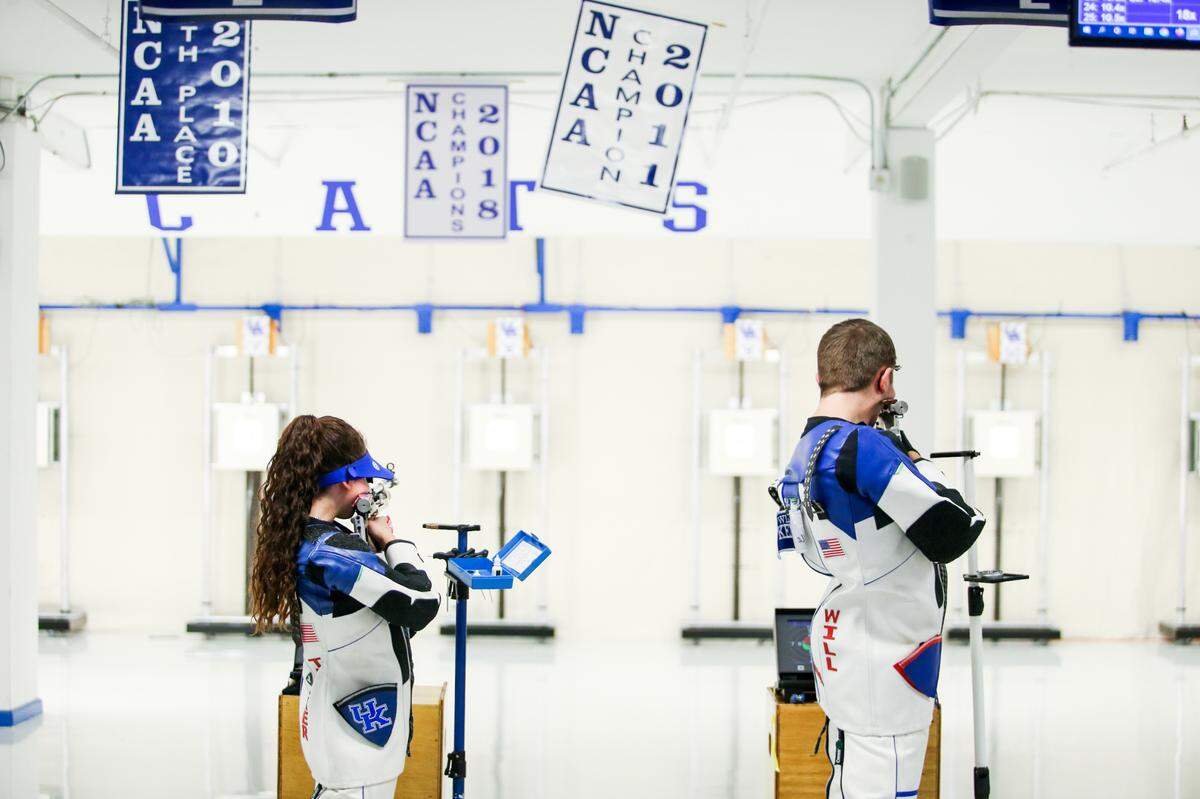
2022 NCAA Rifle Championships
When: Friday (smallbore) and Saturday (air rifle).
Where: United States Air Force Academy’s Clune Arena in Colorado Springs, Colorado.
Teams: Air Force, Alaska Fairbanks, Kentucky, Murray State, Navy, Ole Miss, TCU and West Virginia.
Background: This is Kentucky’s 28th appearance in the NCAA Rifle Championships. UK won a share of the regular season Great America Rifle Conference. UK has won three NCAA titles in rifle: 2011, 2018 and 2021, with six runner-up finishes.
Kentucky is the No. 2 seed for the championships, behind Alaska Fairbanks.
During Kentucky win over North Carolina State on Nov. 6, UK set school-record team marks in smallbore, air rifle and aggregate team score. UK’s aggregate team score of 4,752 is tied for the NCAA record.
Senior Will Shaner leads UK with an average aggregate score of 1,186.889 this season.
Junior Mary Tucker is averaging an aggregate score of 1,186.778 this season.