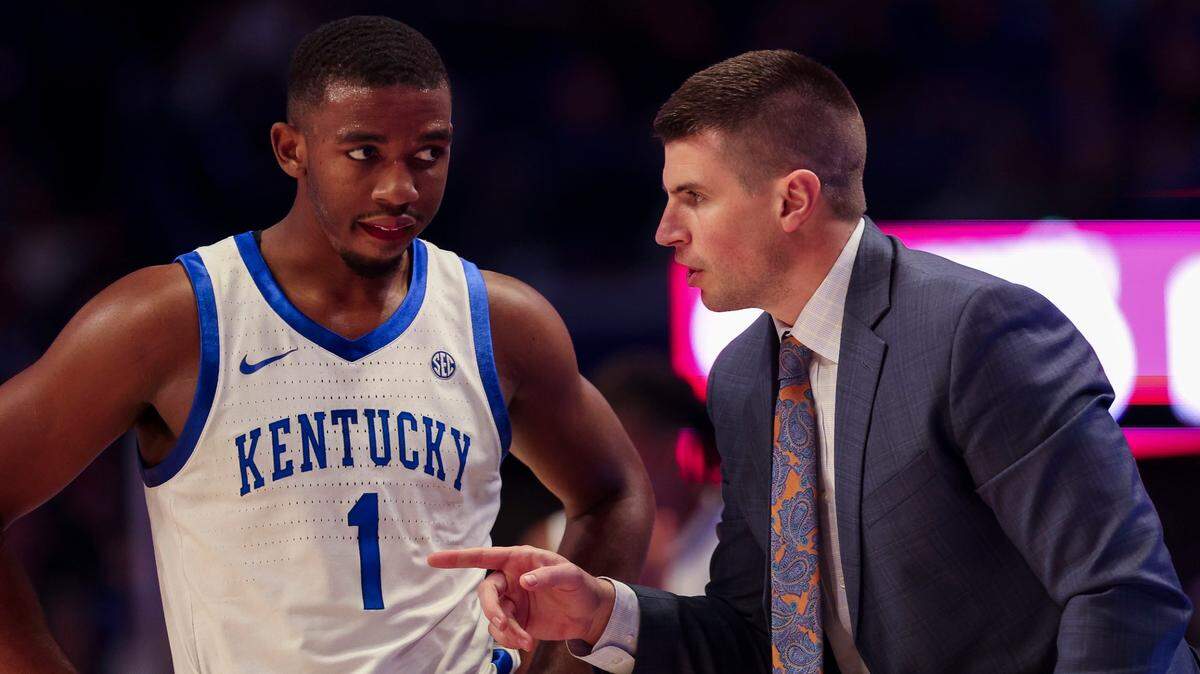
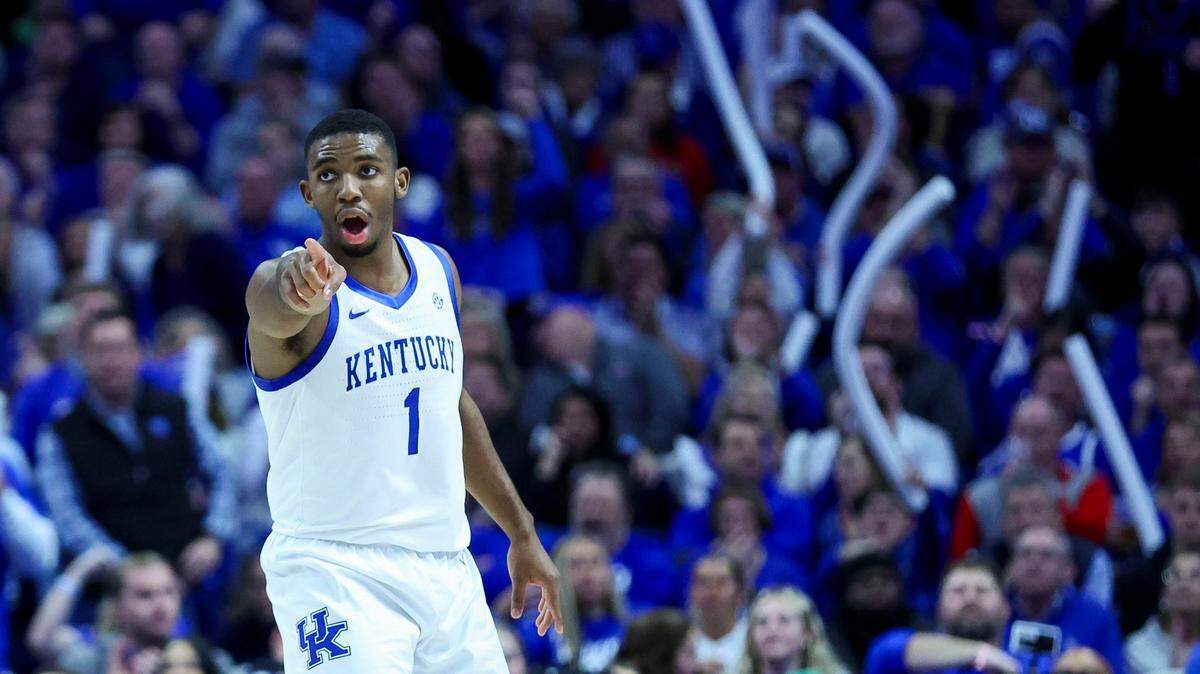
An inside look at Kentucky’s ever-changing defense. ‘We have a lot of tricks in our bag.’
READ MORE
Preview: No. 4 Kentucky vs. Ohio State
Click below to read more of the Herald-Leader and Kentucky.com’s preview coverage ahead of Saturday’s Kentucky-Ohio State game at the CBS Sports Classic in New York.
Expand All
It all started as a casual conversation between college basketball coaches.
The kind of, “Hey, wouldn’t it be cool if …” idea that often blooms whenever forward-thinking, like-minded people who share a profession sit around and talk shop.
“We first started talking about it four or five years ago,” explains Cody Fueger, who is now in his 12th season of calling Kentucky head coach Mark Pope a colleague and his 10th as an assistant on Pope’s staff.
“We’ve always said, ‘Man, we’d love to change our defenses here and there,’” Fueger continues. “But we were at such a point where we wanted to have a defense that could solve every problem, right? And that was just like, ‘That’s not how this works.’ You know, you’re gonna get beat somehow. So let’s kind of narrow it down and make it a little simpler for us and our players.”
The result of those conversations: the “defensive punch,” a phrase that fans might have heard Pope or Fueger or one of Kentucky’s other coaches mention from time to time.
What exactly does it mean?
“All the different ways that we kind of change up the texture of the game, schematically, at a moment’s notice,” Pope said, offering a brief — though not exactly specific — definition of the term.
When pressed for a more detailed description of a “defensive punch” and how the Wildcats utilize them during games, the UK head coach spoke for more than two minutes, barely pausing to take a breath and ultimately saying around 500 words, off the cuff, on the subject.
Pope spoke of “blitzing” ball screens, “tandem zones” and “gator” games, drifting into the wilderness of strategy with specific scenarios of when, how and why his Wildcats might employ one of their defensive punches, talking in terms that surely had Basketball Bennys salivating.
“I could give you 1,000 examples, but that’s just kind of,” Pope finished, likely realizing he’d lost just about everyone in the room, offering a little grin, before saying. “It is what it is.”
So, again, what exactly is it?
Fueger is the only assistant that has been on Pope’s staff for the entirety of his decade as a head coach. Four years at Utah Valley, then five seasons at BYU, and now at Kentucky.
The two share a similar outlook on the game of basketball, and they’ve become known nationally for their innovative offensive approach. Fueger is UK’s “offensive coordinator” — responsible for laying the foundation for the Cats’ scoring attack — but he got his start learning under the legendary Rick Majerus, who prioritized team defense and helped instill a love of that side of the sport in Fueger from the beginning of his career.
On many basketball-related subjects, Pope and Fueger are of one mind, and the longtime assistant often has a way of describing what’s going on in less esoteric terms. He was also there when the “punch” was born.
“We’ve kind of gone back and forth for a while,” Fueger said of the origin and evolution of this idea. “And we wanted to have a zone defense that solved everything, and a man defense that solved everything, and, you know, we just decided a ‘punch’ would be a little bit better to think about. And we’ve kind of gone that route.”
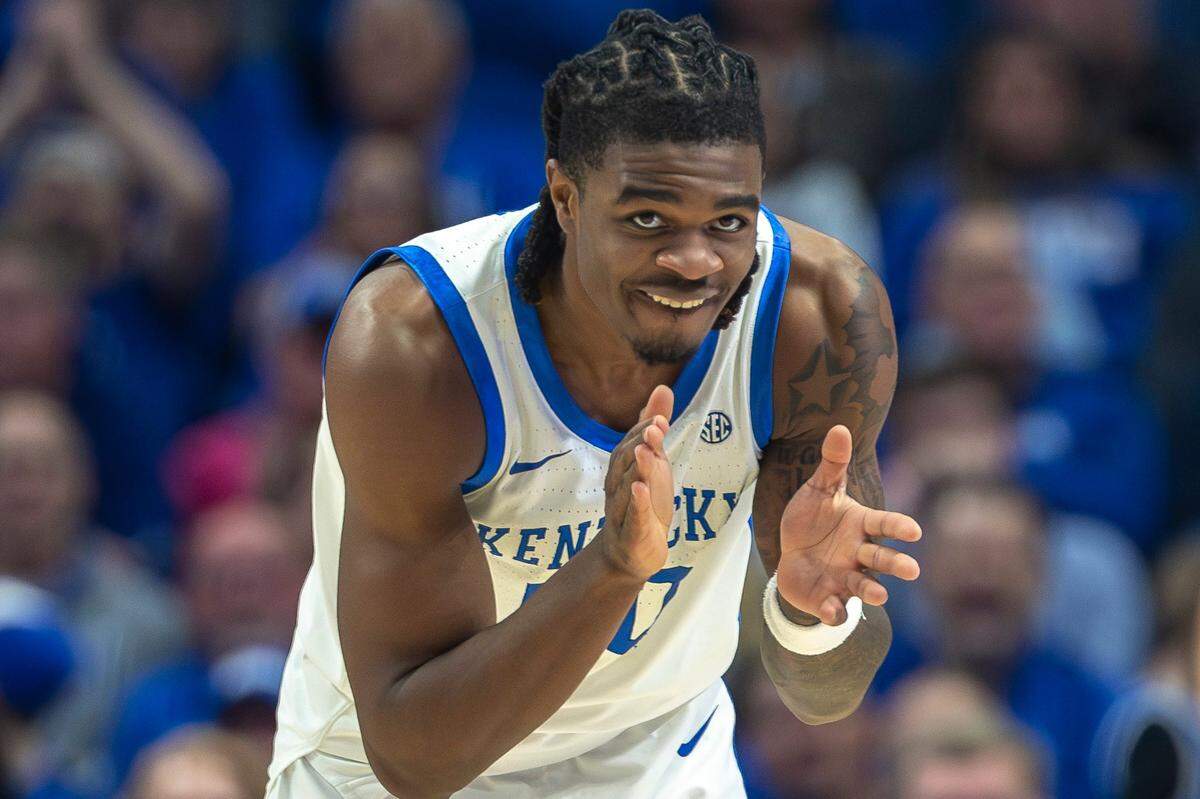
What is a defensive punch?
The defensive punch is fairly straightforward in philosophy and quite complicated in practice.
Simply put, a “punch” is Kentucky’s defense throwing a different look at an opposing offense in the middle of a game. The reasons for doing so vary, and the ways in which the Wildcats can actually do it vary even more, but punches are most often employed as a way to slow down the other team’s offense — to get them thinking — by offering something they haven’t seen before.
“We’ve kind of whittled it down to a couple different things on how we’re going to guard either a certain ball screen, maybe a zone package, maybe a trap, maybe a press,” Fueger explains. “So it’s either (after a timeout) or after a free throw or a late-game situation. … But it’s a punch, just to change it up and just to see how that team is going to react and see if we can do it again.”
Fueger said that Kentucky has “probably 12 different looks” right now, as far as defensive punches. But there are also variations to each of those looks, depending on the personnel of the opposing offense.
If the other team has a point guard who excels at getting to the rim off the dribble, for example, the Cats might throw out a different variation of the same punch used against a team with a playmaker possessing a different skill set.
“It could be unlimited at the end of the day,” Fueger said of all the nuances in UK’s defensive arsenal. “But, like, 12 different looks where teams are like, ‘Oh, what are they in right now?’”
The when of a defensive punch also varies.
Sometimes, the Wildcats will have a plan for throwing a punch at a team during a certain point in the game. If Kentucky’s defense is getting torched in the early going — as has happened this season — the coaches might throw some punch attempts earlier, and in greater volume.
“We’ll have a plan going into the game,” Fueger said. “We’ll see how they react to certain things. And then we’ll see what’s hurting us. And, ‘What do we need to do to change what’s hurting us?’ But we’ll throw out a bunch of different things to try to slow teams down.”
This is an ongoing conversation among the coaching staff. Pope and Kentucky’s assistants are constantly talking about what they see from the sidelines during the flow of the game. They huddle up off to the side at the beginning of each timeout to talk strategy. They listen to feedback from their players, who are obviously seeing everything that’s happening up close. And they make adjustments throughout the game, especially in the halftime locker room.
“We’re communicating as much as possible what we see, what we think, and what we want to focus on what to do — over and over again,” Fueger said. “And that’s what I think our staff does an unbelievable job of is not worrying about what just happened. We’re focused on telling our guys what to do. They’re scoring at the rim. ‘How are they scoring at the rim? How can we solve that problem? How can we help our guys?’ And so we communicate that over and over again.
“Like, Gonzaga was scoring over and over and over at the rim. They only made three 3s until the end of regulation. ‘How do we fix that? How do we solve that?’ And that’s how we kind of change things up.”
.JPG "LEX_53_241112KentuckyDuke_rh (1).JPG")
UK’s defensive adjustments
Fueger spoke to the Herald-Leader about defensive punches not long after that 90-89 overtime victory over Gonzaga, which has become the go-to example of this coaching staff’s ability to make adjustments on the fly and change the flow of the game.
The Zags went 16-for-23 on 2-point shots and 9-for-10 on free throws in the first half, getting whatever they wanted inside the perimeter. Graham Ike had 18 points by the break, with five 2-pointers and four trips to the foul line. Ryan Nembhard had seven assists at halftime.
The second half was completely different. Ike didn’t score and Nembhard didn’t register an assist until nearly 15 minutes into the period. By that point, Gonzaga’s 50-34 halftime lead was nearly gone. The Zags ended up scoring only 29 points in the second half.
“We just changed up matchups,” Fueger said. “And we changed up kind of how we were guarding the coverage. We were switching at times. We blitzed a couple times, and then we went to some zone — changed things up zone to man. So we had a couple different things that we were going back and forth.”
Even when the punches land, it can be difficult to know what to do next.
“And even during the game, we’re like, ‘Man, it’s working. Do we stay in it? Do we change it?’ You know, there’s so many different things,” Fueger said. “And Coach Pope made a heck of a call. And it was good.”
Gonzaga head coach Mark Few was asked about Pope’s adjustments after the game.
“I mean, they were doing a fake zone,” Few said. “You know … they stand in two passes (and switch to man-to-man defense). We do that once in a while. We were getting really good looks. They probably weren’t, maybe, in the same rhythm or context of what we had in the first half.”
Few’s tone about the “fake zone” bordered on dismissive, but he praised the Cats for their play, and his later explanation — that the Zags were thrown off their early rhythm, even if only slightly — is the definition of a punch.
Fueger grinned at the “fake zone” descriptor.
“Yeah, that’s an example of a punch,” he said. “... And that’s what it did. It slowed them down and it made their aggressiveness change.”
UK senior forward Ansley Almonor talked about the team’s defensive adjustments a few days after that game. He said the Wildcats practice the different looks “a good amount,” to be used in situations exactly such as that one. Against the Zags, it all paid off.
“The execution — what we wanted to do — was just confuse them a little bit,” Almonor said. “Slow them down a little bit, mess up their flow — and see how they reacted to it. And they didn’t react that well, so I think it worked, for sure.”
It wasn’t just the Gonzaga game. Pay close attention to the Cats on defense, and you’re bound to catch different wrinkles here or there.
Was that a 1-3-1 zone that UK threw at Duke out of a second-half timeout? Fueger grins again.
“Yeah, we showed a bunch of different, changing defenses that game, too,” he said. “We blitzed a couple ball screens. We had a couple punches out of timeouts. And sometimes it’s during underneath (the basket) out of bounds (plays): ‘Here’s what we’re gonna do.’”
Duke led that one 46-37 at halftime. The Cats outscored the Blue Devils 40-26 in the second half en route to a 77-72 victory and the first marquee win of the season.
Kentucky will also punch down, so to speak.
The Cats don’t save these looks solely for the Top 25 teams. In UK’s early season blowouts over mid-major opponents, plenty of punches were thrown. Sometimes, it’s to have the players practice them in real-game situations, get it all on film so the Cats can learn how to do it better for similar situations later in the season.
“We’ll throw it out at all different times,” Fueger said. “Obviously, we just want to see what it looks like. And does this make sense? And does it make sense for a team like this? ‘Hey, they got a really good driver. We want to do this. They got a really good passing big man. Let’s look at it this way.’ So there’s different things on what they do that we want to throw punches at, for sure.”
Other times, it’s so future opponents have something to look at — and prepare for — that they’ll never see.
“Sometimes we’ll just throw stuff out there that we’re never gonna use,” Fueger said with a mischievous smile. “Just so a team’s like, ‘Oh my gosh, we gotta get ready for it.’ And we don’t do it.”
Is spelling all of this out so early in the season a mistake? For the sake of future results, should Pope be carrying on for more than two minutes about defensive philosophy in language opposing coaches understand? Should Fueger be so open about the Wildcats’ defensive strategies?
Both would tell you the same thing. Kentucky’s opponents can’t prepare for everything, and the Wildcats have a whole lot in their bag. Five minutes spent in practice trying to counter one of UK’s punches — one that team is more than likely not going to actually see in a game — is five minutes that could have been spent on something else.
“Yes, it’s just too much,” Fueger said. “You got three, four, five days to prepare, and it’s too much to prepare for. Right? And we feel like we try to solve every answer offensively and defensively before the game, and it’s just too much with teams sometimes. And that’s what we try to do. We just try to keep you off balance. And you can’t do it all. You can’t solve all the things.”
Kentucky’s talent on ‘D’
How does it feel when the punches work? And UK topples a team like Gonzaga while landing them?
“I mean, that was gratifying,” Fueger said. “But it was also like, ‘Man, how were we so bad from the start?’ Like, ‘We gotta fix that part.’ I guess, you know, we were so happy with what we did that changed and slowed down things. But we were just kind of like, ‘Man, we gotta get better. What was the issue? We gotta figure that out.’ That was kind of the biggest thing. …
“We want to take it all on us as coaches, that we got to be better at communicating something. So it went more to, ‘It was fun. It was gratifying.’ But at the end of the day, we were like, ‘Oh, we gotta fix it.’”
Kentucky’s coaches are pleased with the personnel they have in that pursuit.
Fueger talked about how the staff tries to use the specific and unique skill sets of their players to help form their approach on the court. And UK has some tenacious defenders, starting with Lamont Butler, Otega Oweh and Amari Williams.
“Those three guys are high-level defenders,” Fueger agreed. “And Jaxson Robinson is taking a huge step. I would say we have some guys defensively that are really getting after it. Collectively, as a team, we’re getting better and better.”
Just like on offense — a work in progress despite the scoring success so far, says Fueger — the Wildcats’ defense has been challenged in the early going by the fact that none of these players had ever been teammates before this season. Even with the individual defensive talent on this roster, learning how to stop opponents as a team takes time, and these Cats don’t have much of it.
Their vast experience in college basketball — with seven seniors in the rotation — is a big help there. Fueger said the best success he and Pope have had since incorporating defensive punches has come with last season’s BYU team — “Because we had so many returning guys who knew this” — and this Kentucky squad.
“We got a bunch of guys that are high IQ guys — really talented players that pick things up quickly,” he said. “So we’re able to do that. Does it work all the time? No. Like, we tried to throw a couple punches out there in the first half with Gonzaga, and it didn’t work, because we were late to it and things like that. So it doesn’t always work, but that’s why we call it a punch. See what happens.”
As Pope continues to rebuild this Kentucky basketball program in his vision, roster continuity will be key, for numerous reasons. On the court, the more Cats that know what Pope and his staff want defensively from the get-go, the more they’ll be able to do in games, especially when it comes to throwing those punches.
Fueger said that he and Pope have “different defensive players” at Kentucky than they did at BYU — a nice way of saying these Cats are capable of more things on the court than those Cougars were — and that’s allowed the UK staff to expand the team’s defensive approach.
If, in the future, Pope can have that type of defensive talent plus the institutional knowledge of playing in his system, the results could be even more impressive.
“It helps tremendously,” Fueger said. “You look at the NBA, Steph Curry has been on the Warriors forever — with Draymond (Green) — together for so long. That’s why they win championships, because they did so many things for so long. And that’s the same thing for us, right? If we can get a guy to stay for a year or two and get a great feel, you know what’s gonna happen. You know what we’re looking for, offensively and defensively. It’s just a big deal. I can’t say how much experience helps, especially together with a teammate.”
Of UK’s defensive stoppers with remaining eligibility, Oweh is the one who could help extend that knowledge to future Wildcats. He has one season of college left after this one — if he doesn’t go off to the NBA next year — and he’s having a ball playing for Pope so far.
“He gives us the leeway to make our own decisions on the court, which I would say is huge, because we’re an older group,” Oweh said. “And sometimes coaches can’t really see what’s going on on the court. Like, you have to be in the game. So he gives us the benefit of the doubt to make certain decisions. He trusts in us.
“Obviously, we have our defensive principles, as well, that we stick to and follow. But he gives us so much leeway and the ability to make certain decisions.”
The best example of Pope trusting players to make plays — but also one that shows off his own awareness for what’s happening during games — has become a defining moment of Kentucky’s season so far.
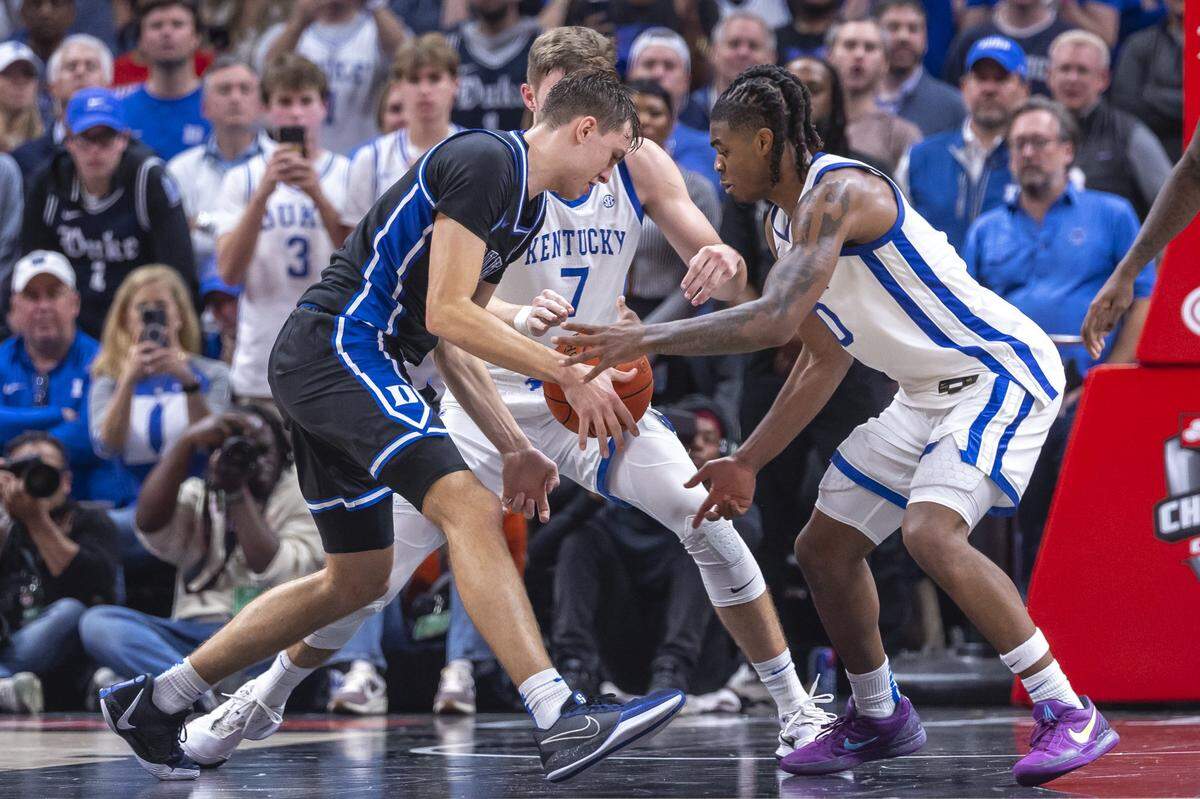
With less than 30 seconds left in the Champions Classic against Duke, the game tied at 72 and the Blue Devils with the ball, Pope sat in a timeout huddle and described a scenario that his team was likely to see when play resumed: Duke star Cooper Flagg getting one of the Cats into an isolation situation before driving to the basket and going to a spin move.
“If Cooper goes to work and spins, we should have a body there to take the ball,” Pope said right before breaking the huddle.
That’s exactly what happened, and Oweh was right there to rip the ball out of Flagg’s hands, take it the other way, draw a foul in transition and score the winning points from the line.
“Facts,” Oweh said. “He’s watching the game. He’s watching. All the little things, he picked up on. The nuances. So even stuff like that, he’s gonna tell one of the guys, like, ‘Oh, so and so does a certain move a lot. So just be ready — when he turns his head, just go.’ Or, like, ‘If he’s always going to his left hand or making a certain move, just sit on that.’
“He’s watching the little things, and it’s always helping us out.”
As for the defensive punches? Oweh likes those, too. A player who prides himself on making things as difficult as possible for those trying to score, Oweh gets a kick out of the “confusion” — as he puts it — that Kentucky’s punches cause and has enjoyed learning all the different ways he can defend.
And for those following along this season, there’s plenty more left to learn about what these Cats can do defensively. You’ll just have to pay close attention.
“We have a lot of tricks in our bag,” Oweh said with a grin. “I would say we still haven’t shown everything, really. I just feel like, we’re gonna play so many different teams in college, you have to have an answer for everything, even if you don’t show it until the end of the year. You just have to always have something new in your bag. So, at random times, we’ll just try certain things.
“So, yeah, we got some tricks.”
This story was originally published December 20, 2024 at 6:00 AM.