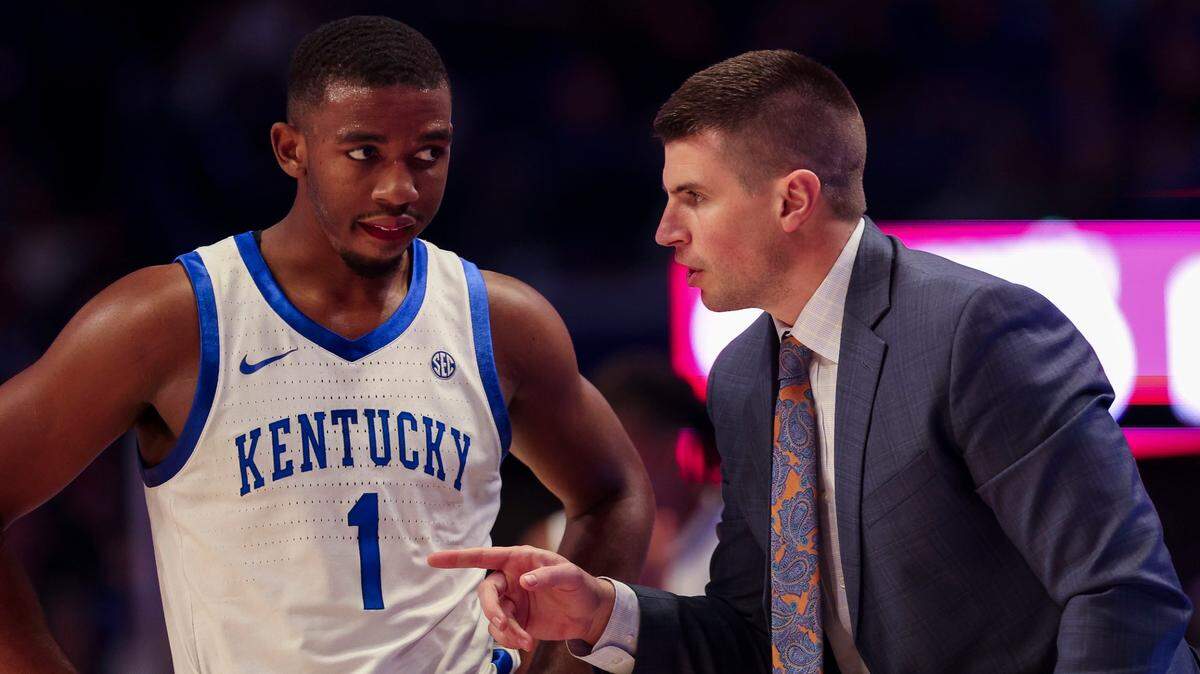
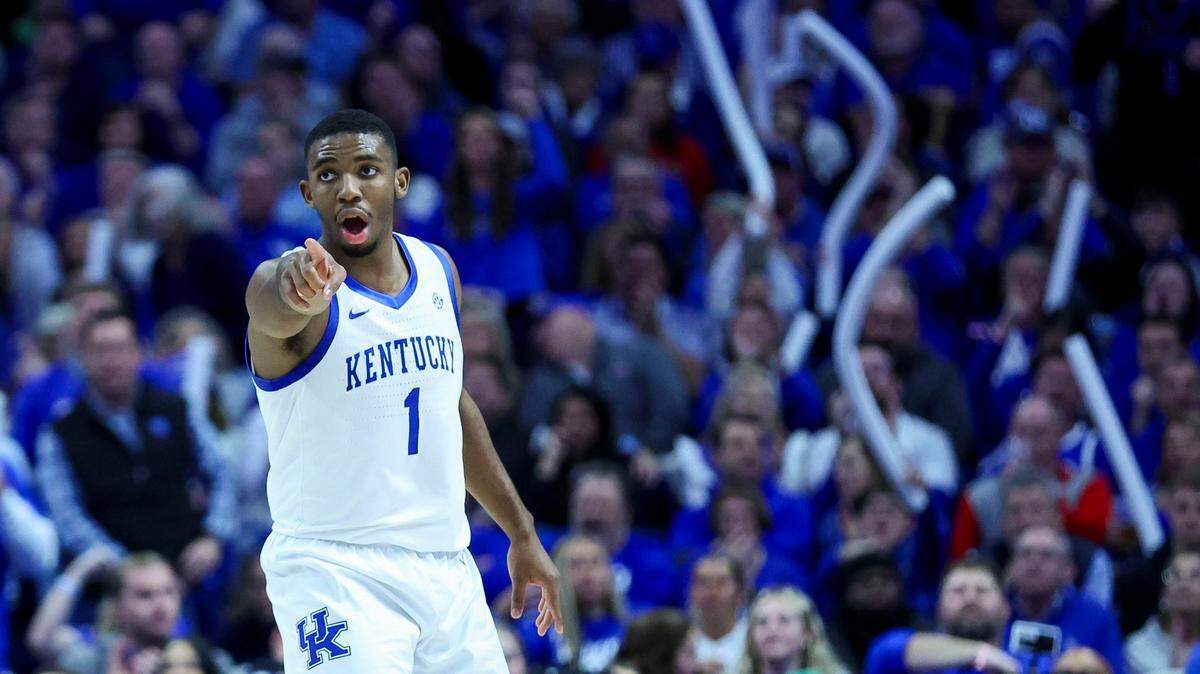
Checking in with the architect of Kentucky’s offense. ‘Nowhere close to where we can be.’
READ MORE
Preview: No. 4 Kentucky vs. Ohio State
Click below to read more of the Herald-Leader and Kentucky.com’s preview coverage ahead of Saturday’s Kentucky-Ohio State game at the CBS Sports Classic in New York.
Expand All
Eleven games into this Kentucky basketball season, the Wildcats sure have been fun to watch.
The promise of a new brand of offensive firepower coinciding with the arrival of head coach Mark Pope has already been fulfilled, and the Cats’ impressive on-court results have been backed up by the numbers behind their 10-1 start.
Going into this week, UK led the nation in scoring with 91.3 points per game. The Cats were No. 8 nationally in offensive efficiency, according to the KenPom ratings, and another prominent set of analytics — the Torvik ratings — had Kentucky’s offense at No. 4 in the country.
UK’s assist numbers are among the highest in all of college basketball. The Cats’ turnover rates are among the lowest. And six Kentucky players are averaging double digits in scoring.
All good, right?
Well, Kentucky fans might be satisfied on the whole with the Wildcats’ start, but UK assistant coach Cody Fueger — known as the “offensive coordinator” behind Pope’s scoring attack — sees plenty of opportunities to put more points on the board.
“We feel like we’re nowhere close to where we can be offensively, and it’s just gonna take a little bit more time,” Fueger said in a one-on-one interview with the Herald-Leader. “But we’re getting better and better.”
Those two words — “nowhere close” — have to be frightening for future opponents who need only look back at the film to see a UK team that so often has been able to get whatever it wants offensively. But Fueger looks at that video of past games and sees room for improvement.
The buzziest of Fueger’s preseason declarations — that this Kentucky team wanted to average at least 35 3-point shots per game — has fallen well short of expectations, so far.
The Cats have hit that number only twice in 11 games — going 13-for-36 against Bucknell and 17-for-39 against Jackson State, both lopsided victories — and they’re averaging 28.0 attempts from deep heading into Saturday’s game against Ohio State.
That number is still close to the school record — 28.9 by Rick Pitino’s “Bombinos” in his first season as head coach — but it ranks only 47th nationally.
“We’re not there,” Fueger acknowledged. “It’s been a little bit difficult there. … We’re not getting 3s nearly as much as we’d like, but everyone is trying to take that away from us.”
That can be frustrating, but it’s also led to teaching moments and opportunities elsewhere.
“Our guys are growing because they’re playing different defenses all the time,” Fueger said. “Every team we’ve played so far, they’ve completely changed with how they’ve guarded previous teams. So our guys are learning in real time on the court. Obviously, we practice and we change things up a lot, but, you know, the game experience — nothing’s better than that.”
Fueger said all but one of Kentucky’s early opponents showed a major shift in the way they attempted to defend the Wildcats, compared to what they showed on film before playing UK.
One of last week’s opponents, Colgate, continued that trend.
Raiders head coach Matt Langel, who has led his program to five consecutive NCAA Tournament appearances, came right out and said it after Kentucky jumped out to an early 17-0 lead and beat his team 78-67.
Langel’s squad finally slowed UK down by switching to a zone — a set the coach said Colgate rarely plays — but his plan all along was to play man-to-man defense whenever the Raiders missed a shot and go to the zone off of their makes. They just didn’t make any at the start.
Throwing in the wrinkle of a zone, Langel acknowledged, was all about Kentucky.
“You can’t keep giving them the same dose of anything,” he said. “They’re smart players. They’re really well coached. If you just throw the same coverage at them — the same defense — they’re gonna pick you apart.”
Langel went on to say that UK ended up with a lot of good looks as the game progressed, a sign, according to the opposing coach, that these Wildcats can adapt on the fly, making them a dangerous bunch as the season goes on.
“So it’s good. It’s awesome, just the learning curve,” Fueger said. “And it’s really good for our guys. And our guys are just gonna keep on getting better and better. But, yeah, we’re nowhere close to the 35 3s. … But teams are guarding us at the 3 right now, so at the end of the day, we still take what the defense gives you.”
And, for the most part, Fueger has been pleased with what Kentucky is doing in those situations.
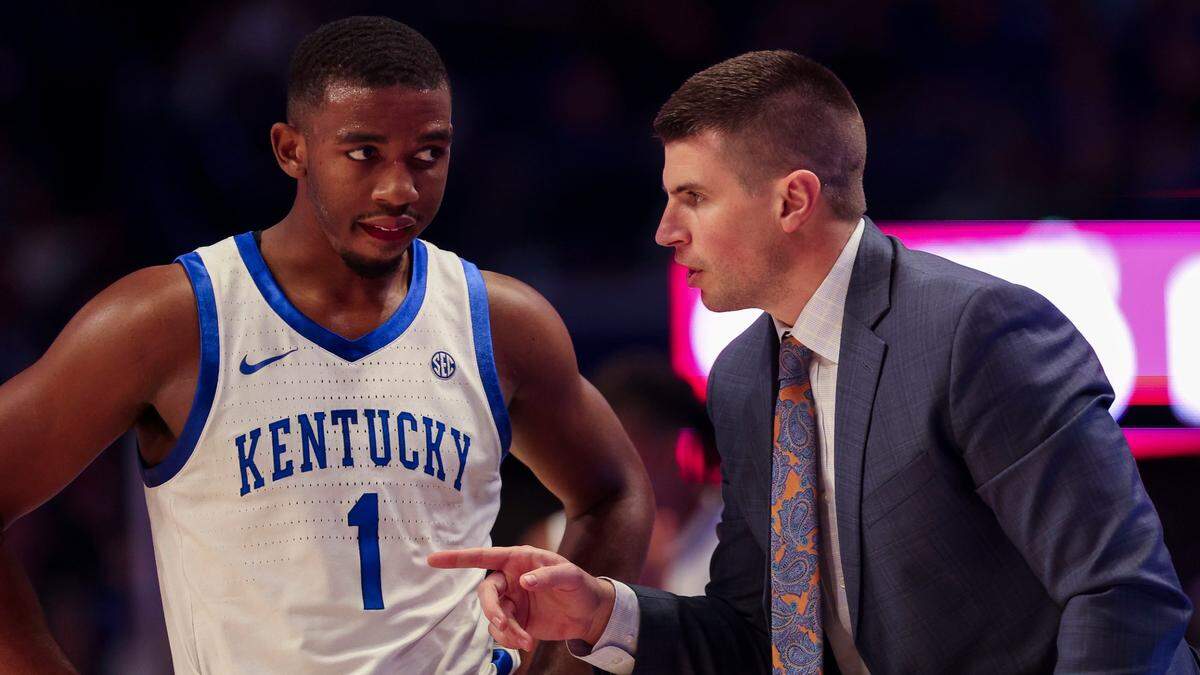
Easy looks for Kentucky
What happens when teams try to take the 3-point line away from the Wildcats?
More space to move inside the perimeter, and more opportunities to score at the rim.
“We are getting a lot of one-on-one and one-on-zero layups, which has been nice,” Fueger said with a smile.
Last season’s BYU team — with Pope and Fueger running the show offensively — was second nationally with 32.0 3-point attempts per game. Those Cougars shot only 34.8% from deep, but the threat of the long ball had the same effect on defenses as it’s having now. BYU ended up finishing eighth nationally and No. 1 in the Big 12 in 2-point percentage at 57.5%.
This Kentucky team is a little lower in those rankings (24th nationally) but the Cats are actually hitting at a higher rate now than BYU did last season — 58.7% on 2-point shots. And they’re ranked among the best teams in the country on hit rate at the rim.
UK is also third nationally with 42.5 points per game coming in the paint.
The Wildcats’ coaches have put an emphasis on playing fast, and this team has been flying, relative to the competition. Kentucky is a top-20 team nationally in terms of pace, and the Cats rank fifth in the country with 18.5 points per game coming on the fast break. They’ve also taken care of the ball at an impressive rate.
“And the real key thing that we look at offensively — obviously, we look at the 35 3s; we look at our pace of play — but we also look at our assist opportunities,” Fueger said. “And assist opportunities, that’s when you make the right play, and the guy even misses the shot. So our goal is 32 (assist opportunities) per game. We’ve only had one game under that right now.”
That came against Clemson, which was — not coincidentally — the Cats’ only loss of the season and their season low, by far, in scoring at 66 points.
Even with starting point guard Lamont Butler sidelined for the next game against then-No. 7 Gonzaga — and backup point guard Kerr Kriisa leaving midway through the second half with an injury — UK ended up with 44 assist opportunities in a 90-89 overtime win over the Zags.
Going into this week, UK was eighth nationally with 19.5 assists per game, sixth in the country in turnover rate and fourth in all of Division I in assist/turnover ratio.
“So that just a huge key for us, is us making plays for teammates,” Fueger said. “I mean, that’s Kentucky basketball. That’s what makes us go. Obviously, we want to get up 35 3s, but we have to take what the defense gives us.”
Butler’s play so far this season — and especially his performance in UK’s 93-85 win over Louisville on Saturday — encapsulates all of this. Butler never shot better than 48.5% from 2-point range in four seasons at San Diego State. So far as a Wildcat, he’s at 67.3% on 2-pointers.
Against Louisville, he scored 33 points — surpassing his career high by 10 points, in his 140th college game — and went 10-for-10 from the field. He was 4-for-4 on 2-pointers, showing off that ability to drive to the hoop and finish. And he was 6-for-6 from 3-point range, taking wide-open shots from deep when his teammates stretched the Louisville defense.
Pope has continually pointed to Butler’s growth as a finisher at the rim this season. He never averaged more than 9.3 points per game with the Aztecs. He’s at 15.1 points per game at UK.
Butler gave some of the credit to his coaches at San Diego State for helping him become a better finisher, but he said the game feels like it’s slowed down even more for him this season. And Kentucky’s ability to spread defenses — leaving more room for guys like Butler to operate at the rim — is a major reason.
“Playing in this offense has allowed me to just grow even more,” he said.
Example of UK’s offense
The Wildcats’ worst offensive game came two weeks ago in that loss to Clemson, a team boasting a physical, in-your-face defense. The Tigers were jamming the ball all night long, and — for the first sustained stretch all season — Kentucky seemed bothered.
“Yeah, we expected that,” Fueger said of Clemson’s approach. “We just got a little bit rushed at times, where I didn’t expect us to get rushed, to tell you the truth.”
He said the Cats went one-on-one and sent the ball to the post a little more than he would have expected — or wanted — going into that game. There were hiccups in the first half against Gonzaga, too, obviously — the Cats trailed 50-34 at halftime — but UK’s adjustments (on both sides of the ball) in the second half ultimately led to a victory.
“And it’s a battle, all year long,” Fueger said. “We’ve got really good players on this team that can make plays, but it’s a battle all year long to keep making aggressive plays for our teammates.”
Anyone paying close attention has surely noticed that Jaxson Robinson looks the most comfortable in Kentucky’s offense so far, whether it’s firing off quick shots before they turn into bad looks or his movement off the ball. That’s no coincidence. In addition to being a smart, talented, veteran player, Robinson is the only Wildcat to have played in this system.
The 6-foot-6 guard was with Pope and Fueger the last two years at BYU and the Cougars’ leading scorer and shot-taker last season, when this offensive approach fully formed. After the Clemson loss, Robinson implied that all of his teammates knew the correct plays to make under pressure, but they simply hadn’t had enough reps to be on the same page enough to make the right moves in real-game situations against a high-level, pressuring defense.
Fueger agreed with that assessment. He also pointed to a play in the very next game — the win over Gonzaga — as a recent example of the right way to do things.
In the second half — about a minute after Kriisa went down with a foot injury, leaving the Cats with no true point guard — Robinson brought the ball up the court, dished it over to Andrew Carr, and started working. Fueger delightedly recounted what happened next from memory.
Robinson flared toward the basket, stopped just past the elbow, looped back around to the top of the key and over to the other side of the court, cut to the rim, backpedaled slowly into the corner, then took off on a dead sprint, faked taking a handoff from Carr on the wing, cut as if he was going to head toward the basket again and instead faded off into the opposite corner.
All the while, Gonzaga point guard Ryan Nembhard had to chase him all over the court, and Robinson’s movement drew secondary attention from other Zags defenders. At the end, Otega Oweh drew two defenders coming off a ball screen, Carr slipped between them toward the basket and finished off an easy dunk, with Gonzaga’s Ben Gregg late to help after colliding with Nembhard, who ran into his own teammate while trying to chase down Robinson.
“Like, he circled the court three different times,” Fueger said with excitement. “And at the end of the day, it’s his cut that got Andrew Carr a wide-open dunk. So it takes time to kind of build that with the team. Jaxson has been through it for a year, and these guys are catching up and catching up fast, but it just takes a little time to believe and see exactly what to do.
“And that was Jaxson’s basket, basically, with all the different cutting that he did. That’s part of our offense. That’s what makes it special.”
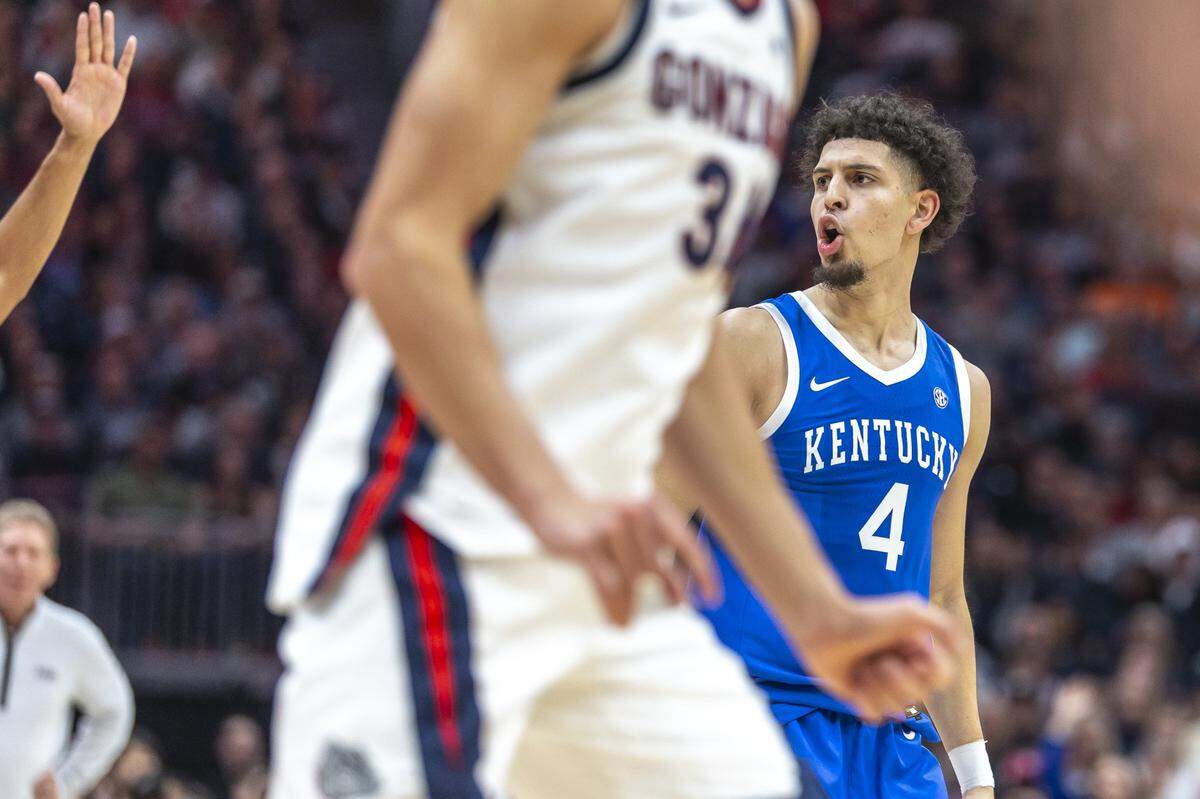
Scary upside as scorers
From the start of the season, it was clear that the roster-building strategy of Kentucky’s coaches was going to pay off. Without sacrificing defense, Pope and his staff managed to get several offensively talented, high-IQ players with unique skill sets, a collective ability to pass the ball and a seemingly willingness to do so.
That this bunch is rated so highly from a national perspective isn’t terribly surprising. That Fueger thinks they haven’t yet truly clicked — or come close to unlocking some of their own individual attributes — has to be terrifying for the remainder of Kentucky’s opponents.
Six Cats are averaging double digits in scoring: Oweh (15.7 points per game), Butler (15.1), Robinson (12.5), Koby Brea (12.2) Carr (10.9) and starting center Amari Williams (10.2). The advanced numbers at EvanMiya.com place five Wildcats — Brea, Butler, Carr, Oweh and Robinson — among the top 25 offensive players in the SEC, which is, by far, the best league in college basketball this season.
Meanwhile, Kriisa, who likely will remain sidelined until January, was leading the team in assists before his injury (and has still yet to truly show his ability as a scorer). Backup big man Brandon Garrison has flashed his NBA upside, with plenty of room to grow. And veteran forward Ansley Almonor has proven to be a 3-point threat.
All involved say they’ve loved playing in this offense, that it continues to unlock new facets of their game while giving them the most room they’ve ever had to operate as scorers.
Oweh and Butler have been clear beneficiaries, and they both appear to be trending in the right direction as 3-point shooters. Robinson will almost certainly hit 3s at a higher rate (just 30.1% right now) and Carr will surely take more of them (only 14 attempts in 11 games).
Brea is perhaps the most intriguing Wildcat to watch as this season progresses.
The top returning 3-point shooter in college basketball, Brea got off to a scalding start — 20-for-27 from deep over his first five games — before hitting a relative skid more recently.
Against Clemson, he went 1-for-2 from 3-point range. Against Gonzaga, he went 1-for-6 from deep. In both cases, the opposing defenses — both rated in the top 25 nationally — made a point to give Brea no good looks from the perimeter. But there was more to it than that.
Fueger reiterated that the Cats didn’t do a good job of creating for their teammates at Clemson. “And that was everybody in that game,” he said, noting the Tigers gave Brea no space at all. At Gonzaga, UK’s ball movement improved, but Fueger pointed out that Brea missed most of the summer while resting from a series of injuries sustained during his playing days at Dayton. He got to see what the Wildcats were working on, but watching is different than doing, especially in an offense like this one.
“So he’s getting a lot of this real-time experience right now,” Fueger said. “But by January, February — Koby Brea is going to be a problem. Because he’s gonna be cutting like Jaxson Robinson and doing all these things that are gonna free up more things for him.
“So it’s definitely something that we talk about every single day. And, you know, every coach has a bunch of plays — this and that — but it’s not about the plays, right? It’s about our guys going out there, reading the defense and making plays for each other. So that’s just going to keep on growing and getting better and better.”
Fueger spoke to the Herald-Leader right before the Louisville game, when Brea scored 10 points and went only 2-for-7 from 3-point range but showed off something a little new. Pope said on his weekly radio show Monday night that “one of the highlights” of the victory over the Cards was watching Brea make a “brilliant” read that involved him cutting to the rim and getting an easy dunk.
“Our guys are learning. We’re getting closer and closer,” Pope said. “But when this starts to work great, it just feels like you’re slicin’ and dicin’. And where you’ll really see this is you’re gonna see the opponent’s bench — the coaches just throwing their hands up. And that’s a beautiful sight for us, guys. That’s what we work for.”
Pope has pointed to the dedication to cutting as a primary reason for what makes this offense work, and he said this week that improvement in that area will be something Kentucky’s coaches will be preaching about all season long. “All the way up until, hopefully, the Final Four.”
Meanwhile, Brea still ranks third nationally at 53.1% from deep, and he’s first among players that average more than five 3-point attempts per game.
The more versatile Kentucky’s players make themselves by cutting, the less opposing defenses will be able to do about it. The SEC is stacked in that department — the league has seven of the nation’s top 30 defenses, according to KenPom — but this UK offense has already faced elite opposition, and these Cats are clearly learning more and more as they play together.
Robinson got a head start on it all. He had a whole year in the system before coming to town. Can Kentucky’s coaches expect his teammates to get to that comfort level in the span of a season?
“I think so. I think so,” Fueger said, before pausing to correct himself. “Actually, I know it’s gonna happen. Our guys are gonna feel ultra-confident. They’re getting better game by game. We’re ranked top 10 offensively right now, so it’s not like we are far behind. Even watching the Duke game, I was like, ‘Oh man, we took a little step.’ And then Clemson. I was like, ‘Ugh, the guys still aren’t where we need them to be yet.’ And then this Gonzaga game in that second half, I was like, ‘All right, these guys are getting a feel.’
“And then we’ll just keep on showing them clips on what we want them to do. They’re getting better and better at it. It’s helpful to see it over and over again. And, yeah, we’ll be able to do it by January, February.”
Saturday
No. 4 Kentucky vs. Ohio State
What: CBS Sports Classic
Where: Madison Square Garden in New York City
When: 5:30 p.m.
TV: CBS
Radio: WLAP-AM 630, WBUL-FM 98.1
Records: Kentucky 10-1, Ohio State 7-4
Series: Kentucky leads 11-10
Last meeting: Ohio State won 71-65 on Dec. 21, 2019, in Las Vegas, Nevada
This story was originally published December 17, 2024 at 6:00 AM.