A boon for families or a bust for public schools? Much at stake with Amendment 2
READ MORE
Herald-Leader election previews
Check out all of the Herald-Leader election preview stories that have published so far.
Expand All
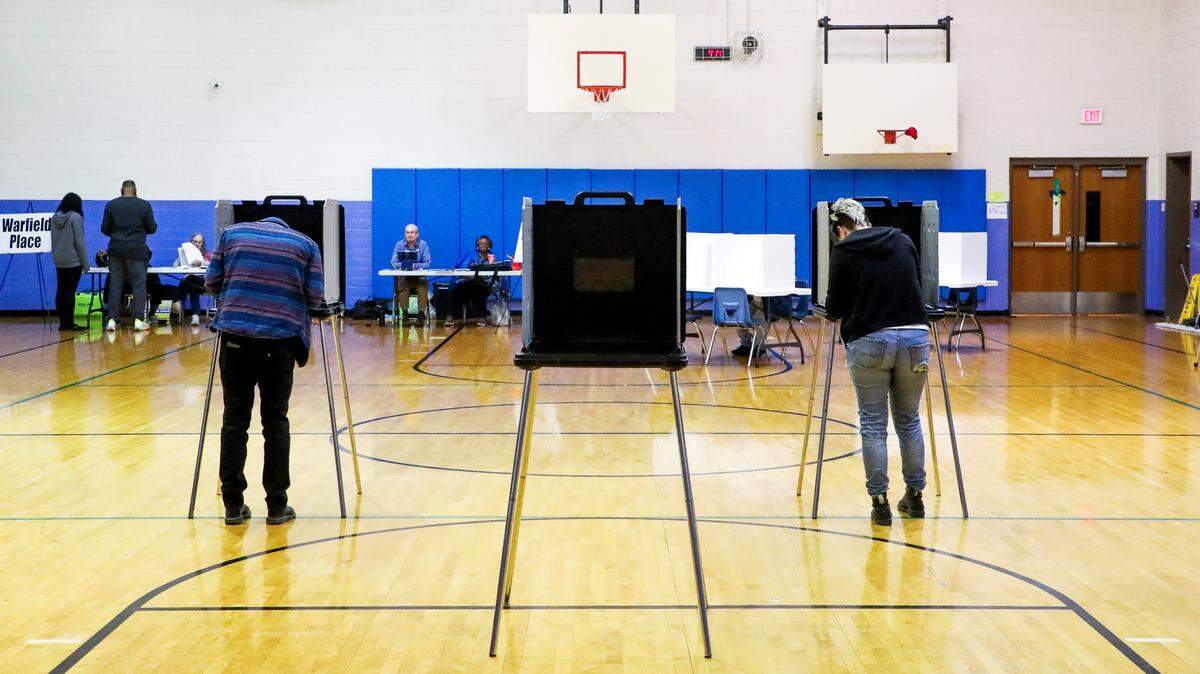
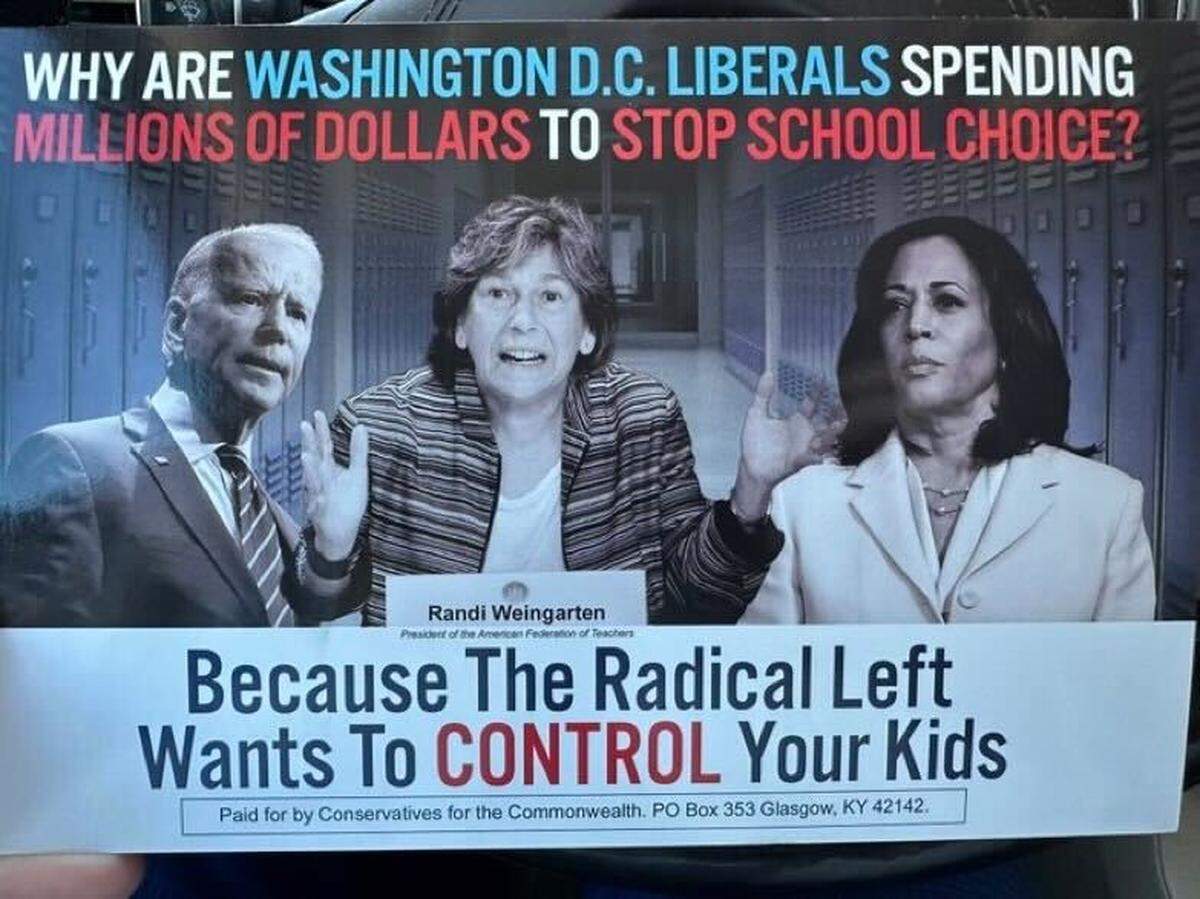
After millions of campaign ads, a constant barrage of TV spots and digital ads and tireless campaigning by advocates and critics alike, Kentuckians will soon head to the polls to decide the most significant education issue before voters in nearly two generations.
Amendment 2 asks voters whether they want the Kentucky General Assembly to spend public tax dollars on nonpublic education.
It’s the most sweeping proposal focused on how commonwealth children are educated since the Kentucky Education Reform Act, or KERA, passed in 1990.
Right now, the state’s constitution declares tax dollars only can fund “common schools,” which state courts have interpreted as public.
If Amendment 2 passes, legislators would be given the green light to steer money to other entities, including private or charter schools.
The measure took root in this year’s legislative session with proponents (many of whom were conservative Republican legislators) saying more “choice” in education wold give families greater leeway in how their kids were educated.
That drew swift condemnation from opponents (many of whom were educators, administrators and Democratic lawmakers) who said diverting public funds from a system they contend is already underfunded would weaken the state’s 120 public school systems.
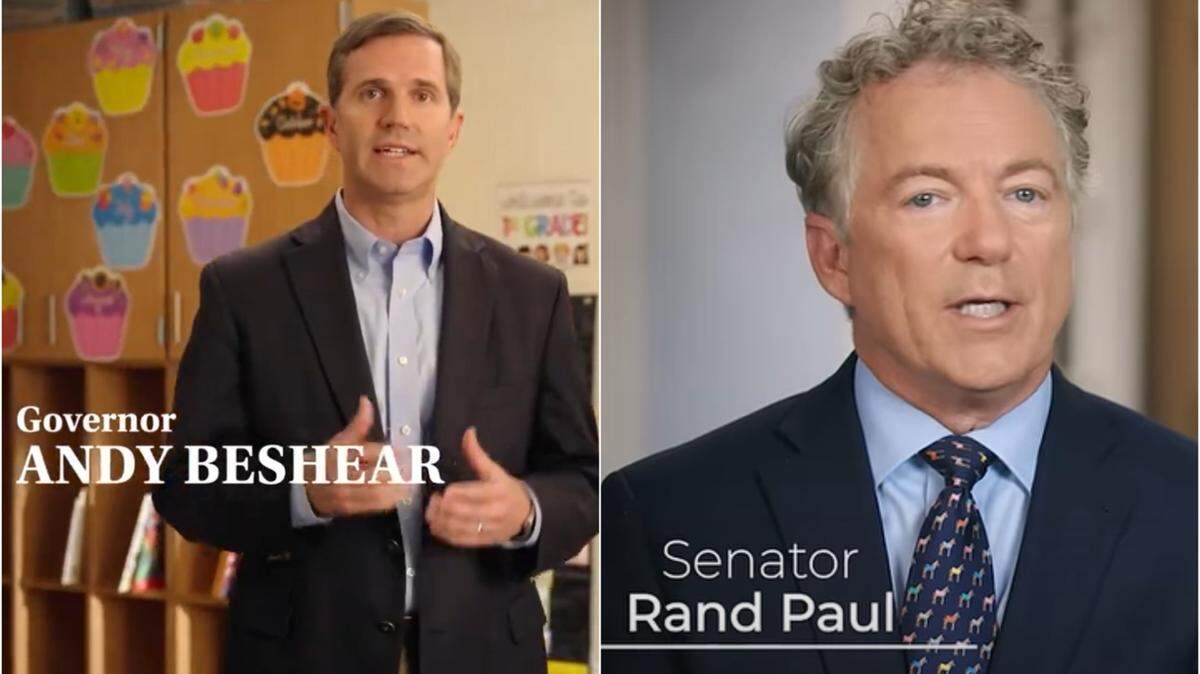
One of the amendment’s most vocal foes is Gov. Andy Beshear. He’s come out swinging in campaign stops and commercials, blasting the “money grab” that he says would leave strained public schools with less state funding.
“This would be wrong for Kentucky,” the two-term Democrat said recently.
Districts would “have less money for (staff raises), less money for resources for our students and have less to do everything that we ask them to do,” Beshear said.
Beshear also headlines an ad from Kentuckians for Public Education, an anti-amendment PAC, urging Kentuckians to vote no. His lieutenant governor, Jacqueline Coleman, has joined him in shooting one for the Kentucky Democratic Party and campaigning across the state.
Other opponents argue passage of Amendment 2 would divert much-needed money from Kentucky’s public school systems, causing reductions in teachers and staff, especially in rural pockets of the state. It also , critics say, would subsidize wealthier families who already pay for private schooling.
Amendment 2 supporters are leaning on their own political heavyweight to convince voters: US Sen. Rand Paul.
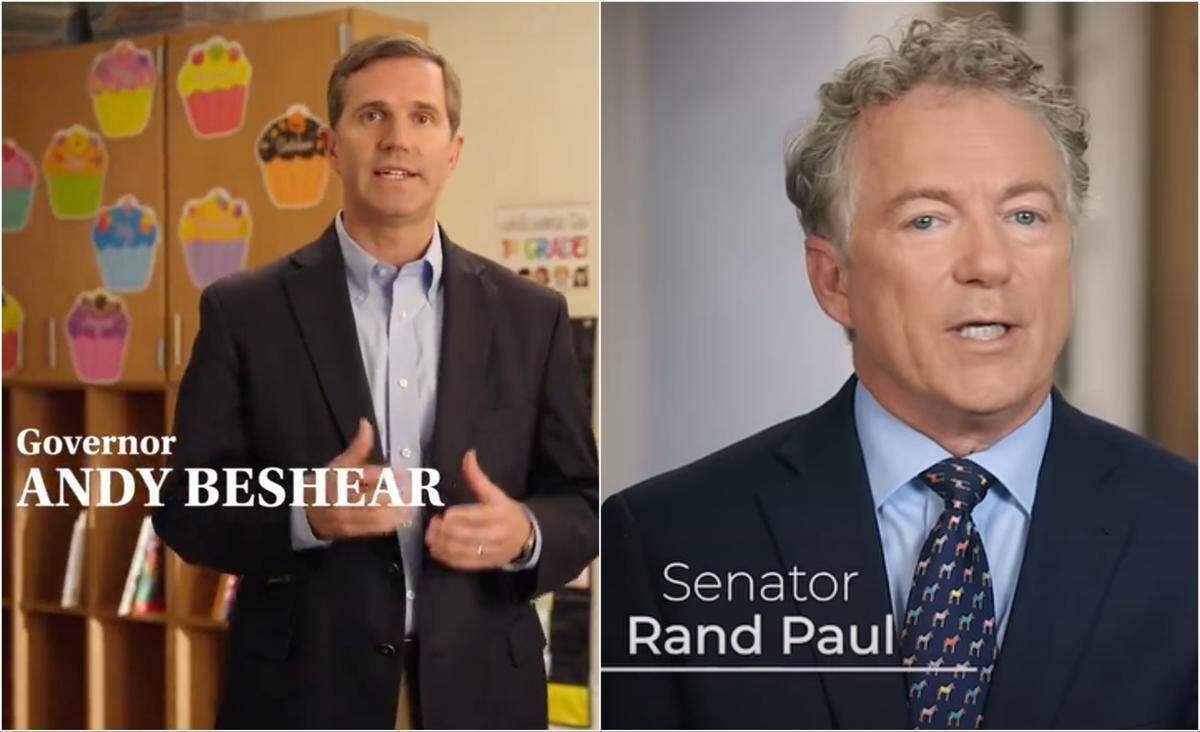
Support from Kentucky’s junior senator is pinned to boosting competition for students and teachers. That competition provides more choices for parents and benefits private and public schools alike, he says.
“Competition makes us all better,” Paul said during an October stop in western Kentucky.
“Public schools can and do great things,” said the Republican, who is not on the November ballot. “But for some of the kids who, generation after generation, we’re losing to poverty and crime, we’ve got to try something that’s a little bit different.”
Paul and his wife, Kelley, star in an ad from Protect Freedom PAC stating the amendment would “give parents a voice in their child’s education.”
There are other supporters of the measure, including the Family Foundation.
Leaders of the conservative-leaning group “believes that families of all backgrounds should be empowered to provide their children the best educational opportunities possible, whether that be public, private, charter, or home school,” said David Walls, executive director of The Family Foundation.
Amendment 2 would allow the General Assembly to empower Kentucky families with school choice programs to accomplish this goal.
Parents know best, and education works best when students, not systems, are put first, Walls added.
One thing is certain: Big dollars are being funneled into both sides of the amendment.
The Herald-Leader reported in late October groups supporting or opposing the amendment have raised at least $16.7 million for their efforts as of this week.
And those behind the big bucks included not only Beshear and Paul, but also such prominent names as the National Education Association; the Koch Brothers’ signature political organization; a group founded by former U.S. Secretary of Education Betsy DeVos; political “dark money” groups and more.
Talk of Kentucky’s Amendment 2 has landed in Florida.
Damaris Allen, the executive director of Families for Strong Public Schools, a Florida statewide non-profit, said a measure similar to Amendment 2 has been harmful to the Sunshine State.
“Vouchers hurt students, families, and communities,” Allen said. “The vast majority of voucher schools have less resources than traditional public schools utilizing uncertified teachers who often do not even have a degree leaving students unprepared for the road ahead.”
He said vouchers cause instability in public schools creating ever fluctuating enrollment leading to school closures and forcing families who choose public schools to leave the school, teachers, and community they love.
“In Florida, we saw firsthand how vital public schools are to our safety and survival,” Allen said.
“As the second hurricane in three weeks hit Florida public schools all over the state became shelters, feeding and housing tens of thousands of people. The proliferation of school vouchers in our state threaten the availability of these shelters which are vital to our communities,” he said,
Boards of Education opposing amendment
Fayette County Public Schools Board members at an Oct. 28 meeting joined Kentucky Board of Education members in approving a resolution supporting the use of state dollars to exclusively fund the common system of public schools.
There continues to be consensus among local school board members throughout Kentucky that public funds should not be directed to private/nonpublic schools, according to a Kentucky Schools Board Association survey.
The September survey gauged school board member perceptions about Amendment 2 in the weeks leading up to the November 5 general election.
Referred to by some as the “voucher amendment,” Amendment 2 will ask voters whether to give state lawmakers broad new authority to direct public tax dollars to private schools.
The Kentucky Board of Education approved a resolution that opposes any legislation or policy that would allocate state dollars to fund schools outside the common system of public schools.
Kentucky Board of Education Chairman Sharon Robinson said the resolution stresses the board’s support for a system of common schools, where children have equal access to educational opportunities for all Kentucky children.
“We know that ‘separate but equal’ is not a reality that can be realized,” said in a news release..
Board member Diana Woods said she’s concerned that if public dollars are diverted away from public education in Kentucky, it could lead to a division of resources similar to the way segregation worked when she was a child in school.
“There are not enough (public) funds now,” Woods said. “And I come from a small rural county. Even after integration, there still was not enough.”
Commissioner of Education Robbie Fletcher said he has concerns about public dollars going away from the public school system. He’s worried about how assessment and accountability would be handled with nonpublic schools.
“I think it’s our role as a board to make sure that all schools are accountable,” he said.
“We owe that to our families. We owe that to our students. We need to make sure we give them every single opportunity possible to be successful. I believe that as we look at this resolution, it points out that our desire is to make sure that every student has an equal playing field.”
Robinson said the resolution is not intended as a directive to vote in a particular way in November. Instead, the resolution is simply about supporting public funding for public education.
“This resolution reflects the board’s unwavering support for our common school system as a priority,” she said.
Kentucky Student Voice Team
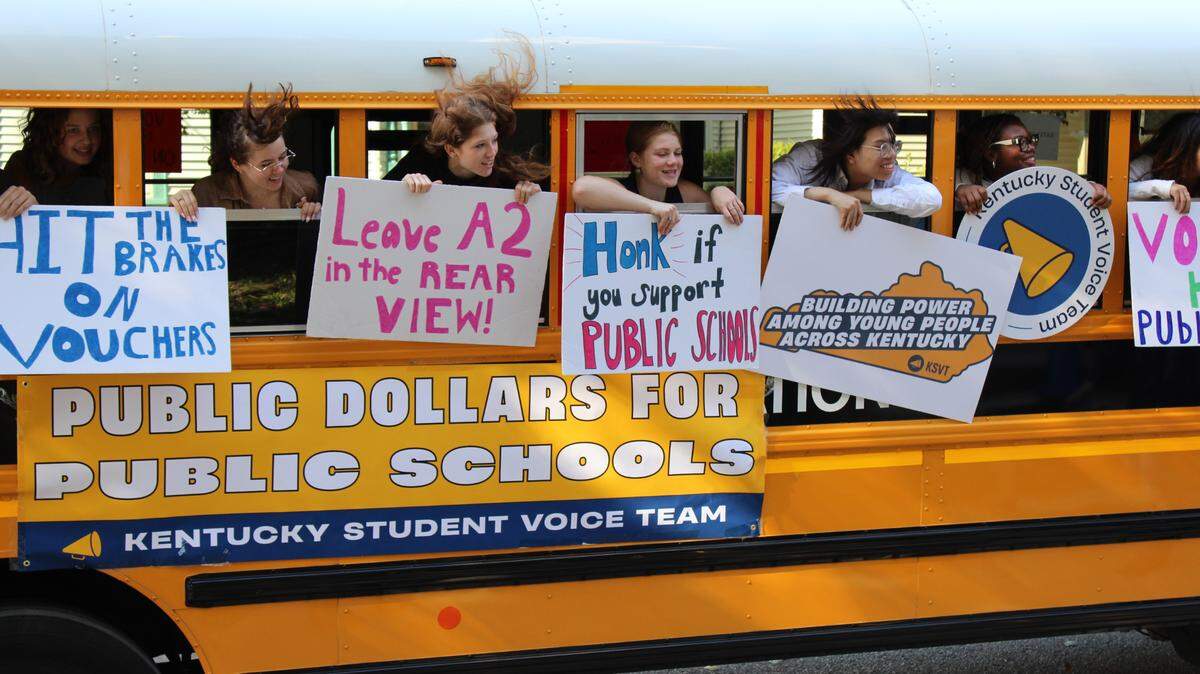
The Kentucky Student Voice Team took a stance against Amendment Two.
Students organized a Central KY Amendment Two “Myth Bus-Tour” that traveled to Lexington, Frankfort and Louisville on Oct. 13 where students hosted “teach-ins” surfacing the stories and perspectives of Kentucky students on Amendment Two.
Georgie Farmer, a sophomore at Danville Independent High School, said in a statement as someone from a family of educators and as an aspiring educator, the impact the measure would have on the livelihoods of educators and public school employees concerns him.
“If Kentucky adopted a Florida-style voucher program, it would cost $1.19 billion dollars annually; that’s equivalent to 9,869 educator jobs. My district alone would lose 31 educators which is equivalent to all the certified staff at our middle school,” Farmer said.
Milo Osborn, a senior at Lafayette High School, said they were one of the over 105,000 Kentucky students living with a disability.
School “choice” is quite the opposite for disabled students due to private schools not being required to provide plans for disabled students and not being held to the same anti-discrimination standards as public schools, Osborn said, adding these services are a vital part of ensuring the success of disabled students.
“A voucher program would not serve students like me, but continuing to fund public schools will,” they said.
Peter Jefferson, a senior at Henry Clay High School, said that his school was recently approved for renovation after over 60 years in the current facilities.
“With these budget cuts, our renovation could be delayed indefinitely, denying thousands of students the possibility of a brighter future at my school,” Jefferson said.
“Amendment 2 is the difference between new modern classrooms with well-paid teachers who support students beyond the classroom and a stagnant public school system fighting for basic necessities,” Jefferson said.
He said while the effects of vouchers in Fayette County are alarming enough, the impact of vouchers on rural communities would be even more dire.
In such communities as Hazard, where public schools employ a large portion of the community, vouchers would be devastating, Jefferson said.
This story was originally published October 29, 2024 at 7:49 AM.