Central KY Senate race a window into the future of ‘Liberty’ politics in state GOP
READ MORE
May 2022 Kentucky Primary Election
May 17 is approaching and Fayette County voters soon will head to the polls and choose the next people to represent them, their needs and wants. Below you’ll find stories explaining voting, explanations of the major local races and candidates, and who the Herald-Leader editorial board is endorsing in city-wide seats.
Expand All
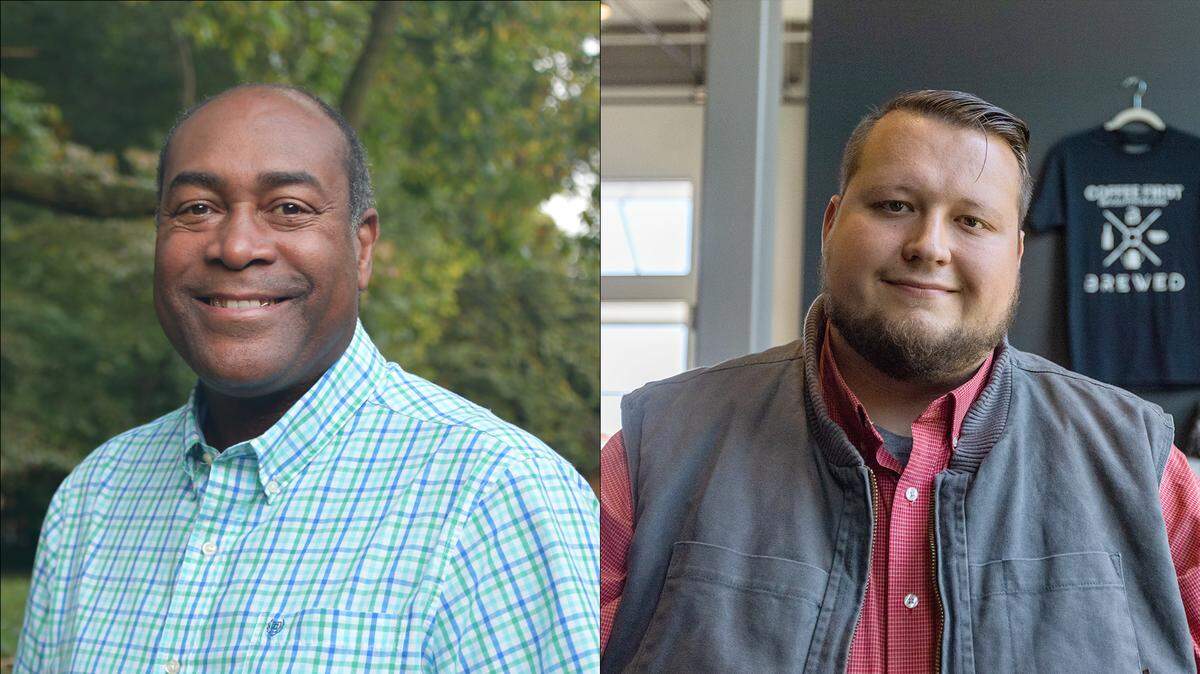
Sen. Donald Douglas, R-Nicholasville, has one of the best stories in Kentucky politics. But his opponent in the May primary this year, Andrew Cooperrider, may have the most compelling story for this moment in Kentucky Republican politics.
Born mid-century into a poor, 16-child sharecropping family near the Western Kentucky hamlet of Maceo, the son of parents who never studied past the eighth grade, Douglas, 65, catapulted his way up the socioeconomic ladder to become one of the region’s top doctors for managing pain without the use of opioids.
Douglas has crafted a life resume about as impressive as any: he nearly represented the U.S. Olympic Team in Track & Field, he became the first-ever Black American class president in the University of Kentucky College of Medicine’s history and in 2021 he won a Senate seat replacing the late legendary Sen. Tom Buford in a special election.
Cooperrider, 30, has been lightning in a bottle for those upset about COVID-19 mandates and Gov. Andy Beshear. His brazen defiance of COVID-19 restrictions at Brewed, the South Lexington coffeeshop, made him a mainstay on Central Kentuckians’ televisions and Facebook feeds.
Before his candidacy, it wouldn’t have been hard to predict that Cooperrider would run for something – governor, local or state office, something. He was a regular at rallies in Frankfort protesting COVID-19 mitigation efforts. He’s also kept a vigorous online presence with his personal, political and business Facebook accounts, posting daily updates and political musings on all three.
Scroll through Brewed’s online shop and you’ll find for sale a coffee bean blend named “Tyrant’s Tears,” a shirt with bold letters proclaiming “HELL NO JOE,” with the word ‘joe’ stylized in the font of president Joe Biden’s campaign slogan. A mat outside Brewed’s front door is turned towards those leaving the shop, offering a parting word: “come back with a warrant.”
Cooperrider is, in his own words, a firebrand.
Douglas, meanwhile, touts his strengths as both a leader and a team player who can work within the existing system to get results. His story, he said, speaks for itself.
How these two competing campaigns, and competing stories, play out could provide a window into the future of the Kentucky Republican Party and overall longevity of COVID-19 politics, observers say. What the Republican party learns will be up to the registered Republican voters of Garrard and Jessamine counties, as well parts of Fayette county.
There are nearly 9,000 registered Republicans in Garrard County, a place that hasn’t elected a Democrat to countywide office since 2006; more than 22,000 in Jessamine County; and at least 19,000 in the Southern portion Fayette County based on the entire county’s proportion of Republicans as a share of the total number of registered voters.
What separates them?
When asked to tell their personal stories in recent interviews with the Herald-Leader, both candidates started off sounding quite like each other.
“Let me start out by telling you this, number one: I’m 100% pro-gun. I’m pro-life. I’m a Christian and I’m a patriot,” Douglas said.
As for Cooperrider: “I’m a christian, family man, business owner, pro-life, pro-gun, pro-liberty.”
In Kentucky Republican politics, these policy stances and branding signifiers are a given – they were even adopted by Douglas’ Democratic opponent in 2021.
What mostly separates the two is posture. And the word “establishment” is a good barometer for that.
“I’m really not an establishment guy. When you look at the things I’ve done, I’ve really been a leader,” Douglas said.
But one of the core premises of Cooperrider’s campaign is that he is decidedly not “an establishment guy,” while Douglas is. Atop Cooperrider’s list of endorsements is fellow libertarian-adjacent politician Thomas Massie, Northern Kentucky’s 4th District U.S. Representative.
Cooperrider regularly signs off on campaign emails “with Liberty.”
Cooperrider was once a Libertarian, citing frustrations with the Republican Party. He gave to the Libertarian Party of Kentucky’s 6th Congressional District for half a year before the beginning of 2021 when he stopped. He said he’s since grown to more strongly identify as a Republican and embrace the two-party system.
“What I realized was that it’s not parties that are the problem,” Cooperrider said. “… The issue is we, as members of the party, have to hold individuals accountable to what they say they’re going to do.”
Douglas’ two political contributions are a 2021 gift to the Fayette County Republican Executive Committee and a 2007 $1,000 donation to former Democratic Gov. Steve Beshear’s campaign. A spokesperson for Douglas’ campaign has yet to return a request for comment on the donation.
Meanwhile, Douglas scored an endorsement from the Central Kentucky area’s congressman, Andy Barr. He’s also been endorsed by Attorney General Daniel Cameron and prominent conservative political issue groups Right to Life and the National Rifle Association (NRA).
An ad featuring Douglas and Barr says the Senator is “endorsed by our congressman,” with the “our” underlined.
Chuck Eddy is the lone Democrat running in the district, which elected Douglas over Democrat Helen Bukulmez by almost 50 points in the special election to replace Buford. Eddy has previously held counter-protests to Cooperrider, with one taking place over the summer at the state Capitol, where he – a previous Republican candidate for the 6th Congressional District and former leader of “Republicans for Beshear” – led a small group in support of Beshear.
Eddy said that he believes there’s not much separating the two Republicans.
“In my opinion, he (Cooperrider) would have voted the same way as Douglas on all those bills this session. His whole shtick is the Republicans didn’t do enough for ‘liberty,’” Eddy said.
Fiscal policy might be one window into spotting a difference between the two. Douglas voted for an historic GOP-led plan to cut the state income tax in increments of half a percentage based on certain revenue and savings triggers.
Cooperrider doesn’t like it. He called personal income tax “immoral,” but said that since the bill is structured to only lower personal income tax when triggers are hit that satisfy revenue and savings goals, the overall tax base will still increase – so, it’s a wolf in sheep’s clothing.
“That money comes from one place: taxpayers. If the government is going to pull in more money, That means your effective taxes have gone up.”
GOP policy architects say those triggers shield the state from having to drastically cut back on state-funded programs, but Cooperrider’s main concern was that he believes government should be shrinking and getting out of the way as much as possible.
On the current legislators, including Senate leadership, Douglas sings their praises.
“One of the things I’ve really, really learned is what good people we have in the legislature… It was nothing like I had been told. We’ve got a lot of caring, smart, intelligent legislators, and I frequently tell people, ‘we elect people, and as soon as they get there, we start bad mouthing them.’ Let’s not do that. Let’s have some confidence in the people that we’ve elected.”
Generally speaking, Cooperrider does not have confidence in Frankfort’s politicians. That criticism began before he was paired up against Douglas – an email subject line from his campaign when he was running for the 12th Senate District reads “The Establishment is PANICKING” – but Douglas has drawn those same criticisms. Cooperrider has also linked his opponent to senate leadership, which recently contributed $30,000 to Douglas’ campaign via the Senate Republican Campaign Caucus Committee (SRCCC).
Cooperrider said that Douglas not receiving a donation from anyone in the district was a bad sign. He also denigrated his ties to the SRCCC, which is mainly bankrolled by PACs associated with industries and other groups that attempt to lobby the General Assembly on certain issues.
“Is that someone who is going to represent the people of District 22, or is it someone who will continue to represent the corrupt political powers in Frankfort who are looking to line their own pockets?”
Though Douglas is technically behind in reported campaign finances, he isn’t really spending like it. His campaign has dropped around $80,000 on local television station ad buys; Cooperrider has spent about $20,000 on such efforts.
Cooperrider has been critical of what he calls corruption on the part of GOP Senate Floor Leader Damon Thayer, who both works in the horse industry and co-chaired a legislative committee on the taxation of horse race wagering.
Douglas said his fundraising efforts ramped up after the mid-April reporting deadline, so local fundraising won’t be reflected on the report.
Thayer, when asked to provide comment on the race, was complimentary of Douglas.
“Senator Douglas has quickly become a conservative leader in our caucus, sponsoring legislation that ended the Andy Beshear car tax increase and the state of emergency,” Thayer said.
“I’m bringing a calm, compassionate, commonsense approach to rein government. I want to work with people, I want to get things done,” Douglas said. “Oftentimes, we see politicians and those running for office that only seek to tear people down and divide. I want to build people up.”
What’s the district like?
Jessamine County and the southern portion of Fayette County allotted to Senate District 20 each hold a little over 40% of the district’s registered Republicans who are eligible to vote in the race. The much smaller Garrard County has the remainder.
The district as a whole isn’t a bad cross-section of Kentucky – from the densely populated urban fringe of Lexington, to mostly suburban Jessamine County, to the truly rural Garrard County community.
Garrard County punches above its weight population-wise in a GOP primary because it’s so red. The county of about 17,000 residents, with Lancaster as its seat, has not seen a Democrat run for county-wide office since 2006, Judge-Executive John Wilson said.
Wilson, who is leaving his post to work in addiction recovery, said that in Garrard County the spotlight hasn’t been so much on Cooperrider-Douglas. Citizens are more oriented towards two other items: local elections and national topics.
“I hear a lot of people talking about illegal immigration and there’s a lot of people here who are very upset with the direction the overall direction of the country,” Wilson said.
Douglas said that the polling his team has done bears out this conclusion.
“The polling shows that people are still very, very uneasy at a national level. Immigration and border policy is really throwing people off,” Douglas said. “A lot of people instead of thinking locally, they’ve sort of shifted to some national issues – immigration, inflation, cost of living.”
Garrard County GOP Chair Ty Sharp described Garrard County as “conservative to the umpteenth degree.”
Southern Methodist University Political Science Professor Stephanie Martin, who focuses on American conservative movements, said that evangelical communities like Garrard County could very well tip toward a loud and proud ‘Liberty’ candidate like Cooperrider.
Standing up against something, as Cooperrider notably stood up against COVID-19 restrictions, ignites a “politics of victimhood” that might excite evangelicals who see themselves as victims of a changing American culture, Martin said.
“You have a population of people that believe they understand what the country is supposed to be, and what the values are, and very often those are traditional Christian values,” Martin said. “When the state says ‘we want you to live in this other way,’ then that becomes a politics of victimhood. Because rather than being able to live out this way, these traditional values, the ability to make a profit, these mores of hard work, you’re being forced to live in this other way.”
Because of COVID-19 restrictions, Martin says that evangelical Christians and ‘Liberty’ causes could start to align more often.
Jessamine County is another locale that ran ahead of the rest of the state of Kentucky – it’s elected Republicans for a while. Take a scroll through the Facebook Group “Republican Party of Jessamine County Discussion Group” and you’ll find opinions running the full gamut of conservative ideology.
Tres Watson, a former spokesman for the Republican Party of Kentucky who’s worked on various GOP campaigns in the area, said that Jessamine County is split between strong social conservatives – the kind who might be more liable to side with a conservative with the professional bonafides of Douglas – and those more sympathetic towards Libertarians.
“There is an interesting breakdown in Jessamine County where you have a much more socially conservative electorate over in the Wilmore area around Asbury University’s campus versus the rest of the county, and probably even the rest of the district, where there’s more of a libertarian lean,” Watson said.
Watson said that there’s an inherent advantage in Douglas being the incumbent, but University of Kentucky Political Science Professor D. Stephen Voss added that the advantage is perhaps weaker than normal because of Douglas’ short time in the state legislature.
Voss, who lives in Lexington, said that the part of Lexington now in the 22nd Senate District – it shifted from Western Fayette County to Southern Fayette County along Tates Creek Road – is more white than it previously was. That could play in Cooperrider’s favor, Voss said, and the district is essentially Cooperrider’s backyard.
The challenger was barely redistricted out of the 12th District, which now includes Woodford, Mercer and Boyle counties. Cooperrider’s home address is only a couple blocks away from the new 12th District.
As for Republican voters in the district who may not be following the race so closely, Voss said that titles may play a role.
“One way voters simplify their decision is that they use someone’s job as a stereotype, as a way to sort of guess what they are, where they’re likely to stand and what they’re likely to prioritize. So, having a doctor against a small business person who’s known to be a COVID skeptic, that can make it easy for people to decide just in that context.”
A bellwether for the Kentucky GOP?
Scott Lasley, a political science professor at Western Kentucky University who is running for magistrate in Warren County as a Republican, says that the race is emblematic of where the new primary battleground in Kentucky politics will be: within the Republican party.
With 75-25 and 30-8 majorities in the House and Senate, both of which could grow this cycle, statehouse Republicans find themselves politically insulated from across-the-aisle pressure. That could be the case for long into the future, Lasley said.
“It’s the internal dynamics (within the GOP) that are going to matter, both in terms of electoral politics, but certainly also in how they’re going to ripple through governing,”
Cooperrider often mentions how he won’t play into the hands of special interests. Among Kentucky’s most dedicated lobbyists, and often its top spender in lobbying efforts, is the Kentucky Chamber of Commerce.
Lasley said that the party’s close relationship with the chamber could be a real inflection point if Cooperrider’s wing of the party begins to play a more prominent role.
“I think one of the defining issues could be the relationship with the Chamber of Commerce. At the end of the day, I think there’s a larger segment of the party that is probably becoming more skeptical of the chamber, and business in general. On progressive social issues, businesses have been largely responsible for pushing some of those.”
There could be parliamentary implications with a Cooperrider win, the candidate said. He indicated that he’d provide a second on proposed floor amendments from Sen. Adrienne Southworth, R-Lawrenceburg.
Southworth has made no bones about her opposition to some party initiatives, opposing the GOP’s redistricting maps because she said they were unfair to Democrats and making statements about Kentucky elections that Senate leadership, the Secretary of State and members of the State Board of Elections have called false.
However, the Republican majority caucus can change the Senate floor rules with regards to floor amendments via a majority caucus and floor vote.
Chris Wiest, prominent attorney for ‘liberty’ causes both local and national, said that the race may tell state Republicans a lot about their own party.
Wiest, who has endorsed Cooperrider, led legal efforts in Brewed’s fight against the Lexington Health Department over COVID restrictions and was the attorney for a group of ultra-conservative members congress who sued over the U.S. House of Representatives mask mandate.
In Wiest’s Northern Kentucky, the division between ‘Liberty’ candidates and those who are considered more establishment has become a point of contention. The Cincinnati Enquirer reported that two county parties in the region have recruited candidates to run against GOP incumbents, a rare occurrence.
“The race is a bellwether, but the degree of bellwether, I think would be the degree of a Cooperrider win. I think if it’s a 51-49 race, I don’t know how much of a bellwether that is,” Wiest said. “If it’s a 60-40 win, then yeah I think that says something about the midterm and what the ‘23 statewide races are gonna look like.”
Cooperrider frames his campaign as a victory regardless of whether or not he beats Douglas: it raises the profile of his already-growing wing of the party.
“You would hope that even if we do lose, they’d look back and look at how much effort and work they had to put in to beat us and realize that some of the issues I’ve brought up would hopefully be addressed.”
This story was originally published May 2, 2022 at 11:51 AM.

.png)
.png)
.png)
.png)
.jpg)
.png)
.png)