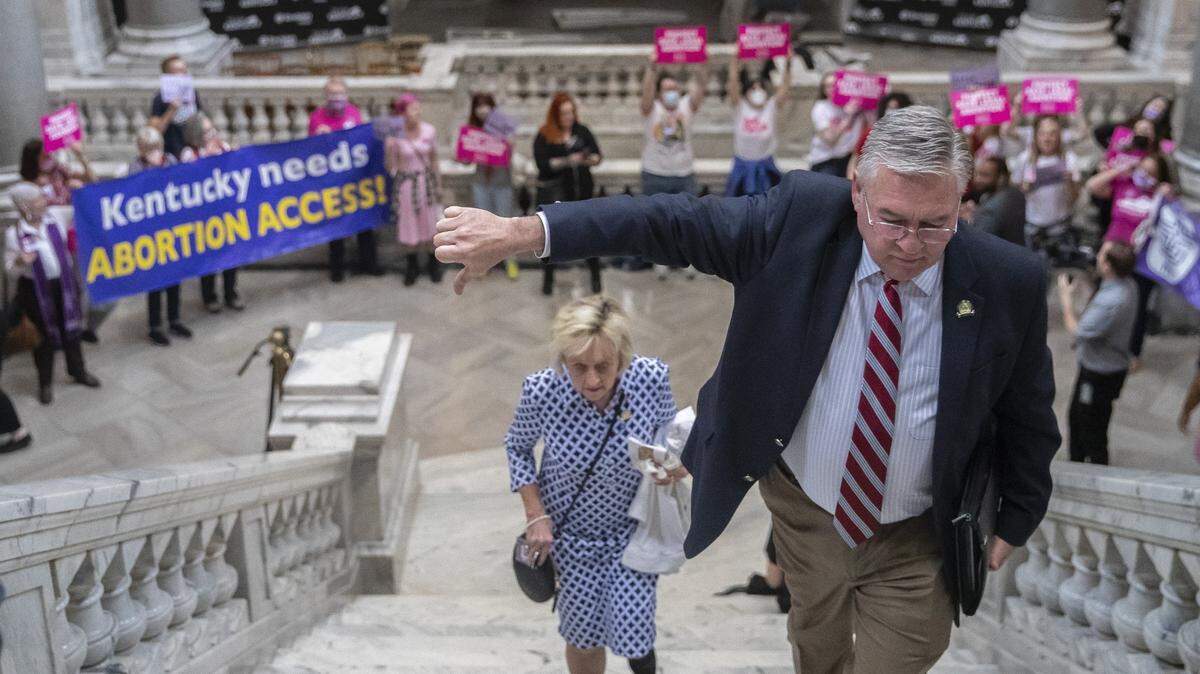
Abortion now banned in KY after Supreme Court ruling. What state’s ‘trigger law’ says.
READ MORE
What’s next for abortion rights in Kentucky?
Expand All
With the monumental fall of federal constitutional protections for abortion care nationwide on Friday, abortion is now banned in Kentucky.
The U.S. Supreme Court voted 6-3 in Dobbs v. Jackson Women’s Health Organization that abortion is not a constitutionally-protected right, and in doing so, overruled Roe v. Wade, a landmark ruling that had enshrined federal protections for abortion for half a century.
The reversal had an immediate impact in states like Kentucky, where “trigger laws” locked into place instantly, outlawing nearly all abortion.
Kentucky’s trigger law defines a fetus and embryo as an “unborn human being,” and states that, if Roe is overturned, “no person may knowingly administer to, prescribe for, procure for, or sell to any pregnant woman any medicine, drug, or other substance with specific intent of causing or abetting the termination of the life of an unborn human being.”
Likewise, no person may “use or employ any instrument or procedure upon a pregnant women with the specific intent of causing or abetting the termination of the life of an unborn human being.”
Only if an abortion is necessary to “prevent the death or substantial risk of death . . . or to prevent the serious, permanent impairment of a life-sustaining organ of a pregnant women” can a physician perform an abortion in Kentucky without risking a Class D felony charge, according to the law. The law does not include exceptions for rape or incest, or for a minor seeking an abortion.
Planned Parenthood Alliance Advocates, which operates one of two remaining abortion clinics in Kentucky, said it plans to sue the state in the coming days to block the trigger law from being enforced.
“We are suing to restore the right to abortion,” said Tamarra Wieder, state director for the organization.
Republican Rep. Nancy Tate, lead sponsor of an omnibus anti-abortion bill passed into law in April and member of the Kentucky General Assembly’s Pro-Life Caucus, lauded the high court’s decision, calling it a “historic and tide-turning day in the fight to protect humanity’s most innocent.”
“The Supreme Court has given the power back to the states to decide, which is how it should have always been,” Tate continued. “From this moment on, states have the power to choose whether or not to uphold the sanctity of life. Abortions will now be illegal in the Commonwealth, except to protect the life of the mother.”
But Gov. Andy Beshear, who vetoed Tate’s bill earlier this year, called Kentucky’s trigger law “extremist,” since it “will eliminate all options for victims of rape or incest.”
“As the former chief prosecutor of Kentucky,” Beshear said, “I know that these violent crimes happen, and not having options for victims of rape and incest is wrong.”
Tate, along with Sen. Robby Mills, R-Henderson, called Roe a “flawed precedent,” the consequences of which have been the “premature death of tens of millions of lives we will never know and who are denied their chance to leave an impression on this world. We remember them today.”
In yet another step to signal the Kentucky General Assembly’s deep opposition to abortion, a question posed in a statewide referendum this fall will ask whether the state constitution should be amended to deny one’s guaranteed right to an abortion. The product of a 2021 bill, residents will vote on whether to add this sentence to the constitution: “To protect human life, nothing in this Constitution shall be construed to secure or protect a right to an abortion or require the funding of an abortion.”
Tate on Friday endorsed that change, saying “doing so will amend the Kentucky Constitution to state unequivocally that nothing in our state constitution creates a right to abortion or requires government funding for it. This General Assembly is the most pro-life in our Commonwealth’s history, and we will continue to advocate for those who have no voice.”
Attorney General Daniel Cameron, who has championed Tate’s bill and recently sued the Cabinet for Health and Family Services for not enforcing the new law, despite it being blocked by a federal judge from being enforced, said Friday, “we are entering a new era. Abortion is, for all intents and purposes, over in the Commonwealth.”
“No longer will unelected judges make abortion policy for the Commonwealth. Instead, our elected representatives will be able to make public policy that reflects the values of Kentuckians and our deeply held respect for unborn life,” Cameron said. “There will be those who will certainly oppose such efforts. Let them see Christ in our response, that empathy and understanding govern our reaction, including the way in which we implement our laws.”
The Kentucky American Civil Liberties Union on Friday, speaking on behalf of EMW Women’s Surgical Center, one of two abortion clinics in Kentucky, called it a “devastating ruling.”
The organization cast doubt on the fact that the state’s trigger law bans the procedure out right.
“Anti-abortion activists are likely to argue that abortion is now banned in Kentucky,” the ACLU said in a statement. “As a precaution, [EMW] has stopped providing care while our legal team analyzes the court’s opinion and how it relates to federal and Kentucky laws.”
The ACLU, like Planned Parenthood, vowed to “aggressively litigate” any abortion ban. Heather Gatnarek, ACLU of Kentucky staff attorney, said, “No one should have the decision to remain pregnant forced upon them, which is what anti-abortion politicians seek to do.”
Erin Smith, director of the Kentucky Health Justice Network, which provides financial aid to Kentuckians who cannot pay the full cost of their abortion, said the decision, while unsurprising, is still a blow.
“We all knew it was coming, but it still hurts,” Smith said.
Jennifer M. Allen, CEO of Planned Parenthood Alliance Advocates, called it a “dark day for our country.”
“Make no mistake — this decision goes beyond abortion,” Allen said. “This is about who has power over you, who has the authority to make decisions for you, and who can control your future.”
Rebecca Gibron, CEO of Planned Parenthood Great Northwest, Hawaii, Indiana and Kentucky, vowed the organization will challenge this new precedent.
“We will keep fighting with everything we’ve got to ensure that everyone can access the care you need to control your body and your life.”
Herald-Leader reporter Austin Horn contributed to this story.
This story was originally published June 24, 2022 at 10:52 AM.

.png)