Statehouse GOP to continue march to zero income tax. But will they listen to warnings?
.JPG "The Kentucky state Capitol in Frankfort, Ky. Thursday, Oct. 28, 2021")
READ MORE
2023 KY Legislative Preview
We break down what the Kentucky legislate has in store for its 2023 session.
Expand All
As much as 2022’s legislative session was about bluster over hot-button social issues, the eyes of many turned to a less-controversial topic: the state income tax.
For those concerned with the dollars and cents of state coffers, a GOP-led effort to cut the state’s income tax all the way to zero was a bigger deal than any other bill passed this session. House Bill 8 put the state on a clear path to go from taxing 5% of residents’ income to not levying a tax on income at all.
As far as meat-and-potatoes policy making goes, it’s state Republicans’ crown jewel.
House GOP Floor Leader Steven Rudy, R-Paducah, indicated as much at an event previewing the 2023 legislative session held by the Kentucky Chamber of Commerce.
“It’s really quite amazing the things that we’ve been able to accomplish, and we’ve not lost focus of what we want to do: we wanted to eliminate the personal income tax, make Kentucky a right to work state… to take care of all the things you love in Kentucky, but fundamentally change those things that have been holding us back,” Rudy said.
The state income tax is already set to drop to 4.5% on Jan. 1 based on a state analysis earlier this year, but for future years the General Assembly has to approve a further 0.5% reduction given that certain budget health requirements are met. House Bill 8 set the state on a path to get from 5% to 0, and conservatives are giddy to get it there – and fast.
First up on the schedule this year is a resolution that affirms the tax decrease.
Republicans in support of House Bill 8 have argued that the cuts will attract more businesses and workers to the state, often citing the economic success of neighboring state Tennessee, one of nine states with no income tax.
The fundamental change of Kentucky’s tax code is exciting news for nearly all lawmakers in Rudy’s party. But it’s terrifying for Democrats and some outside observers.
Jason Bailey, executive director of the Kentucky Center for Economic Policy, has been one of the chief voices against the tax cut from its very inception, calling the first version of the bill drafted by Rep. Jason Petrie, R-Elkton, “the worst bill I’ve seen in 23 years.”
Bailey is railing against it because the math on keeping the state’s coffers healthy doesn’t quite add up. Though Republicans have emphasized that some lost revenue from the tax cuts will be made up by applying the state sales tax to a broader range of items, it doesn’t come anywhere near replacing it.
According to figures presented by the state Consensus Forecasting Group, a panel of independent Kentucky economists who determine revenue projections for the state, the decrease in individual income tax will decrease state revenue from the individual income tax by more than $1 billion through Fiscal Year 2024. In the same time frame, the sales tax broadening will only increase state revenue by $126 million.
“The attempt is to get rid of the income tax entirely with no plan to replace it. Show me the bill to replace the lost revenue. It just doesn’t exist,” Bailey said.
In mid-December, the Kentucky Center for Economic Policy released a statement signed by a coalition of 28 different organizations in Kentucky urging lawmakers to rethink their march toward erasing the state income tax. Among other issues, it highlighted the fact that cutting the income tax rate the same percentage for earners across the board lets wealthy Kentuckians keep much more money in their pockets than middle- and low-income earners.
“If lawmakers choose to continue the tax cuts under HB 8, the benefits would flow largely to those at the top. The top 1% of earners, who make an annual average salary of $1.4 million, would receive a $11,056 tax cut, more than a family four in Kentucky spends on food in an entire year. Those in the middle 20% would get only $278 a year, or just over $5 a week,” the coalition wrote.
The loudest voice in the room – and the one with the most money in Frankfort, as they’re the capital’s top lobbying spender – in support of the tax cut is the Kentucky Chamber of Commerce.
Now it’s encouraging legislators to cut faster and harder. In a recent piece, the chamber’s center for policy & research recommends that the legislature look at making “all future rate reductions automatic” instead of requiring action. It also recommends that they consider adding provisions that allow the tax to go down in an increment greater than 0.5%.
About half of all the states in America have pursued some kind of tax relief in 2021 and 2022, very often because state coffers are still filling up with money related to COVID-19 stimulus packages and an economy that got hot once the pandemic began to wane.
But there’s skepticism about the benefits. Dr. Jennifer Bird-Pollan, a professor and dean who specializes in tax law at the University of Kentucky College of Law, said that she remains unconvinced about the economic merits of lowering the income tax rate.
“The evidence that tax cuts lead to any kind of economic growth, it’s just not (there). You’re not going to generate more revenue, because you’ve cut your income tax rate by 1%. It’s just not going to matter. I haven’t seen any evidence in Kentucky or elsewhere to convince me otherwise,” Bird-Pollan said.
Timing and the opposition’s hope for success
According to Rudy, the opposition to House Bill 8 holds no sway in Frankfort.
“I don’t think the 80 members of the House majority or the 31 members of the Senate Majority, pay any attention to Jason Bailey. Our members are united and we look forward to seeing the personal income tax go away in Kentucky,” Rudy said.
But Bailey said his activism against the tax cut is more than just tilting at windmills.
He said that concerns he and others shared about the effect of swift income tax cuts have already affected policy. Last session, the Senate version of House Bill 8 pumped the brakes on the House’s initial version.
Senate Appropriations & Revenue Chair Chris McDaniel, R-Taylor Mill, added some important caveats to the House’s version. The final version replaced previously static dollar amounts that triggered tax rate decreases with a more complex formula, adding a requirement that the state maintain a Budget Reserve Trust Fund – also known as the rainy day fund – equivalent to 10% of the actual revenue drawn in a given fiscal year for the personal income tax rate to drop by half a percentage point and that the legislature pass a resolution affirming any further 0.5% drop.
“I think there are a couple of people in the Senate that understand the numbers better and that are concerned about this,” Bailey said. “I think there’s some hesitation about how this thing is designed and the impact.”
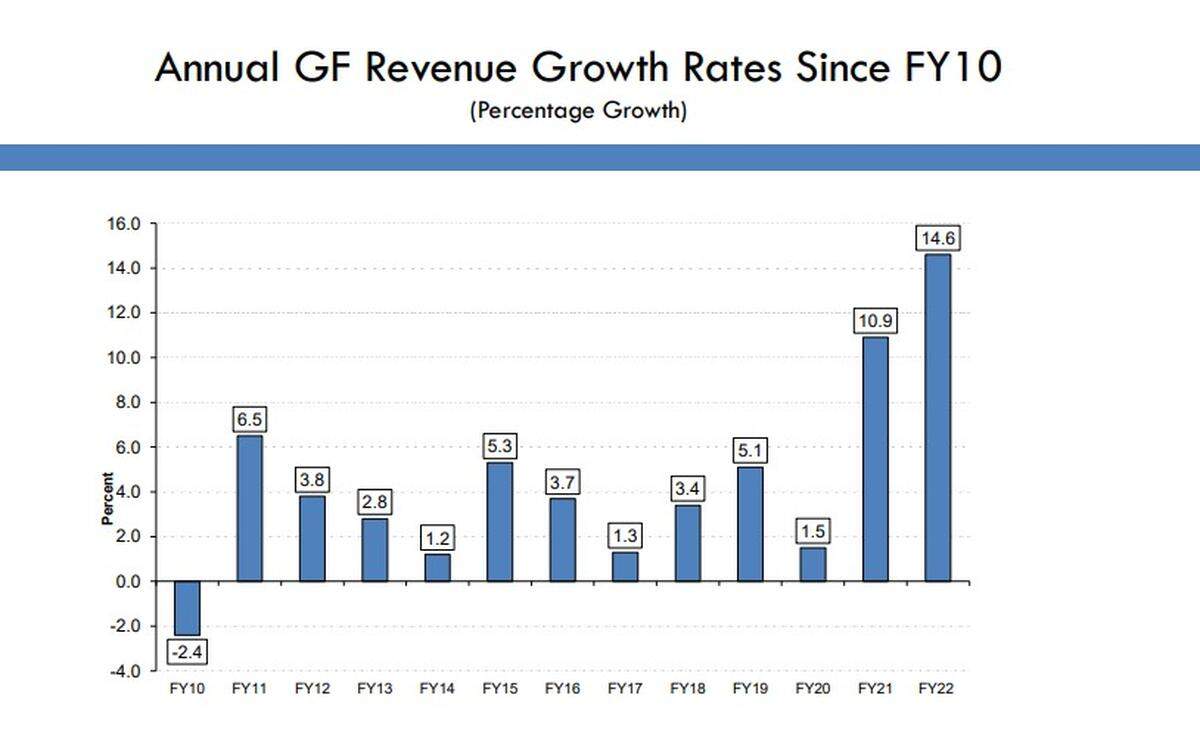
The Consensus Forecasting Group found that actual revenues for Fiscal Year 2022 far exceeded the first estimates, to the tune of $945 million. Fiscal Year 2021 already saw a major influx of cash, growing by 10.9%, but the General Fund in Fiscal Year 2022 grew by an even more impressive 14.6%, all the way up to $14.7 billion.
As of now, the Republican-led legislature seems set on passing the resolution to go from 4.5% to 4% income tax, but the timing is unclear.
Thayer has indicated that the House would work to pass a bill affirming the further income tax drop during the first week of January, but that the Senate would wait until February when they reconvene after a multi-week break.
This story was originally published December 29, 2022 at 7:37 AM.
.png)