Are paid influencers boosting KY political campaigns? They don’t have to say
READ MORE
Nate Morris & X influencers
Kentucky 2026 Republican U.S. Senate candidate Nate Morris has the backing of possibly coordinated online influencers. One expert says it’s likely an ‘astroturf,’ paid campaign. Morris’ campaign says it has no relationship with the influencers, and a strategist working with Morris called the allegations “fake news.”
Expand All
Network of online influencers back Nate Morris for Senate. Are they getting paid?
Are paid influencers boosting KY political campaigns? They don’t have to say
Popular X accounts backing Nate Morris have been previously accused of ‘pay-to-post’
X influencers’ other similar posts
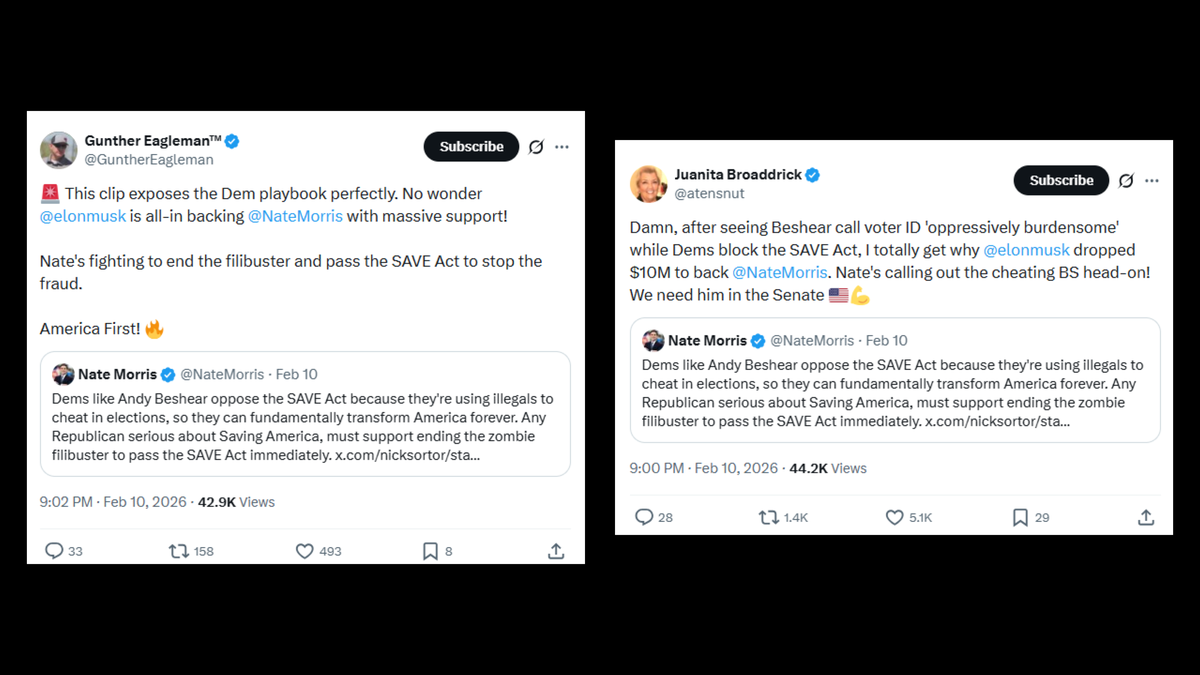
X influencers’ Nate Morris posts
Social media users are required by law to disclose when they’re being paid to advertise a product.
But, if that payment is for promoting a political candidate or cause, there’s no legal requirement to be upfront about it.
That’s a big problem, according to experts who follow social media’s effects on politics, like Renee DiResta, a professor and social media researcher at Georgetown University.
In the late 2000s, the Federal Trade Commission released rules cracking down on undisclosed product advertising, called the “mommy blogger laws.” The Federal Elections Commission, which oversees most political activity, has not followed suit.
“There’s more legal compulsion to disclose that you’re talking up Tupperware than a political candidate,” DiResta told the Herald-Leader. “If you’re boosting a watch, you have to disclose. If you’re boosting a political candidate, that’s a gray area. That’s the weird loophole that our influencer ecosystem operates under this at this point.”
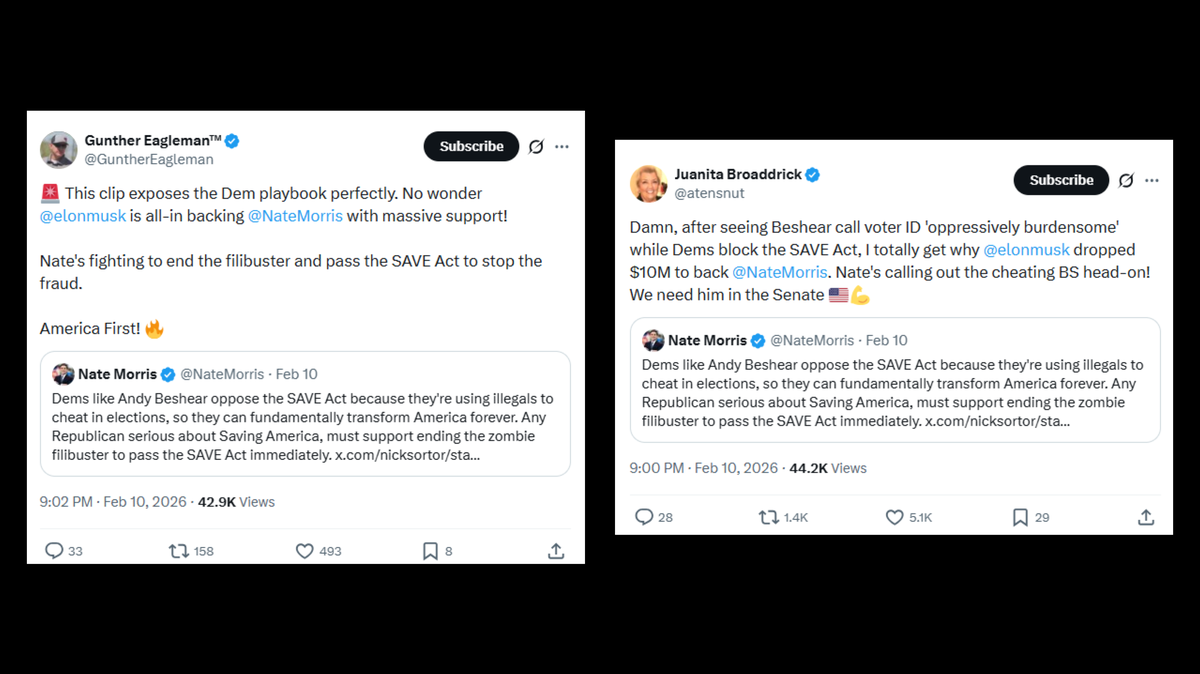
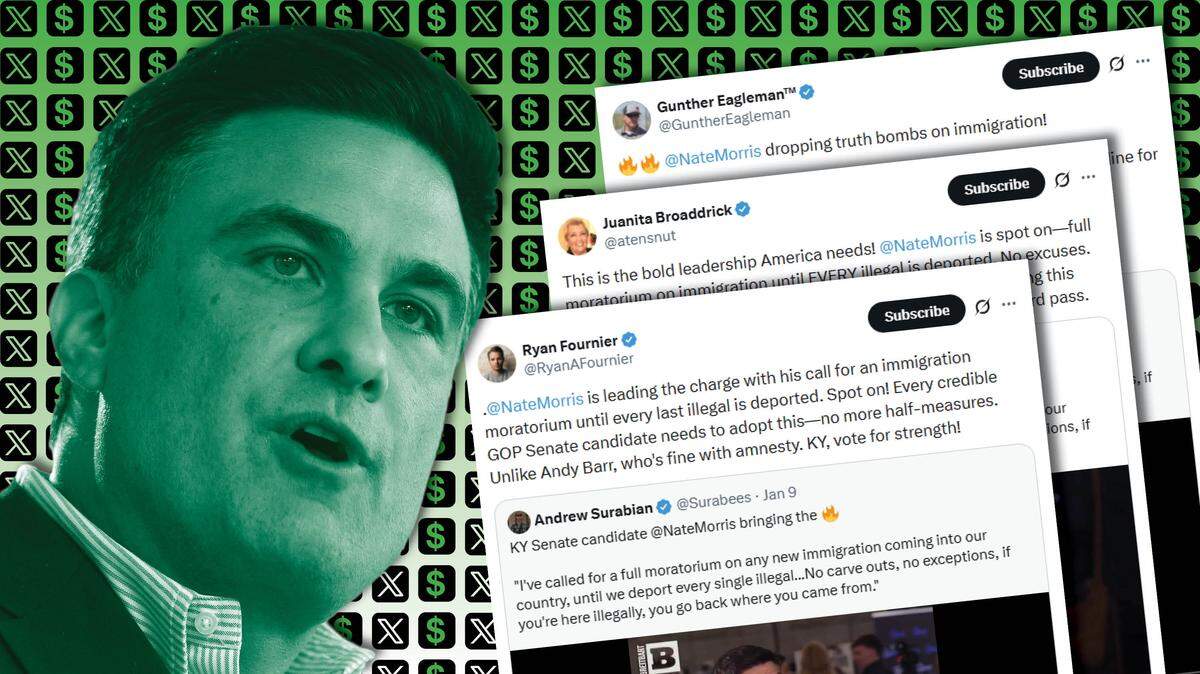
Experts have suggested a network of influencers supporting Kentucky Republican U.S. Senate candidate Nate Morris operates in that gray area. A Herald-Leader analysis found a network of conservative influencers repeatedly boosting Morris’ posts — in addition to other candidates and niche causes — in bursts, often echoing the same phrases and themes across accounts.
The Herald-Leader’s investigation centered on the influencer accounts of Ryan Fournier, Juanita Broaddrick, and Gunther Eagleman, a pseudonym for former Texas police officer David Freeman. All of them either have direct ties to X Strategies, a firm Morris, and a political action committee supporting him, is paying, or post frequently in response to one of its leaders, prominent Trump adviser Alex Bruesewitz.
Morris is one of several Republicans, including Rep. Andy Barr and former Attorney General Daniel Cameron, running to replace Sen. Mitch McConnell.
In a statement to the Herald-Leader, a Morris campaign spokesperson wrote they “have no relationship with” Broaddrick, Eagleman or Fournier.
Bruesewitz called the line of inquiry “fake news,” and said he was proud to work with Morris. He did not answer questions about his firm’s relationship with the influencers in his statement.
Fournier, Eagleman and Broaddrick did not respond to questions sent via text or social media.
A popular young political strategist and influencer, Bruesewitz was the lead anecdote in a Wall Street Journal story on paid influencers on the American right. Bruesewitz posted in favor of marijuana rescheduling but did not disclose that X Strategies was paid $300,000 by a group funded by corporate marijuana interests.
The rest of the Wall Street Journal story paints a picture of the practice dominating Washington politics, particularly on the right.
The outlet reported that Caitlin Sinclair, an influencer with less than one-tenth of Broaddrick, Eagleman and Fournier’s follower count on X, received $67,500 in one year from the MAHA PAC for videos about issues linked to the Robert F. Kennedy Jr.-aligned movement. A project tied to the Israeli government is expected to spend $250,000 per month on influencers. One agent for an influencer told the Wall Street Journal that most deals he cuts range from $5,000 to $20,000 per post.
Sam Woolley, a professor at the University of Pittsburgh who has worked closely with paid influencers as a researcher, said he’s seen some who have been paid up to $10,000 per post.
It’s not a conservative-exclusive issue, either, Woolley says.
“The use of coordinated groups of influencers kind of came into the public consciousness during the 2020 presidential campaign, when (Democratic candidate) Michael Bloomberg was running. He employed a company called Hawkfish that that hired a bunch of influencers to endorse him, sometimes without disclosure,” Woolley said.
Since then, the ball has been mostly carried by conservatives, he said.
In an era of information overload, spurred by the advent of artificial intelligence, Woolley said the consequences of coordinated influencer campaigns are serious.
“Not only do we have generative AI populating social media feeds with huge amounts of ‘AI slop,’ we have coordinated groups of influencers that are being paid by political entities saying whatever it is they’re paid to say without any kind of disclosure. It’s all sort of leading to a degradation of the informational environment,” Woolley said.
Experts: Disclosure needed for paid posts
A lot of political media frames paid influencing as a normal cost of doing business.
The New Yorker and The New York Times have aired claims that Laura Loomer, a prominent conservative provocateur who is close to Trump, is paid to influence political outcomes. Loomer has posted multiple times against Morris, claiming he’s not pro-Trump enough.
Mike Cernovich, a far-right commentator and influencer in his own right, wrote recently on X that most influencers are “shilling.”
“Lobbyists hire influencer agencies, who pay people on X, to push talking points for corporate and foreign clients. None of this is disclosed. Most of what you read on X from ‘influencers’ is shilling,” Cernovich wrote.
One prominent conservative content creator from Kentucky, Nick Sortor, told the Herald-Leader he’s been offered money to post certain messages in the past, but has refused every time. In an interview last year, Sortor said he’s developed a reputation as an independent voice after he called out an influencer campaign against the “Make America Healthy Again” proposal to ban food assistance programs from being used to purchase soda.
He said he’s been offered “dozens” of payments, and in one instance got an offer explicitly because a company wanted to cater to Trump supporters.
“There was an American company that Trump was calling out for moving manufacturing to Mexico, and they were willing to pay me $1,200 to praise them for their investment in American manufacturing,” Sortor said. “Their customer base is (agriculture-) based, and obviously agricultural people are going to be more on the Trump side of things. They were trying to get me to counter message whatever Trump was saying at the time about them moving stuff to Mexico.”
This environment has led to calls for action from people following the issue, like Isabel Linzer of the Center for Democracy and Technology. She said influencers are “falling through the cracks” of U.S. election law.
Given the strength of the country’s First Amendment protecting political speech, she said efforts to ban paid messaging from influencers would be misguided. Requiring disclosure, Linzer said, is the best path forward.
That’s good for both creators — who post on different platforms, each with very different rules — and consumers, she said.
“Clarifying and standardizing is really valuable, not just for the creators, but also so that people consuming content online have some kind of consistent baseline to understand what they’re looking at,” Linzer said.
X technically bans undisclosed political paid promotions in its terms of service, but enforcement is lax. In response to a raft of influencers supporting now-U.S. Senate candidate Ken Paxton in 2024, the Texas state legislature passed a law requiring disclosure from political influencers.
Though Eagleman, whose actual name is David Freeman, is a Texas resident, it’s unlikely his posts on matters of federal politics or outside Texas’ borders would violate the law if he were paid for them.
Texas ethics attorney Andrew Cates told the Herald-Leader that Texas law limits enforcement to commentary on “Texas laws, state and local,” but don’t entirely rule out the possibility of someone claiming he violated the law if he were paid to post and influence public opinion.
Kate Starbird, a computer science professor at the University of Washington whose research focuses on information networks, told the Herald-Leader it can be tricky to differentiate between when a network acts like a “flock of birds,” just looking around and copying each other, and when they’re consciously coordinating or even being paid.
She said people steeped in online culture have come to accept the practice of “influencers for hire.” Normal people, on the other hand, don’t like it, she said.
“I was in a conversation with someone, and I was explaining one of these influence operations that I’ve seen, and she had no idea about people being paid to post content on social media sites and that these kinds of operations happen,” Starbird said. “So I do think there’s room for us to revisit, like, ‘Do we want to accept that this kind of deception is happening in online spaces? If not, what could we do about it?’”
The main thing all experts agreed on: the need for disclosure.
“Transparency won’t solve everything, but when people know who’s paying for a message, it’s a lot easier to decide whether to trust it.”