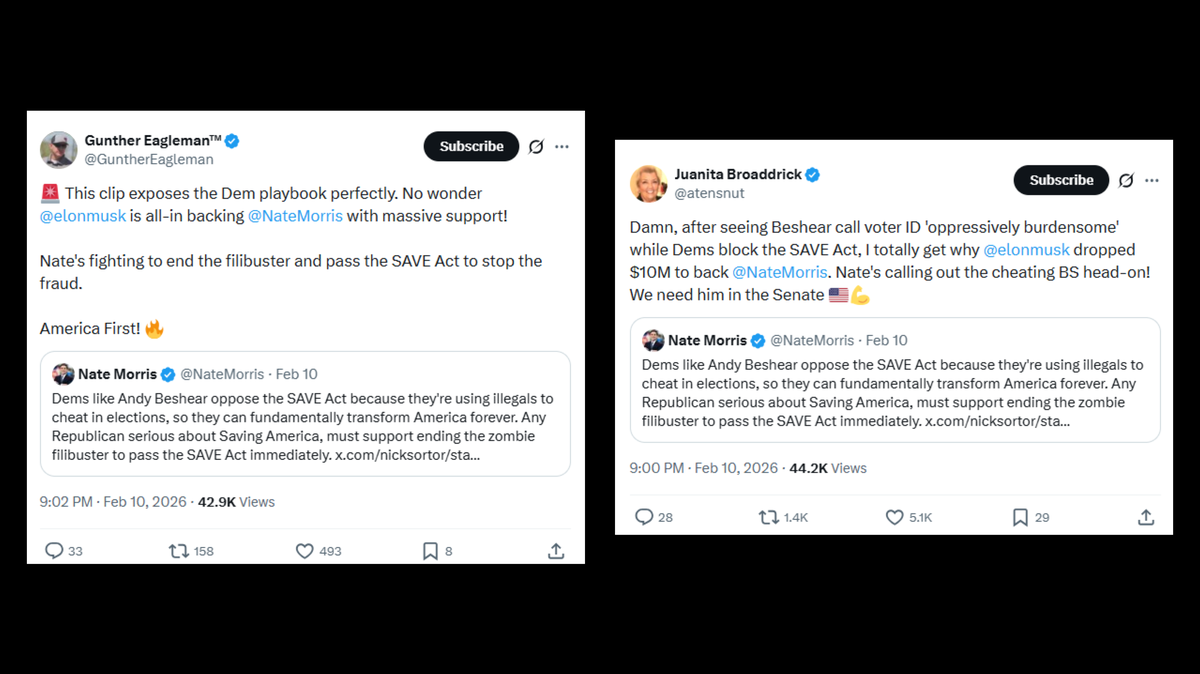
Network of online influencers back Nate Morris for Senate. Are they getting paid?
READ MORE
Nate Morris & X influencers
Kentucky 2026 Republican U.S. Senate candidate Nate Morris has the backing of possibly coordinated online influencers. One expert says it’s likely an ‘astroturf,’ paid campaign. Morris’ campaign says it has no relationship with the influencers, and a strategist working with Morris called the allegations “fake news.”
Expand All
Network of online influencers back Nate Morris for Senate. Are they getting paid?
Are paid influencers boosting KY political campaigns? They don’t have to say
Popular X accounts backing Nate Morris have been previously accused of ‘pay-to-post’
X influencers’ other similar posts
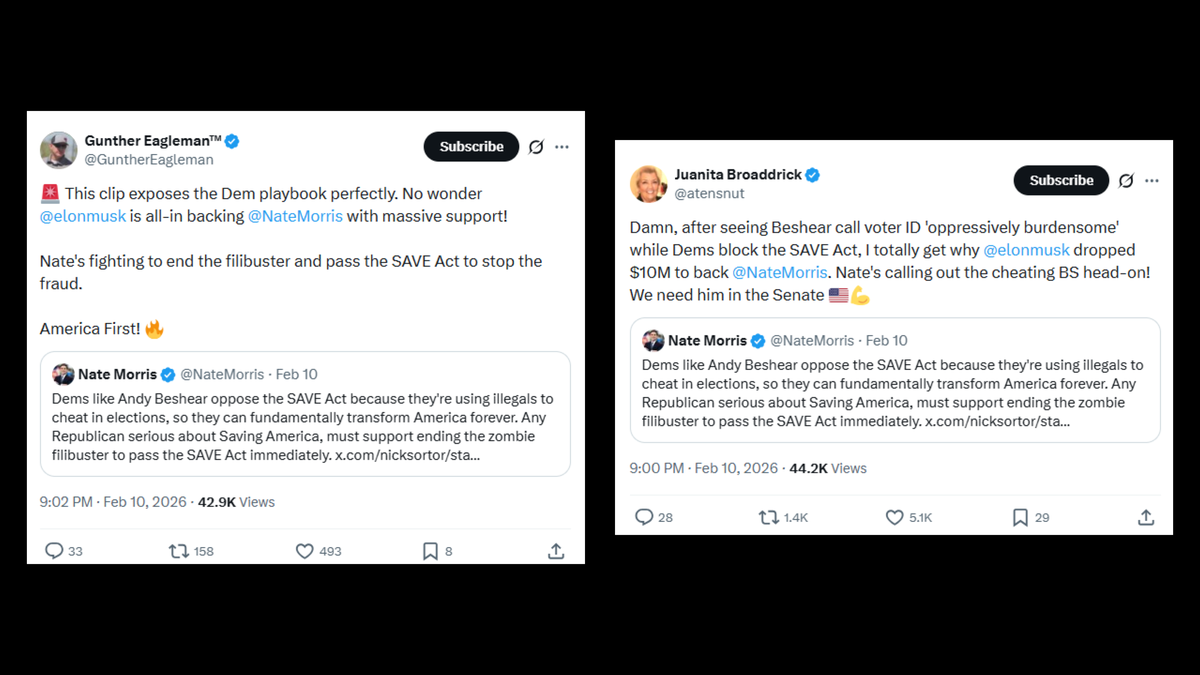
X influencers’ Nate Morris posts
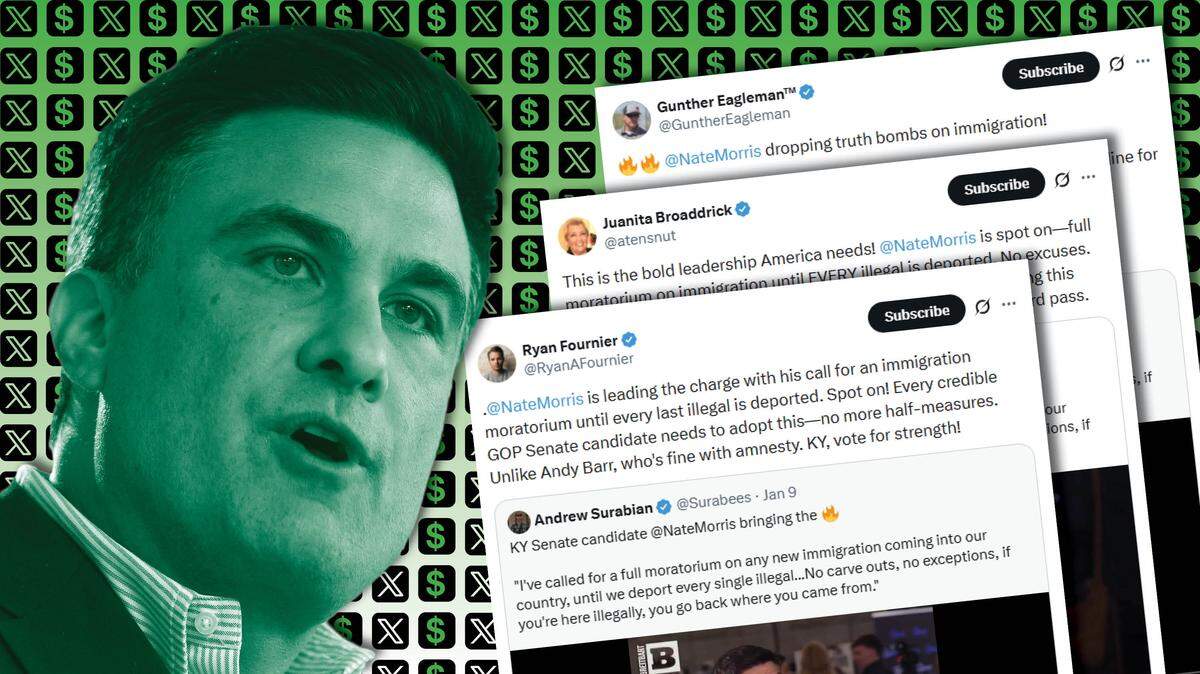
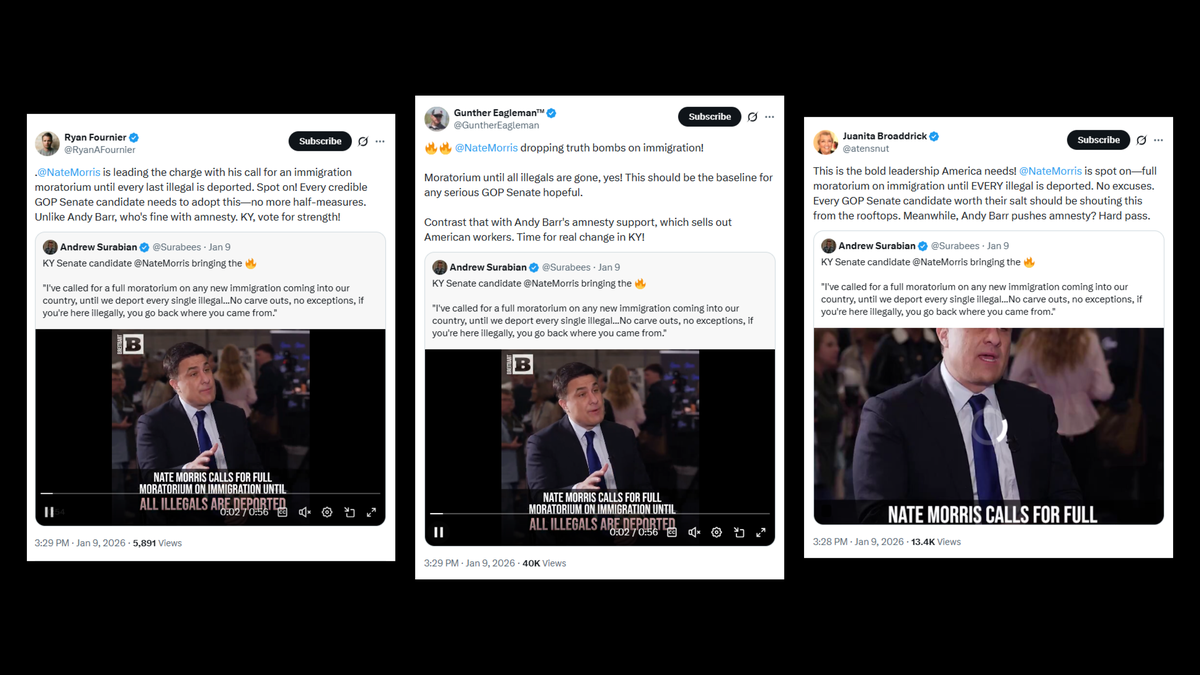
On the same day, at the same time, three of America’s biggest conservative influencers all had the same thing to say about Kentucky U.S. Senate candidate Nate Morris’ immigration stance.
Morris was showing “the bold leadership America needs” with his call for an immigration moratorium, Juanita Broaddrick posted on X at 3:28 p.m. on Jan. 9.
Morris is “leading the charge” on the issue, Ryan Fournier wrote the next minute.
Morris was “dropping truth bombs,” Gunther Eagleman said, also at 3:29 p.m.
All three were boosting a post from Morris campaign consultant Andrew Surabian touting the candidate’s position on immigration. All three called on other Republican candidates to back the idea. And all three took a dig at Morris’ well-funded GOP opponent, Rep. Andy Barr, in the process.
Over the last 10 months — since Morris launched his campaign in June 2025 — the trio of accounts has posted near-simultaneously timed messages of praise about him 20 times. In the first three months of 2026, at least one of the three accounts reposted 56% of Morris’ posts. About 30% of the time, all three accounts reposted Morris, sharing his posts to their collective 4.8 million followers.
In a statement, Morris’ campaign denied any relationship with the accounts.
None of the accounts have apparent ties to Kentucky, nor are the people behind them registered to vote in the state. Broaddrick is from Arkansas, and Fournier calls North Carolina his home state. Gunther Eagleman, who by one count has the third-highest engagement of any account on X, is a pseudonym for David Freeman, a former Texas police officer.
The accounts have a long, varied pattern of seeming coordination in their posts on X. The Herald-Leader identified 111 different posts on topics, including Morris, local data center projects and state legislation, that were either posted around the same time or feature highly similar language.
That record has led other users, people who have interacted with the accounts and some experts who study social media and politics to conclude their efforts are definitely coordinated and possibly a “pay to post” scheme linked to Morris campaign vendor X Strategies. Fournier has direct ties to X Strategies, which has received at least $150,000 from Morris and a supporting group during his campaign, according to Federal Elections Commission reports; the other users have a long history of praising one of X Strategies’ founders.
X Strategies is a West Palm Beach, Florida-based company founded by Derek Utley and Alex Bruesewitz, the ascendant young strategist credited with successful political maneuvers from Trump’s team like embracing podcasts and bringing the rapper Nicki Minaj into the “MAGA” fold.
“Short of having the contract between the influencers and the firm, this is about as good of proof as you ever get of there being a coordinated campaign,” said Samuel Woolley, a communications professor at the University of Pittsburgh who has worked closely with political influencers in his studies and reviewed the Herald-Leader’s evidence.
“This has all the hallmarks of a top-down astroturf campaign,” he added.
An “astroturf campaign” refers to a coordinated effort that mimics organic social media behavior to make a message appear more broadly supported than it is.
Though traditional paid advertisements are subject to strict disclosure laws, and product endorsements must be disclosed, political social media posts like these fall into what experts describe as a legal loophole.
Morris is running in the May 19 GOP primary against Barr and former Kentucky Attorney General Daniel Cameron in the race to replace Mitch McConnell in the U.S. Senate.
Barr, a Kentucky political veteran and member of the House Financial Services Committee, has proven a strong fundraiser and has led in some recent polls. Cameron, polling in second or first in recent surveys, has high name ID across Kentucky as the only candidate who has run statewide before.
Morris, 45, a Lexington tech entrepreneur, is a first-time candidate. He began his race for statewide office with little name ID; his own pollster pegged him with 5% support two months after launching.
Morris claims Vice President JD Vance as a close personal friend, has been spoken of approvingly by Donald Trump, Jr., and a political action committee supporting him got a $10 million boost from Elon Musk, the world’s richest man.
All three X accounts — Broaddrick, Fournier and Eagleman — have faced previous accusations they were paid to promote certain messages and later deleted the posts.
In a statement to the Herald-Leader, Bruesewitz did not directly address his firm’s relationship to the accounts, but called the line of questioning “fake news.”
“This is fake news that an anti-Trump consultant working for one of Nate’s opponents likely fed to you,” Bruesewitz wrote to the Herald-Leader. “But I am used to anti-Trump losers and fake news journalists spreading lies about me, I suppose it comes with the territory. I am proud to be on Team Morris because Nate is a good man who built an incredible business and loves our country.”
Conor McGuinness, a spokesperson for the Morris campaign, praised Bruesewitz in a statement and wrote the campaign had “no relationship” with the three influencers.
“Alex Bruesewitz, the CEO of X Strategies, was one of the top political advisors on President Trump’s campaign in 2024 and is one of the most sought-after political strategists in the Republican Party today,” McGuinness wrote. “He is well known for only working with strong pro-Trump candidates and we’re proud to have him as an adviser on Team Morris. We have no relationship with any of the other people mentioned in this inquiry.”
None of the people running the X accounts responded to Herald-Leader attempts to reach them over social media, phone or text as of Thursday night.
Prominent supporters of President Donald Trump, the accounts regularly charge that whatever candidate or cause they’re championing is truly “MAGA.”
Morris’ campaign paid X Strategies $90,000 in 2025, and a political action committee, Fight for Kentucky PAC, supporting but not directly affiliated with the campaign paid another $15,000, according to FEC filings. The campaign paid X Strategies another $45,000 in the first three months of 2026.
The face of X Strategies, Bruesewitz star is rising fast in GOP circles. A recent profile in POLITICO dubbed him “the White House’s unofficial ambassador to pop culture.”
Posts about Nate Morris’ campaign
At a February campaign town hall in Oldham County, an older attendee asked Morris what his plans were to “reach the younger voters.”
Morris responded that he was “running the campaign of the future, today.”
“If you look at the way we’re running our campaign, the great online influencers that are helping us,” Morris began, highlighting his endorsement from Benny Johnson, a popular right-wing influencer and commentator. He contrasted his approach with that of Barr, who is running a more traditional campaign featuring dozens of local elected official endorsements.
“You take my opponent, Andy Barr: You could have run that campaign in 1960. He has no reach into the internet, no reach into the ‘X sphere,’ if you will,” Morris said.
As Morris was speaking, Broaddrick, Eagleman and Fournier all posted strikingly similar messages online, quoting the same Morris post within three minutes of each other. At 6:17 p.m., Fournier praised the candidate’s stance on ending the “zombie filibuster,” and contrasted it with Barr in an X post. Broaddrick and Eagleman wrote similarly at 6:19 and 6:20 p.m.
Morris has had the backing of Eagleman and Broaddrick from day one of his campaign. Eagleman and Broaddrick posted similar messages about Morris’ launch ad within a half-hour of each other. Fournier posted favorably not long thereafter.
“All the evidence paints an extremely suspicious picture, and it bears explanation. If they’re saying, ‘We’re not being paid, there’s no coordination going on here,’ my response would be that you’re asking people to basically not believe what their eyes and ears are telling them,” Woolley said. “There’s too much pointing in the direction of, ‘Something is happening here.’”
Joshua A. Cohen is a popular left-of-center X and Substack user working under the name “Ettingermentum.” He’s deeply familiar with the influencer ecosystem.
Cohen told the Herald-Leader that “these tweets make it look like there’s pretty clear coordination going on,” and the behavior runs counter to what made the influencers grow their audiences in the first place.
“I think it’s best understood as one of countless examples of how quickly and eagerly these guys transition straight to the most flagrantly fake DC-style messaging as soon as they get close to power,” Cohen said. “I find it to represent a remarkable lack of understanding about where their appeal came from.”
X Strategies
Bruesewitz himself was exhibit A in a recent story from the Wall Street Journal about the growing ecosystem of “pay-to-post” influencers in Republican politics.
The story highlighted Bruesewitz’s post advocating for the reclassification of marijuana as a less dangerous drug without disclosing that X Strategies was paid $300,000 by a group funded by corporate marijuana interests. He’d stated previously he had “no personal stake” in the matter.
Bruesewitz also has posted in favor of Morris 10 times without disclosing his company’s financial relationship with the campaign or a political action committee supporting Morris.
All three accounts have a connection to X Strategies. Fournier worked as a “vice president of political media” for X Strategies for more than six years, according to his LinkedIn profile. Eagleman and Broaddrick have posted approvingly of Bruesewitz more than a hundred times, often replying to his posts and congratulating him on his successes.
Morris and the marijuana industry are far from the only beneficiary of simultaneous posting from these accounts.
They have posted in unison to benefit the development of data centers that fuel artificial intelligence, big tobacco companies, players in the cryptocurrency industry, energy companies and more.
Their involvement in these campaigns — both political, like Morris,’ and in business, like crypto regulation — raises questions about the legitimacy of the democratic system, Woolley, the social media influencer expert, said.
“Influencers, much more so than traditional celebrities, traffic in trust and in authenticity, and the kind of behavior we’re seeing from these accounts is anything but trustworthy and authentic,” Woolley said. “Even if they say that they’re not being paid, the fact that they’re copying each other’s content so closely and so closely coordinating about political content suggests that there’s some kind of manipulation effort going on here.
“I think the people that follow them have a right to know whether or not those kinds of political machinations are going on.”
Other candidates
The accounts’ backing of political causes and candidates extends to other X Strategies clients.
Take Republican U.S. Sen. Tom Cotton, of Arkansas.
America One, a PAC supporting Cotton, started paying X Strategies $10,000 per month in August 2025.
Fournier had never tagged Cotton’s X account before that, but has done so 12 times since Aug. 1, 2025, reposting ad material and celebrating Cotton’s work.
Broaddrick and Eagleman were openly oppositional to Cotton — calling him a “traitor,” “disappointing,” “pathetic,” and even cursing at him — in the first half of 2025.
“We see you and will do everything we can to ensure a TRUE Republican replaces you,” Eagleman wrote on July 28.
The first check from America One went to X Strategies on Aug. 7. Since then, Eagleman has been exclusively positive about Cotton, ramping up in the lead-up to his March primary.
Writing in the style of political ad copy, Eagleman posted Feb. 24 a photo of Cotton from his time as an infantry officer.
“He brings that experience to the Senate every day, fighting to keep our military strong and our enemies on notice. Arkansas is lucky to have a leader like that. Get out on March 3 and vote for @SenTomCotton,” Eagleman wrote.
On Jan. 8, Broaddrick made a post praising Cotton’s “DATA Act,” lessening regulation on AI data centers. On Jan. 12, Eagleman posted the same exact message, copied word-for-word.
The accounts have also boosted the other candidates and PACs that pay X Strategies, according to reports with the Federal Elections Commission. All the accounts have frequently reposted or replied to accounts tied to Rep. Lance Gooden, of Texas, Sen. Jim Banks, of Indiana, and Tennessee Sen. Marsha Blackburn — the three federal candidates, all Republicans, most regularly paying X Strategies.
State-level clients like Florida GOP gubernatorial frontrunner Byron Donalds have been the subject of several positive posts from Broaddrick, Fournier, Eagleman and Bruesewitz. Donalds’ campaign and a PAC supporting him paid X Strategies $6,250 each per month throughout most of 2025, according to Florida Department of State records.
The efficacy of these kinds of posts is disputed.
Morris’ follower count has shot up since launching his run, but University of Kentucky political science professor Stephen Voss said that may be overrated in a general election setting. In a primary, it could be more effective.
“X is the social media network, these days, that tilts most rightward. So, you’re going to get a disproportionate share of the sorts of people who would be politically active and watching a Republican primary,” Voss said.
Lobbying
Jonathan Franks, a consultant and president of the Sand Key HOA in Clearwater, Florida, was surprised to see who weighed in on an intensely local matter. The controversy centered on whether the City of Clearwater should sever its relationship with Duke Energy and purchase the utility’s infrastructure to provide city-run electric service.
Broaddrick, Eagleman and Fournier took to X on the same day to bash Clearwater’s proposal, posting the same link to a Tampa Bay Times article, tagging the city’s mayor and making the same points about how the move was against conservative principles.
“My thought was ‘Please don’t make this any harder by politicizing it,’” Franks, who is neutral on the idea, said. “A lot of my neighbors in my association are older people on fixed incomes. This is a very important decision, and it should not be influenced by out-of-state influencers.”
At the time, he was already familiar with Eagleman and left a reply littered with colorful language berating the influencer.
When presented with the group’s X posts on other issues, Franks — whose career is in corporate public relations and communications consulting — said his takeaway was clear.
“This is what I do in my profit-making life: work for companies like Duke to come up with ways to achieve goals,” Franks said. “This, to me, sounds like somebody’s got a scheme, somebody’s trying to get paid. Because I just can’t think of a friend that these people would have here that would get them into this fight.”
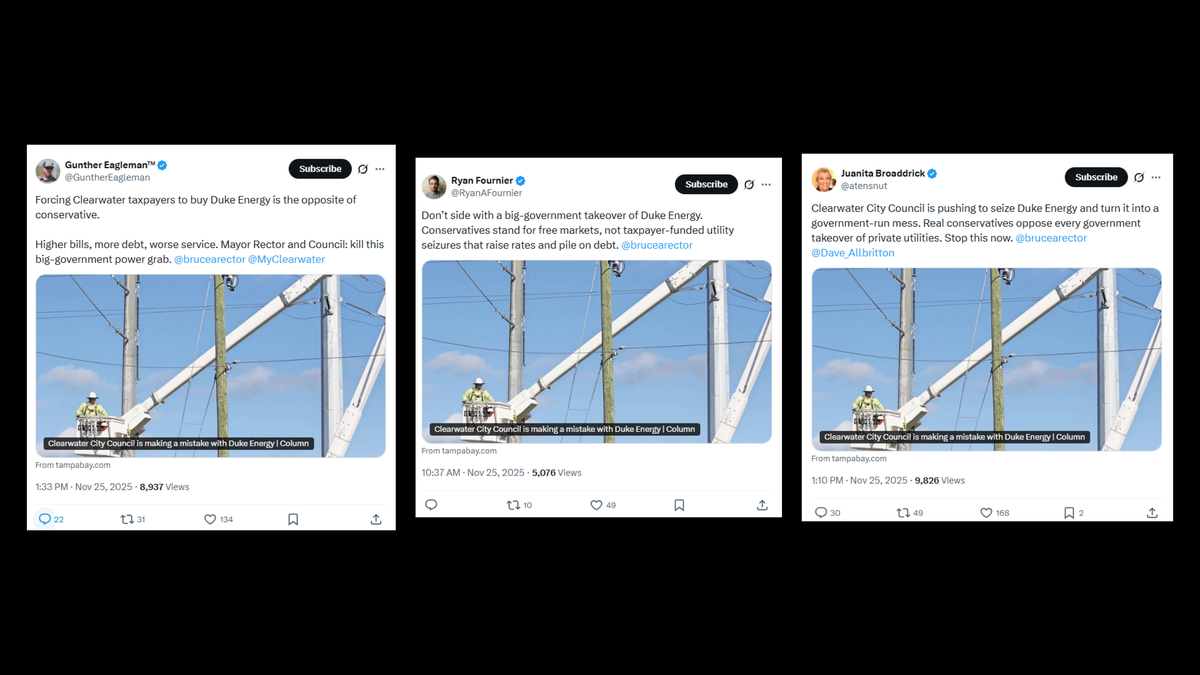
Broaddrick, Eagleman and Fournier’s similar messaging extends to a grab-bag of topics, many of them obscure. They posted about drug policy, data center projects, niche aspects of the “One Big Beautiful Bill,” cryptocurrency regulation and more.
Sometimes they contradict their own messaging when advocating for, or against, certain measures.
In Feb. 2025, Broaddrick posted in support of a Tennessee ban on the sale of vape products not approved by the FDA, warning that “China isn’t just stealing your data — they may even be poisoning your vape pen.”
The bill favored vapes from larger multinational companies that have pivoted from tobacco toward nicotine products like vapes such as Altria and Philip Morris. Smaller manufacturers with less ability to navigate the FDA’s system were hurt.
Three months later, Broaddrick was making the opposite argument. She opposed a Texas bill targeting vapes with components manufactured in China, including a flagship vape from Philip Morris and many top-selling brands.
“The bill targets China-made vapes, effectively banning nearly all vaping products since most are manufactured there. Critics say this protects Big Tobacco by blocking safer alternatives, mimicking New York AG Letitia James’ tactics,” Broaddrick wrote.
Eagleman and Fournier both penned similar posts the same week, tagging the same elected officials.
Another example is a Tennessee bill that would prohibit pharmacies from owning pharmacy benefit managers, or PBMs, which negotiate drug reimbursement rates between insurers and pharmacies.
In May 2025, Fournier endorsed that very idea.
“(PBMs) are a huge problem, and it should be illegal for companies like CVS to operate retail pharmacies, while also being able to run a PBM to set prices on drugs they sell,” he posted.
Fast-forward nine months and Fournier, Eagleman and Broaddrick all posted messages raging against the Tennessee bill that would do just that, aligning with the only company affected: pharmacy behemoth CVS, which has carpeted the state of Tennessee with $1.3 million worth of ads protesting the bill.
Reposting an ad from a dark money group funding its own ad campaign against the bill, Fournier wrote that if the sponsor “refuses to back down on SB 2040, he will be standing in the way of TrumpRX’s plan to lower drug prices.”
The accounts have also aligned on data centers.
On Feb. 21, all three accounts, within the same 17-minute window, put pressure on the 5,000-person city of Fort Meade, Florida, to accept a proposal for a nearby AI data center.
Broaddrick tagged the city’s X account and wrote “this is common sense!”
“If Florida wanted politicians who block jobs and tax cuts, they would have voted for Democrats,” she added.
Fifteen minutes earlier, Eagleman tagged the same account and posted the same link, which referenced a poll from a Florida pro-development group claiming Floridians would welcome data centers if they led to lower taxes, local jobs and warded off “foreign adversaries.”
“Floridians want data centers if it means jobs and tax relief,” Eagleman wrote.
More than 100 accounts commented on Eagleman’s post, nearly all of them disagreeing.
The top comment: “This is bulls--t. Floridians DO NOT want Datacenters. Stay in Texas and leave Florida out of it.”
The projected $2.6 billion facility, which is expected to be powered by Duke Energy, was unanimously approved by Fort Meade city commissioners this week.