Popular X accounts backing Nate Morris have been previously accused of ‘pay-to-post’
READ MORE
Nate Morris & X influencers
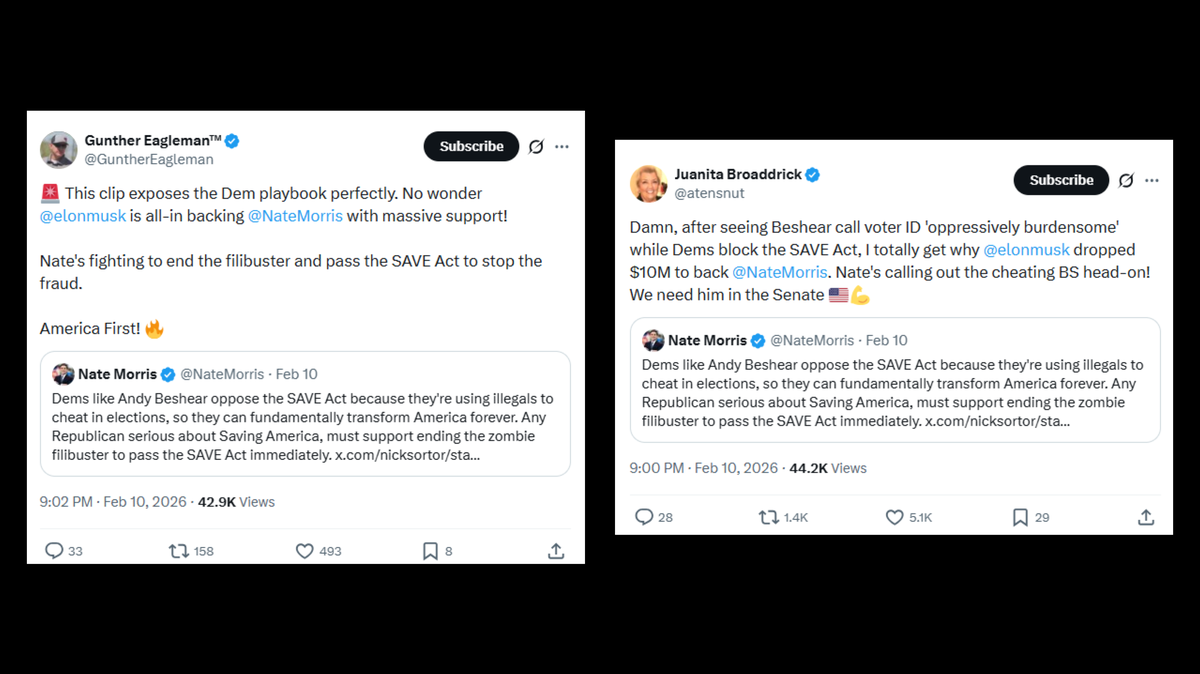
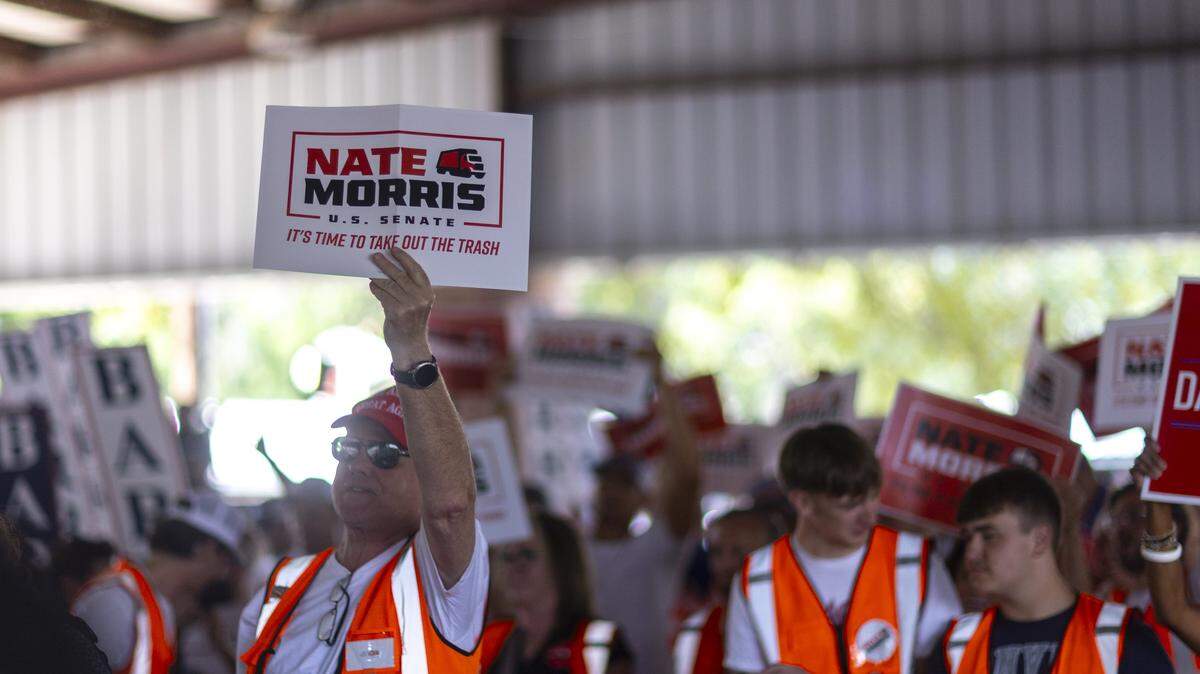
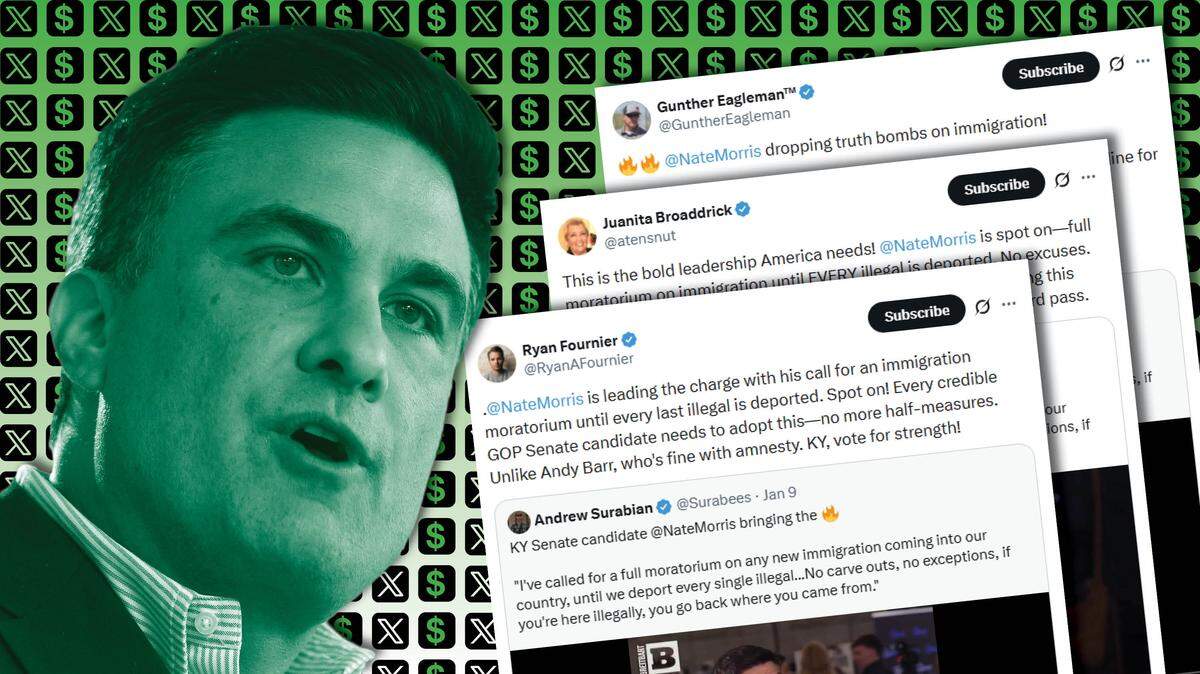
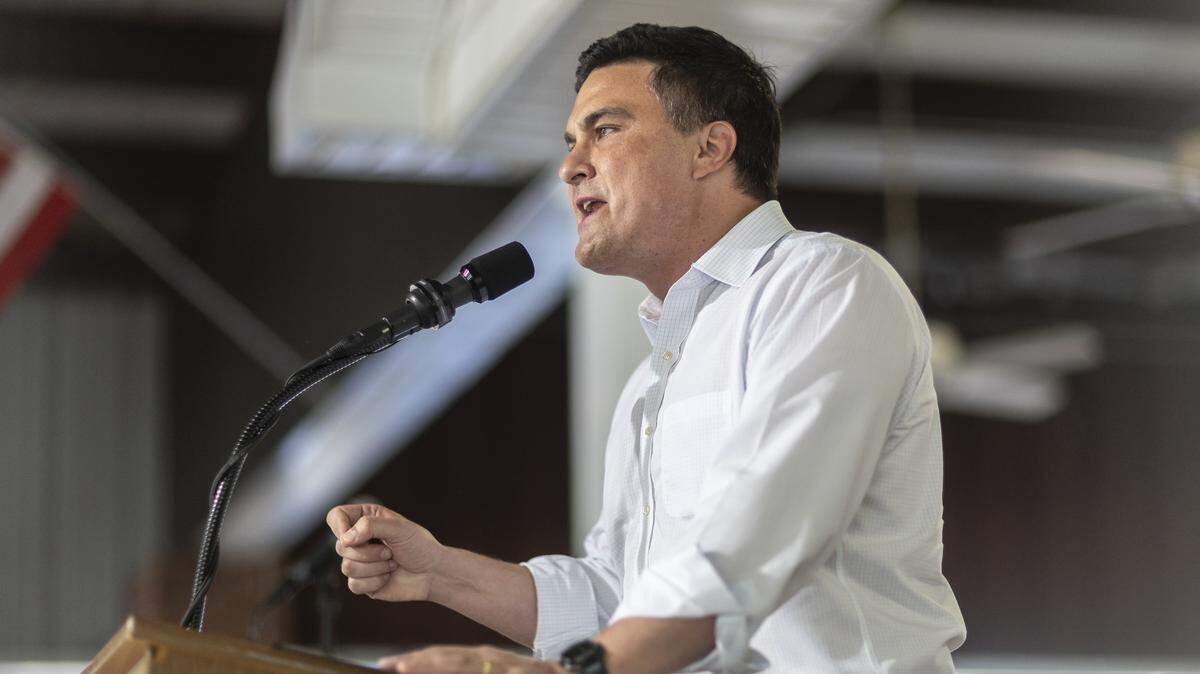
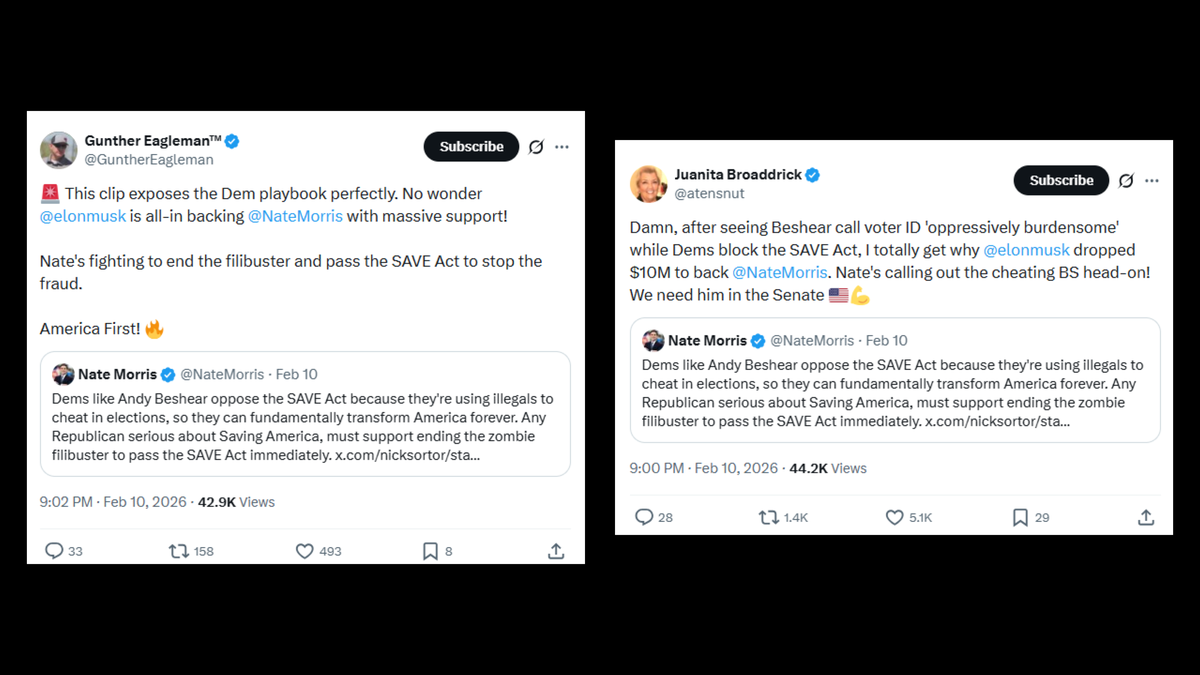
Kentucky 2026 Republican U.S. Senate candidate Nate Morris has the backing of possibly coordinated online influencers. One expert says it’s likely an ‘astroturf,’ paid campaign. Morris’ campaign says it has no relationship with the influencers, and a strategist working with Morris called the allegations “fake news.”
Expand All
Network of online influencers back Nate Morris for Senate. Are they getting paid?
Are paid influencers boosting KY political campaigns? They don’t have to say
Popular X accounts backing Nate Morris have been previously accused of ‘pay-to-post’
X influencers’ other similar posts
X influencers’ Nate Morris posts
The Herald-Leader’s investigation into Kentucky U.S. Senate candidate Nate Morris, X Strategies and multiple prominent conservative accounts on X is not the first time the company or these social media users have been identified as coordinating and potentially being paid to post.
Alex Bruesewitz, the founder of communications firm X Strategies and rising star on the American right, was the lead anecdote in a January Wall Street Journal story about the rise of influencers being paid by lobbying interests to post. In a since-deleted post, Bruesewitz hyped marijuana reclassification without disclosing X Strategies was paid $300,000 by a committee funded by legal marijuana industry giants.
Morris and a political action committee supporting him have paid X Strategies more than $100,000 throughout Morris’ campaign to replace Sen. Mitch McConnell in a crowded GOP primary.
Bruesewitz has behaved similarly with Morris as he did on marijuana.
In his 10 posts lauding Morris to roughly 670,000 followers, Bruesewitz has not disclosed the support his company has received from Morris and the PAC backing his campaign. As of March 31, Morris’ campaign paid X Strategies $135,000, and a group supporting Morris paid it another $15,000, according to Federal Elections Commission records.
“I’m a @NateMorris fan. He totally gets it,” Bruesewitz wrote in October, quoting a post from Morris featuring an interview clip.
Ryan Fournier, Juanita Broaddrick and Gunther Eagleman, a pseudonym for a former Texas police officer — the widely followed conservative X accounts that are the subjects of the Herald-Leader’s investigation — have also posted in favor of Morris and the effort to reschedule marijuana as a less dangerous drug.
In response to questions about his firm’s involvement with the influencers, Bruesewitz wrote in a statement suggesting it was “fake news.”
“I am used to anti-Trump losers and fake news journalists spreading lies about me, I suppose it comes with the territory. I am proud to be on Team Morris because Nate is a good man who built an incredible business and loves our country,” Bruesewitz wrote.
Conor McGuinness, a spokesperson for Morris’ campaign, wrote they “have no relationship with” Fournier, Eagleman or Broaddrick.
Though traditional paid advertisements are subject to strict disclosure laws, and product endorsements must be disclosed, political social media posts like these fall into what experts describe as a legal loophole.
Eagleman had posted the word “marijuana” on his account twice prior to X Strategies being paid by the marijuana group, with no opinion on rescheduling; he posted 13 times in favor of it from then on, up until President Donald Trump signed the executive order making it official.
Luke Niforatos, an executive at Smart Approaches to Marijuana, was on the other side of the rescheduling push. He’s confident that influencers like Eagleman were part of a coordinated, paid effort tied to X Strategies in that campaign.
“There are big, big, big, big, big people that are playing this game of social media. They’re monitoring what people say, they’re paying influencers. It’s a very complex apparatus that’s taking hold around politics and around issues,” Niforatos said.
Most private, non-political contracts are not subject to public disclosure, but X Strategies’ most consistent source of revenue from politics is Never Surrender, Inc, a fundraising committee supporting Trump. It paid the group in monthly installments throughout 2025, totalling $260,000, according to reports filed with the Federal Elections Commission.
Fournier has direct ties to X Strategies, working as a vice president there from 2017 to 2023, according to his LinkedIn profile. Eagleman and Broaddrick have posted approvingly of Bruesewitz more than a hundred times, praising him effusively and congratulating him on his successes, both political and personal.
Fournier rose to prominence as a cofounder of the “Students for Trump” organization from his North Carolina college during the 2016 election. He was arrested and charged with assault for allegedly striking his girlfriend in the forehead with a handgun in 2023; the charges were later dropped.
Eagleman, whose real name is David Freeman, is a former Texas law enforcement officer. Broaddrick is an 83-year-old woman who has been a regular on conservative media dating back to her allegation, first made public in 1999, that former President Bill Clinton raped her when he was attorney general of Arkansas in the 1970s. Clinton has denied her claim.
Broaddrick has hyped Bruesewitz as a prospective candidate for two different congressional campaigns, neither of which he ultimately pursued. One of those, Bruesewitz told POLITICO in a recent profile, was a deliberate gambit to bide time for a more MAGA-friendly candidate to run.
Another now-inactive business that used the same West Palm Beach apartment unit address as one of X Strategies’ founders called Rapid Response Digital brought in $908,062 when it was active, per FEC records. Most of that money — $731,514 in 2022 — came from “Friends of Matt Gaetz,” a group supporting the controversial former Florida GOP congressman. All three influencers plus Bruesewitz have praised Gaetz for years, cheering him on as he was being considered and later nominated for attorney general in late 2024. Following scrutiny for being the target of a federal investigation over allegations of sex trafficking involving a minor, Gaetz later withdrew his name from consideration.
X Strategies has made more than $2.8 million on political contracts reported through the FEC from 2018 to 2025. That figure does not include private contracts or state-level electoral work.
Derek Utley, the other cofounder of X Strategies alongside Bruesewitz, regularly reposts Fournier, Eagleman and Broaddrick’s posts.
Talk of Bruesewitz controlling certain influencer accounts, and of the accounts operating on a “pay-to-post” basis, dates back several months.
In a November 2024 story for The Atlantic magazine, reporter Tim Alberta credited Bruesewitz with Trump’s podcast-centric approach to media. He also wrote Bruesewitz “maintained an impressive network of right-wing influencers.” The sentence was an aside in a larger story about the 2024 election; Alberta did not elaborate on what “maintained” meant.
The tagline of X Strategies on its website reads: “We get you the attention you deserve, the messaging you need, and the results you want.”
The company addresses potential corporate clients by noting “what separates us from our competitors is that we are activists first.”
Fournier, Eagleman and Broaddrick have all been accused of posting on behalf of private interests.
Another popular conservative X user named Aesthetica alleged in September to have “four independent sources” claiming Fournier was behind a paid influencer campaign to post positively about India as it faced tariffs from the U.S. for increasing its imports of Russian oil.
In a since-deleted post, Fournier wrote “India has always had president Trump’s back,” and that “if India made a fortune off Russian oil, their margins would show it… They don’t.” Eagleman and Broaddrick no longer have pro-India posts up from the time, but specifically worded denials from September suggest they did.
“I have not taken any money or payment from Ryan Fournier to post those pro India posts,” Broaddrick wrote in separate posts on the same day addressing the claims made by Aesthetica.
“I never took a penny from India or any other foreign entity,” Eagleman posted twice.
Another conservative account named MJUltra claimed Fournier offered them $250 per post, and shared a screenshot of a private message from Fournier with the offer.
Tony Ortiz, publisher of a Texas right-leaning outlet, posted on X that he had asked Broaddrick if a post of hers on Texas politics was “coordinated or paid.” She later deleted the post and did not answer his inquiries, he said.
Ortiz also accused Eagleman in a separate report on his website of being paid to promote a wind energy venture in Texas. Eagleman deleted the post Ortiz referenced.
‘The new dark money’
Some of the accounts’ posts also align with initiatives that influencers have said were paid.
In a March interview with the media outlet Bulwark, former conservative influencer Ashley St. Clair said she was offered “a lot of money” to promote Richard Grenell as a possible pick for U.S. Secretary of State after Trump won the White House in 2024. St. Clair — who is locked in a custody battle with the world’s richest man, Elon Musk, over their shared child — did not say who offered the money.
Shortly after the election, both Eagleman and Fournier posted to X on the same day that Grenell was the “current favorite,” promoting him to fill the post. Ultimately, Trump picked Marco Rubio, then a U.S. senator.
One prominent Washington U.S. House Republican, Dan Crenshaw of Texas, blames some of his recent primary loss on Bruesewitz, X Strategies and the accounts linked to them. He said in a recent interview that accounts tied to Bruesewitz and X Strategies “start(ed) this cottage industry of slandering me online, just making crap up if they had to.”
Crenshaw told the Herald-Leader that the behavior began in 2021, when Bruesewitz was engaged in a primary race supporting a candidate against Crenshaw’s ally Morgan Luttrell; Rapid Response Digital, the now-defunct group that shared an apartment address with an X Strategies’ founder, contracted with that candidate, Christian Collins.
Eagleman, Broaddrick, Fournier and Bruesewitz have all hit Crenshaw repeatedly in X posts, calling him “a piece of human trash,” “as unpopular as dogs--t on your lawn,” and “an unhinged RINO.” They even elevated Eagleman as a possible congressional candidate against Crenshaw.
“As election time gets closer, I WILL USE ALL AND ANY INFLUENCE I have to get Dan Crenshaw out of office,” Eagleman wrote.
Bruesewitz shared a meme in a post taking credit for Crenshaw’s downfall. It features one child, labeled “memers,” pinning another child labeled as Crenshaw to the ground and punching him in the face. In the background are two children cheering on the aggressive child, labeled X Strategies and Bruesewitz; the child representing X Strategies is holding a remote, implying they’re controlling the “memers.”
When asked about posts he referenced allegedly tied to X Strategies, Crenshaw told the Herald-Leader he hopes voters will see through those accounts.
“No one should think that these influencers are principled actors simply choosing who they believe is the best conservative candidate. That’s absolutely not what’s happening. They’re being paid, and they’re not telling you they’re being paid. The FEC needs to require them to disclose that they’re being paid,” Crenshaw said.
“It’s the new dark money,” he added.
This story was originally published April 17, 2026 at 5:00 AM.