Maxwell Street houses saved for now, but fight exposes future conflicts
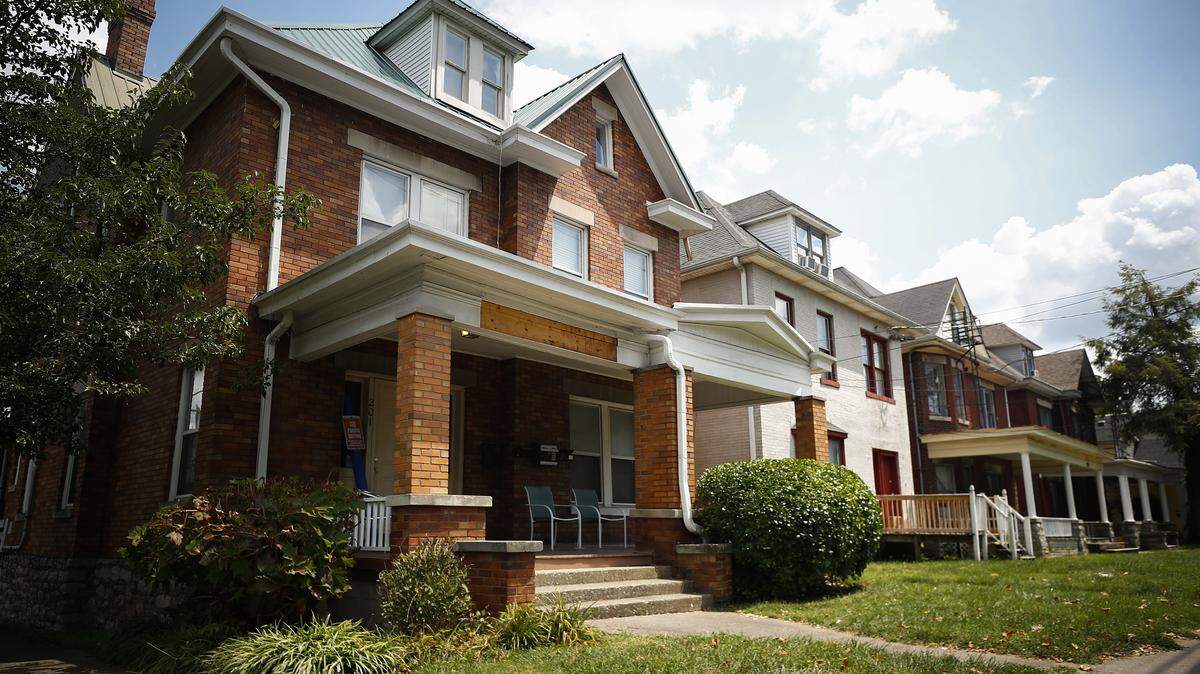
To put it in context, the plan to plop a 10-story apartment building on top of a block of historic houses on Maxwell Street was all about, well, context. Or lack thereof. Six planning commission members agreed with numerous opponents that the plan would irreparably harm the character of the Aylesford neighborhood.
Member Frank Penn spoke for several members who said they want more housing density in Lexington, just not here. Indeed, earlier in the meeting, they unanimously approved a complex of five apartment buildings for University of Kentucky students off Angliana Avenue.
“I want density and I know I want change or change can be accommodated,” Penn said. But “this is seven pounds of flour in a five pound sack.”
Graham Pohl pointed out the staff recommendation to approve the plan from New Jersey-based Aptitude Development upheld some pieces of the 2018 Comprehensive Plan, but ignored others, such as the need to preserve Lexington’s historic fabric.
The Aylesford Neighborhood Association, which hired a lawyer to oppose the development, can now breathe a sigh of relief, but a short one. As planning commission member Carolyn Plumlee noted, it would be incumbent on the neighborhood to seek the only protection from demolition that exists, an H-1 zone for this block to adjoin the protection in the rest of the neighborhood. In addition, the developer could still request a hearing in front of the city council.
The block is still owned by Lexington Village LLC, which has spent the past few years allowing demolition by neglect to those properties. They can still be sold and can still be torn down. The Planning Commission does not control the division of code enforcement and how its job is done.
But the four-hour meeting also pointed to possible storm clouds ahead for the Planning Commission and Lexington neighborhoods because of the new comp plan, which uses a philosophy called “Placebuilder.” It was planned for flexibility, in that one party can decide something is one kind of neighborhood and another party an entirely different one. In this case, the developers decided that Maxwell was a “downtown” place type and city planners agreed, much to the surprise of the neighborhood residents themselves, who see it as a “second tier urban neighborhood” that borders downtown but is not a direct part of it. Several members described that as the frame of a picture that is downtown.
“I think this application highlights a dilemma we have,” Pohl noted. “The issue of place-making, protecting the character of a place.” Maxwell sits between UK and down, “a hinge between those worlds and currently there is clarity about that role that would be impossible to replicate.”
This flexibility will continue to cause confusion, but it does promote some very serious discussions about many important issues: density, housing, economics, the kinds of places we want to live. It’s difficult but possible to balance historic preservation with density; cities struggle with it all the time, and it’s heartening that the Planning Commission would recognize that sometimes proposed development works and sometimes it doesn’t.
Member Bill Wilson said that they realized the comp plan might have “unintended consequences.” They just got a taste, with no doubt more to come.
But planning director Jim Duncan says the whole point of Placebuilder is to “provide clarity.”
The planning staff agreed that the place type was downtown, but said the project still needed to have context with the neighborhood.
“When we came back with height limit, that was part of the context,” Duncan said.
He said that development and planning issues bring out human nature: “Nobody wants anything different than what is already there, even if it would improve the community,”’ he said.
Still, Lexington has said loud and clear that it values the urban service boundary, and that means Lexington has to accept more growth inside that boundary. “If we have this policy of growth containment, then we have to find ways to have growth elsewhere, and that’s what Placebuilder is designed to do.”
The day after the meeting, Planning Commission member Pohl said he thought the process is working as it should.
“I think these are discussions that have to be had,” he said. “My experience on the BOAR (Board of Architectectural Review) is helpful because one of the lessons I’ve learned is that every single application is unique even if they appear to be very similar to others.
“We’re still in a learning curve on Placebuilder, but we’re going to learn, the attorneys are going learn and the developers are going to learn,” he said. “I think the answer is going to lead to longer meetings, but I don’t think it’s a problem.”
This story was originally published November 21, 2019 at 6:38 PM.