Two Kentucky basketball games in one day? For a little while, that was on the schedule.
Picture this: The Kentucky Wildcats play the Indiana Hoosiers on the Saturday morning before Christmas, meeting for the first time in Rupp Arena in 15 years, a much-anticipated return for one of college basketball’s best rivalries.
After the game, the Cats rush to Bluegrass Airport, hop on a plane and fly to some neutral-site location to play the UCLA Bruins — the only program with more NCAA titles than UK — in a marquee matchup on Saturday evening.
Two Kentucky basketball games in one day. Against two of the biggest names in the sport. Watch the Cats, do a little last-minute shopping while they’re in the air, and return to the couch a few hours later to watch them again. A UK basketball fan’s dream Saturday, right?
Well, for a while, that exact scenario was actually on the books. Signed contracts and all.
Last October, it was officially announced that Kentucky and Indiana would resume their regular-season rivalry — after not playing since the 2011-12 season — with the first game of the series set for Rupp Arena on Dec. 20, 2025.
One problem: The Cats already had a partner for that date. They were scheduled to play UCLA in the CBS Sports Classic on Dec. 20, 2025, in a location to be determined. UK athletics director Mitch Barnhart’s signature was on both contracts.
Obviously, such a scenario was never going to happen.
Once the mistake was discovered, a UK official reached out to Indiana so the two sides could try and figure out a new date. Though it has not yet been announced, the Herald-Leader has been told that the Kentucky-Indiana series is now set to resume — for real this time — on Saturday, Dec. 13, in Rupp Arena, one week earlier than expected, with the CBS Sports Classic clash against UCLA staying on the 20th.
“It was very routine. There was no kerfuffle or anything,” UK Athletics spokesman Tony Neely said. “That’s the good thing about basketball schedules … There’s always a lot of flexibility. A lot of the games don’t get filled in until (later). So there’s usually some flexibility, and if you have an issue, you can figure it out soon enough.”
The temporary hangup was also an example of the complexity that comes with building a college basketball schedule, compared to the relatively straightforward process of putting together a football schedule.
For example, UK already knows all of its nonconference football opponents for the 2028 season. Those Wildcats’ complete schedule for next season was unveiled Dec. 11 — nearly nine months before the 2025 campaign begins.
By comparison, the final schedule for the 2022-23 men’s basketball season wasn’t announced until Oct. 4 — less than four weeks before the Cats’ first exhibition game — due to moving parts late in the process. The complete schedule for this season was revealed July 11 — early, by recent standards, but still less than four months before the regular-season opener.
It should be noted that the UK-Indiana-CBS Sports mix-up happened before Mark Pope arrived in Lexington — both of those contracts were signed during the John Calipari era — and the coaching staff typically has a major role in shaping the nonconference schedule.
Pope certainly has plans for the kind of games he’d like to see the Cats play in the future, but preexisting agreements might keep him from implementing those for a while.
Future UK basketball schedule
Now that this season’s nonconference slate is nearly complete — the last remaining non-SEC game comes Tuesday afternoon against Brown University in Rupp Arena — it’s worth looking ahead to the gauntlet that Kentucky will face a year from now.
The highlights, so far:
▪ Michigan State in the Champions Classic in Madison Square Garden on Nov. 18.
▪ A (presumably formidable) ACC opponent on Dec. 2 or 3 (location TBA).
▪ Indiana in Rupp Arena on Dec. 13.
▪ UCLA in the CBS Sports Classic (location TBA) on Dec. 20.
▪ Louisville in the KFC Yum Center (date TBA).
▪ Gonzaga in Nashville (date TBA).
That’s six brand-name opponents before SEC play even begins, and — if the current situation is any indication — the 18-game league schedule should be extremely difficult again next season.
Only one of the above games is set for Rupp Arena, though it sounds like UK is expecting to return home for the ACC/SEC Challenge next season after going on the road to Clemson in this year’s edition. This will be the third edition of the event and the first in which Kentucky will be eligible to play both Duke and North Carolina. Both teams were already on UK’s schedule for other games the past two seasons. The Cats played Miami at home in year one.
Kentucky will also control the majority of the tickets for the Gonzaga game in Nashville, as the Zags did for the matchup in Seattle earlier this month.
With current NCAA rules allowing for 31 regular-season games — and 24 already booked for next season via the SEC schedule and the aforementioned nonconference games — that leaves Pope and UK officials with only seven games to line up for the 2025-26 slate.
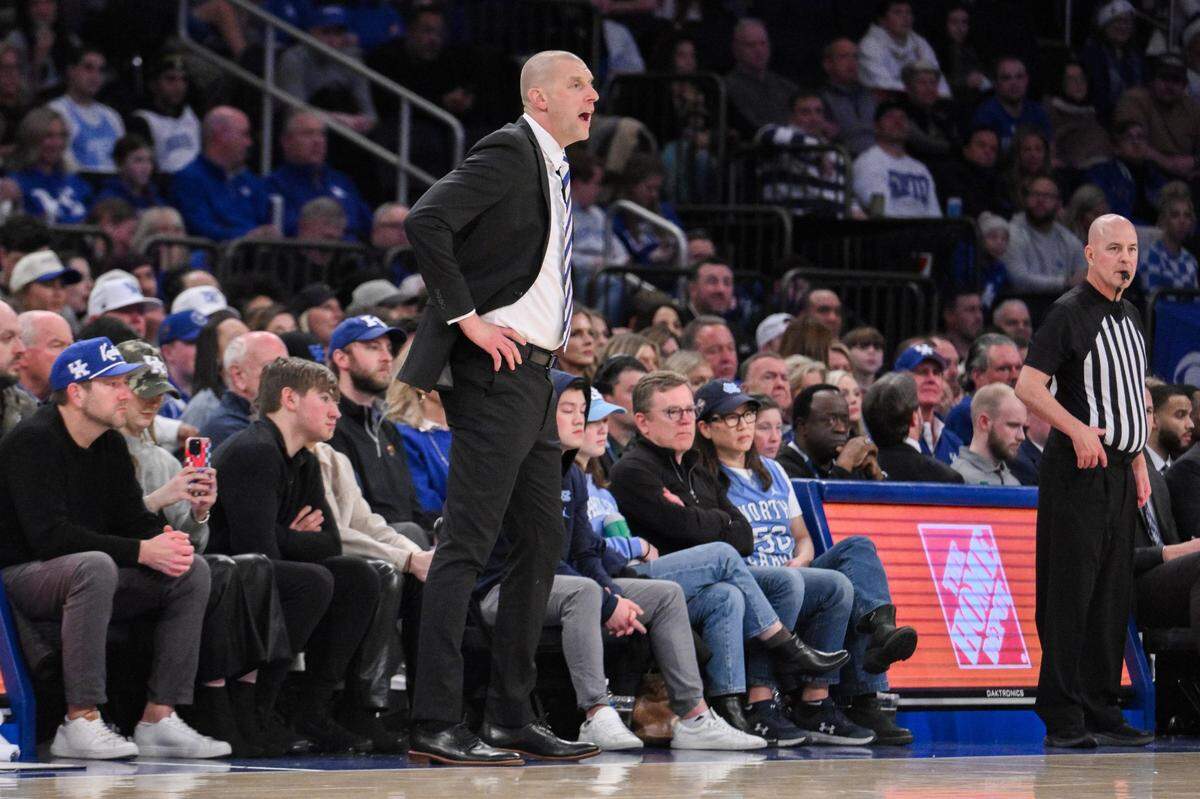
The Kentucky coach made clear this month that he’d like more flexibility, in that regard.
Future of MTEs
Earlier this season, Pope extolled the usefulness of playing an MTE — college basketball slang for “multi-team event” — on the road, a tool to help a team build more chemistry early in the season by being away from the comforts and distractions of home.
With so many other, high-profile nonconference challenges built into the annual schedule, John Calipari typically used the MTEs to schedule easily beatable — on paper — opponents, a way to help his young teams work out their shortcomings in Rupp Arena.
Since teams are allowed to participate in only one MTE per season, UK missed marquee events like the Maui Invitational, with Calipari reasoning that the Cats would get plenty of challenges elsewhere on the schedule.
A question from the Herald-Leader regarding Pope’s feelings on how Kentucky should schedule MTEs turned into a minutes-long manifesto on the nature of the NCAA basketball season itself.
First, he used the Maui Invitational as an example.
“It’s such an incredible event. It’s great for our team, it’s great for our fans. It’s great. It also comes at a cost, right? It comes at a cost in a bunch of different ways. And so, especially, the NIL factors and the revenue-sharing factors and all that stuff is going to come into play. The number of games in conference play is going to come into play. Like, all those things start to kind of walk into this space. And so it just becomes a mixed bag.
“If it was a standalone, I would love to go to Maui every single year, because I just think it’s an unbelievable experience to go grow your team, right? I think it’s great for fans. But it’s not a standalone prospect. There’s other things that are really important to the success of our program, the success of our team. And so we’re just trying to figure all that out.”
The Maui event happens Thanksgiving week — five times zones away and a few days before the ACC/SEC Challenge — and adding an event like that one to the current schedule would leave Kentucky with just four other nonconference games, precious few opportunities to help still-growing teams work things out against lesser opponents.
And if UK were to play in such a big event down the road, others have popped up recently that might make more sense in this new era of college basketball. The Players Era Festival debuted in Las Vegas during Thanksgiving week with eight teams — Oregon defeated Alabama in the title game — and a promise of at least $1 million in NIL opportunities to each competitor, with teams that won games getting even more.
CBS Sports reported after the event that the promise was fulfilled. With programs everywhere working year-round to get as much NIL capital as possible for their current players and future roster-building efforts, events like the Players Era Festival are likely to grow.
And teams like Kentucky will certainly want to consider playing in them.
A 40-game schedule?
Kentucky’s future obligations will make participating in such MTEs difficult, with the Wildcats also needing enough home games to meet the demands of season-ticket holders.
The Louisville game is cemented into the schedule. So is the ACC/SEC Challenge, for the time being. The Champions Classic has been extended through the 2028-29 season. The Indiana series runs through the 2028-29 season. The Gonzaga series goes through the 2027-28 season. And UK is in the CBS Sports Classic for two seasons beyond this one.
Pope and his college coach, Rick Pitino, were hoping to schedule a two-year series between Kentucky and St. John’s for Rupp Arena and Madison Square Garden over the next two seasons, but there have been no recent indications that such a home-and-home will happen.
The Wildcats’ dance card is basically full. And it won’t open up anytime soon.
Pope’s plan?
“My solution is, like, ‘Let us get to 40 games. Let us get to 40 games, guys,’” he said as part of that three-and-a-half-minute speech on scheduling.
If that 40-game slate has to include several exhibition games — some of them against high-profile teams — so be it. Pope just wants more games on the schedule, period.
“As we inherit these teams that are newer, that are less familiar, that have less staying power — making the season longer is going to give us a better product,” he said. “Because, you know, you kind of have to build a team in one season. And it’s not just us. A lot of people are feeling that. And so it makes a huge difference in revenue stream. It gives you a huge opportunity to go play other teams.
“If we would finally change this legislation where we … were just allowed to play D1 opponents in an exhibition game, I think that’s great for basketball. I think that’s going to allow unbelievable home-and-home matchups. We have sports that are playing well over 40 games in college right now. I know our guys can handle it academically and still be great students. I think it preps our guys better for moving on to the NBA.”
Such a move would take a pretty drastic shift from the NCAA, and Pope knows that might be a slow, uphill battle. But things are changing in college sports at a rapid pace — relative to the past — and who knows what the future might hold.
“I think it fits in better with this NIL era. I think that gives you the chance to have the flexibility to maybe go jump into really special MTEs, too. That’s the solution I’m pushing for. I don’t know if a lot of people are listening yet, but I would love it if we got there at some point.”