The idea of UK hiring 2 people to fulfill the AD’s duties has problems
Fast-break points from the Triple Crown letdown:
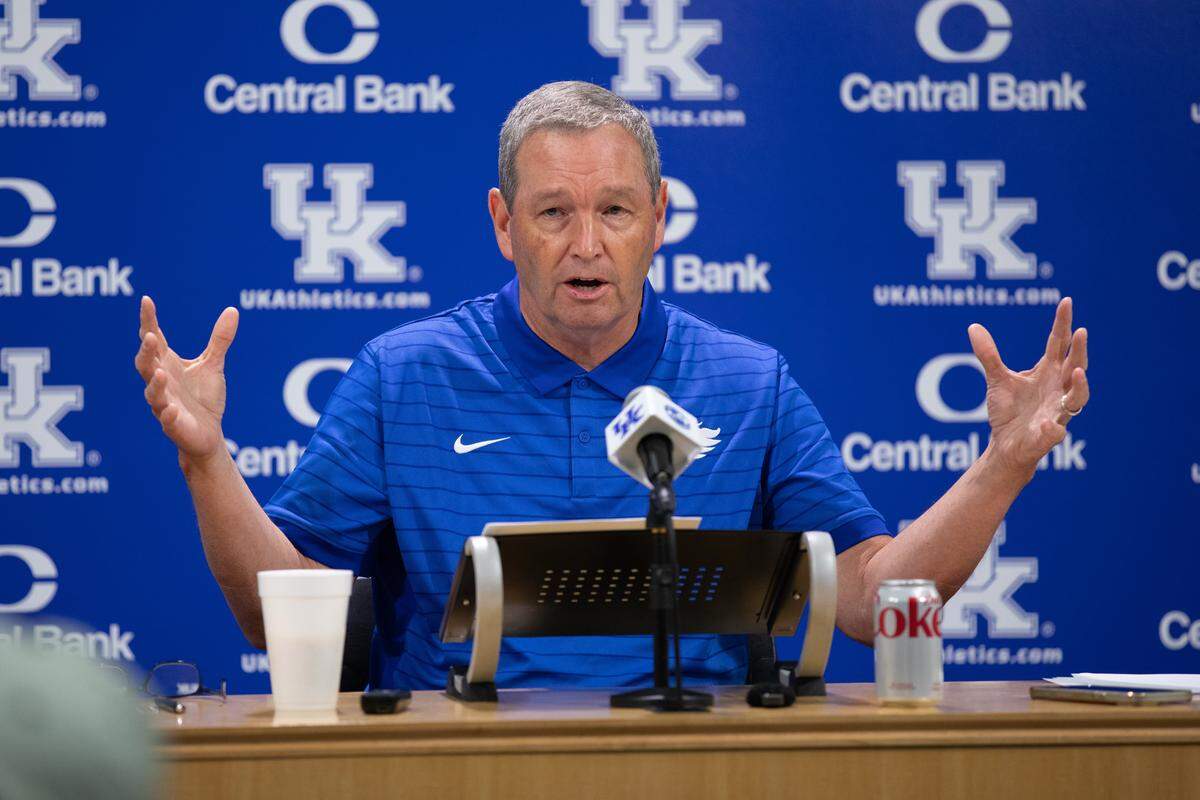
21. Mitch Barnhart. Does the University of Kentucky need to hire two people to replace its outgoing athletics director? Barnhart’s final day in the job he’s held since 2002 will be June 30.
20. A two-headed UK AD structure? As reported by the Herald-Leader’s Jon Hale, consultant Deloitte has suggested four potential operating structures for UK Athletics in the post-Barnhart era. Two of those envision splitting leadership between a traditional athletics director and a new “chief commercialization and growth officer.”
19. A time for bold thinking. Given the unprecedented level of change in big-time college sports now, this is a time for thinking outside the box. UK deserves credit for seeming to do so.
18. An old football saying. A pigskin cliché says “If you have two quarterbacks, you have none.” Essentially, it means if you don’t have a clear starting QB, you have instability at the most vital position — and that would be my concern with a multi-headed AD structure.
17. An unnatural separation. It seems unrealistic to think you can divide an athletics department between “commercialization and growth” (the domain of the new CCGO) and “operations and competition” (the AD) because there will be issues that overlap.
16. Who’s the boss? Many corporations employ both a CEO and a CFO, but it is generally clear that the chief financial officer works for the chief executive officer. In whatever athletics structure UK adopts, somebody has to be in charge with the power to make a final decision.
15. No Triple Crown. Cherie DeVaux, trainer of the 2026 Kentucky Derby champion, announced via X on Wednesday afternoon that Golden Tempo will not be entered in the Preakness Stakes, ending hope for a Triple Crown winner this year.
14. A distressing trend. This is the third time in the past five years that the Kentucky Derby winner has not been entered in the Preakness Stakes. Golden Tempo joins Rich Strike (2022) and Sovereignty (2025) in being trained toward the Belmont Stakes instead of the second leg of the Triple Crown.
13. Understandable to a point. In the cases of Rich Strike and Golden Tempo, both off-the-pace runners reliant on kicking in the deep stretch, being wary of running in the shorter Preakness Stakes (13/16 miles) carried logic.
12. Bad for horse racing. Essentially, horse racing commands a national audience four times a year: the Kentucky Derby, the Preakness, the Belmont and the Breeders’ Cup Classic. When the Derby winner skips the Preakness, you cancel out one of those high-profile moments.
11. More time between races? Momentum seems to be building for putting more weeks between the Kentucky Derby and Preakness Stakes (currently a two-week separation) and the Preakness and the Belmont Stakes (three weeks).
10. Diluting the Triple Crown. What makes Triple Crown winners American Pharoah (2015) and Justify (2018) special is theirs was the same achievement recorded by Citation (1948) and Secretariat (1973). You water that down, you are losing some of the cachet from winning the Triple Crown.
9. Will trainers actually run their horses? Before the horse racing hierarchy alters the most prestigious thing in the sport, it would be helpful to get a sense of whether trainers will actually be more likely to run their horses in more legs of the Triple Crown if given more time between the races.
8. The magnitude of the task. I get that Thoroughbred racehorses seem less hardy than in the past and are therefore trained differently, but winning the Triple Crown should be hard. That’s what makes it great.
7. The Preakness favorite. According to BetOnline.ag, Crude Velocity (9-4), Silent Tactic (13-2) and Kentucky Derby third-place finisher Ocelli (8-1) are now the top choices in the Preakness Stakes.
6. Cody’s Wish. The bond between the now-late Madison County teenager Cody Dorman and the champion racehorse who bore his name is the subject of a new book: “Cody’s Wish: A Boy, a Racehorse, and a Fight for Life.”
5. A Tom Hammond foreword. Written by veteran equine journalist Paul Halloran with a foreword by retired NBC Sports announcer and Lexington native Hammond, the book tells the story of Dorman, who was born with the rare genetic disorder Wolf-Hirschhorn Syndrome, and the racehorse he met through the Make-A-Wish Foundation.
4. A story both sad and uplifting. Cody Dorman died at age 17 on Nov. 5, 2023, one day after he had watched Cody’s Wish win his final race, the Breeders’ Cup Dirt Mile, at Santa Anita Park.
.jpg "ezgif.com-webp-to-jpg (1).jpg")
3. Chuck Mraz. The veteran Morehead State University men’s basketball and football radio play-by-play announcer has branched out as an author.
2. A book for children. Mraz has written a book, available on Amazon, called “Baseball Stories for Kids.” It is a collection of five fictional stories “that I always wanted to tell to kids who were like I was, growing up, loving baseball,” he says.
1. Another purpose. In an era when deficient childhood literacy has become a national concern, Mraz says he hopes his book can spark a joy for reading among children. “If I can help one kid (do that), I’ll feel like my book is a winner,” he says.