
KY General Assembly Week 10: What will these bills cost Kentucky taxpayers?

READ MORE
Catch up on Kentucky legislative news every week
Read our recaps from the Kentucky Legislature for all the latest news from the statehouse during the 2026 session.
Expand All
Republican lawmakers have been clear from the jump: a “major theme” of the state budget for the next two years will be fighting “spending that’s out of control.”
The executive branch budget bill, House Bill 500, is still waiting in the Senate for a committee hearing and floor vote. But it’s far from the only bill that’ll have an effect on state dollars and cents.
Many bills have accompanying fiscal impact statements, which are analyses of what legislation, if enacted, could cost the state or local governments.
Consider House Bill 422, also called Logan’s Law, filed in response to last year’s controversial early release of Ronald Exantus, who killed 6-year-old Logan Tipton in the boy’s Versailles home in 2015. That bill cleared the House 93-to-1 on Feb. 24; the corrections impact statement for the bill was issued March 6. That analysis showed the bill, if passed into law, would “result in significant long-term increases in operational costs,” eventually adding hundreds of millions of dollars in expenses.
For other bills, the governor’s office has taken things into its own hands.
For the third year, Gov. Andy Beshear’s office has rolled out its own “Facts & Fiscal Notes” page, assessing the hypothetical costs of dozens of bills filed during this General Assembly. Beshear, a Democrat, often finds himself in opposition to many priorities passed by the Republican supermajority.

Scottie Ellis, a spokesperson for Beshear, said in a statement the governor’s office began the fiscal notes in 2024 because he “has prioritized transparency and fiscal responsibility.”
“The Governor believes our people should have access to this information because decisions made during the legislative session ultimately impact Kentuckians and taxpayer dollars,” Ellis continued.
For example, House Bill 103 — the perennial effort from Rep. Mark Hart, R-Falmouth, to end Kentucky’s water fluoridation mandate — does not have a fiscal impact statement.
But according to the governor’s office, it could cost the state millions.
Assuming 10-to-30% of the state population has drinking water without fluoride, that could cost between $19.7-to-$59.1 million for “increased dental services.” Of that expense, the governor’s team predicts $3.9-to-$11.8 million would be state money.
“Unfortunately, the General Assembly has chosen not to include information about a bill’s fiscal impact on their website or elsewhere,” Ellis said. “While many other states have laws in place requiring that fiscal impact statements be published, Kentucky does not.”
That’s not for one lawmaker’s lack of trying.
Rep. Savannah Maddox, R-Dry Ridge, filed House Bill 917 in early March. It would require fiscal notes accompany each bill or resolution, and legislation could not be voted on until such an analysis has been done. Similar legislation from Maddox in 2025 didn’t gain any traction.
If one were to put the political beliefs of Beshear and Maddox on a Venn diagram, this might be the only overlap.
Child care bills on the move
Several proposals meant to help Kentucky’s struggling child care industry are nearing the final stages of the legislative process.
House Bill 6, a far-reaching child care bill based on recommendations from the Kentucky Chamber of Commerce, was approved March 10 by a Senate committee and sent to the Senate floor. Among its many sections, HB 6 would strengthen the state’s five-star quality ratings system for daycare centers; require child care employees to be trained in working with special needs children; and improve the state’s tracking of demand and supply of child care around the state.
Other child care bills passed in one legislative chamber and now moving through the opposite chamber include Senate Bill 160, requiring state regulators to go a little easier on child care centers during inspections, especially if they’re new; Senate Bill 191, financially rewarding child care centers that do a better job of preparing kids for kindergarten; and House Bill 190, letting some child care centers count bathrooms and hallways toward their usable square footage, which determines how many children they can serve.
-Reported by John Cheves
Planned Parenthood rallies supporters
As session reaches its final stretch, advocates are drawing attention to legislation they’d still like to see passed. Among them is the Planned Parenthood Alliance, which hosted a rally at the Capitol Education Center with legislators, students and reproductive health care supporters.
During the event, multiple speakers demanded better access to sex education and solutions for period poverty.
Rep. Vanessa Grossl, R-Georgetown, said Kentuckians need more tools, including contraceptives and comprehensive care, to help reduce unplanned pregnancies. While Grossl didn’t mention the word “abortion,” she spoke in support of Planned Parenthood, saying it provides essential resources, including STD testing, Plan B and birth control.
“In my party, we pride ourselves in limited government and individual liberty, and there is no greater liberty than the right to make your own health care decisions without a bureaucrat standing between you and your doctor,” Grossl said.
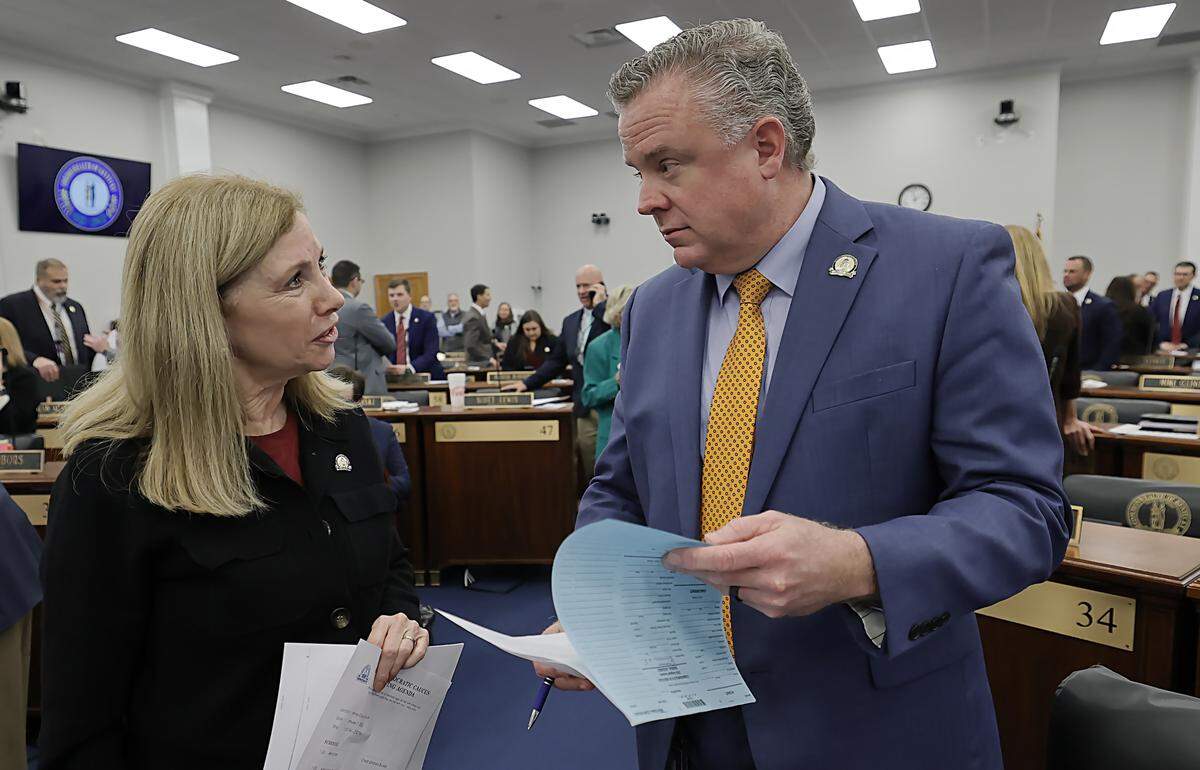
Rep. Lisa Willner, D-Louisville, said providing appropriate sex education to students should be a “non-controversial and common-sense issue.”
Willner said she filed House Bill 717, which has yet to receive a committee hearing, to require students to learn about consent, healthy relationships, how to make responsible decisions about their health and their futures.
“It would ensure that the curriculum is respectful and inclusive of all students, and it would give parents the option to opt their child out,” Willner said.
-Reported by Hannah Pinski
More headlines from Week 10 of the 2026 General Assembly
- Beshear on Friday vetoed a high-priority Republican bill that would authorize federal tax credits in exchange for donations to private school scholarships. It’s his second veto this session; the first was easily overridden by lawmakers. -Reported by Austin Horn, Tessa Duvall and Karla Ward
- A House committee passed a bill Tuesday allocating $801 million to various Kentucky projects, but the bill is short on details of where exactly that money would go. -Reported by Austin Horn and Hannah Pinski
- Fayette school board chair Tyler Murphy contends it is unconstitutional for Kentucky lawmakers to remove him from office, and a Kentucky law expert says Murphy is probably right. Also, who is covering Murphy’s legal bills for all this? -Reported by Valarie Honeycutt Spears
- Fayette Circuit Judge Julie Muth Goodman filed a lawsuit Wednesday against Kentucky legislators to stop impeachment proceedings, which she claims are illegal. A Franklin Circuit judge ruled Friday a Monday hearing can proceed as planned. Meanwhile, dozens of Kentucky lawyers say these proceedings set a dangerous precedent. -Reported by Taylor Six and Karla Ward
- Last month, the Beshear administration quietly proposed to withdraw a prohibition on weight loss drugs from being covered by Medicaid. The Senate voted Wednesday to repeal that change, arguing it would cost the state too much to take on the cost of increasingly popular GLP-1 drugs. -Reported by Austin Horn
- The Kentucky House on Friday approved a bill that would require people to submit a driver’s license or other photo identification with their home address when they make a request to public agencies through the state’s Open Records Act. -Reported by John Cheves
- Controversial new legislation that would prohibit Kentucky regulators from setting pollution standards that exceed federal minimums has stalled. -Reported by Austin R. Ramsey
- The Kentucky House amended a bill on Wednesday to change how the state and local human rights commissions handle civil rights complaints for citizens. -Reported by John Cheves
- The gun industry must be protected from the liability lawsuits that can follow deadly shootings in Kentucky, a Republican lawmaker said Wednesday before his civil immunity bill advanced to the House floor. -Reported by John Cheves
- For the second year in a row, a bill that would allow Kentucky school staff members to wear silent panic alert systems has passed out of a state House committee. -Reported by Valarie Honeycutt Spears
- Two bills introduced this year aim to help solve Kentucky’s physician shortage, as the University of Kentucky is expanding its medical enrollment. -Reported by Monica Kast
- A bill has been filed by a GOP lawmaker that would prohibit some people with “gender identity disorders” from getting a teaching license. -Reported by Valarie Honeycutt Spears
- More rural parts of Kentucky could be given assistance when competing for business, jobs and better economic growth opportunities if a bill sponsored by a Pikeville Republican, currently working its way through the legislature, becomes law. -Reported by Piper Hansen
- Lawmakers filed nearly 1,300 bills in total this session. Here are some that came in just before the filing deadline. -Reported by Hannah Pinski
- Kentuckians could have the chance to change the state’s constitution in November. Here’s a look at several proposed amendments. -Reported by Hannah Pinski
What we’re looking for in Week 11 of the 2026 General Assembly
The end is near — but not near enough.
There are 12 legislative days left until the 10-day veto recess begins, followed by two more legislative days, which will largely be used to override Beshear’s vetoes. April 15 is when the General Assembly adjourns sine die. (A Latin phrase I’m not confident that I, or anyone else in Frankfort, has ever pronounced correctly, meaning “without a day.”)
At some point, I expect to see the Senate pass some House bills and the House pass some Senate bills. The number of times that has happened so far this session can be counted on one hand with a finger to spare.
Meanwhile, there are more than 160 bills that have passed the House but not the Senate, and more than 110 that have passed the Senate but not the House.
Not all of those bills will make the cut, but anything the GOP supermajority doesn’t want the governor to have unchecked veto power over needs to be on his desk by April 1.
Session wraps up in about a month, but we must slog through some very long days before we reach sine die — however you say it.
Thank you for following the Herald-Leader’s coverage of the Kentucky General Assembly. If you haven’t already, consider signing up for our (twice-weekly during session!) Bluegrass Politics newsletter.
Give me a shout at tduvall@herald-leader.com with any feedback, tips or sine die haiku drafts.










.png)