
KY General Assembly ends: What happened to all those bills we wrote about?
READ MORE
Catch up on Kentucky legislative news every week
Read our recaps from the Kentucky Legislature for all the latest news from the statehouse during the 2026 session.
Expand All
We did it. We made it through another session of the Kentucky General Assembly.
There were moments, particularly during the long and frenetic days toward the end, when it felt like we’d never get here. But we persevered. Good for us.
This year’s session lacked the fiery debates over social issues that have defined years past and saw only one constitutional amendment question passed by both chambers. We’ve got these and other takeaways here.
While the budget may have been the big-ticket item of 2026, the Judge Julie Goodman impeachment saga was the headline-grabber — and it may not be done yet.
During the veto recess, the Kentucky Supreme Court ruled 5-1 that lawmakers could not proceed with their efforts to remove the controversial Fayette Circuit judge from the bench.
On the final day of session, the Senate agreed to table the Goodman proceedings, but vowed to come back to the matter if the state’s Judicial Conduct Commission doesn’t take action against her. The House, meanwhile, adopted a resolution declaring the court’s opinion unconstitutional. (If it’s been a while since you’ve taken a civics class, a quick reminder: the legislative branch makes the laws and the judicial interprets them.)
Republican lawmakers in both chambers were aggrieved by a concurring opinion penned by state Supreme Court Justice Kelly Thompson on the Goodman matter — and so they censured him.
And in case that wasn’t enough drama to end the session, lawmakers quietly referred a pair of petitions taking aim at Fayette County Board of Education Chairman Tyler Murphy and Kentucky Supreme Court Justice Pamela Goodwine to the Legislative Oversight and Investigations Committee.
It seems we should buckle up for an exciting interim.
Whatever happened to all those bills we wrote about?
The Bluegrass Politics team has churned out hundreds of stories the last few months, including covering dozens of bills filed throughout the 2026 General Assembly.
As much as we wish we could, the Herald-Leader can’t feasibly cover every bill from start to finish. But we can take a look back at some legislation we wrote about along the way.
Senate Bill 40, to give county politicians greater independent authority to appoint members of public libraries’ governing boards, became law without the governor’s signature.
House Bill 312, to let Kentuckians carry concealed firearms at age 18 instead of age 21, became law over the governor’s veto.
Senate Bill 122, to let parents convicted of certain nonviolent felonies avoid prison if judges decide it would be better for them to remain in the community on probation while they care for their dependent children, was signed into law by the governor.
House Bill 491, to allow nursing home residents or their families to openly place video cameras in their rooms that would watch for incidents of elder abuse, never got a committee hearing.
House Bill 6, a sweeping bill full of numerous changes to child-care regulations, including more daycare employee training to deal with special-needs children and a requirement that state inspectors cut new daycares a break on certain violations when possible, became law without the governor’s signature.
Senate Bill 195, this year’s business-led attempt at “tort reform” that would have changed several rules by which lawsuits proceed, ended up focusing specifically on shielding road contractors from liability under certain conditions. It became law without the governor’s signature.
House Bill 468, which would have stripped most of the power from the state and local human rights commissions to investigate civil rights complaints filed by citizens, stalled in the Senate. A last-minute attempt in the House to attach it to a noncontroversial agriculture funding bill on its way to the governor’s desk failed.
House Bill 697, which would ban any person or agency from entering into, soliciting, or enforcing a commercial pregnancy surrogacy agreement, never received a committee hearing.
House Bill 924, which would create the Kentucky Public Service Student Loan Forgiveness Program fund, never received a committee hearing.
House Bill 370 would have scrapped the model where Kentucky gas dealers pay a tax of roughly 9% of the wholesale price of all gasoline and fuel. The bill would have implemented an excise tax of 29.6 cents per gallon for fiscal year 2026-2027 and 34.6 cents or fiscal year 2027-2028.
House Bill 867, which would ban people from using bathrooms in public buildings that don’t align with their sex assigned at birth, never received a committee hearing.
Senate Bill 57 creates the Nuclear Reactor Site Readiness Program to ease the cost of applications and permitting with the federal government for nuclear energy facilities wanting to locate in Kentucky. It was signed into law by the governor.
Senate Bill 104, to criminalize harassing or obstructing the work of first responders, including federal immigration agents, became law without the governor’s signature.

Senate Bill 161, to repeal Kentucky’s right-to-work law and allow labor unions to require membership as a condition of employment for public workers, never got a committee hearing.
Senate Bill 197, to make a tiered incentive structure for a state income tax program so rural parts of the state can compete better when attracting jobs and other investment, was delivered to the governor where it awaits further action.
House Bill 336, to allow local governments to adopt and enforce ordinances requiring a minimum wage higher than federal and state levels, never got a committee hearing.
House Bill 377, to prevent utility shutoffs during dangerous weather conditions and set notification requirements for disconnections, never got a committee hearing.
House Bill 526, to let licensed attorneys decide whether they want to be a member of the Kentucky Bar Association rather than participation being mandatory, passed off the House floor but was never assigned a Senate committee hearing.
House Bill 567, requiring a photo ID to request public records, cleared both the House and Senate, but because the Senate made changes and the House did not adopt them, the bill did not reach the governor’s desk.
And while it wasn’t originally a piece of legislation, my early March suggestion that Kentucky adopt the eastern hellbender — a native, rare giant salamander — as our official amphibian, could actually become reality. Senate Bill 37, which establishes the treeing walker coonhound as the state dog, was amended in the House to add the hellbender, shelter pets and a little skunk to our list of “official” Kentucky things. The bill is on the governor’s desk. Dreams really do come true.
- Staff writers Hannah Pinski, Piper Hansen and John Cheves contributed reporting.
Use your manners
In discussion before voting April 14 to override the governor’s veto and give final passage to Senate Bill 4, House Minority Whip Rep. Joshua Watkins offered a proposal to his Republican colleague.
“If I asked you really, really nicely not to pass this bill, would you not do it?” Watkins said.
Majority House Floor Leader Rep. Steven Rudy, R-Paducah, jokingly swayed back and forth, appearing to consider the question.
Rudy ultimately replied with a resounding, “No.”
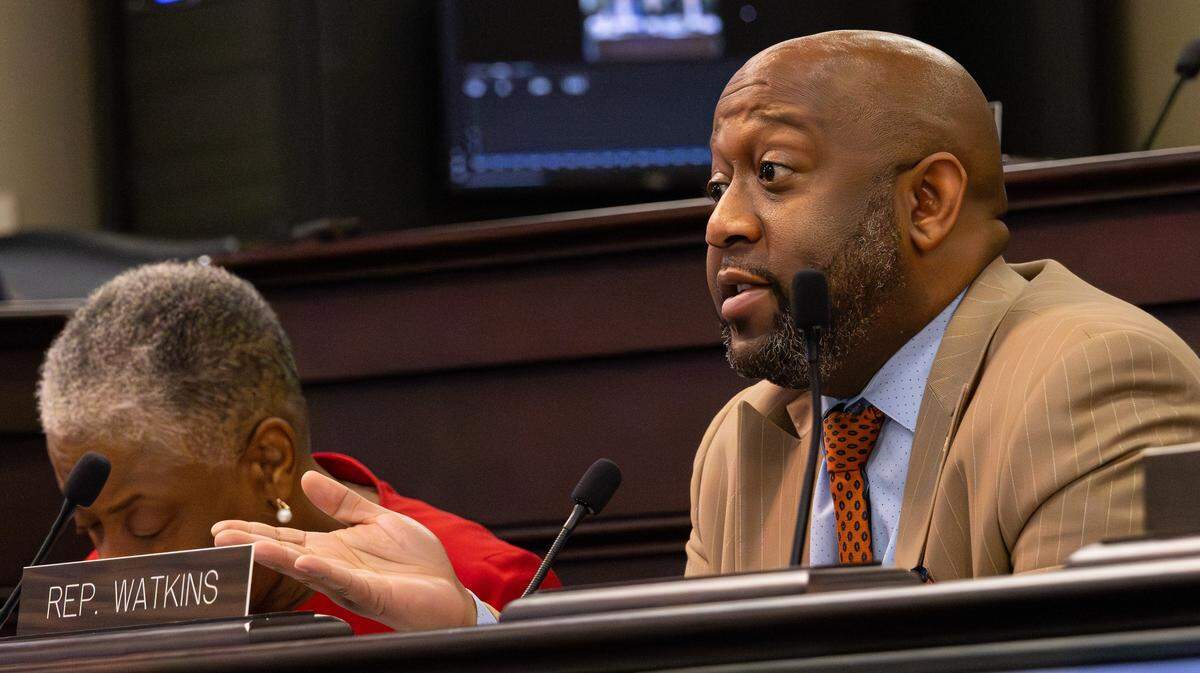
The bill changes board of education membership for Jefferson County Public Schools from seven to five members, a section Watkins, a Louisville Democrat, took issue with in previous debate.
The bill also includes language that prohibits Fayette County Public Schools Board Chair Tyler Murphy from serving in the role because he teaches in another school district. (He’s not backing down, though.)
House Minority Caucus Chair Rep. Lindsey Burke, D-Lexington, followed Watkins’ opposition to overriding the veto in a more prepared speech criticizing the policy’s targeted FCPS and JCPS language. The House voted 78-19 to override the veto and the Senate concurred, voting 30-8.
- Reported by Piper Hansen
What we’re looking for post-2026 General Assembly
Sleep, mostly.
But there ain’t no rest for the wicked, because political journalists, elected officials and campaign folks all now get to devote our attention to the rapidly approaching May 19 primaries.
Keep an eye on Kentucky.com because we’ll be rolling out our voter guide, candidate profiles and race previews in the next couple of weeks. And of course, we’ll have a ton of coverage on election night.
Thanks for following along this legislative session. Like it or not, we get to do it all over again come Jan. 5, 2027.







.png)