Did the KY legislature make a $200M mistake? Here’s what you missed in the state budget.
READ MORE
2024 General Assembly
Keep up with the latest out of Kentucky’s 2024 legislative session.
Expand All
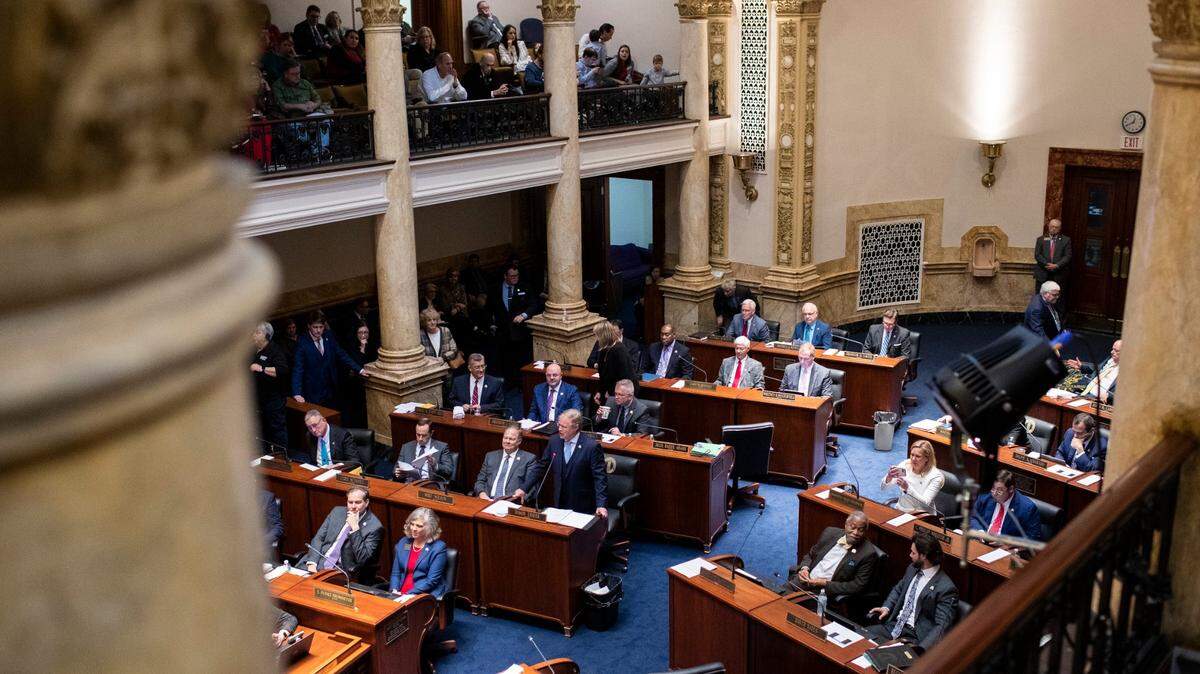
Every two years, the Kentucky state legislature passes the state’s multi-billion-dollar budget.
Most of the time, it’s a rush to get it over the finish line, with lawmakers revealing the final version just a few hours before they give it ultimate passage.
Sometimes that speed can cause mistakes of varying size. This year was no exception, to the tune of a $200 million appropriation moved to the wrong department.
A publicly available copy of the major one-time spending measure known as House Bill 1 was not provided until late into the night Thursday.
That’s the last day of the legislative session to pass bills that can withstand a governor’s veto – seen as the deadline for much legislation by the Republican-led legislature that’s overridden dozens of Democratic Gov. Andy Beshear’s vetoes.
With more than $15 billion in General Fund dollars spent per year over the next two and about $2.7 billion in one-time spending approved, what all is in there?
For one, $200 million in the one-time spending bill was moved to the wrong state agency.
The legislature had initially planned in House Bill 723 to move a program meant to help cover local funding matches for communities and nonprofits seeking federal grants away from the governor’s Department of Local Government and to the Republican-controlled Department of Agriculture.
Then, in a committee substitute filed Thursday, the program was moved to the Cabinet for Economic Development.
The latest version of House Bill 1 gave $200 million to the Department of Agriculture’s budget for the program based on the previous version of House Bill 723.
A spokesperson for the House GOP called it a “simple drafting error,” saying it will get fixed when the legislature comes back on April 12 and April 15. Having already given House Bill 1 final passage, the legislature could pass a separate bill
Gov. Andy Beshear, who derided the initial attempt to move the program under the department of agriculture as a power grab, could line-item veto that portion of the bill.
The legislature would then have to move on a separate bill rectifying the mistake.
Tax changes
Add gold and silver to the already-long list of items exempted from the state’s 6% sales and use tax.
In the final version of House Bill 8, a bill that started as a near-blank “shell” bill morphed into a wide-ranging revenue bill that included the gold and silver tax exemption, among others.
This enthused some Republicans, such as Rep. Steven Doan, R-Erlanger, who filed a separate bill earlier in the session to add this exemption.
“Kentucky will become the 45th state to stop taxing sound money. Thank you to (Senate Appropriations & Revenue Committee Chair Chris McDaniel) for your leadership on this issue and for making sure this got over the finish line,” Doan posted on X.
Some Democrats took issue with the fact that the exemption for gold – often sold to America’s elderly as a way to hedge against inflation or government collapse – came to fruition but one benefiting the youngest Kentuckians did not.
Sen. Cassie Chambers Armstrong, D-Louisville, received bipartisan applause when she filed a bill exempting diapers from the sales tax, but that plan did not make it into any revenue bill on the final day before the veto break.
“I have to say I’m very disappointed to not see the end of the diaper tax in our revenue bill. Why this matters is that we know that one out of two families in Kentucky right now struggle to afford the diapers they need,” Armstrong said on the Senate floor.
“It’s the smallest ask I can think of.”
Other new and notable changes to the tax code include an income tax credit for broadband investments and an exclusion of hybrid vehicles that are not plug-in hybrids from the electric vehicle ownership fee.
Perhaps most importantly in House Bill 8, the language codifies changes to how state spending making it more likely the Republican legislature’s long-held goal of cutting the state’s personal income tax more likely.
The bill permanently exempts reserve spending (this year, the legislature agreed to spend $2.7 billion of state reserves) from consideration in hitting the “triggers” set by statute to bring the state’s personal income tax down.
Also in House Bill 8: it grants allowance for the Kentucky Economic Development Finance Authority to enter into an agreement to exempt several expenses from the sales tax for a data center project with an investment of $450 million or more.
The language would restrict the project to Louisville, which recently saw social media giant Meta open an $800 million “AI-first” data center right across the river in Indiana.
At a news conference Tuesday, Louisville Mayor Craig Greenberg said he was very excited about the potential project to be located in southwestern Jefferson County.
Medicaid and child care
A significant expansion of “Michelle P.” Medicaid waivers, which help fund care for adults with disabilities, made it into the final version of House Bill 6.
The waiting list for such waivers runs more than 8,000 people long, the longest of any of the state’s Medicaid programs, according to the Kentucky Lantern. The legislature spent more than $13 million in General Fund dollars to support an additional 750 slots for the waivers.
The legislature made one choice on Medicaid funding that was unexpected for some. It allocated $62 million from state reserves to the state Medicaid budget “to support ongoing needs of the Medicaid benefits program.”
Usually funded through the primary Executive Branch budget bill, the move further increases the odds of the state lowering taxes due to its placement in House Bill 1.
Sen. Danny Carroll, R-Benton, led the most prominent effort to help the state navigate the so-called “child care cliff,” as many pandemic-related funding for child care has dried up. That bill got waylaid in the Senate, but the final budget contained some additional funding for child care – not nearly enough, according to some advocates in the child care space.
The state’s Child Care Assistance Program ended up with about $52 million allocated over the next two fiscal years in House Bill 6.
Education and infrastructure
Water systems in the commonwealth have long been an issue, particularly in parts of Eastern Kentucky, including Martin County, where persistent problems have made it such that residents are very hesitant to drink the water.
The General Assembly created the Kentucky Water and Wastewater Assistance for Troubled or Economically Restrained Systems (WWATERS) program to tackle that issue, putting $150 million in reserve funds toward it over the next two fiscal years.
That’s on top of the pre-existing revolving funds meant to tackle the issue.
Individual water districts also got one-time appropriations in addition to the water and wastewater program. Martin County Water and Sanitation District, specifically, got about $2.7 million.
School transportation in the budget is funded at record levels, but there’s some dispute about the percentage.
While budget drafters reported that the state would fund 90% and 100% of school funding in the next two fiscal years, the Kentucky Center for Economic Policy said those percentages were based on 2023 data instead of 2024 data.
Taking the 2024 data into account, the funding percentage would be roughly 74% and 82%, they say – still a significant increase, but short of the full funding the state hasn’t put forward since 2005.
Much was made of the initial language in the House’s version of the budget related to education funding, requiring schools to post certain test score markers and the Kentucky Department of Education to post a “rank order by overall academic performance” of all Kentucky schools on its website.
The language also encouraged local districts to give teachers raises, but didn’t mandate it.
Almost all the language made the final version of the budget except a portion stating that the failure of a district to make “adequate progress in the recruitment and retention of classroom teachers” could lead to school closures, local board takeovers or board consolidation.
This story was originally published April 2, 2024 at 3:48 PM.





.JPG)






%20-1%20.jpg)

.JPG)




.JPG)